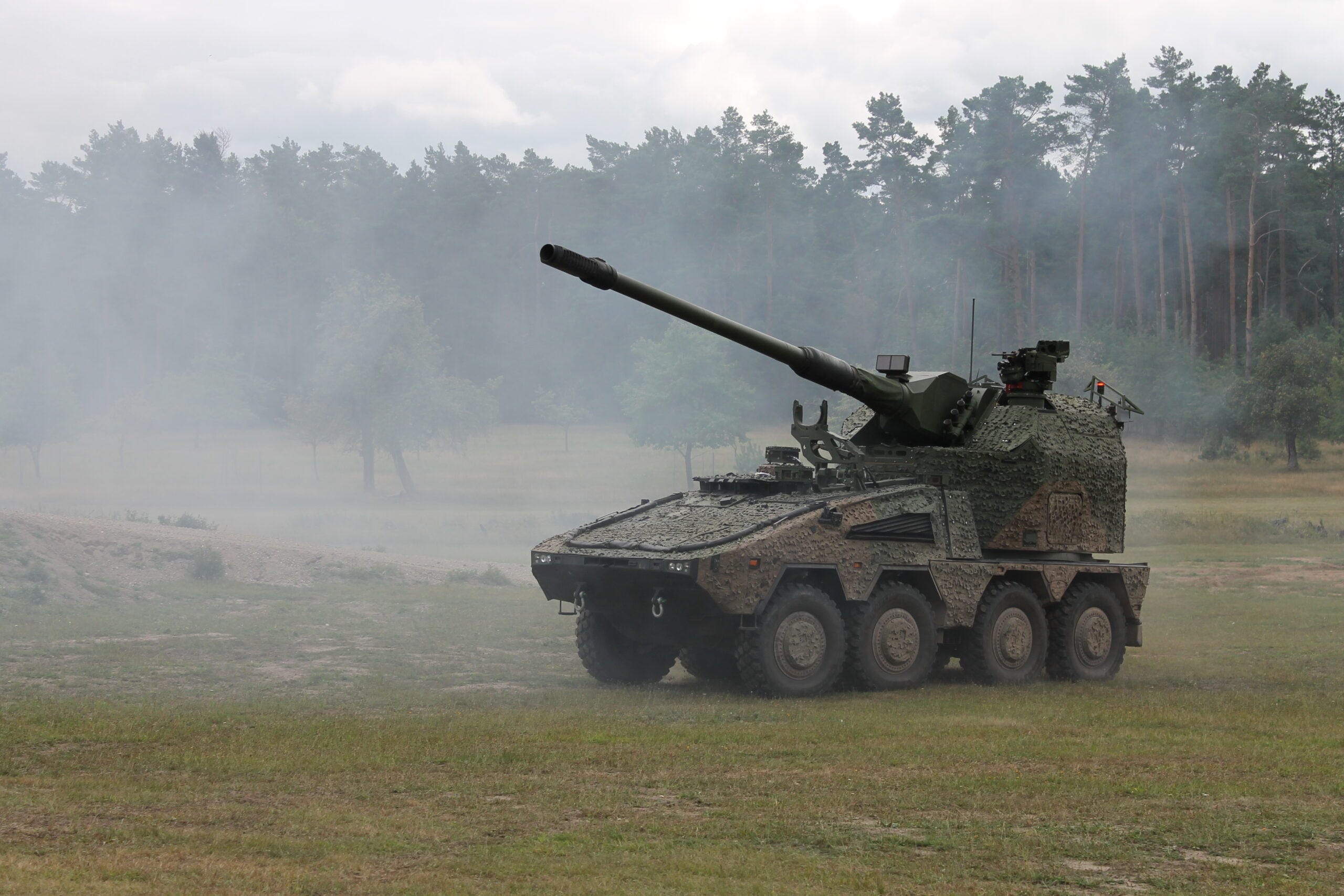
The UK Just Ordered the Howitzer Ukraine Is Already Fighting With
Britain gave away its artillery to Ukraine, created a capability gap, and just spent a billion pounds to fill it with a gun that Ukrainian crews are already using in combat.
In 2023, the UK shipped its AS90 self-propelled howitzers to Ukraine.
Smart move, genuinely appreciated, and exactly the kind of materiel support that mattered early in the war when Ukraine needed 155mm tubes more than the British Army did. The UK accepted a temporary gap in its own force structure to help Ukraine stay in the fight.
Quite magnanimous; but now, three years later, Britain just signed a contract worth close to £1 billion for 72 RCH 155 remote-controlled howitzers to replace those donated AS90s.
Ukraine is already fighting with the RCH 155.
Right now.
In contact.
The system is generating live combat data while the UK waits for its first deliveries in 2028.
What’s New Here
I’ve done several pieces on the RCH 155 in Ukrainian service, (and a YouTube video) so I’m not going to spend five paragraphs re-hashing the Boxer chassis and the automated turret borrowed from the Panzerhaubitze 2000.
You can find the most recent here but it is likely paywalled since all of my free work gets auto-paywalled after a certain period of time. (Shameless plug: Consider upgrading!)
The short version: two-person crew, eight rounds per minute, up to 70-plus kilometers with extended-range munitions, can relocate at 62 mph, and it shoots on the move. It’s a badass mo-fo.
It’s about as far from the old AS90 as an AS90 is from a horse. (mild exaggeration)
What’s new is the British piece of this story.
The contract was awarded through OCCAR, the Organization for Joint Armament Cooperation, on behalf of the UK to ARTEC GmbH, which is the KNDS-Rheinmetall joint venture behind the system.
That’s a mouthful, but the practical upshot is that this is a genuine NATO industrial collaboration, not a mere purchase order.
The barrel, breech, recoil system, and trunnions will be manufactured at Rheinmetall’s facility in Telford. The Boxer chassis and drivetrain will be built by KNDS UK in Stockport. The steel will come from Sheffield Forgemasters.
If you want to talk about putting defense industry back into places that built Britain’s industrial identity, you start there.
Sheffield Forgemasters is a 250-year-old company, MoD-owned since 2021, whose lineage runs through Vickers, supplied armor and armaments through two World Wars, and currently makes the reactor pressure vessels for Royal Navy nuclear submarines.
The MoD nationalized it five years ago specifically because most companies capable of producing that category of specialized defense steel are located in Russia or China, and “just source it elsewhere” stopped being an acceptable answer.
The company is midway through a £1.3 billion investment program, including a 13,000-tonne forging press and a new 30,000-square-meter machine shop. Putting Sheffield Forgemasters steel into British howitzer barrels is a deliberate choice to anchor a critical capability inside the UK and keep it there.
The new RCH-155 program is expected to support around 500 jobs across the UK supply chain. UK Defense Secretary John Healey framed it as defense delivering both operational capability and economic benefit simultaneously, which is also how you sell a billion-pound contract to a domestic audience that’s been watching defense budgets fluctuate for forty freaking years.
The Trinity House
The RCH-155 contract frames itself as a deliverable under the Trinity House Agreement, the bilateral defense framework the UK and Germany signed in 2021 to deepen military interoperability and industrial cooperation.
The UK and Germany haven’t always been aligned on defense procurement timelines. The Germans spent years deliberating on everything from fighter jets to tank exports.
The British have had their own procurement irregularities (the Ajax program, for anyone who wants an entertaining dive into how to spend billions on armored vehicles without getting armored vehicles). But here, both nations end up operating the same 155mm howitzer platform, drawing on the same supply chain, using common training, common ammunition logistics, and common spare parts.
I want to pause here for a quick aside because there are many who believe standardization is the future across the EU. And to be sure, there are benefits like surge capacity and logistical depth.
But if several countries operate one standardized platform, it can create very real risks. For instance, if an adversary reverse-engineers the RCH 155’s fire control system response to electronic jamming, cracks a software vulnerability in the automated loading sequence, or identifies a specific radar cross-section signature that enables consistent targeting, that exploit doesn’t degrade one nation’s battery.
It potentially degrades every battery across every nation fielding the platform simultaneously.
The cybersecurity community has a term for this: monoculture risk. The same logic that makes a single operating system dominant also makes it the highest-value target for anyone who wants to cause maximum disruption with a single investment in research.
Then there’s doctrinal predictability: Common platform means common limitations. The RCH 155 has a very specific rate of fire, a specific reload interval, a specific crew procedure under stress, a specific shoot-and-scoot timing window.
All of that is either in open-source literature or discoverable by any adversary with access to enough observation data. When every NATO ally’s 155mm wheeled howitzer is the same system, an adaptive adversary builds one playbook and deploys it everywhere.
Diverse platforms force an adversary to solve multiple different problems with different solutions simultaneously, which is expensive and time-consuming.
Homogeneous platforms hand them an economy of scale in countermeasure development.
Anyways, I don’t mean to be the party pooper here, but worth mentioning…
So, initial deliveries are planned in 2028. Full deployment before the end of the decade.
That’s three-plus years from now, which leaves a perfectly legitimate question: is it fast enough?
The threat environment in Europe is a now problem. The Archer artillery system will cover the interim, which is a very capable stopgap and not exactly a shameful choice.
But the UK accepted a real capability gap when it transferred AS90 to Ukraine, and that gap closes slowly. The British Army’s goal, per the Strategic Defense Review, is to increase lethality tenfold over the next decade. The RCH 155 is the opening move toward that number.
Whether “next decade” is the right timeline given what’s happening in Eastern Europe right now is a question that defense planners in London, Warsaw, Tallinn, and Riga are all wrestling with in their own ways.
I don’t have a clean answer.
What I do have is this observation: the procurement system wasn’t designed for the pace of a live war that’s been producing combat data on this exact system since the day Ukraine took delivery.
Ukraine as the Proving Ground
Ukraine became the world’s first operator of the RCH 155 in January 2025, when German Defense Minister Boris Pistorius handed over the first of 54 ordered systems at a ceremony in Kassel.
The guns stayed in Germany for crew training. Then Ukrainian soldiers started working with them.
Ukrainian crews who, three years earlier, were working Soviet-era D-30s patched together with Flex Seal, are now running a two-man automated howitzer platform that can put rounds on target from 70 kilometers away and move before the counter-battery radar has time to blink.
(I wrote about that transition in the previous coverage, and watching it happen in real time has been one of the more interesting stories of the war.)
That Ukrainian combat experience is already flowing back into the program.
KNDS Deutschland CEO Ralf Ketzel said it explicitly in an interview with Deutsche Welle: “The experience of working with Ukrainian soldiers was very valuable, as it allowed us to make several changes to the RCH systems.”
He didn’t specify all of them publicly, but one uniquely Ukrainian issue was impossible to miss: the Kropyva integration problem. It forced KNDS to rethink how the system’s command and control architecture actually worked in practice.
Kropyva is an artillery-specific tactical fire control system, essentially an Android app. It takes enemy target coordinates and routes them to the nearest available battery.
It’s been the dominant system at the frontline since early in the war and is still deeply embedded at the tactical level. As of a 2025 Ukrainian Ministry of Defense survey, it remained one of the top three most-used combat software systems across the entire force.
Just to clarify, you may have heard of Ukraine’s Delta battlefield command and control app. Delta is broader than Kropyva. It started as a situational awareness and digital map platform, officially commissioned in August 2024, and has since evolved into a fuller command and control ecosystem that aggregates data from drones, satellites, cameras, and sensor networks into a shared operational picture.
Resolving the Kropyva integration required KNDS to work through a series of technical issues in close coordination with Ukrainian crews who were actually planning to take these guns into a counter-battery environment (where Russia’s Zoopark-1 radar can locate a firing howitzer within seconds of the first round leaving the barrel).
That pressure doesn’t appear in any German training exercise. It comes from people who will personally get killed if the shoot-and-scoot timeline slips.
But the survivability question goes beyond the basic concept of shoot and scoot. Ukraine has taught that the drone threat to artillery is constant and evolving. Lancet loitering munitions, FPV kamikaze drones, Orlan-10 spotters feeding counter-battery radars, and mass one-way attack drones that saturate air defenses on their way to secondary targets have collectively made static artillery positions untenable.
The days of occupying a fire base are over. You arrive, shoot, and leave before the targeting cycle closes. The RCH 155’s 62 mph road speed and fire-on-the-move capability were designed for exactly this environment.
But designing for it and proving it are different things.
Ukraine is proving it… Or working through the cases where it doesn’t work yet. Both are valuable.
That data is worth its weight in fish & chips for the UK.
Usually weapons enter service with an experienced military force and then get exported to allies who learn from the originating country’s doctrine.
Here, that sequence is inverted. The nation that ordered the RCH 155 to replace a system it gave away will take delivery years after the nation it gave that system to has already accumulated a combat record with the replacement.
I’m not sure there’s a clean historical precedent for that…
So, the RCH 155 is becoming a kind of NATO-wide adoption that creates real supply chain depth, common training pipelines, and combined interoperability that holds up under actual operational conditions.
The question of whether NATO has the industrial base to sustain a prolonged high-intensity conflict isn’t abstract anymore.
It got answered, badly, in the first twelve months of the Ukraine war when Western ammunition stockpiles turned out to be significantly shallower than anyone had anticipated.
Rebuilding that base takes time and contracts like this one, where you’re deliberately anchoring production capacity inside your own borders.
Sheffield steel in British howitzers is an additional hedge against the supply chain vulnerability that exposed itself in 2022 and hasn’t fully been resolved since.
The UK gave Ukraine its artillery when Ukraine needed it most.
Ukraine used that window to survive, adapt, and eventually take delivery of a system that’s better than anything the UK is currently fielding in the same role.
Now the UK is rebuilding its own capability with that same system, informed by Ukrainian combat experience that’s still being generated right now, today, somewhere east of the Dnieper.
And if the Bundeswehr and the British Army end up fielding the same howitzer, sustained by the same supply chain, trained to the same standard, and informed by Ukrainian crews who proved the system worked, then the AS90s that crossed the Channel in 2023 will have done more for NATO artillery than they ever would have done in a British depot.
That’s not a bad return on a gap you accepted.
Слава Україні!


Monoculture risk or don't put all your eggs in the same basket. Let's be cautious. Lol
Uh?
I read in 2024 an article on Ares Difesa which said that the Italian Army, by ordering the RCH-155, was getting on the same caisson of the Heer and the British Army, so what is the new news in this article?
https://aresdifesa.it/maggiore-potenza-di-fuoco-per-lesercito-italiano/