


In case you missed my video on the topic, here you go. Video transcript below:
VIDEO Transcript:
Here’s two numbers from this week that belong in the same sentence.
On June 26, a German drone company recorded an electric drone hitting 699 kilometers per hour in straight and level flight. That’s 434 miles per hour. Unofficial world record, pending Guinness certification.
On July 7, Bloomberg confirmed Ukraine failed to intercept a single one of the 23 Iskander ballistic missiles Russia fired overnight. Not one.
Those two numbers aren’t connected yet. The entire point of what Quantum Systems and their Ukrainian engineering partner WIY Drones are building is to start connecting them.
Because Ukraine doesn’t just have a missile shortage. It has a math problem. The missiles that stop Russia’s most expensive threats cost millions of dollars each. There aren’t enough of them. They won’t be built fast enough. And the question the defense establishment doesn’t want to answer publicly is whether a very fast, very cheap drone could take enough pressure off the upper end of that stack to actually matter.
The speed record is step one of that answer.
Hey friends, Wes here. Defense journalist, Army and Air Force veteran. And I hope you feel the need for speed because today we’re covering a speed record, a missile shortage, a drone speed calculation that has some genuinely interesting implications for Russia’s air force, and the honest answer to the question that headline is implying.
Here’s the assumption most defense coverage is operating on right now.
Interceptor drones are the cheap, slow, Shahed-chasing tool you use to take pressure off the expensive air defense stack. You save your Patriot missiles for ballistic threats, your NASAMS for cruise missiles, and you let FPV drones handle the Shaheds before they eat through your high-end magazine depth.
That hierarchy makes sense. It also assumes the FPV interceptor tier stays slow.
Quantum Systems just demonstrated that electric drone propulsion doesn’t have to stay slow. And once it doesn’t, the question of which threat tier a drone interceptor can realistically address starts shifting. Not all the way to fighter jets. Not yet. But further up the threat ladder than most people are modeling.
That shift is worth paying close attention to.
On June 26, the Munich-based company’s N3XT team took their Apex Recordhunter drone to 699 km/h in straight and level flight. The current official world record for a battery-powered aircraft sits at 657.59 km/h. The Apex cleared it by 41 kilometers per hour. Official FAI certification is pending, with a formal attempt coming in the next few weeks.
The Apex Recordhunter was developed over about a year. It’s a technology demonstrator, not a production weapon. Quantum has been explicit about that. What it does is prove that a specific propulsion architecture can hit speeds nobody’s hit on electric power before, and several of the engineering innovations from the program are headed directly into next-generation interceptor work.
That interceptor work is happening through WIY Drones, Quantum’s Ukrainian subsidiary. WIY is pursuing two Ukrainian national speed records in the next few weeks: the STRILA interceptor, targeting the fastest FPV drone carrying a half-kilogram payload, and the SPYS, targeting the fastest anti-aircraft class FPV interceptor. These aren’t airshow records. They’re capability benchmarks directly tied to what Ukraine encounters on the battlefield every night.
Quantum also has a separate interceptor program already further along. The Jäger uses a combined electric-and-rocket drive, hits 4,000 meters altitude in 30 seconds, engages targets at up to 25 kilometers, and operates on a hit-to-kill basis with no explosives. The company already supplies Ukraine with its Vector reconnaissance drone. This isn’t a company learning what Ukraine needs. It’s a company that’s been in Ukraine long enough to know the answer.
One more thing worth naming. That 434 mph number keeps getting compared to an unofficial New Zealand claim of 453 mph by the Blackbird drone. That number was reportedly achieved downwind, in a single direction. The Apex ran in straight and level flight. A certified two-way average and a one-directional downwind pass are genuinely different benchmarks, and until the Blackbird runs the official course, the comparison needs that asterisk.
To understand why drone interceptor speed matters beyond the record book, you have to understand how bad the missile math has gotten.
Global production of Patriot PAC-3 interceptors ran about 620 missiles in 2025. That’s the record. The entire world. Ukraine, the US, Germany, Japan, Poland, the Gulf states, and everyone else waiting in that queue sharing 620 missiles annually. During the Iran conflict earlier this year, Middle Eastern countries burned through more than 800 Patriots in a matter of days against a combined attack of 2,000 drones and 500 ballistic missiles.
Ukraine’s minimum viable monthly requirement, according to Defense Express modeling, is more than 60 PAC-3s just to pace Russia’s ballistic missile campaign. US production, headed toward 2,000 per year by 2033, is Lockheed’s target. Lockheed’s own leadership told the Financial Times they can’t guarantee delivery timelines or allocation priorities for existing customers. The queue is long and the factory isn’t magic.
A PAC-3 interceptor costs somewhere between three and six million dollars. A production FPV interceptor drone costs one to five thousand dollars. That cost differential is not a rounding error. It’s three orders of magnitude.
The Shahed-136 flies at about 185 km/h. A current-generation FPV interceptor doing 300 km/h is more than fast enough to run it down. But Russia has been accelerating its drone program. The Geran-4, Russia’s newer jet-propelled kamikaze drone, reaches speeds up to 500 km/h. That’s the threat that pushed the requirement for faster interceptors, because a 300 km/h FPV can’t reliably catch a 500 km/h target from behind. It needs either a head-on engagement geometry, which requires positioning and prediction, or it needs more speed.
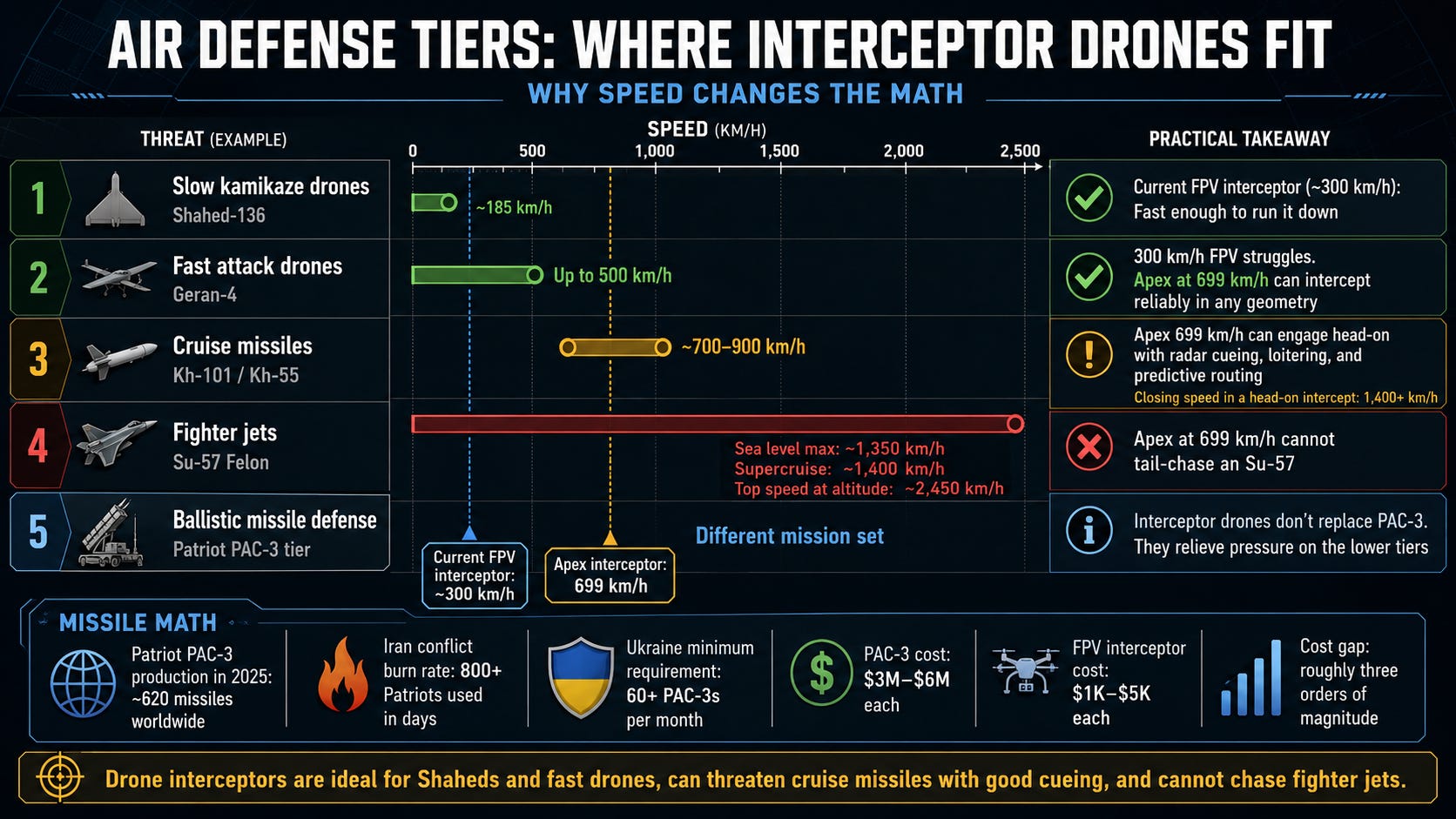
The Apex at 699 km/h handles the Geran-4 in any geometry. That’s not a marginal improvement. That’s moving from “sometimes possible” to “reliably achievable.”
Cruise missiles are the next tier. Russian Kh-101 and Kh-55 cruise missiles travel at roughly 700 to 900 km/h. A drone interceptor at 699 km/h can engage a cruise missile head-on, which produces a closing speed north of 1,400 km/h and a collision that doesn’t require the interceptor to be faster than its target. It requires the interceptor to be in the right place when the target arrives.
That’s a positioning problem more than a speed problem, and it’s one that radar cueing, loitering behavior, and predictive routing already address in current systems.
Now let’s do the honest calculation on fighter jets, because the headline implies it and you deserve the actual numbers.
The Su-57 Felon has a top speed of approximately Mach 2, about 2,450 km/h at altitude. At sea level its maximum speed drops to roughly Mach 1.1, about 1,350 km/h. Its supercruise speed, flying supersonic without afterburner, sits around Mach 1.3, roughly 1,400 km/h.
The Apex hits 699 km/h. That’s Mach 0.57.
A tail-chase against an Su-57 at any combat speed is not currently possible with electric propulsion. The jet is between two and four times faster depending on altitude and throttle setting. The Apex can’t chase an Su-57. Full stop.
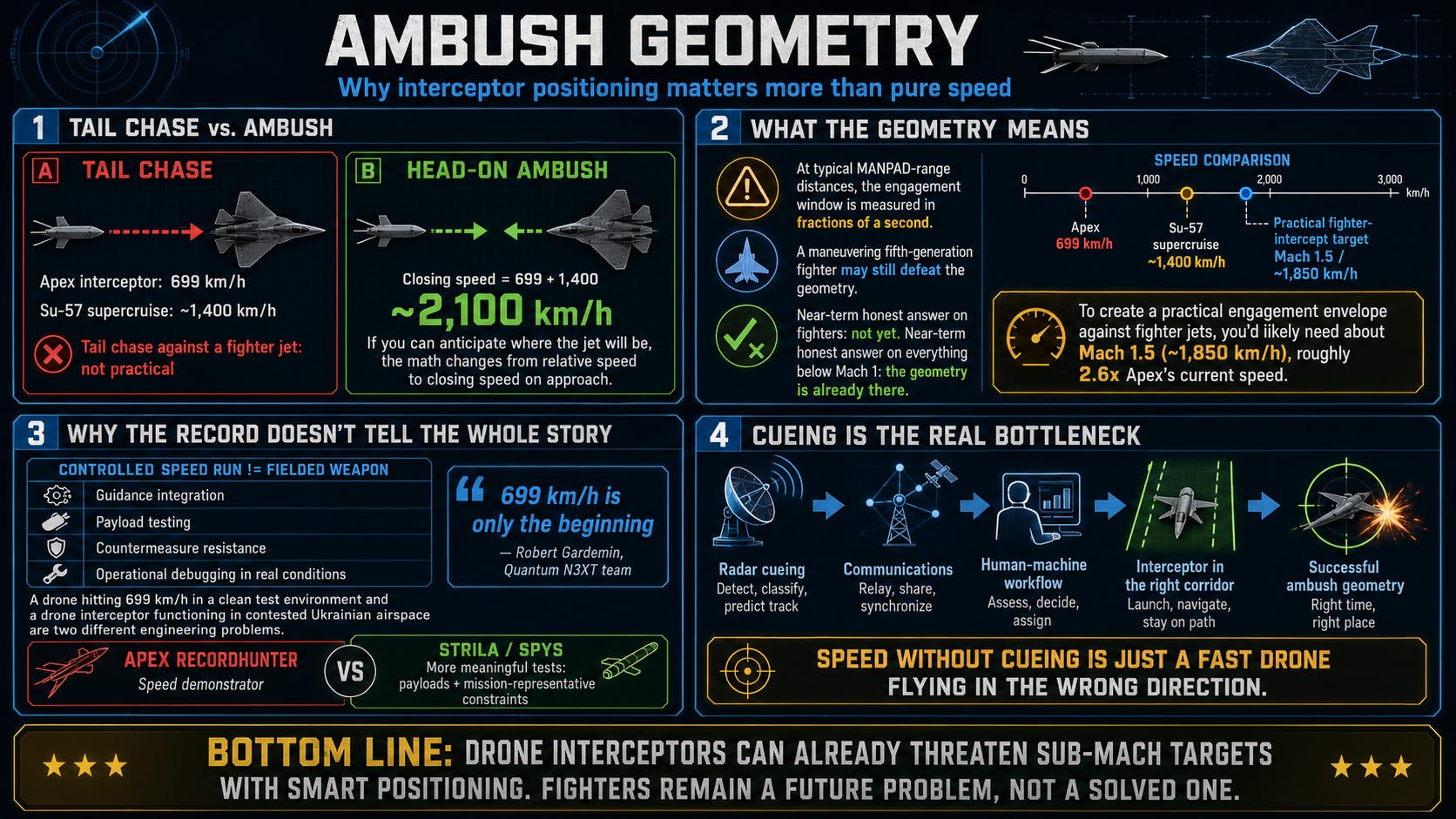
Where the math gets more interesting is ambush geometry. If you’re not chasing the jet but positioning ahead of it, the relevant calculation changes from relative speed to closing speed on approach. In a head-on geometry against an Su-57 flying supercruise at 1,400 km/h, the closing speed between the drone and the jet is 699 plus 1,400, roughly 2,100 km/h. The engagement window is measured in fractions of a second at typical MANPAD-range distances. Whether a drone interceptor can execute that geometry reliably against a maneuvering fifth-generation fighter is a question the technology can’t currently answer.
To build a drone interceptor with a practical engagement envelope against a fighter jet in the current sense of that phrase, you’d need something in the Mach 1.5 range, roughly 1,850 km/h, to generate enough geometric flexibility to account for jet maneuvering, engagement timing margins, and the basic unpredictability of a fighter pilot who knows something is coming. That’s 2.6 times the Apex’s current speed.
The Quantum N3XT team has already said the 699 km/h number won’t stand for long. Robert Gardemin called it an incredible milestone but only the beginning, and said the team would be back soon to go faster. The direction of the speed curve is real. Where it arrives and how quickly is the open question.
The near-term honest answer on fighters: not yet. The near-term honest answer on everything below Mach 1: the geometry is already there.
Here’s what the record doesn’t tell us, because a drone hitting 699 km/h in a controlled test environment and a drone interceptor functioning in contested Ukrainian airspace are two different engineering problems.
The Apex Recordhunter’s specific propulsion architecture and technical specs haven’t been published. Quantum got to 699 km/h somehow, and the innovations from that program are headed into the WIY interceptor work, but the path from speed demonstrator to fielded weapon still requires guidance integration, payload testing, countermeasure resistance, and the kind of operational debugging that only happens when things start failing in real conditions.
The STRILA and SPYS record attempts from WIY will tell us more than the Apex did, because those platforms carry payloads and operate under mission-representative constraints. Those results matter more than the clean-air speed run.
And the positioning problem is real. Getting an interceptor drone into the right corridor ahead of a target requires radar cueing, communications infrastructure, and human-machine workflows that are still being figured out under fire in Ukraine. Speed without cueing is just a fast drone flying in the wrong direction.
But here’s the thing about the direction of travel. Ukraine has taken fiber optic guidance, mesh networking, and half a dozen other technologies from demonstrator to operational deployment in timeframes that Western procurement officials would consider logistically impossible. If WIY’s interceptors prove the speed at the weapon tier, the workflow problem gets solved the same way Ukraine always solves workflow problems. Quickly, messily, and ahead of schedule.
Here’s the shift this speed record represents when you zoom out.
For fifty years, air defense has operated on a basic cost assumption. You use expensive guided missiles to intercept expensive manned threats, because the cost of missing a fighter jet or a ballistic missile exceeds the cost of the interceptor. You accept that this calculus is unfavorable for cheap threats like drones, because the alternative, spending Patriot missiles on Shaheds, is fiscally incoherent and operationally unsustainable.
Ukraine’s war broke that assumption at the bottom of the threat hierarchy. Russia sends 200 to 300 drones per day. You can’t meet that with Patriot. You need something cheap at the bottom of the stack so the expensive stuff can breathe.
What Quantum and WIY are building is the first electric drone that’s fast enough to handle not just the bottom of the stack, but a significant portion of the middle. Shaheds, Geran-4s, potentially cruise missiles on favorable geometry. That’s not just a Shahed-chasing tool. It’s a stack reliever that moves the line of what Patriot has to handle.
Ukraine needs 60-plus PAC-3 missiles per month and the global system produces 52. A drone interceptor that takes the Shaheds and the faster drones and possibly the lower-speed cruise missiles off the Patriot queue doesn’t solve the math. It changes what the math is about.
Russia’s air campaign was built on an economic calculation. Cheap attack drones overwhelm expensive interceptors. Ballistic missiles exhaust precious PAC-3 stocks. Volume beats the magazine depth of any defender willing to spend six million dollars stopping a $50,000 drone.
It’s a sound calculation. It’s been working.
The German engineers who spent a year losing sleep over an electric drone just posted a number that starts moving one of the inputs. Not enough to break Russia’s math today. Enough to make it worth watching very carefully over the next eighteen months, as WIY takes what Quantum learned in a test field in Germany and runs it over Ukrainian airspace, against real threats, at real stakes.
699 km/h. On batteries. With Ukrainian engineers in the room.
That’s not a record for the record books. That’s the beginning of a new layer in the stack.
That’s it for today, my friends. If this was useful, hit subscribe.
And as always, Glory to Ukraine, glory to the heroes, Crimea is Ukraine.


