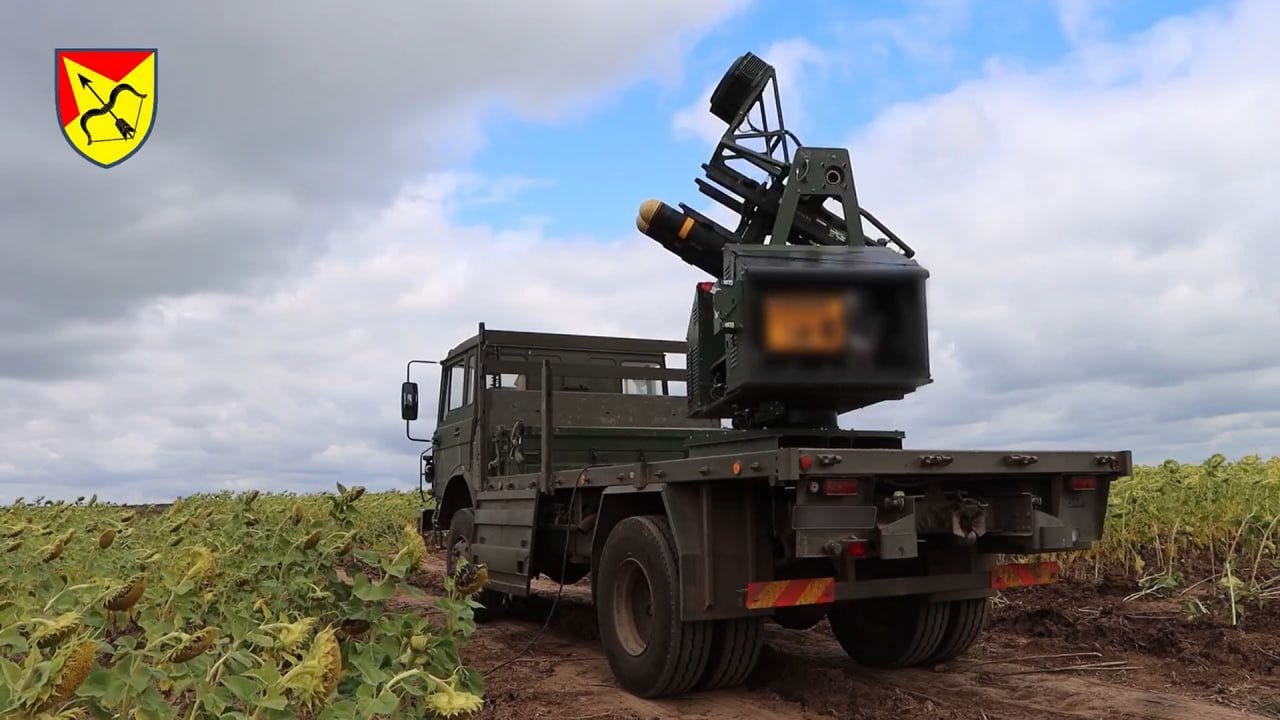
Ukraine Found the Air-Defense Missile Hiding Inside Hellfire
We have evidence of Ukraine using Hellfires as air defense missiles Franken-strapped onto a Dutch truck
I remember the first time I saw a Hellfire strike in person. It was the early 2000s at Fort Campbell and the unit was gearing up for its first Iraq rotation.
I was recovering from surgery, but I still somehow talked the commander into letting me tag along to the field with a video camera during a live fire exercise.
(I was the videography nerd in the unit and would often film our infantry company at the range or in close-quarters combat, and make VHS tapes dubbed to Metallica. These were the 8mm camcorder days, and I still have all these tapes somewhere. To my knowledge, none of them ever made it to the internet.)
Anyway, this was a few years before the invention of the Joint Fires Observer (JFO), who would normally communicate with the Apache pilot from the ground. Back in 2003, our commander’s radio operator would use an early version of the 5-line brief over basic FM radios to talk directly to the Apache pilots.
Because attack helicopters were classified as a commander’s “organic” maneuvering assets, we didn’t need a dedicated Joint Terminal Attack Controller (JTAC) or Forward Air Controller (FAC).
This obviously led to problems in those days. Grunty grunts sometimes struggled to talk to pilots using all that college-educated aviation talk… Hence, the invention of the JFO.
For a young company commander, having three Apaches as company assets must have felt like having the power of Zeus.
That day, I saw the twinkle in his eye.
“O’Donnell! Get the camera ready.”
“Yes sir!” I said with a growing smile.
A few minutes later, an Apache roared by. I didn’t even hear it coming over the gunfire on the ground. First platoon was executing Battle Drill 5: Knock out a Bunker located about 200 meters away. We marked our position with smoke and a few minutes later, I saw the hellfire; literally.
Members of the platoon fired their own AT4 rockets into the bunker at the same time it was getting hit by the Hellfires. With concrete powder still hanging heavy in the air, the assault element advanced.
I’m going to make it a point to find these tapes and digitize them, minus the Metallica for obvious copyright reasons. James Hetfield is quite litigious.
Now, thanks to the prolific Dylan Malyasov at Defense Blog, we have evidence of Ukraine using Hellfires as air defense missiles Franken-strapped onto a Dutch truck.
Wait, Hellfires for air defense?
Indeed. But this isn’t new. I actually made a video in January about Ukraine’s new Tempest buggy with armed with Hellfires.
During the Red Sands exercise in Saudi Arabia in September 2024, an AH-64D Longbow Apache tracked a hostile drone with its Longbow radar and killed it with [what officials strongly implied] was an AGM-114L Hellfire.
Israel had already been doing something similar with Apaches for years, including a shootdown of a Hezbollah drone near the Syrian border.
General Atomics later confirmed its own MQ-1C Gray Eagle drone had used the identical missile, guided by its onboard radar, to kill another small UAS in live-fire testing at Dugway Proving Ground.
So, when Ukraine’s 302nd Anti-Aircraft Missile Brigade formally unveiled a system called STASH this week, pairing Longbow Hellfires with a compact Israeli radar on a Dutch-built DAF YA 4442 military truck, it’s technically not a new use for the missile.
But Ukraine did find the fastest, cheapest, most practical way to turn the missile into routine wartime air defense.
Today, let’s look at how a missile, the AGM-114L designed for ground attack can be repurposed for air defense.
“AGM” stands for air-to-ground missile, and a lot of folks don’t realize that HELLFIRE itself is an acronym for HELiborne Laser, FIRE [and-forget missile].
Obviously, the air-to-ground designation is just a label.
From a physics standpoint, the missile itself only cares about five things: a sensor that can find or receive information about a target, guidance smart enough to steer toward a point in the sky where that target is going to be, enough speed and maneuverability to get there, a warhead capable of doing damage on arrival, and a launcher that can physically point it into a valid shot.
Hellfire already had four of those five nailed down.
The US Navy’s own public fact sheet says that Hellfire can function as an air-to-air weapon against helicopters and slow-moving fixed-wing aircraft.
The Longbow variant is the whole story
Most Hellfires guide themselves with a laser.
Someone paints the target with a designator, and the missile chases the reflected light home. That works beautifully against a tank. It gets considerably harder against a moving aircraft in darkness or smoke, because someone has to keep that narrow laser beam locked on a moving object for the entire flight.
The AGM-114L, the Longbow variant, throws that requirement out entirely.
It carries its own active millimeter-wave radar in the nose. So, the missile launches with a rough target picture already loaded in, flies the first leg on inertial guidance alone, then switches on its own radar seeker to find, lock, and finish the intercept without anyone holding a beam on anything.
That’s the decisive difference. A laser-guided Hellfire needs a human staring at the drone the entire time. A Longbow Hellfire carries the last, hardest part of the job inside its own braincase.
The millimeter-wave seeker was originally built to punch through battlefield smoke and darkness to find armored vehicles hiding underneath. It turns out those same all-weather qualities are exactly what you want when the target is a Shahed instead of a T-72.
Then there’s the Israeli radar…
I spent years working around radar systems, and the lesson that never stopped mattering was the hole between a radar noticing something and a radar being confident enough in what it noticed to shoot at it.
A search-quality return tells the crew something might be out there.
A fire-control-quality track tells the weapon precisely where that object is going to be after the missile has already left the rail.
STASH’s ground radar, widely identified as belonging to the Israeli-designed RADA family (though not officially confirmed component by component), has to build the second kind of picture, not the first, before anything gets fired.
The likely sequence probably runs something like this.
The ground radar picks up the drone and starts building a track, folding in position, altitude, heading, and speed over several seconds.
A fire-control system checks whether that track falls inside the Hellfire’s actual launch envelope.
Target data passes to the missile.
The launcher fires.
The missile flies its first leg on inertial guidance toward a calculated intercept point, then wakes up its own millimeter-wave seeker to search the expected volume of sky, find the drone, and correct itself home.
Nobody has published Ukraine’s exact wiring diagram for how the ground radar hands that track to the missile, so treat this as educated speculation.
In Ukraine’s case, the missile likely doesn’t fly toward where a drone currently is, because by the time it arrives, the drone has moved. The fire-control system must calculate an intercept point using the target’s speed, heading, and altitude alongside the missile’s own acceleration, flight time, and launch angle, then send the missile toward that future meeting point in the sky rather than the current one.
Like throwing a football to a receiver: You throw it at the spot where he and the ball are both going to arrive at the same moment, and the difference here is that the football has its own radar and remains religiously committed to correcting your throw on the way there.
Against a Shahed, this is actually a piece of cake.
The drone is slow, flies a comparatively stable route, and can’t maneuver aggressively even if its operators wanted it to, which compensates for the fact that Hellfire was never built as an AIM-9 Sidewinder chasing a fighter jet through hard turns.
The reason this is happening right now
So, STASH exists because of a very specific, very recent Russian adaptation.
A standard piston-engine Geran-2 flies around 180 to 185 kilometers an hour, slow enough that Ukraine’s fleet of cheap interceptor drones can catch and kill it. Russia has started fielding jet-powered versions of the same airframe that can push past 500 kilometers an hour, and a jet-powered Geran simply outruns anything Ukraine can chase with another propeller-driven drone.
That leak in the dam is exactly the hole STASH was built to plug, and Ukraine’s 208th Anti-Aircraft Missile Brigade has already used an earlier Ford F-350-mounted version of the system to intercept exactly this threat: jet-powered Shahed and Geran variants Ukraine’s slower interceptors physically cannot run down.
Tempest crews, running a closely related American-built missile-and-radar architecture from V2X, also uses Hellfires and had destroyed at least 21 Shahed-type drones by January of this year.
Here’s my Tempest video:
STASH looks like Ukraine taking that same basic package and distributing it across cheaper, more available vehicles.
No evidence of fragmentation
But there are a couple of complications here nobody’s talking about.
The AGM-114L carries a tandem shaped-charge warhead, purpose-built to punch through a tank’s reactive armor and then keep going through the hull underneath.
A traditional surface-to-air missile usually carries a fragmentation warhead paired with a proximity fuse, so it doesn’t need to physically strike the target at all. It just detonates nearby and fills the surrounding airspace with a bunch of angry steel bees.
Nothing in the publicly available material on the standard AGM-114L describes it carrying that kind of air-defense proximity fuse, which means Ukraine’s system, unless it’s running some undisclosed modified configuration, is likely leaning heavily on a direct hit or an extremely close terminal pass rather than a forgiving fragmentation blast.
That makes guidance accuracy the whole shebang.
A shaped-charge warhead that misses a Shahed by several meters accomplishes far less than one that arrives through the airframe.
So, let’s say the honest target list for STASH runs through Shahed and Geran-series attack drones, Gerbera decoys, larger reconnaissance UAVs, slow fixed-wing drones, and helicopters, with maybe some low-flying conventional aircraft under favorable conditions.
Cruise missiles are the interesting edge case. Defense Blog claimed that Hellfire simply cannot catch cruise missiles because they’re too fast.
Objection, your honor!
Ballistic missiles are definitely too fast. But a Hellfire can reach roughly Mach 1.3, and plenty of Russian land-attack cruise missiles fly subsonic. So, a crossing intercept geometry could theoretically produce a real shot at one under the right conditions.
So, you’re telling me there’s a chance?
If anyone could do it, I would expect Ukraine to be the first to hit a Russian cruise missile with a Hellfire.
The harder cruise missile-related problems technically aren’t raw speed at all. They’re detection range, how quickly the seeker can lock on, how much maneuvering energy the missile has left by the time it needs it, and the fact that it’s carrying an anti-armor warhead instead of a purpose-built air-defense fragmentation charge.
The RADA’s detection range depends on the target type, reaching up to 100 km for heavy aircraft, 45 km for medium drones, and 5 to 10 km for small mortars or rockets. For cruise missiles, DRS RADA Technologies claims it can detect cruise missiles at about 15 km.
Although, I should note that speed really isn’t the determining factor in radar detection. After all, the radar wave is moving at (carry the one) oh, the speed of light… I mean, it’s more like 99.97% the speed of light because of atmospherics. But still…
The real issue in detection is actually altitude and radar cross section.
So, Defense Blog is correct that STASH probably shouldn’t get marketed as “cruise-missile defense” without real combat evidence from Ukraine behind that claim. But the reason for that caution is just a set of engineering questions; and the Ukrainians are engineering savants.
Why the truck keeps changing
Also, STASH has now shown up on a trailer, a Ford F-350, and a Dutch military cargo truck.
This appears to be a case of Ukraine testing which chassis fits which mission.
A trailer works well parked next to a fixed asset like a power station or an airfield.
A pickup favors speed, dispersal, and quick relocation after firing.
A proper military cargo truck brings better off-road capability, more onboard electrical power, room for reloads, and easier integration into an existing air-defense unit’s logistics.
What matters here isn’t the vehicle at all. It’s that the missile-and-radar package is increasingly vehicle-agnostic, something Ukraine can bolt onto whatever chassis happens to be available and durable enough for the mission in front of it.
One last thing: The Hellfire isn’t exactly cheap.
Historical US procurement figures put a Hellfire’s fully loaded cost well into six figures once support and integration are factored in, against a Shahed that might run Russia tens of thousands of dollars.
That math looks different the moment the drone in question is descending on a transformer station or a radar site. Air defense was never really a comparison between the missile’s price tag and the drone’s price tag. It’s a comparison between the missile and whatever the drone is about to destroy if nothing stops it.
And older AGM-114L stock already sitting in Western inventories carries a kind of value that a fresh line-item purchase doesn’t. That money is already spent, friendo.
Ukraine’s live question tonight isn’t what the missile originally cost. It’s which interceptor actually exists right now to fire.
But just keep in mind that a Hellfire for a Shahed is not a winning math problem on paper.
Okay, so the Hellfire family has now flown off helicopters, drones, ships, and ground vehicles, against tanks, boats, buildings, and aircraft, which, methinks, points at something bigger than one Ukrainian truck.
The Army’s intended successor, the Joint Air-to-Ground Missile, blends radar and laser guidance in one weapon, and Lockheed Martin demonstrated JAGM firing from a vertical ground launcher against a drone earlier this year, which suggests the next generation is drifting even further away from any rigid air-to-ground label.
The strategic direction here is that future missiles are increasingly becoming common effectors wired into whatever sensor happens to find the target first.
A radar spots the drone. A command system assigns whichever weapon is closest and compatible. The nearest launcher fires. The missile’s original service branch and launch platform become irrelevant details rather than defining ones.
I keep thinking about that twinkle in my commander’s eye. He felt pure joy from blowing things up.
Back at Fort Campbell in 2003, I saw the Hellfire do exactly what it was built to do.
Twenty-three years later, I’m writing about the same missile family doing something nobody in that field at Fort Campbell would have guessed: Reaching up into the sky over a Ukrainian tree line and finding an Iranian-designed drone built in a shitty Russian factory, guided there by a radar bolted to the back of a Dutch cargo truck.
Actually, the weapon hasn’t changed nearly as much as the job has.
It still carries the same rocket motor, the same fins, the same logic. Somebody just pointed the whole package in a different direction and discovered it had been capable of that the entire time.
I’ll look for that 8mm tape, by the way. When I find it, digitized and Metallica-free, you’ll be the first to know.
Stay frosty.
Слава Україні!


Can it work against glide bombs?