


This article is one of three weekly exclusive articles for my paid subscribers. Thank you for continuing to fund independent, approachable military analysis with a heavy dose of pro-Ukrainian sentiment and a side of anti-authoritarian humor.
Something has changed in Ukraine. I know you feel it too.
A tailwind?
A sea change?
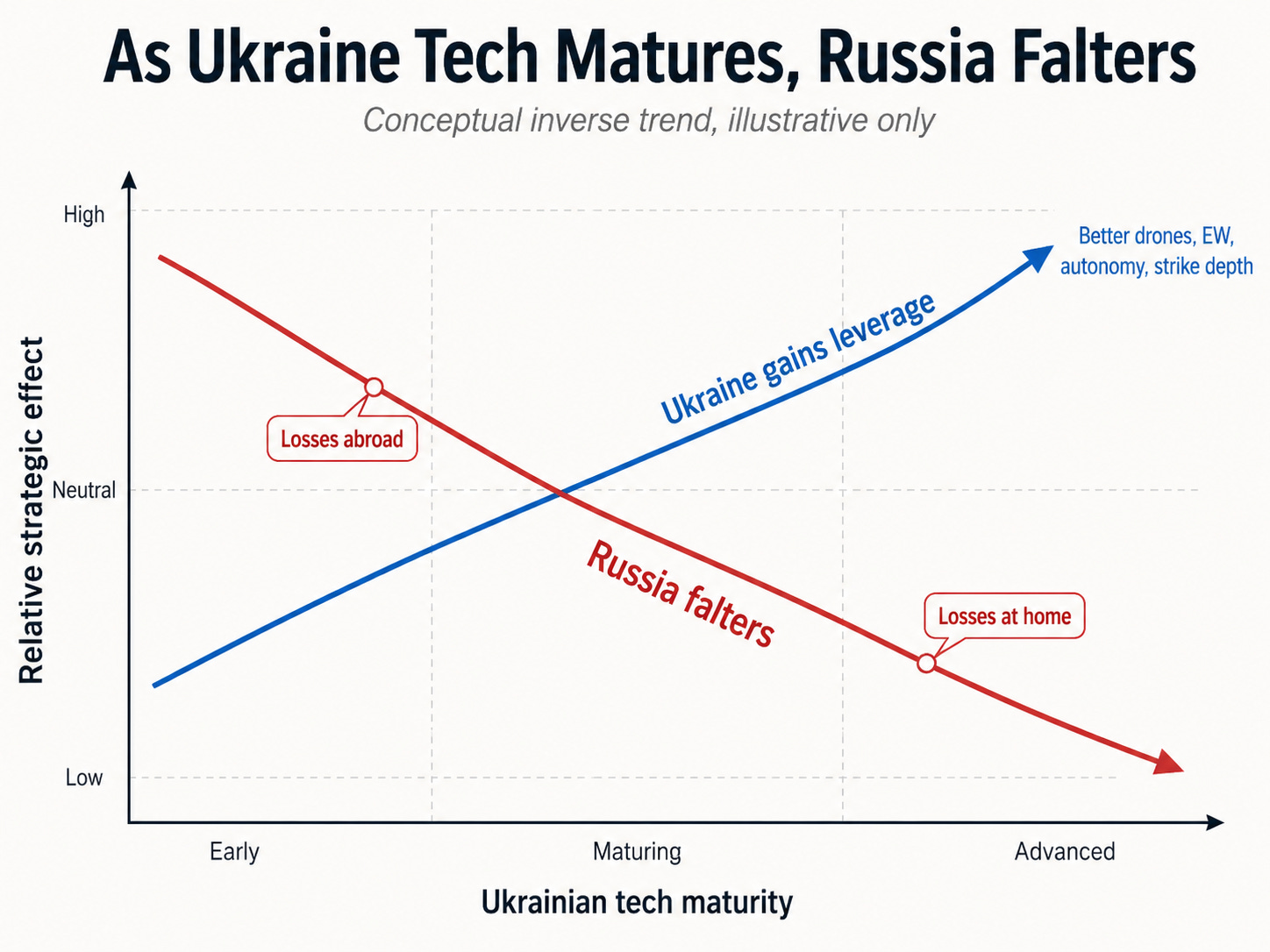
I’m not sure what to call it except to say that Russia is faltering both at home and on the battlefield, while Ukraine’s unique brand of “techno-war” hits its stride.
It’s almost as if the Ukraine-Russia fight is inversely proportional.
Today, we need to talk about Andriy Biletsky, and he’s not the kind of Ukrainian commander who says things for the cameras.
He’s the founder of the Third Assault Brigade, now the commander of Ukraine’s Third Army Corps, and one of the most brutally effective combat leaders this war has produced.
When Reuters caught up with him, he was underground, in Kharkiv, running a sector of the front that was hemorrhaging 60 square kilometers a month before his corps arrived. His corps got there and reduced that number to nearly zero.
When Biletsky says Ukraine has a six-month window to seize the initiative, take key positions, and enter negotiations from a position of strength rather than a defensive crouch, that’s a commander who’s been fighting inside the problem telling you what he thinks the clock looks like.
So, let’s talk about why this summer will be the summer of Ukrainian gains.
In February 2026, Ukrainian Air Assault Forces launched a counteroffensive along the Oleksandrivka axis, the junction of Dnipropetrovsk and Zaporizhzhia oblasts, an area Russia had been pushing into hard.
By early March, Ukraine had reclaimed more than 400 square kilometers, nearly fully clearing Dnipropetrovsk Oblast of Russian forces, and Syrskyi confirmed the operation was still ongoing.
ISW assessed that successful Ukrainian counterattacks in the south “could completely undermine Russia’s plans for its 2026 spring-summer campaign.”
That’s not a small thing to drop into a paragraph for the normally dour ISW.
Russia’s 5th Combined Arms Army had crossed the Haichur River, taken Huliaipole, and was pushing toward Orikhiv. The 36th Combined Arms Army had advanced north of Huliaipole.
Russia was building momentum in the south, and that momentum is now disrupted, at least partially, and at a cost to Russia that ISW says it can’t easily absorb.
Ukraine’s Air Assault Forces, the 82nd Bukovyna and 95th Polissia brigades specifically, launched a limited, high-intensity operation: specific objectives, fast consolidation, massive drone and artillery support, and the goal of creating a Russian failure rather than a Ukrainian breakthrough.
That’s the new template. Not a huge “Thunder Run” pushing deep into Russian territory, but numerous small gains that add up to thousands of square kilometers regained from the invader.
The question is whether Ukraine can run the 82nd Bukovyna and 95th Polissia brigades’ template again, in more sectors, with enough remaining combat power, before Russia reconstitutes and its spring-summer offensive finds a seam.
The Ghost of Summer 2023
I keep thinking about Ukraine’s failed mechanized assaults into the Surovikin Line in 2023.
It was one of the first large-scale offensive breaching operations in decades, conducted under conditions where drones, mines, artillery, and precision fires had completely changed the old ways of mechanized assault.
