Ukraine Has Now Surpassed Russia in Modern Combat Power
Four years after the full-scale invasion, Russia still has mass… But Ukraine has the kill chain.
By the time Russia invaded Ukraine in earnest in 2022, I had already been writing about the conflict for over five years. I called it “Europe’s forgotten war.” But when the full-scale invasion happened, I actually believed that Russian mass alone would eventually overwhelm the defenders and Ukraine would need to transform itself into an insurgency.
Ya know, make life hell for the occupiers.
I was in good company. The massive US intelligence apparatus got it wrong too.
You see, the instinct when comparing Russia and Ukraine is to count things like tanks, aircraft, artillery tubes, and population…
On that scoreboard, Russia still looks formidable: larger army, larger air force, larger missile inventory, larger industrial base, and a nuclear arsenal designed to end the convo.
But I’ve learned a crucial lesson since then: That scoreboard is dead wrong.
Russia entered February 2022 with every numerical advantage that scoreboard rewards.
Then, it failed to seize Kyiv.
It failed to destroy Ukraine’s air defense network.
It failed to dominate the Black Sea.
It failed to convert numerical superiority into strategic victory.
Four years later, the war has exposed something my tank-counting approach misses entirely: combat power isn’t what a country owns. It’s what its military can see, hit, repair, replace, learn, and adapt faster than the enemy.
By that measure, Ukraine’s story is extraordinary.
2014: The Army That Barely Existed
When Russian aggression began in 2014, Ukraine’s armed forces were hollowed out.
The IISS estimated that only around 5,000 to 6,000 soldiers out of a nominal force of 120,000 to 130,000 were genuinely combat-ready. The initial response to Crimea was handed to the SBU, the security service, which itself was a confession about the state of the military.
Volunteer battalions and civilian networks filled gaps the state couldn’t.
Ukraine had inherited Soviet structures without Soviet scale, and two decades of neglect, the 1990s and 2000s, had turned those structures into bureaucratic shells.
Logistics, readiness, command culture, and mobilization were all weak. Russia’s seizure of Crimea and intervention in Donbas forced the West into the obvious discovery that Putin was, in fact, a threat to his neighbors.
By 2016, Ukraine had expanded the AFU to roughly 250,000 personnel, begun shifting units east, and started reforming command structures toward NATO standards.
Eight years of grinding, low-intensity war in Donbas followed.
US and NATO trainers rotated through western Ukraine for years, helping Ukrainian forces rebuild from the wreckage of 2014 into a more professional, more interoperable, and more survivable army.
The main vehicle was the Joint Multinational Training Group-Ukraine, or JMTG-U. The mission started in 2015 at the Combat Training Center-Yavoriv, located at the International Peacekeeping and Security Centre.
There were also annual multinational exercises like Rapid Trident, which predated the full-scale war and were also held near Yavoriv.
The US Army’s 173rd Airborne Brigade began training Ukrainian National Guard forces in April 2015 under Fearless Guardian. The early focus included small-unit tactics and building Ukrainian forces for the fight against Russian-backed separatists in the east.
I was out of the military by this time, but many soldiers I served with told stories of training with the Ukrainians, specifically in awe of their fighting spirit, and very American way of small-unit warfighting where, in the absence of orders, squads reorganize themselves almost organically and keep fighting.
This little American trick, by the way, absolutely astonished the Germans in World War II, (which is ironic because they invented the concept in the 1930s and forgot about it in the 1940s). It was called Auftragstaktik (mission-type tactics), which delegated decision-making to lower-level commanders.
Instead, they were told that the American “dollar army” would surrender if their leaders were killed.
Nope! In the 101st Airborne Division, we were always told, “In the absence of orders… ATTACK!”
So, Putin prepared to conquer a memory of 2014. But Ukraine had spent eight years becoming a problem.
2022: Russia Invaded the Wrong Mother F*cking Country
Russia’s invasion plan rested on several assumptions: rapid political collapse, a paralyzed command structure, and a population that would either submit or wait things out.
Instead, it encountered a Ukrainian military with eight years of combat experience, improved reserves, better local command initiative, Western training partnerships, and a society already wired for resistance. The Euromaidan showed that Ukrainians wanted closer ties with the EU.
But this part is key: Ukraine’s 2014–2022 reforms hadn’t made it a NATO army. They had made it survivable… more durable to shock.
The defense of Kyiv proved Ukraine could absorb this strategic shock and keep functioning. The Kharkiv counteroffensive in September 2022 and the liberation of Kherson demonstrated Ukraine could also maneuver like NATO, seizing collapse points, moving faster than Russian logistics could respond, and exploiting a command culture that had become too rigid to adapt in real time.
But Russia’s biggest failure in 2022 was cognitive. Moscow planned against the Ukraine of 2014 and collided with the Ukraine of 2022.
This was made worse by the sorry state of the Russian military at the time. In fact, the difference between expectation and the reality of the Russian army was the basis for my first dozen or so articles on Medium.
If you go back and read my work here in the early days of the invasion, you’ll find me writing about how pleasantly surprised I was that the Russian army was actually a corrupted mess.
I think one of my early titles was something like “Putin’s Invasion of Ukraine Show the Dangers of Believing Your Own Hype”
Actually, here it is:
Putin’s Attack on Ukraine Shows the Danger of Believing Your Own Hype
The Russian invasion of Ukraine reveals a surprising truth about Russia’s conventional military forces: they are not…
But even an incompetent army can still be dangerous.
2022–2023: Learning Under Fire
The first phase of the full-scale war established Ukraine as a serious military. It also revealed what serious military competition now looks like.
Ukraine absorbed Western systems at a pace that surprised even the countries supplying them: HIMARS, NASAMS, IRIS-T, Patriot, Storm Shadow, Leopard 2, Bradley, CV90.

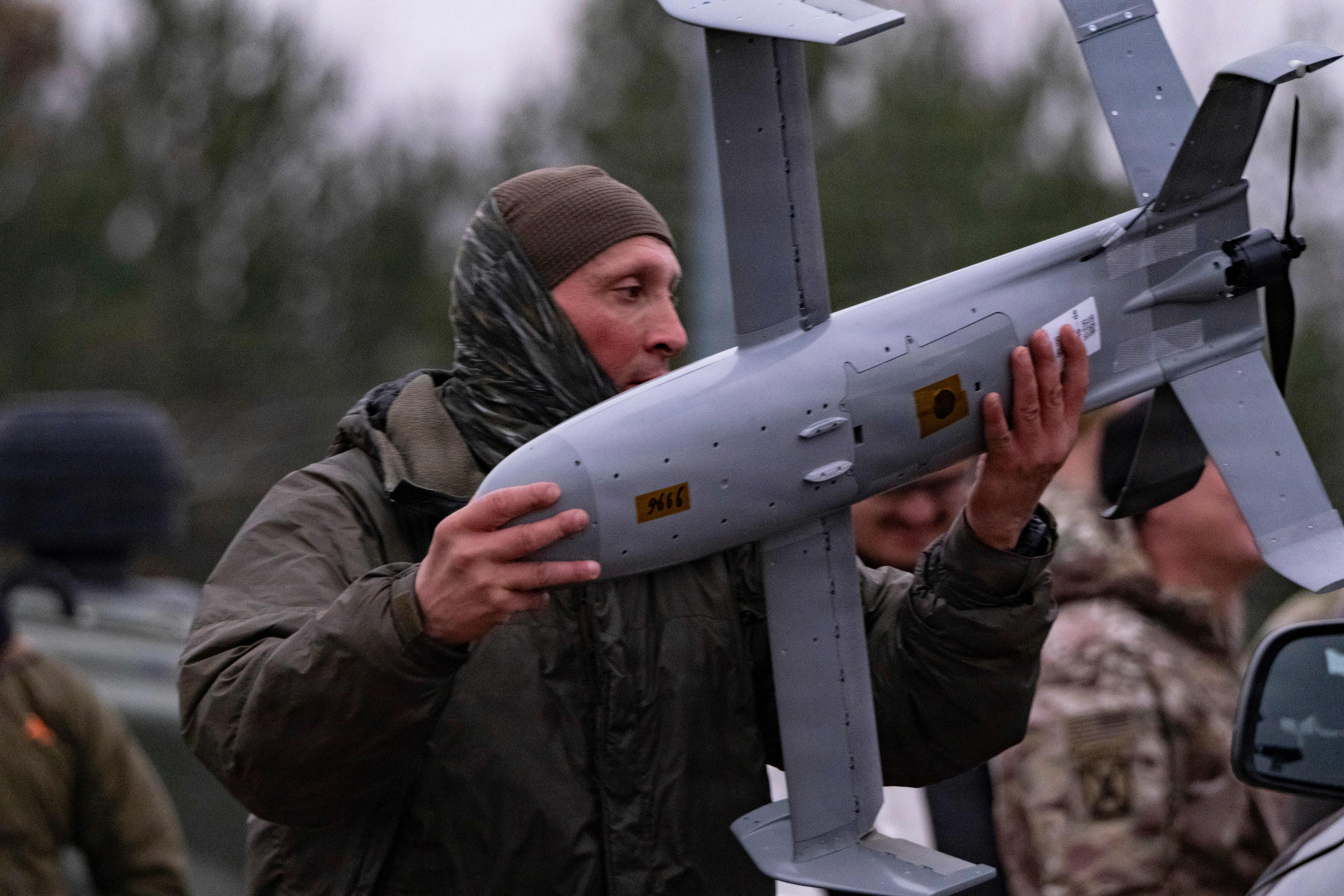
It sank or neutralized large portions of Russia’s Black Sea Fleet as an operational force. It pioneered the use of commercial drones for ISR and artillery correction at a scale no Western military had attempted outside of a defense contractor’s wet dream.
Ukraine’s 2023 counteroffensive also supplied the sober half of the ledger.
Without air superiority, against layered minefields, Russian electronic warfare, and drone-saturated defenses, Ukrainian maneuver formations paid a brutal price.
Ukraine became stronger because it learned from failure faster than most Western bureaucracies can schedule a low-key appointment at their favorite massage parlor.
Russia adapted too: more Lancets, more EW, deeper defensive positions, and heavier mining. Both sides were turning the front into a continuous military-technical experiment.
2024–2025: Russia Scaled the Old War. Ukraine Industrialized Improvisation
Russia’s adaptation through 2024 and 2025 was largely about volume.
More glide bombs. More Shahed attacks. More North Korean ammunition. More armored assaults absorbing casualties at a rate that would end the career of any Western general who suggested it.
CSIS assessed in January 2026 that Russia’s defense industry was producing significant quantities of tanks, munitions, and drones with support from China, Iran, North Korea, and others.
Ukraine’s adaptation was structurally different.
Ukraine radically shifted from a state-owned defense R&D model toward private companies, civilian engineers, battlefield-driven requirements, and procurement cycles fast enough to move some unmanned systems from concept to fielding in weeks.
The result was a commercial drone industry operating at wartime scale: FPV drones by the millions, naval drones threatening Russia’s Black Sea infrastructure, long-range one-way attack drones reaching deeper into Russian territory, AI-assisted targeting experiments, and improvised counter-drone layers built from interceptor drones, machine guns, and jamming systems.
Russia built a drone war through scale. Ukraine built one through software, workshops, and volunteers.
At the same time, Western defense companies, the big boys and startups alike, were donating weapon systems into Ukraine for a number of reasons: Some wanted to test their shit. Some wanted to hurt Russia. Some had surplus and saw an opportunity to score some diplomatic points.
At the end of the day, Ukraine got its hands on cutting edge Western military kit, like Soft Recoil Technology (SRT) artillery which prioritized “shoot and scoot” tactics.
Russia graciously volunteered to let Ukraine test this equipment on its soldiers and armor. How magnanimous…
Today, the comparison across key categories looks like this:
Russia has the larger population and larger mobilization base. Ukraine faces real infantry strain: exhausted troops, long deployments, mobilization politics, and training quality concerns.
Ukraine’s top general ordered a two-month limit for troops in forward positions followed by mandatory rotation, citing drone-dominated logistics and the need to preserve lives. No amount of drone brilliance fully replaces infantry holding ground in mud, tree lines, and shattered villages. Ukraine has not solved the human problem.
Russia is still ahead in firepower volume. They maintain advantages in artillery mass, glide bombs, missiles, and industrial depth. Ukraine’s edge is in precision, targeting quality, and long-range strike reach.
Ukraine’s deep-strike range grew from roughly 630 km in February 2022 to approximately 1,750 km by April 2026, enabling strikes against oil installations and manufacturing plants sustaining Russia’s war effort.
Russia still has more aircraft, but Ukraine has denied Russia air dominance. Integrated layers of Patriot, NASAMS, IRIS-T, Soviet legacy systems, mobile fire teams, electronic warfare, and drone interceptors have kept Russian aviation from operating freely over the front.
In this war, denial has mattered more than possession.
Ukraine holds the innovation edge with drones and counter-drone systems. Ukraine shot down more than 33,000 Russian drones in March 2026, a monthly record.
Carnegie’s April 2026 analysis concluded that both Ukraine and Russia have moved beyond prevailing Western practices, with the battlefield functioning as continuous military-technical experimentation, and Ukraine ahead in several software and integration categories.
As for defense industries, Russia’s is bigger. But Ukraine’s is faster and closer to the front. About 400,000 people work in Ukraine’s defense sector, and Ukraine’s industry could reduce reliance on Western support if better capitalized.
The structural difference, private-sector speed versus state-sector mass, increasingly favors the side that can iterate.
Ukrainian adaptation is decentralized, unit-driven, and civilian-networked. Russia still adapts, (EW improvements, Lancet refinements, layered defensive doctrine) but the adaptation is slower, more casualty-dependent, and more politically constrained.
Russia adapts after enough men die to prove the previous idea was stupid. Ukraine adapts because survival requires it by Friday.
So, Ukraine has surpassed Russia in modern combat power if modern combat power means: sensor-to-shooter integration, drone and counter-drone adaptation, long-range strike development, electronic warfare flexibility, commercial defense innovation, battlefield software, civil-military technical integration, and the ability to turn scarcity into precision.
Russia still leads in population, mass, strategic missile inventory, aircraft numbers, legacy stockpiles, artillery production, willingness to absorb casualties, and nuclear coercion.
One side is trying to win the 20th century harder.
The other is prototyping 21st warfare under fire.
The Army Russia Created
Russia invaded to demilitarize Ukraine. Then it helped create one of the most combat-experienced, technologically adaptive militaries in Europe.
Whoopsie.
It wanted a submissive buffer state. It got a hardened military-technical power with NATO weapons, domestic drone production, deep-strike reach, combat-tested air defense, and a national memory that won’t be negotiated away.
Ukrainian veterans will be teaching classes at West point and the most prestigious military academies across Europe. They are now the most battle-hardened fighting force on the European continent.
I wonder if Putin feels regret, or at least, a sense of irony for what he’s created? Had he left Ukraine alone and focused on his own military modernization, or at least, eliminate some of the corruption that hollowed out the army, Ukraine may have been an easier target at a later date.
So here we are over four years later. Ukraine is a military technological powerhouse and Russia’s military is a shadow of the mighty Red Army.
Could Putin eventually reconstitute his forces and attempt an attack on NATO? Certainly…
But thanks to Ukraine, NATO forces have increased spending and incorporated lessons learned into their own forces.
And as for me, unlike 2022, I won’t be overestimating Russian combat power any time soon.
Thanks for reading, friends. Слава Україні!


Excellent article, Wes.
You must surely have a big staff to produce so great a quantity of well researched and referenced quality analysis. Your work is unparalleled. Thanks.