


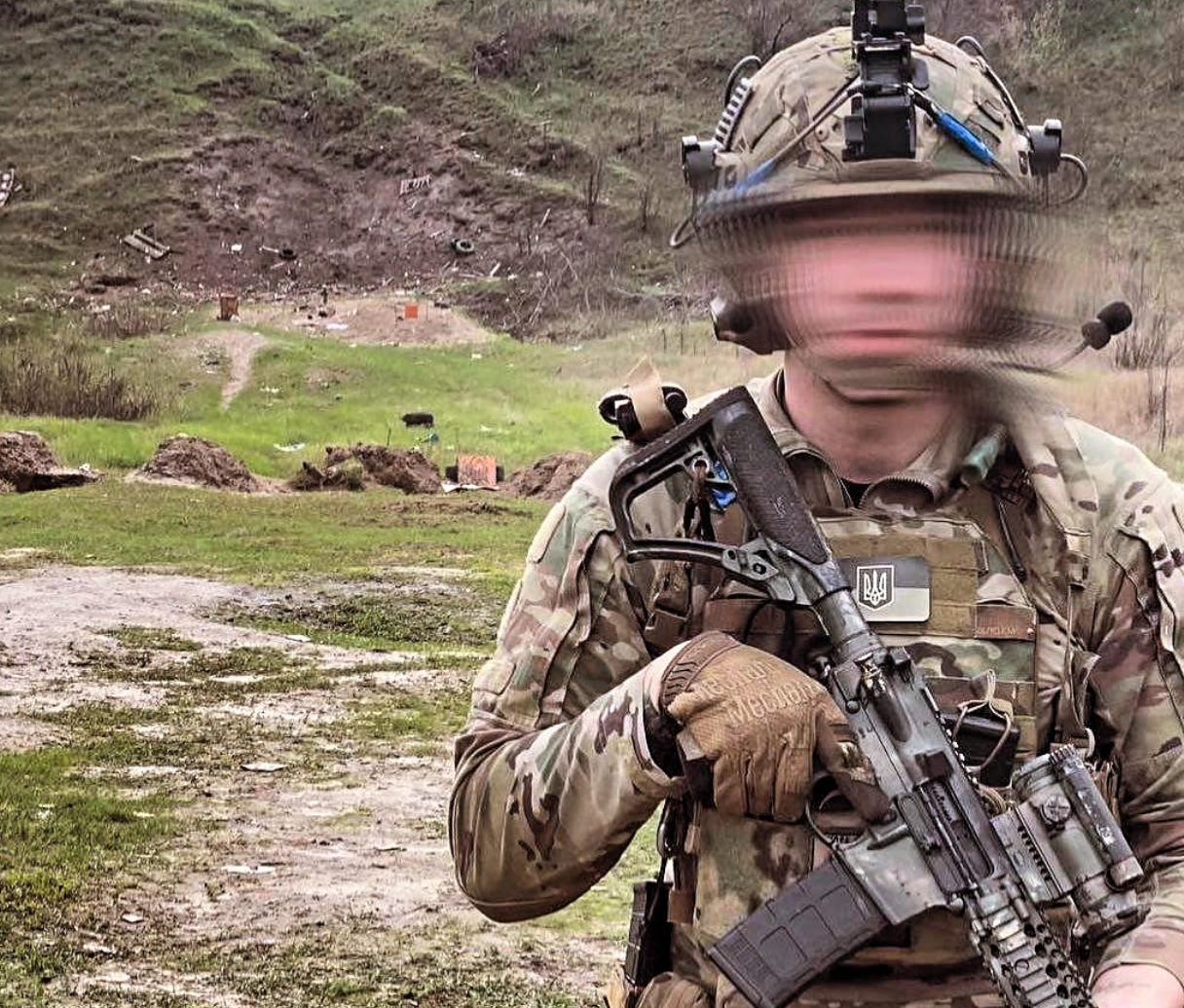
Ukraine has some of the best small-unit fighters on earth right now.
Years of Russian artillery, glide bombs, Shaheds, Lancets, minefields, and electronic warfare have produced soldiers who adapt or die, and the front line is so saturated with drones that outdated warfighting doctrine tends to enjoy the same life expectancy as a Vietnam-era Huey door gunner.
That is to say… not long.
So, I was surprised to read a recent piece from Militarnyi, a Ukrainian outlet, where a Ukrainian soldier was openly advocating for a dedicated NCO Corps.
Wait, doesn’t Ukraine already have noncommissioned officers?
It does. Ukraine has sergeants. It has chief sergeants. It has experienced NCOs whose authority comes from years of hard-earned combat credibility.
NATO has been helping Ukraine build a professional NCO system since at least 2016, and Ukraine’s Ministry of Defense approved a formal concept for developing the sergeant corps back in 2022.
What Ukraine is still building, unevenly, across a military that expanded enormously and violently under wartime pressure, is the culture, authority, career structure, training, pay, and institutional trust that make those sergeant ranks function the way they do in mature Western militaries.
What a sergeant is actually for
An individual sergeant can become an excellent leader through combat experience, character, competence, and the trust of his soldiers, and plenty of Ukrainian NCOs have done exactly that.
The problem starts when an institution requires exceptional people just to make the rank function at all.
A sergeant shouldn’t need the personality of a minor warlord to exercise authority the position already carries with it. In a mature system, the officer and the sergeant occupy different rooms of the same house.
For some of my non-military readers, a commissioned officer in the West generally requires a four-year college degree before commissioning. This is the leadership class. Enlisted require only a high school diploma (or GED) to enlist, but I should note that many enlisted have college degrees also.
So, ideally, the officer plans the mission, understands the wider fight, allocates resources, coordinates with adjacent units, and makes the calls that belong at his level.
The NCO takes that “commander’s intent” and turns it into something soldiers can actually execute, which means knowing whether the weapons work, whether the troops actually understood the plan, whether the radios got checked, whether ammunition sits where it’s supposed to, and whether the private who keeps insisting he’s fine has slept at any point in the last week.
No officer can personally track all of that while also running the larger fight, and a good one knows better than to try.
The American military spends serious money making sure this division of labor holds.
Advancement into the NCO corps requires completing a real leadership course, and the more senior the sergeant, the more professional development he has to complete to keep climbing. I believe now in the US Army, some amount of college is required to be promoted at higher enlisted ranks.
That investment buys something specific…
NCOs get handed real decision-making authority in most career fields, which frees mid- and senior-level officers to actually think about the larger fight instead of drowning in the daily mechanics of running one.
I learned what that authority looks like from the inside.
As a young infantry private, I was walking through a swampy part of the back forty of Fort Campbell, Kentucky, with my unit. At a brief halt, our platoon sergeant walked the line barking at everybody to change their socks.
My immediate reaction, (silently), was something close to indignation.
I’m a grown ass man. I’ll decide when to change my own socks! Then I pulled my boots off and saw what ten kilometers of wet, uneven terrain had already done to my feet. They basically looked like white ground beef.
The platoon sergeant was protecting the unit’s combat readiness with the kind of instinct that only comes from having watched trench foot, or immersion foot syndrome, take men out of the fight before.
By the way, that condition killed an estimated 2,000 American soldiers and 75,000 British soldiers in World War I, and every one of those deaths was, in a real sense, a failure of exactly this layer of leadership.
That’s the whole job in miniature.
Socks.
Why Russian generals keep dying
Now take that division of labor, (officer plans, NCO executes, soldier performs), and look at what happens to a military that never built it.
Russia doesn’t run anything close to a Western-style NCO corps.
Its enlisted leaders may have performed well individually, but they don’t hold a well-defined leadership role and don’t manage lower enlisted troops the way a Western sergeant does.
Russian officers absorb nearly all of that decision-making and tactical responsibility themselves, which makes the whole force officer-heavy and forces Russian officers to lead from much farther forward than their Western counterparts ever have to. That structural choice also makes the force rigid at the tactical level.
Absent explicit orders, Russian units tend to hunker into defensive positions rather than adapt and push toward an objective on their own initiative.
An American officer orders a unit to secure an airfield. The NCOs work out how to actually get it done, and if the unit hits an unplanned roadblock along the way, the lower enlisted soldiers look to their sergeants to adapt on the spot rather than radio back up the chain and wait.
It’s the difference between a unit that needs to be micromanaged and a unit trusted to solve the problem in front of it.
Now look at the bill Russia paid for skipping that layer entirely. Only three months into the full-scale invasion, Russia had already lost nine generals: Major General Magomed Tushayev, commanding Chechen National Guard units, killed in an SBU Alpha Group ambush near Hostomel. Major General Andrey Sukhovetsky, shot by a sniper at that same airfield days later. Major General Vitaly Gerasimov, chief of staff of the 41st Combined Arms Army, reportedly killed outside Kharkiv. Lieutenant General Andrey Mordvichev, commanding the 8th Guards Combined Arms Army, killed in a Ukrainian artillery strike on the Chornobayivka airfield.
Five more followed inside that same three-month window: Kolesnikov, Mityaev, Rezantsev, Frolov, and Simonov, a senior electronic-warfare commander lost to an artillery strike near occupied Izium.
