


Hey friends,
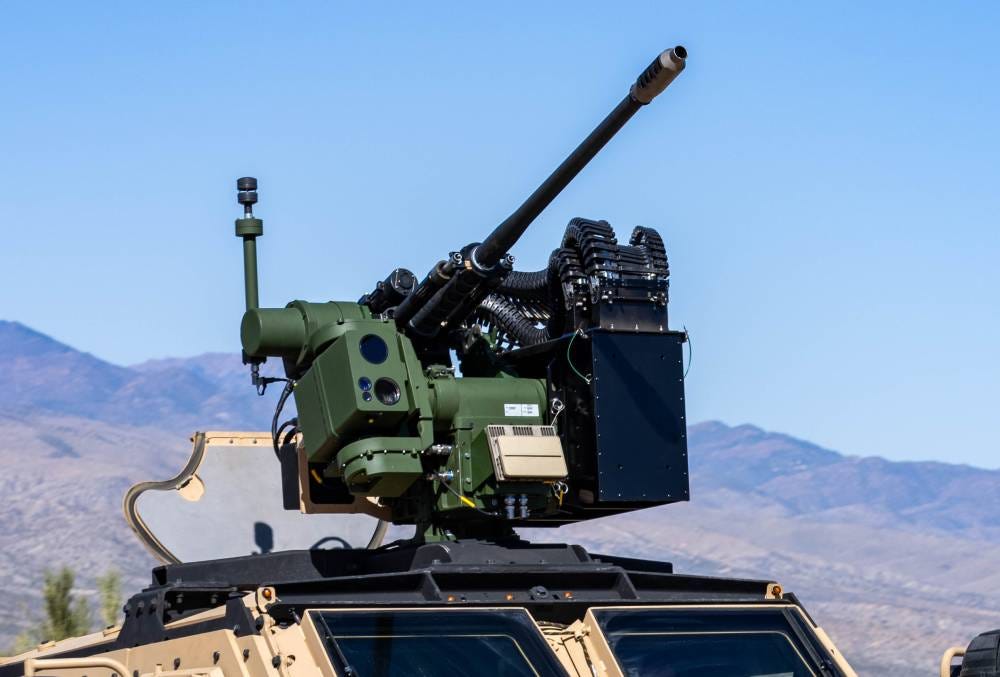
I have a fondness for the Aussie Slinger system: an automated counter UAS gun turret with expert stabilization thanks to Australia’s Electro Optical Systems (EOS).
There’s a reason my YouTube audience analytics say that a full 29% of my watchers are from down unda. A video on the Slinger system operating in Ukraine (in 2025) was one of my first “viral” hits. Besides, you tend to remember the weapon system you were discussing when that discussion gets viewed by four million people.
(It’s also why I’m fond of the British Starstreak.)
So, I just saw a bit of news about the Slinger’s radar system and I thought this would be a good time to revisit the weapon; albeit, in written form.
The biggest thing that caught my eye was the claim of “4D radar.”
Wait, what the hell is 4D radar?
I went down this particular rabbit hole after EOS Defense Systems USA, the American arm of Australia’s EOS, announced on October 7 that it is finishing development of a new version of its Slinger counter-drone weapon.
EOS plans to begin producing the system in Huntsville, Alabama in 2027, and a lot of the early coverage has grabbed onto the phrase “4D radar.”
Ooh, 4D! It sounds so exotic.
It sounds like somebody at EOS figured out how to detect Russian drones before the Russians have actually launched them; ya know, because the fourth dimension in classical physics is time…
But apparently, I spent a decent chunk of my Air Force career working with “4D radar,” and nobody bothered to tell me.
This is a bit irritating because “four-dimensional surveillance radar journeyman” sounds a hell of a lot more impressive than whatever I was putting on my résumé back then.
Okay, let’s level set here… This is all 4D means: Range, bearing, altitude, and velocity.
My first assumption was that Slinger had received some remarkable new radar and the marketing department had gone completely feral with the terminology. But the first Slinger, unveiled in 2023, already carried Echodyne’s EchoGuard radar, and Echodyne has been selling that system as 4D radar for years.
The new Slinger inherits that capability. What EOS is adding now is what the company calls “enhanced sensing,” along with aided target recognition, selectable autonomy, and an autonomous kill chain intended to operate at scale.
That is MUCH more interesting than the 4D label, particularly because Slinger has already been sent to Ukraine. The system is developing while the Ukrainians and Russians are simultaneously rewriting the counter-drone problem every few months.
So all this talk about 4D buries the lede, methinks.
A basic two-dimensional radar gives you range and azimuth, meaning how far away the target is and which direction you need to look. Add elevation information and you have what the radar world generally calls three-dimensional coverage.
The additional measurement behind the “4D” label is just Doppler velocity.
I don’t think the company is trying to hide the ball here; Echodyne is straightforward about this. Its own descriptions of 4D radar refer to range, azimuth, elevation, and radial velocity. The company even acknowledges that what many people historically called a 3D Doppler radar can reasonably be described as 4D under the newer terminology.
So, sadly, there is no infinite wormhole or closed timelike loop.
The fourth dimension, in this sense, is essentially how quickly the target is coming toward you or moving away.
That measurement comes from the Doppler effect, which is the same physics you experience when an ambulance goes screaming past your car. The pitch of the siren sounds higher while it approaches and lower after it passes because the relative motion between you and the ambulance changes the soundwave frequency reaching your ears.
Same thing applies to light waves, or in our case, a less energetic version, radio waves.
Send energy toward an object, let that energy bounce back, and motion changes the frequency of the return slightly. Measure the shift with a computer and you gain information about the object’s movement relative to the radar.
That was important on AWACS because the earth itself is a gigantic radar reflector that stayed annoyingly directly underneath all the airplanes we wanted to find.
Early airborne radar systems had a difficult time looking down at aircraft flying close to the ground because terrain, trees, buildings, roads, and everything else down there sent energy back toward the radar.
That clutter could bury a low-flying aircraft.
Pulse-Doppler processing helped solve the problem because most of the ground is stationary relative to the radar while the MiG screaming along at 300 feet is very much not. Once the system separates returns based partly on velocity, the moving aircraft becomes easier to distinguish from the clutter below it. That capability helped make the E-3 such an extraordinary surveillance platform.
The Air Force has long credited it with detecting low-flying aircraft at ranges beyond 250 nautical miles under certain conditions (250 is the unclassified range, by the way). One aircraft orbiting high above the battlespace could watch an enormous amount of sky, including aircraft trying to hide down near the terrain.
But Doppler does have a limitation that becomes relevant to our little Australian drone killer.
The radar directly measures radial velocity, meaning the portion of the target’s motion toward or away from the radar. If an aircraft turns roughly perpendicular to the radar beam, with the radar at its 3 or 9 o’clock, that radial velocity measurement can fall dramatically.
Fighter pilots have exploited that for decades. “Beaming” or “notching” a pulse-Doppler radar means maneuvering your jet to reduce your radial velocity enough that your return can fall into, or close to, the Doppler clutter notch the radar uses to filter out the ground.
Modern radars have ways to fight through that, so it is not an H.G. Wells-level of disappearing trick, but the underlying physics are very real.
We dealt with the same physics on AWACS. The tracking computer watched successive returns and calculated what the target was actually doing based on how its position changed over time. If the aircraft was here during one sweep and somewhere else ten seconds later, the computer could start figuring out heading and overall speed even though the Doppler measurement itself represented only part of the motion.
That is why I find the 4D label simultaneously accurate and funny. It makes the radar sound as though it has been granted some new sense unavailable to previous generations, when much of what is happening involves familiar Doppler physics combined with increasingly capable tracking software.
And tracking software is where Slinger starts getting nasty.
My radar needed a Boeing 707. This one rides next to a cannon.
The difference between the radar I worked with and the radar on Slinger gives you a pretty good picture of how far the engineering has come.
My radar lived on a four-engine airliner.
It required a 30-foot rotating dome, massive electrical generation and cooling, specialized maintenance crews, ground support equipment, and a mission crew in the back of the aircraft.
The rotodome rotated six times per minute, so roughly ten seconds passed between complete sweeps.
For what we were doing, that was fine.
If you are monitoring an aircraft 200 miles away, ten seconds is not a long time. The E-3 mission was surveillance, identification, command and control, and battle management. We built the air picture, kept track of who was who, figured out where everybody was going, and helped fighters get into position.
The E-3 never carried offensive weapons. We simply, ahem, arranged introductions.
Slinger has a much shorter and more violent decision cycle.
Imagine one mounted on the back of a pickup moving down a cratered road somewhere in eastern Ukraine. A Russian FPV drone appears around a kilometer away. The drone is moving, the truck is moving, the suspension is pitching and rolling, the cannon is moving relative to the vehicle, and the vehicle itself is moving relative to the earth.
The drone might weigh only a few kilograms and can change direction in the blink of an eye.
Slinger’s fire-control system has to sort through that mess and determine where the target will be when the projectile arrives.
I love military technology partly because enormous amounts of violence so often come down to geometry.
Echodyne’s radar uses what the company calls a metamaterials electronically scanned array, or MESA.

Traditional mechanically scanned radars point their beams partly by moving the antenna. Electronically scanned arrays can steer the beam by manipulating the timing and phase of signals across the antenna face, allowing the beam to move without physically swinging the entire antenna toward the target.
My old APY radar combined approaches. The entire rotodome rotated mechanically around the aircraft for azimuth coverage, while the radar could electronically manipulate the beam in elevation.
Echodyne has packed its radar technology into a package small enough to mount directly alongside a weapon system. This “miniaturization” is the part of this story I find much more impressive than calling it 4D.
Defense engineers use the acronym SWaP for size, weight, and power. Radar historically demanded truckloads of all three. Battlefield systems meant antennas, generators, trucks, cables, and support equipment.
Now the radar is small enough to ride on the gun.
And detecting the drone is just the beginning.
Slinger has to build a reliable track, which means repeatedly measuring the target until the computer has a decent estimate of its location, speed, heading, and likely path. Then the fire-control system calculates lead because you generally do not shoot at where the target is. You shoot where it is going to be.
At counter-drone ranges, tiny errors compound.
The M230LF cannon fires 30x113mm ammunition. Once you account for drag, range, and the actual ballistic characteristics of the round, the projectile takes meaningful time to cross a kilometer.
An FPV drone traveling at 120 kilometers per hour covers roughly 33 meters every second.
If your estimate of its movement is wrong by even a little, the projectile can arrive at an empty piece of atmosphere while the drone continues toward you.
Now compare that with my old radar.
At 120 kilometers per hour, that drone could move more than 300 meters during one ten-second E-3 sweep interval.
That’s manageable when you are tracking a bomber far over the horizon but it would be absurd for a gun trying to swat a small drone at one kilometer.
Slinger needs rapid updates because its target can radically change the geometry of the engagement in seconds. EOS also gave the original system a four-axis sighting arrangement that lets the sensor head move independently of the cannon in azimuth and elevation. That allows the optics to remain on the target while the weapon slews toward the appropriate firing position, which becomes especially valuable when the entire system is mounted on a moving vehicle.
Then the computer has to account for vehicle motion, pitch, roll, yaw, vibration, crosswind, ballistic drop, projectile flight time, and whatever the drone operator decides to do after realizing somebody is shooting back.
An Abrams firing accurately while moving already performs an impressive amount of mathematical housekeeping. Now shrink the target from a tank to a quadcopter, lift the target into three-dimensional space, let it change direction quickly, and mount your gun on a pickup.
Welcome to counter-drone warfare.
Fortunately, Slinger gets some help from the ammunition.
The 30mm high-explosive fragmentation round can use a radio-frequency proximity fuse, which means the projectile does not necessarily need to drill directly through a drone the size of a dinner plate. Get the shell close enough and the fuse can trigger the explosive charge, spraying fragments through propellers, motors, batteries, wiring, flight controllers, and whatever other important pieces of plastic are keeping the drone airborne.
That gives the fire-control system a larger acceptable error than a direct-hit weapon would have.
Ukraine has already been grading Slinger
Slinger’s relationship with Ukraine goes almost all the way back to the weapon’s public debut.
EOS unveiled it in Canberra in May 2023 and was already talking about lessons emerging from the war. Northrop Grumman subsequently ordered three systems, and the Ukrainian configuration placed Slinger on a manned 4x4 truck while integrating it with Northrop’s M-ACE architecture.
M-ACE means acquisition, cueing, and effector.
Defense contractors are legally prohibited from describing anything in fewer than three nouns, so in normal English it means the network detects the target, points the weapon toward it, and kills it.
That tells us something useful about Slinger from the beginning. It wasn’t designed to operate as an isolated gun truck wandering around hoping a drone flew past. External sensors could detect threats and cue the weapon toward the appropriate piece of sky, after which Slinger’s radar and electro-optical sensors could handle the close engagement.
The exact number delivered to Ukraine is still murky.
Reports in 2023 said 160 Slingers were headed there, and that number spread quickly through the defense press.
It appears, however, that some reporting blended Slingers with other EOS remote weapon stations. In 2024, EOS said Germany had purchased Slingers for Ukraine to protect IRIS-T air-defense radars from small drones.
Monocle later reported around 200 Slinger systems in Ukraine, another figure I would hold loosely until we get clearer confirmation.
More recently, Militarnyi reported Ukrainian forces operating Slingers on pickup trucks as part of mobile counter-drone teams and published photographs showing the systems in Ukrainian service.
Whatever the number, the useful part for this story is not necessarily the exact inventory…
It’s what EOS is doing with the battlefield experience.
Company personnel told Monocle that EOS teams travel to Ukraine roughly every other month, sometimes close to the eastern front, and feed what they observe back into development. One employee described the process as learning “day by day, week by week.”
EOS began publicly discussing aided target recognition and “selectable levels of autonomy” for Slinger in 2025. The company described automation as a way to reduce the operator’s workload by helping detect, classify, and engage drones.
The October announcement goes further.
EOS says the next-generation system will use selectable autonomy to respond to threats on a faster decision cycle, and it describes an autonomous kill chain “built to operate at scale.”
Once you chisel away the corpo-speak, the engineering problem looks like this: The radar is fast. The computer is fast. The gun is fast. The incoming drone is definitely fast. The operator is still a slow human. I don’t mean “slow” developmentally. I’m sure they are well-read and well-traveled. I mean slow because the human’s internal computer is wet and squishy and the consistency of Jell-O.
The computer might automatically search for objects, classify them, build tracks, rank threats, point sensors, slew the weapon, calculate firing solutions, and then wait for a biological human being to approve every engagement.
A better configuration would potentially automate additional parts of the sequence.
So, what does any of this have to do with “4D radar”?
This entire story started because I was amused by the terminology, and I am still amused by it. The fundamental questions my old E-3 radar tried to answer were not very different from the questions Slinger asks.
Where is the target?
How far away is it?
How high is it?
How is it moving?
The E-3 answered those questions across hundreds of miles while orbiting at altitude with a 30-foot rotating antenna, four jet engines, and a mission crew sitting in the back of what was essentially a flying office building.
Slinger asks them from the bed of a truck.
What changed dramatically is how quickly the answer has to become action.
On AWACS, we usually had time.
A track appeared. We watched it. We correlated information. We checked identification. People talked over Link-16. Controllers built situational awareness. Fighters could be vectored toward the target.
There was an entire human decision-making architecture between the radar return and whatever happened next.
A Slinger crew facing an FPV drone at a kilometer is in a more harrowing situation.
That is why the next-generation Slinger interests me far more than the phrase “4D radar.”
The radar technology is impressive, particularly because Echodyne has compressed so much capability into such a small package. The gun is impressive. The proximity-fused ammunition is clever.
But I think the real race is happening between detection and decision.
Ukraine keeps shortening that interval because the drones keep getting faster, more numerous, harder to jam, and more disposable. EOS is responding by pushing more of the workload into software and giving the operator less to do manually during the handful of seconds that matter.
I still take the classical approach that the fourth dimension is time. On the AWACS, we had plenty.
On a Ukrainian road with an FPV screaming toward your truck, you may have three seconds.
That’s the dimension EOS is really trying to buy back: time.
Слава Україні!