


Somewhere over Ukraine, a guy is climbing into the back seat of a Soviet-era Yak-52 training aircraft with a UAR-15 rifle and a plan to shoot down a Russian drone.
Somewhere else, another Ukrainian crew has mounted an American M134 Minigun inside an old Antonov transport aircraft. They’ve also begun launching interceptor drones from underneath its wings.
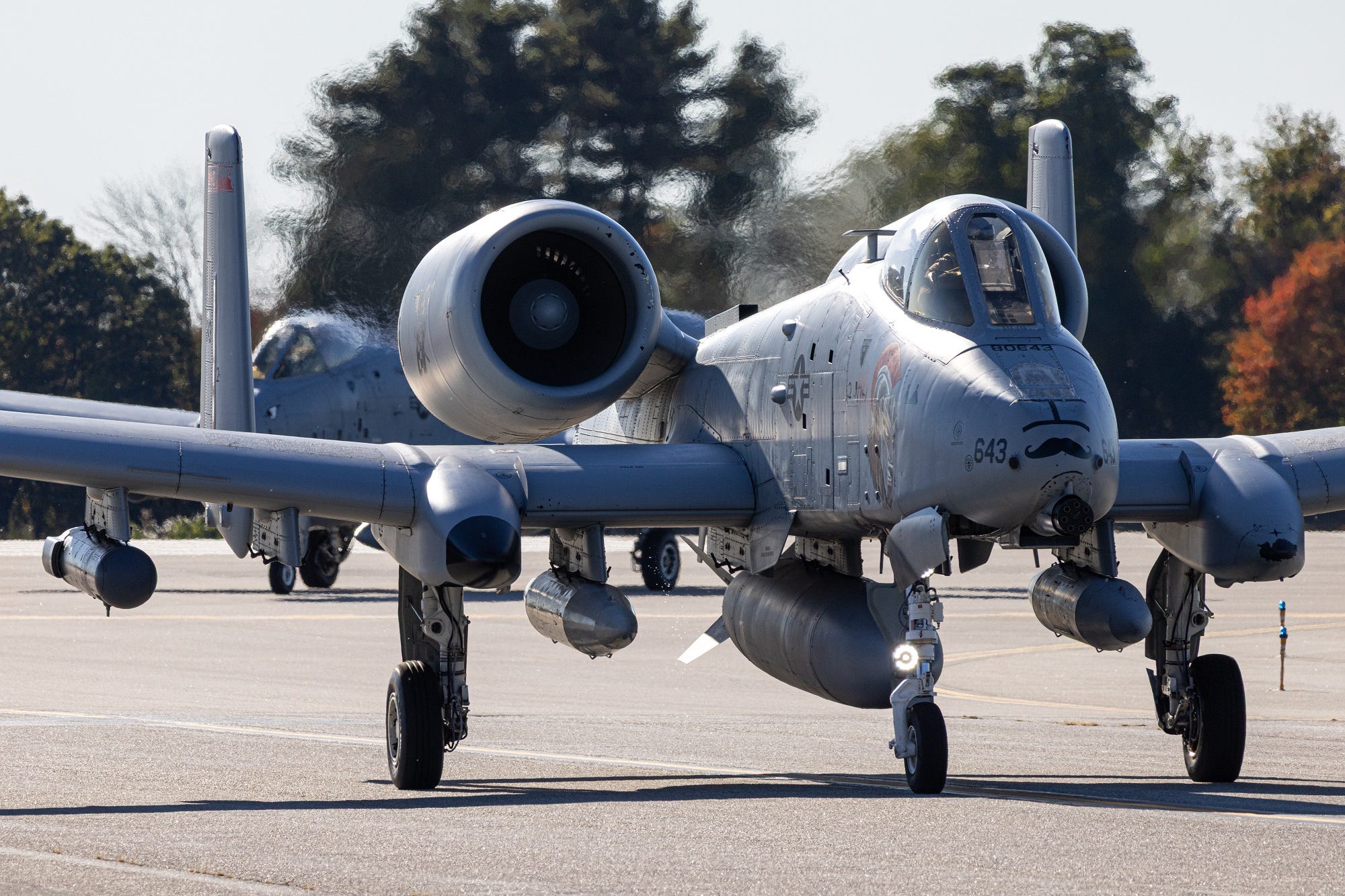
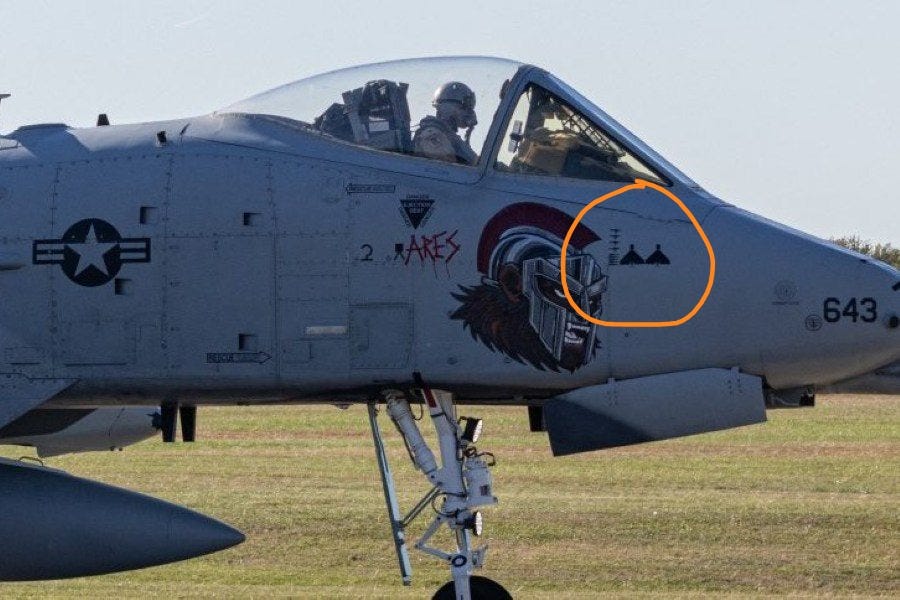
And in October 2025, an American A-10 Thunderbolt II named Ares returned from the Middle East with two little Shahed silhouettes painted on its nose.
I feel a bit vindicated.
I’ve been arguing since 2023 that the United States should transfer its retiring A-10 Warthogs to Ukraine, specifically to hunt Russian Shahed drones far behind the front lines. I’ve received some great YouTube comments about that proposal, along with a few from people who apparently think I want the Warthog to recreate Desert Storm over the Donbas.
Welp, the US Air Force has now demonstrated that an A-10 can apparently shoot down Shaheds.
Unfortunately for my argument, Ukraine has spent the last two years coming up with a bewildering collection of its own airborne drone hunters, some of which accomplish the mission for a fraction of what it costs to operate an American attack aircraft.
And that’s forced me to reconsider something: If Ukraine can shoot down Shaheds with a retired training aircraft and some dude carrying a rifle, what exactly would an A-10 add?
Because the strangest thing about these airborne interceptors is that many of them don’t have the equipment you’d normally associate with an air-defense aircraft.
The A-10 doesn’t have a radar. The Yak-52 sure-as-shit doesn’t have one. Ukraine’s improvised Antonov gunships aren’t exactly E-3 AWACS aircraft, either.
Yet they’re all finding and destroying drones.
I spent part of my Air Force career working on the E-3 Sentry AWACS, where finding aircraft and directing other aircraft toward them was our entire business. And I think the answer to this little mystery tells us quite a lot about what Ukraine’s future air-defense force should look like.
Somebody has to find the damn thing
The E-3 is an airborne early warning and control aircraft, and its job is to detect aircraft, maintain surveillance of the battlespace, and help coordinate friendly forces.
Most people imagine an AWACS as a really big flying radar.
That’s part of it, although radar returns aren’t really that useful until somebody figures out what they represent.
A surveillance system detects something moving through the sky.
Operators establish a track, determine its direction and speed, and attempt to identify it. That information then gets distributed to the people who need it.
Sometimes that’s a fighter pilot. Sometimes it’s a ground-based air-defense unit. Sometimes it’s another aircraft that’s already in a position to intercept.
When I was in the Air Force during the War on Terror, we heard stories from older AWACS crews that during Desert Storm, an E-3 Sentry saw three Iraqi MiGs flying supersonic straight at the AWACS. What followed was pretty funny: The alarmed AWACS crew started vectoring in every F-15 fighter squadron in the vicinity to intercept, to the point where it was vast overkill.
Apparently, the MiGs bugged out when they realized there were roughly forty F-15 Eagles between them and the AWACS.
Also, there’s a huge amount of communications equipment involved, along with computers, tactical data links, and people wearing headsets and staring at screens looking “tacti-cool.”
The original Iranian-designed drone has a wingspan of approximately 2.5 meters and cruises at around 185 kilometers per hour. It often flies low, where radar systems have to fight with terrain, buildings, and other sources of clutter.
A modern airborne radar can use Doppler processing to distinguish moving objects from stationary backgrounds, although slow targets can be challenging depending on their direction of travel relative to the radar.
It’s a legitimate detection problem… The radar cross section (RCS) of a Shahed is between 0.01 and 0.05 square meters depending on the radar frequency and viewing angle. For comparison, the RCS of a MiG-29 Fulcrum is about 3 to 5 square meters from a frontal profile.
So, could an E-3 Sentry find a Shahed?
I’m going to say yes, but not at long range. Probably at no more than 70 miles. My butter-bar lieutenant might disagree with me here but trust me sir; in fact, why don’t you let the NCOs work and head on back to the O-club. We’ll handle it…. fng.
Ukraine has developed some creative answers to this detection problem. One of my favorites is the country’s network of acoustic sensors.
Ukraine operates systems such as Sky Fortress and Zvook, which use microphones distributed across large areas to listen for the distinctive sound of incoming drones.
Shaheds have noisy piston engines. If you place enough microphones across the countryside, software can compare the sounds they detect and estimate where a drone might be flying.
A US Army study published in April 2026 examined Ukraine’s acoustic systems and their ability to help cue local air defenses.
Wait. We’re spending billions of dollars developing increasingly sophisticated space-based surveillance platforms, and Ukraine has built part of its air-defense warning network around repurposed Android microphones that recognize an MD550 four-cylinder, horizontally opposed, two-stroke engine?
Cool, cool. Got it.
Ukraine combines these acoustic reports with radar coverage, command networks, and other sources of information to develop an increasingly useful picture of incoming attacks. Then, they increasingly combine and process that data using an AI-assisted system that can assign interceptors far faster than any human battle manager ever could.
Mobile teams can receive target information electronically, while aircraft crews can be directed toward suspected drone locations.
What happens next depends largely on what the Ukrainians have managed to bolt onto the airplane.
Ukraine brought a rifle to an air war
The Yakovlev Yak-52 entered production in the late 1970s as a Soviet aerobatic and training aircraft.
It’s a two-seat, single-engine propeller airplane designed to teach pilots how to fly, perform maneuvers, and eventually move on to more sophisticated aircraft. It was never intended to be a fighter.
And yet, by 2024, Ukrainians were flying Yak-52s against Russian reconnaissance drones.
One person flew the aircraft while another occupied the rear seat with a firearm. The pilot maneuvered into a position where the gunner could engage the drone.
That’s roughly how people started fighting aerial battles during the First World War.
In March 2026, footage emerged showing a Ukrainian Yak-52 crew engaging a Russian Geran-type drone with an automatic rifle fired from the rear cockpit. The drone subsequently exploded.
I have several questions about this operation, beginning with how the gunner managed to aim accurately from a moving aircraft. Let me tell you, that would be an insanely difficult shot for any leg infantryman.
A leg infantry (or simply a “leg”) is military slang used by airborne-qualified units to describe a conventional infantryman who is not airborne-qualified.
Imagine trying to shoot something from the back seat of an open airplane, where the wind is tearing past you at a hundred miles per hour, your own aircraft is pitching and weaving, and your target is moving independently through three-dimensional space.
Oh God, I’m getting vertigo just visualizing this.
You also have to account for the relative motion between both aircraft. If the pilot can establish a reasonably stable position alongside or behind the drone, the gunner’s task becomes more manageable, but no less impressive.
The Yak-52 does have one enormous advantage over a modern fighter jet.
It’s slow.
An F-16 can’t casually fly alongside a Shahed at 185 kilometers per hour. Its aerodynamic limitations and stall speed make that impossible.
A Yak-52 operates much closer to the drone’s speed range.
The tactical logic makes sense. If ground-based sensors can direct a light aircraft toward an incoming drone, a gunner armed with a relatively inexpensive weapon might destroy a target that would otherwise require a costly missile.
Ukraine has essentially revived a century-old form of aerial combat because the enemy has introduced a target that makes the old tactics useful again.
Then someone found an American minigun
The Antonov An-28 is a twin-engine turboprop aircraft developed during the Soviet period.
It’s a relatively small transport airplane, designed to operate from short or unimproved runways. It can carry passengers or cargo, and its operating characteristics make it suitable for flying slowly over a large area.
One Ukrainian An-28 had been used for skydiving before the war.
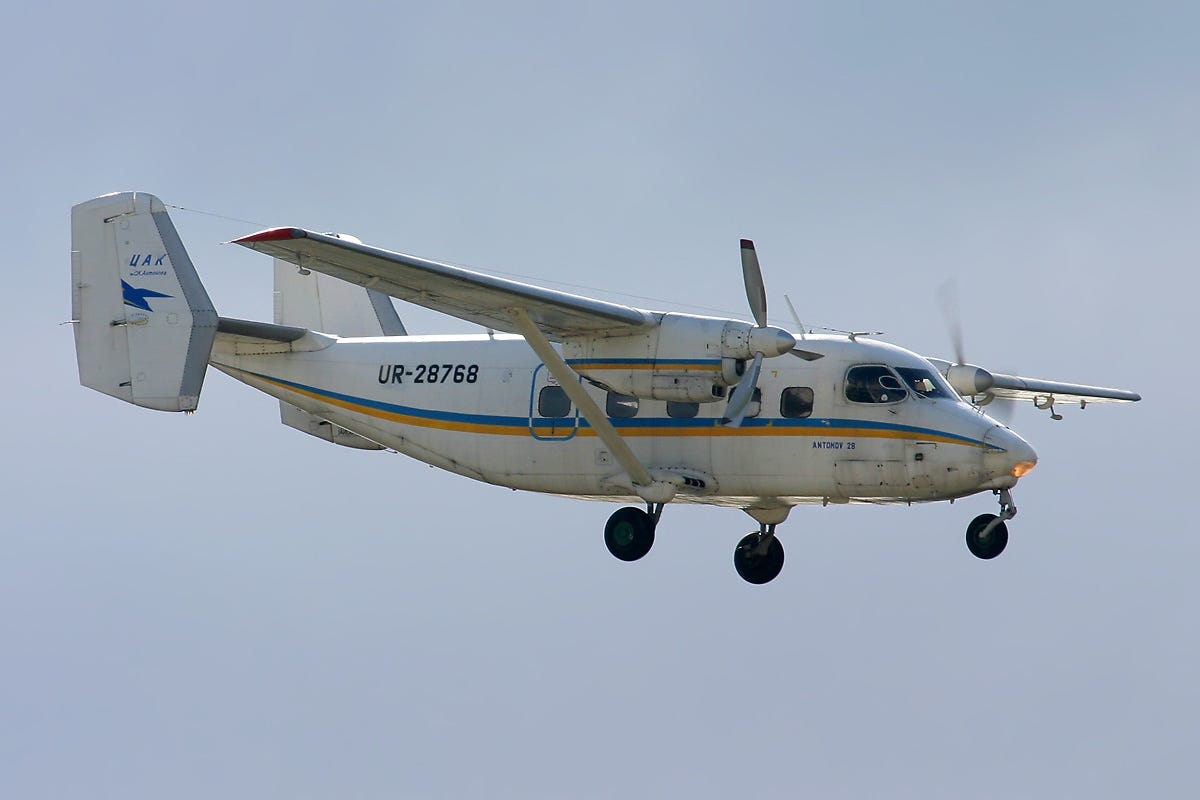
The aircraft became part of a volunteer drone-hunting operation associated with Ukrainian aerobatic pilot Timur Fatkullin and his team.
And the weapon they selected for their flying drone hunter was the American M134 Minigun.
Now we’re talking. Let’s cue up that scene from Predator:
The M134 is an electrically driven, six-barrel rotary machine gun chambered in 7.62×51mm NATO. Depending on the configuration, it can fire several thousand rounds per minute.
It’s an extremely effective way to place a large number of projectiles into a relatively small area.
The Ukrainian An-28 carries a thermal-imaging camera that helps its crew locate drones at night. The pilot maneuvers the aircraft to establish a useful firing angle, and the gunner engages the target through a side opening.
Journalist Ed Caesar actually flew with Fatkullin’s crew for a remarkable New Yorker report published in May 2026. His account describes the crew using a shared air-defense picture, thermal imaging, night-vision equipment, and a spotlight to acquire and engage Shaheds.
I found the technical details fascinating.
A thermal camera can spot the heat generated by a Shahed’s engine, even when the drone is extremely difficult to see against the night sky. The pilot and gunner have to cooperate closely because the weapon’s firing arc depends on the aircraft’s position relative to the drone.
According to Caesar’s reporting, Fatkullin’s aircraft had accumulated 171 drone kill markings by the time of his visit.
Fatkullin was an accomplished aerobatic pilot before the war, and the skills required to fly precisely alongside another aircraft turned out to be exceptionally useful for hunting drones.
Military aviation has always rewarded pilots who understand relative motion and positioning.
The technology changes. The physics don’t.
Unfortunately, getting close enough to destroy a Shahed with a Minigun introduces another problem.
You’re shooting at an explosive aircraft from relatively close range.
Debris can strike the An-28, and the blast from a drone’s warhead creates additional danger. Fatkullin’s team has reportedly had to repair shrapnel damage to its aircraft.
In April 2026, footage emerged showing a Ukrainian An-28 launching P1-SUN interceptor drones from mounting points underneath its wings.
The P1-SUN, developed by Ukrainian company SkyFall, is a small interceptor designed to chase and destroy enemy drones. These interceptors had already been used in ground-launched configurations.
Mounting them on an aircraft introduced an entirely different set of possibilities. For starters, an airborne interceptor doesn’t have to climb from the ground to reach its target’s altitude. If the An-28 is already flying near the altitude of an incoming Shahed, the interceptor can begin its mission much closer to the target’s operating environment.
The launching aircraft also contributes its own velocity to the interceptor’s initial flight conditions.
That can reduce the distance and time the drone needs to cover under its own power, depending on the launch geometry. This means more hunting time in the air.
And the An-28 itself can reposition across a larger area than a stationary ground launcher. It can fly toward a suspected interception point, use its onboard sensors to help find the target, and release an interceptor when the geometry is favorable.
Public footage shows an An-28 carrying what appear to be six interceptor drones, three under each wing.
The crew has also experimented with other systems, including Wild Hornets’ Sting and the American-developed Merops interceptor.
So, essentially, the Ukrainians have re-invented the air-to-air missile, but cheaply… to combat a cheap, numerous threat.
Meanwhile, the F-16 pilots are using their guns
On November 5, 2026, a Ukrainian F-16 commander known by the callsign “Phantom” spoke at the International Fighter Conference in Munich. He reported that Ukrainian F-16s had shot down approximately 4,700 Russian one-way attack drones since the aircraft entered service in August 2024.
Of those, 1,100 were reportedly destroyed during October 2026 alone.
Those figures are an indication of the enormous defensive workload being carried by Ukraine’s fighter fleet.
Most of those reported kills were achieved with the F-16’s internal 20mm M61 Vulcan cannon.
Good old-fashioned “pew pew” gunfire.
One pilot reportedly destroyed nine drones during a single sortie.
The Falcon’s M61 is a six-barrel rotary cannon that fires 20mm ammunition at an extremely high rate. Unlike the Minigun mounted in the An-28, the F-16’s cannon is fixed inside the aircraft. The pilot has to aim the entire fighter at the target.
When a fighter approaches a slow target, the closure rate can become uncomfortable very quickly.
The pilot has to detect the drone, establish the correct firing geometry, stabilize the aircraft sufficiently to aim, fire a short burst, and avoid the resulting debris.
This isn’t an easy shooting problem, and the consequences of getting it wrong can be serious.
In May 2025, a Ukrainian F-16 was lost during an air-defense mission after its pilot had reportedly destroyed several targets and was engaging another with the gun. The pilot successfully ejected.
The precise cause of that aircraft’s emergency wasn’t established in the initial public reports, so I’m not going to attribute it to drone debris without evidence.
Ukraine’s MiG-29 pilots face similar difficulties.
On November 6, 2026, Ukraine’s Air Command West released footage of a MiG-29 pilot known as Denfix destroying a Shahed with the aircraft’s GSh-30-1 cannon.
The GSh-30-1 is a single-barrel 30mm aircraft cannon, a bit different from the M61’s rotary arrangement. It fires a powerful projectile, and the MiG-29 pilot can use it against aerial targets without expending an expensive air-to-air missile.
Denfix described the difficulty of the engagement as nine out of ten, citing the extremely short distance to the target and the limited time available for maneuvering and accurate fire.
Which is one reason the arrival of APKWS rockets on Ukrainian F-16s is so interesting.
In February 2026, the Ukrainian Air Force released footage that analysts identified as an F-16 engaging a Russian drone with an APKWS II laser-guided rocket.
I’ve covered APKWS extensively because it’s one of my favorite examples of adapting existing military hardware to solve a problem nobody anticipated when the original weapon was developed.
The Advanced Precision Kill Weapon System started life as the familiar 70mm Hydra rocket.
A conventional Hydra is unguided. You launch it, and the rocket travels along its trajectory without correcting its course toward the target.
BAE Systems developed a guidance section that fits between the rocket motor and warhead. The section contains small deployable control fins and sensors that detect reflected laser energy.
A targeting system illuminates the intended target with a laser. The rocket’s guidance section detects that reflected energy and steers toward it.
The result is a precision-guided weapon built from an inexpensive existing rocket.
For airborne drone interception, the US Air Force developed a configuration known as FALCO, which incorporates software changes and proximity fusing.
A conventional impact-fused rocket has to strike its target. A proximity-fused rocket can detonate when it passes sufficiently close, allowing fragments from the warhead to destroy the drone.
The Warthog has no radar. It might not need one
Remember those two little Shaheds painted on the nose of the A-10 named Ares?
The aircraft belonged to the Idaho Air National Guard’s 124th Fighter Wing and returned from a six-month Middle East deployment in October 2025. The markings strongly suggest two drone kills, although the Air Force hasn’t publicly released a detailed account of the engagements.
We don’t know the precise weapons or the detection systems involved.
But the A-10 is cleared to employ the FALCO version of APKWS, and aircraft returning from the deployment were photographed carrying APKWS rocket pods.
That’s a useful clue.
The A-10C has a modern targeting pod capable of detecting and tracking targets with infrared and electro-optical sensors.
What it lacks is a conventional air-search radar that can independently scan large volumes of airspace.
Fortunately, the aircraft can receive tactical information through communications and data-link systems, including its historically used Situation Awareness Data Link, or SADL. Gateways can connect SADL-equipped aircraft to other tactical networks, and some A-10 configurations have received direct Link 16 capability.
Here’s how I’m confident those engagements went: A sensor somewhere, whether an airborne early warning aircraft, a ground radar or another jet, picks up a drone heading toward a base, a US warship, or a city.
Controllers identify it as hostile and assign it to an available interceptor, which happens to be a Warthog loitering nearby with rocket pods under its wings. The A-10 gets the track over its data link or a voice cue and turns toward the intercept.
As it closes, the pilot slews the targeting pod onto the spot where the drone should be, finds the hot little engine glowing against the cold night sky on his infrared screen, locks on with the laser, and fires.
And after examining what Ukraine is doing with Yak-52s, An-28s, MiG-29s, and F-16s, the A-10 suddenly looks a lot more plausible as a drone interceptor.
It can operate for extended periods, carries a substantial weapons load, and has sensors that can help identify and engage targets once the aircraft receives an initial cue.
Its speed is also well suited to pursuing slower piston-powered Shaheds.
That doesn’t make it a good answer to every drone threat.
Russia has introduced faster, jet-powered Geran variants, although the A-10 is actually fast enough to intercept most of them. The Warthog can reach roughly 676 kilometers per hour, compared with 450 to 600 kilometers per hour for the Geran-5.
Just yesterday, on November 9, 2026, Ukrainian military intelligence published details of the Geran-5 K5-K, a newer variant that cruises above 450 km/h and can reach 1,000 km/h during certain maneuvers. Admittedly, that would be a problem for an A-10.
Plus, the US decided in April 2026 to extend A-10 service through 2030, which might make my argument moot in any case.
Still, whether that’s worth the operating costs and the additional aircraft fleet is something I’d want Ukrainian air-defense commanders to answer before Washington starts shipping Warthogs across the Atlantic.
Of course, I’m still rooting for the A-10.
There’s something smugly satisfying about an aircraft built to destroy Soviet tanks finding a second career shooting down Iranian drones launched by Russia.
Although after watching the Ukrainians turn a skydiving aircraft into a flying Minigun platform that launches interceptor drones, I’m beginning to think they could make just about anything fly into battle.
Including, perhaps, my old butter-bar lieutenant.
Слава Україні!
Putin would never give Trump permission to deliver them.
The Ukrainians - and their creativity - are unbelievably impressive.
I read your updates eagerly thank you!