Ukraine Is Sending Its Drone Killers to the Gulf. Here's What's in the Arsenal
Not all heroes wear capes. Some wear camo.

I said it in a Medium article almost three years ago… “When the Ukraine War is over, Ukrainian veterans will be teaching classes at West Point.”
Well, they didn’t wait until the war was over.
Here is a sentence I genuinely did not expect to write in 2026: the Gulf states are calling Kyiv for help.
Not Washington. Not Brussels. Not Lockheed Martin’s maddening customer care line.
Ukraine.
The same country that has spent four years absorbing tens of thousands of Iranian-designed drone attacks on its cities, power grids, and civilian infrastructure has become the world’s foremost authority on destroying those exact drones cheaply, quickly, and at scale.
Every Gulf government has now contacted Ukraine, either directly or through Washington, to discuss buying the systems Ukraine built under fire while the rest of the world was still writing threat assessments about it.
Zelensky confirmed he personally spoke with the leaders of Qatar and the UAE about the technology, calling Ukraine’s expertise in intercepting Shahed drones “among the world’s most advanced.”
That’s not braggadocios... It’s a four-year live-fire résumé written in blood.
So, what exactly is Ukraine offering to send? And can it afford to send it without leaving its own cities exposed? Those are the two questions I’ve been asking, and the answers are more interesting than the headlines suggest.
Wait, Wes! Iran no longer has a central command authority, and yet the Shaheds keep coming. What gives?
True… More than 40 of Iran’s most senior leaders were killed since the operation began, with 49 eliminated in the opening salvo of Operation Epic Fury alone, fracturing the regime’s command structure and dealing a crippling blow to its military leadership and command-and-control networks. And yet, Iran is still firing.
The reason comes down to how the IRGC was deliberately designed to survive exactly this scenario.
A central component of Iran’s military doctrine is the delegation of decision-making authority to operational units across the country.
This decentralization preserves continuity of resistance even in the event of severe decapitation strikes against senior leadership. At the same time, it complicates the adversary’s targeting process by reducing reliance on centralized command nodes.
Basically, Iran’s military was deliberately designed so that cutting off the head does not kill the body. Individual IRGC units have standing operational authorities; pre-delegated orders that authorize them to continue launching drones and missiles.
Those units don’t need a phone call from the Supreme Leader to keep fighting. They already have their orders and complete discretion to prosecute the war against the West however they see fit.
In my humble opinion, this makes Iran more dangerous, not less.
So, the Gulf states should expect and prepare for a long war or, at least, an unpredictable air defense environment.
Right now, for every $1 Iran spends manufacturing a Shahed, it costs the UAE approximately $20 to $28 to intercept it using traditional, overpriced munitions. Iran doesn’t need to win every exchange. It just needs to keep the exchange rate favorable.
A single Shahed drone costs Iran around $30,000-$50,000 to manufacture. A single Patriot PAC-3 interceptor missile costs more than $4 million. Intercepting a single ballistic missile typically requires two PAC-3 missiles for the Patriot system. In total, roughly $10 billion has reportedly already been spent to repel ballistic missile attacks alone in the first week of the Iran conflict.
Ukraine figured this particular math problem out a long time ago, and now everyone is trying to copy their homework.
Ukraine’s answer to this economic trap is straightforward: deploy $2,500 interceptors against $35,000 Shaheds, and preserve exquisite missiles for cruise missiles and ballistics.
One in every three Russian aerial targets destroyed over Ukraine is now brought down not by a missile or a gun, but by interceptor drones costing less than a used car. (That’s a bad analogy, used cars have gotten quite expensive.)
Over Kyiv in February alone, interceptor drones were credited with more than 70% of Shahed downings.
The Gulf states are burning through their Patriot stocks doing what Ukraine stopped doing eighteen months ago.
The Arsenal: What Ukraine Is Actually Offering
A senior Ukrainian official confirmed today, March 6, 2026, speaking to AFP, that Ukrainian military personnel will soon deploy to the Middle East to assist the United States and its regional allies in defending against Iranian drone threats.
Specialists are going. That is confirmed. Zelensky has also proposed a direct swap: PAC-3 missiles from Gulf states in exchange for Ukrainian interceptor drones. “If they give them to us, we will give them interceptors. This is a fair exchange,” Zelensky told journalists in Kyiv.
And it’s worth noting that Ukraine’s interceptor ecosystem isn’t a single product. It’s a layered family of systems developed by different companies under combat pressure, each solving a slightly different piece of the problem.
Here is what is on the table.
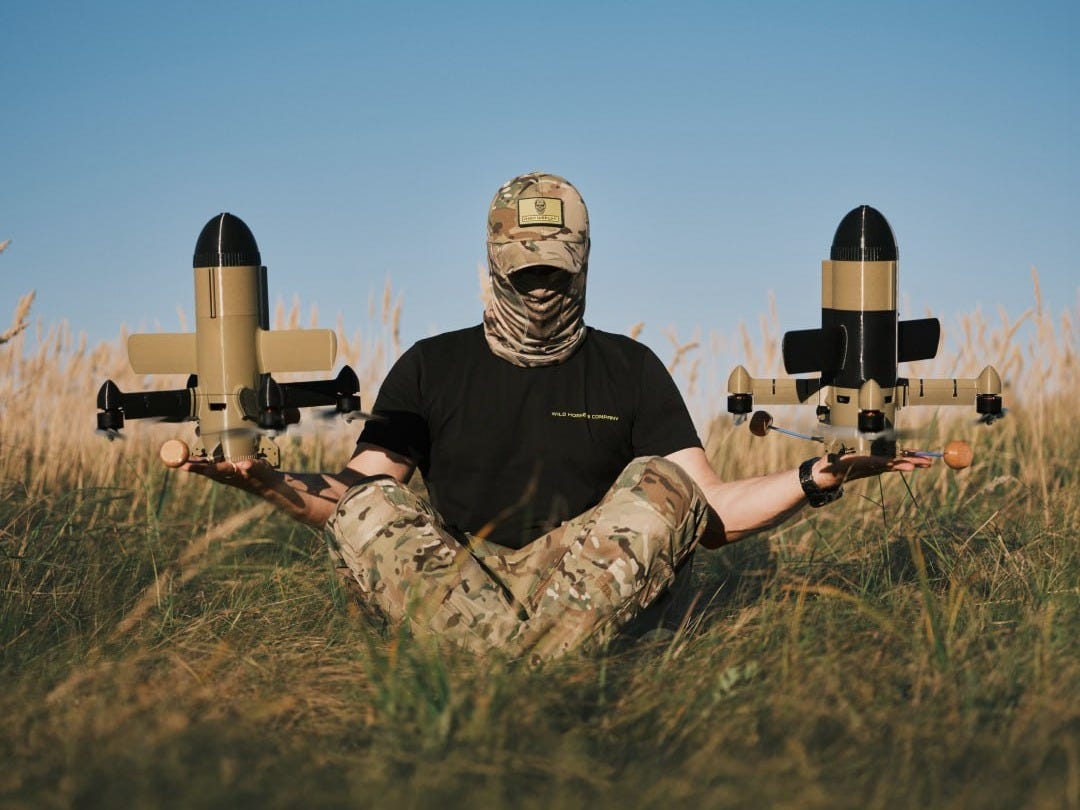
The Sting (Wild Hornets)
The Sting is the most widely discussed Ukrainian interceptor and the one most likely to anchor any Gulf export package.
The Sting uses thermal imaging to track Shaheds at altitudes up to 10,000 feet and reaches nearly 195 mph; fast enough to catch a Shahed cruising at 115 mph with significant closing speed to spare.
It is a bullet-shaped quadcopter design, flown by FPV operators who chase incoming Shaheds and physically ram them out of the sky before they reach their targets.
The Strila (WIY Drones)

The Strila is a high-speed interceptor UAV designed specifically to counter Shahed-136-type drones. It reaches speeds over 350 km/h, with testing hitting 400 km/h. It operates up to 14 km in tactical mode and 28 km at maximum range, reaching altitudes up to 4,000 meters.
What makes the Strila particularly interesting for Gulf export is its radar integration. The interceptor is integrated with RADA radar systems, which automatically guides the drone into the interception sector, and final targeting is carried out by the operator.
The system automates the hard part: finding and tracking the incoming Shahed. Then it hands final engagement authority to a human.
The January 2026 price was reduced from $3,317 to $2,292 through production scaling, with roughly 70% of components now Ukrainian-made. The company is currently manufacturing about 100 interceptors per day. The new upgraded version also features a SineLink communication system that enables it to operate without GPS and increases resistance to electronic warfare jamming.
The Octopus-100 (UK-Ukraine Joint Production)
The Octopus-100 sits in Ukraine’s newest industrialized tier of drone interceptors, reflecting a joint UK-Ukraine production effort under the Build with Ukraine initiative designed to move counter-UAS from workshop-scale builds to repeatable output. Optimized to defeat low-altitude strike drones, it uses a bullet-shaped quadcopter airframe with oversized stabilizers to sustain stable, high-speed flight even under heavy electronic warfare.
The joint UK-Ukraine production angle is relevant for Gulf states because it means the supply chain is not entirely dependent on a country actively at war.
British manufacturing capacity plus Ukrainian design experience is a more exportable package than either could offer alone.
I made a video about that puppy a while back you can watch here:
The Bullet (General Cherry)
General Cherry’s [best company name ever] Bullet comes in three variants: daytime, nighttime, and a guidance-enhanced version. These reach speeds up to 309 km/h and carry a 300-gram fragmentation charge.
What distinguishes General Cherry is their work on computer vision-enabled autonomous targeting, where the drone identifies and tracks a Shahed using onboard cameras and AI rather than requiring continuous FPV operator input.
That autonomy is the direction the entire Ukrainian interceptor industry is heading, and it matters for Gulf deployment because it reduces the specialized operator burden on countries that have not spent four years training FPV drone pilots.
Also, people get a little antsy when you start talking about “autonomous targeting” and letting the AI make the kill decision (based on its training of thousands of images and video of what a Shahed looks like). Mainly because that is a slippery slope into human targeting.
Human autonomous targeting is its own can of legal and ethical worms, but if anyone is going to give AI the ability to make the “kill decision” then I wouldn’t fault Ukraine; ya know, the democracy currently fighting for its very existence.
If you’re new here and want a primer about AI in warfare, I wrote a nifty thing you can find here.
But the interceptor drones are not the whole package. Ukraine’s deployable counter-Shahed offering includes acoustic arrays, electro-optical cues, and mobile radars that feed intercept vectors to multiple drone teams, scaling defense density without scaling missile expenditure.
In practical terms, what Ukraine is offering Gulf states more than a crate of cool-ass drones. It’s an integrated kill chain: find, fix, track, target, engage, and assess, built from four years of iterating against a live threat. The drones are the terminal end of a system that starts with detection infrastructure and ends with a $2,500 airframe flying into a $30,000 bomb before it reaches a fuel depot or a port.
The operational problem the Gulf faces is an economic and tactical trap: Shahed-type drones are cheap enough to fire in volume, slow enough to be awkward targets for premium missiles, and numerous enough to force defenders into unfavorable cost-per-kill exchanges.
The Trump administration briefed Congressional leaders three days ago that Patriot radars have difficulty picking up slow, low Shaheds because they tend to blend in with ground clutter.
Ukraine built the answer to that trap. The question is how fast it can be installed somewhere else.
The Question Everyone Is Asking: Can Ukraine Afford to Share?
This is the legitimate concern.
Ukraine produced 100,000 interceptor drones in 2025, with production capacity growing eightfold compared to the prior period. Frontline units received an average of over 1,500 interceptor drones per day in December 2025 and January 2026.
That production rate is staggering. And it tells us that Ukraine deliberately scaled beyond its immediate battlefield needs in anticipation of export demand.
Kyiv is also hoping that wider international adoption of its interceptors will free up foreign Patriot missiles for its own air defense needs.
This is the strategic logic Zelensky has been explicit about. Ukraine does not need Patriot missiles to shoot down Shaheds anymore. Ukraine needs Patriot missiles for the fast Russian garbage Putin lobs over the border.
If Gulf states stop burning their Patriot stocks on Shaheds because they have Ukrainian interceptors doing that job, those Gulf state Patriot systems become available for redeployment or restocking; and Ukraine is very interested in where that redeployment conversation goes.
There’s also an integration timeline that provides a natural buffer. Discussions are focused on details such as quantities and infrastructure, as Ukraine’s interceptors require certain integration with radar systems, which could take time to set up.
A Gulf state cannot simply unbox a crate of Strila drones and start shooting down Shaheds on Sunday. The detection infrastructure, the operator training, the radar integration, the flight corridor deconfliction over civilian airspace… all of that takes weeks to months to establish.
Ukraine has time to scale production to meet export demand without stripping its own front line.
So, the nation that I once called “Europe’s Shield” is soon to become the Gulf’s shield as well.
Ukraine spent four years absorbing the same weapon now threatening American service members and Gulf state infrastructure.
It built, tested, iterated, and scaled a countermeasure ecosystem that the most powerful military alliance in human history is now calling to purchase.
You can’t missile-defense your way out of mass drone warfare. The Gulf states are learning that lesson in real time. Ukraine learned it under fire, in the dark, during winter, while a continent watched and wondered whether it would survive.
It survived. It built the answer. And now it is offering that answer to the people who need it most, at a price point that makes the economics of this war look very different for Iran than they did six days ago.
Think about it like this: Before the Ukraine War, all the big powers were talking about putting billions into face-meltingly fast hypersonics. The irony here is that a painfully slow Iranian mario cart drone with a lawnmower engine is just as hard to defend against when deployed at scale.
As for Ukraine and its interceptor drones… well, the student is now the principal.
The lesson is $2,500 per unit, and enrollment is open.
Слава Україні!


Fantastic article Wes! I will link it in my weekend piece, "Ukraine Made Cards"
You my friend are outstanding! And an excellent affordable research source. I write strategic analysis based on my Military Intelligence background and my West Point history professor studies. In fact that’s my handle on Substack: The West Point History Professor. Take a look, you might get interesting background for your posts. They are terrific as is, and you grab strategic implications as well. But as you will see I cruise at 30k ft. You are in the trenches with bad ass armor and AI drones. Good Hunting and 🦅 Talons Up!