


When I was in infantry basic training, one of our marching cadence songs said something along the lines of “Oh, hail, oh, hail, oh, infantry…. Queen of battle, follow me….”
(for the longest time, I thought it was “hello, hello, infantry” — smh)
And I always thought it was weird how all these hyper-masculine 19-year-olds in the infantry would call ourselves “queen of battle” while artillery was known as the “king of battle.”
Hey, I’m an ally. You do you. If you’re queens, get on with your bad self. I’ll march with you.
A more mature version of Wes would later learn that it has nothing to do with gender. It’s a chess analogy and represents more of a partnership than a hierarchy. The king is powerful symbolically and central to the fight, while the queen is the most flexible piece on the board.
Infantry can attack, defend, patrol, clear buildings, hold trenches, seize objectives, and operate in terrain, while heavier systems can control the tempo of battle.
Still, it seems like it’s been a while since we’ve talked about “the king of battle” in Ukraine; I know I’ve personally focused on deep strike and air defense heavily over the past six months, both here and on YouTube.
But the Ukrainian guns are still firing…
These kings just have to play chess and do it strategically.
The artillery war continues
Lt. Col. Vitalii Korniienko, commander of Ukraine’s 7th Artillery Brigade, described the change in September to The War Zone. The old practice of massing guns together to create an “artillery wall” has pretty much disappeared in his brigade. A modern fire mission may involve fewer than ten rounds because sitting in one place long enough to fire dozens or hundreds invites the wrong kind of attention.
Researchers from RUSI have seen the same thing. Ukrainian artillery increasingly operates as individual guns rather than traditional batteries. Crews bury positions into tree lines, stretch camouflage and mesh around them, move ammunition away from the weapon itself, and spend a good chunk of time staring upward before firing.
Some resupply is even being pushed forward by unmanned ground vehicles so trucks and soldiers don’t have to make repeated trips into positions that Russian drones may already be watching.
That’s a different artillery war from the one I was writing about in 2022 and 2023.
The artillery duel didn’t disappear.
The drone war grew around it like crabgrass.
We saw that during Ukraine’s Operation Vivaldi around Lyman. The robots and drones got most of the attention, naturally, because “air-dropped robot assaults Russian position” makes a more clickable headline than “artillery continues doing artillery shit.”
By the way, here’s a video I hosted at The Sun about Operation Vivaldi:
But in Vivaldi, Ukrainian forces still assembled substantial gun support to suppress Russian movement and help infantry consolidate terrain.
Make no mistake: The guns still matter. They just have less time to do their work before something with a camera notices them.
And that’s why a story at Militarnyi about a fairly boring memorandum signed in Kyiv on October 4 caught my attention.
Ukraine’s Ministry of Defense signed three agreements with Germany’s Diehl Defense covering IRIS-T air-defense systems, missiles for those systems, and something described by the Ukrainian president’s office as “precision-guided artillery ammunition.”
That last phrase may refer to Vulcano.
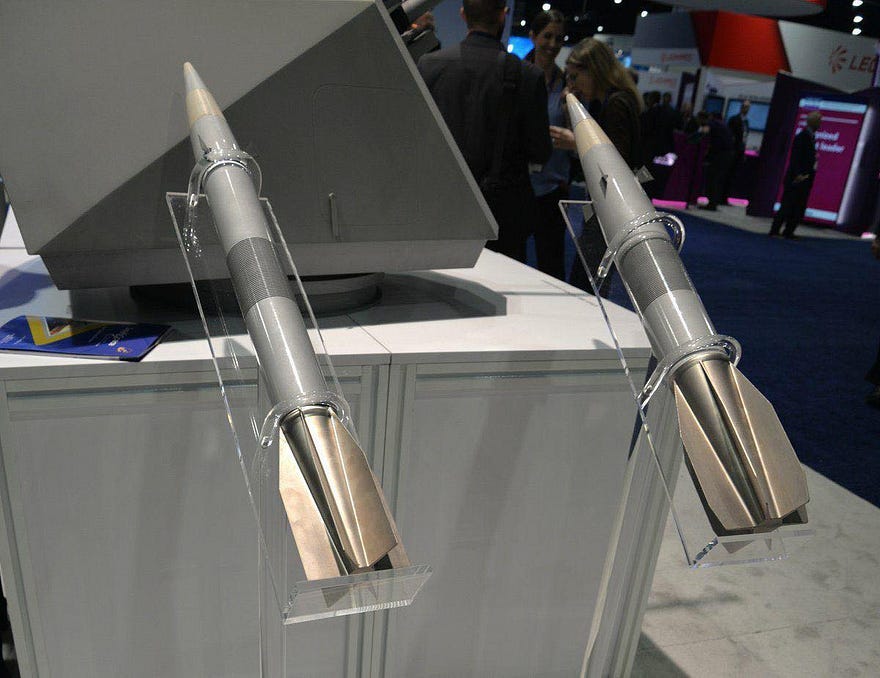
German Aid to Ukraine believes the agreement could cover additional 155mm Vulcano ammunition, a family of long-range shells developed by Germany’s Diehl Defense and Italy’s Leonardo.
And actually, Ukraine already has experience with it.
Germany sent 255 Vulcano rounds to Ukraine in 2022, with the first ammunition arriving in March 2023. Ukrainian footage later showed a PzH 2000 crew from the 43rd Artillery Brigade firing the unguided Vulcano 155 BER.
What I’m not sure about is how many of those original 255 rounds are still sitting in Ukrainian ammunition storage, assuming any are left at all.
The 155mm shell that isn’t really 155mm
A normal 155mm artillery projectile is, ahem, about 155 millimeters across.
The projectile itself is sub-caliber, meaning the actual body flying toward the target is narrower than the bore of the gun that fired it. It sits inside a sabot that lets the smaller projectile travel through a standard 155mm barrel. Once it leaves the muzzle, the sabot separates and the skinny projectile continues downrange.
Why go through all that trouble?
Drag.
A narrower projectile presents less frontal area to the air, which means less aerodynamic resistance trying to slow it down. Vulcano combines that with high muzzle velocity and a shape designed to retain energy efficiently as it travels.
There is no rocket motor tucked into the back that suddenly ignites halfway through the flight. Someone essentially looked at a conventional artillery shell and decided it needed to lose weight and become more aerodynamic.
The payoff is range.
Fire the unguided Vulcano BER, or Ballistic Extended Range version, from a 155mm gun with a 52-caliber barrel such as the German PzH 2000 or RCH 155, and the published maximum range is around 50 kilometers.
The guided GLR, or Guided Long Range version, stretches that to roughly 70 kilometers.
Seventy kilometers is a long way to throw something out of a basic tube cannon.
Also, barrel length matters here, no matter what your friends at the bar have told you.
Ukraine also operates shorter 39-caliber 155mm guns like the American M777. Vulcano works from those weapons too, although the lower muzzle velocity cuts the range. From a 39-caliber gun, the BER reaches about 36 kilometers and the guided GLR about 55.
So, this creates an interesting split inside Ukraine’s artillery park.
Load Vulcano into an M777 and you have given a relatively short-barreled howitzer considerably more reach.
Load the guided version into a PzH 2000 or RCH 155 and now you are reaching distances where some targets might otherwise have received a rocket or missile.
Ukraine doesn’t need to send an ATACMS after everything sitting 60 kilometers behind the front.
There are artillery pieces, command posts, electronic-warfare systems, air-defense components, ammunition points, logistics sites, and other relatively small targets where a precisely placed 155mm projectile may be enough.
The guided Vulcano GLR was built for that sort of work.
Using coordinate guidance, its published circular error probable (CEP) is no more than five meters. Add the optional semi-active laser seeker and that figure drops to roughly three meters, while also creating the possibility of attacking moving targets as long as somebody can keep a laser designator on them.
That changes the old economics of the fire mission.
With conventional artillery, missing by enough may simply mean firing more ammunition until the target has received sufficient persuasion to fuck off.
A precision-guided shell gives the commander another option: spend considerably more money on one projectile in exchange for potentially firing substantially fewer projectiles overall.
Ukraine has good reasons to care about that.
Every artillery round begins its life in a factory somewhere, then has to move through European logistics networks, cross into Ukraine, reach a depot, move forward again, eventually arrive at the gun position via robot, get loaded, fired, and preferably hit something valuable.
So yes, the guided shell costs more… But the relevant question is what the entire fire mission costs.
If one precision round can achieve what might otherwise take ten, twenty, or more conventional rounds, suddenly sticker price becomes a less useful metric.
And we have to acknowledge that physics, naturally, wants its cut.
Vulcano pays for that range and guidance partly by losing explosive mass.
The 155mm projectile is about 950 millimeters long and weighs roughly 36 kilograms. The unguided version contains around 7.5 kilograms of explosive material, while the guided model carries approximately 30 percent less.
Nobody has yet managed to cram guidance electronics into an artillery shell without those electronics occupying space that could otherwise contain something more explode-y.
That makes Vulcano a poor answer to some problems: If you are trying to pulverize a large defensive position, you may still want conventional high explosive and a lot of it.
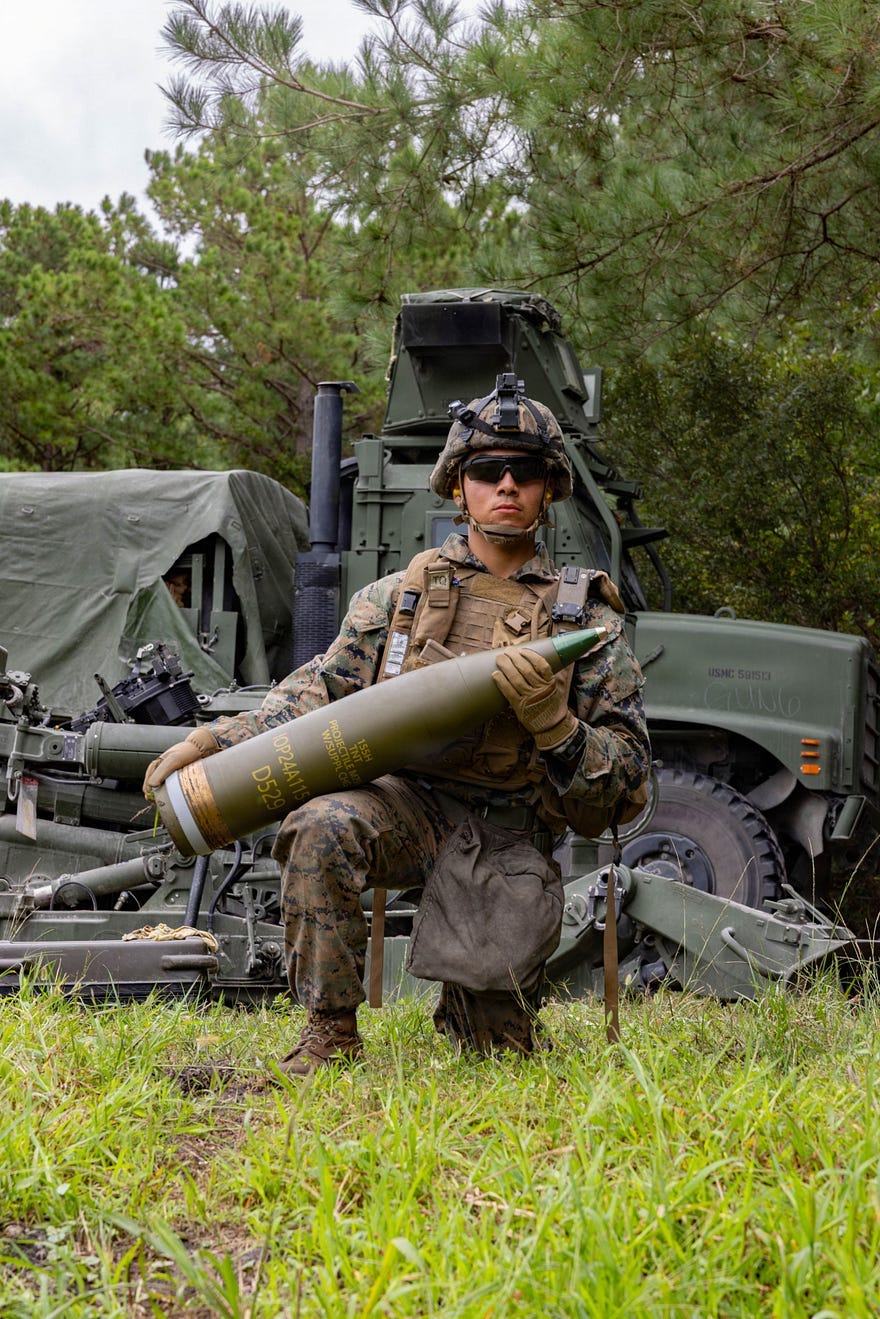
If a Russian radar vehicle is sitting 63 kilometers away and you have reliable coordinates, five-meter accuracy starts looking sexy.
That’s the trade: Smaller warhead, much better chance of putting it exactly where you wanted it.
Vulcano partly makes up for the smaller explosive charge by surrounding the warhead with pre-formed tungsten fragments. Tungsten is absurdly dense, so those little pieces leave the detonation carrying a huge amount of kinetic energy. Put the shell within a few meters of a radar truck and you turn its antennas, electronics, tires, and anybody standing nearby into Swiss cheese.
Then there’s the laser seeker
Semi-active laser guidance requires reflected laser energy from the target during the terminal phase of flight.
Essentially, somebody has to shine a laser on whatever you want Vulcano to hit. But in Ukraine, “somebody” increasingly means drones.
A reconnaissance platform closer to the target can identify what’s there, generate coordinates, and, with the right equipment, potentially provide terminal designation.
A 70-kilometer gun is only useful if somebody can find a target 70 kilometers away, determine exactly where it is, get those coordinates to the artillery crew, and complete that process before the target decides to bugger off.
Ukraine has spent years building the reconnaissance architecture required to do that.
Drones, electronic intelligence, satellite imagery, battlefield-management systems, special operations teams, and other sensors can feed targeting information toward weapons whose crews may never physically see what they are firing at.
That part rarely makes the cool combat footage on Telegram.
We see the PzH 2000 fire.
We don’t see the hours of reconnaissance, communications, target confirmation, and data exchange that made the shot worth taking.
Artillery has always required information.
Precision artillery requires precision information.
Okay, so what do we know about this most recent agreement?
The October 4 document is a memorandum of understanding, and the public language describes precision-guided artillery ammunition without naming the specific projectile. I also don’t know how many rounds might eventually be purchased, how many would be guided GLR ammunition versus unguided BER, what Ukraine would pay for them, or whether the first delivery could happen before the end of 2026.
The existing inventory is even murkier.
The publicly documented German supply was only 255 Vulcano rounds.
Ukraine has been fighting a very large artillery war for more than three years since those rounds arrived.
Maybe some remain.
Maybe none remain.
And even if the new agreement produces several hundred more shells, that is not enough ammunition to change the artillery war by itself.
Several hundred rounds in Ukraine is a boutique stockpile.
You save them for things worth killing.
Which, I suppose, is probably the point.
The current artillery fight increasingly rewards exactly the behavior Vulcano encourages: find something valuable, shoot fewer rounds, and leave.
The old Soviet image of artillery involved rows of guns, enormous ammunition dumps, sustained barrages, and batteries spending huge amounts of time in one place. Ukraine’s drone-saturated front has become hostile to nearly every part of that picture.
A gun that fires ten rounds from the same position may already be pushing its luck.
The longer an artillery piece remains exposed, the more chances somebody gets to add it to a kill chain.
So, the question facing an artillery commander is whether the crew can find the target, hit it with as few rounds as possible, and be somewhere else before the sky starts looking back… The so-called “shoot and scoot” capability so often publicized in German marketing brochures.
That’s why I find Vulcano more interesting in 2026 than I would have a few years ago.
The marketing specification is 70 kilometers. But I think the battlefield value is time.
A longer-ranged gun can sit farther back. A precision-guided projectile can reduce the number of shots required against the right target. Fewer shots mean less time firing. Less time firing means less time announcing your location to every Russian drone operator in Donetsk.
None of that makes the gun safe, but it does give the crew more options.
Remember, for all the attention we give Ukraine’s thousand-kilometer drone strikes and long-range missiles, there are still exhausted artillery crews sitting in tree lines much closer to the front, listening for drones overhead, and trying to get a fire mission completed before somebody finds them.
They need the “king of battle” to become harder to kill.
A skinny Italian-German shell flying 70 kilometers might help with that.
Слава Україні!
I learned so much about the interlocking swirl of optimization problems that make up a war from this one post. Like most civilians, I had never really considered any of the issues you explain about artillery beyond BOOM.
I'm truly better informed when I read your work. Thank you!
I read this morning that there is actually a monetary reason Trump wants Ukraine to surrender. Sure the is. Money is what the Trump family is all about, but just no. No to surrendering, no to letting Putin win anything, no to the old type of war, fought with tanks and artillery. The innovators are Ukrainian. Putin knows how to send people to war, other people to war, but they will never best the Ukrainian people for critical thinking. The Ukrainian people are fighting for their lives and we need to back the democratic country, not enemies. Russia will always be the enemy.