


Hey friends, anytime I can turn a bit of Ukraine news into a radar story, you know I’m all over it.
In Ukraine, an interceptor drone launches, climbs, and gets vectored toward the predicted intercept point with beautiful precision.
Then the pilot looks through the camera and sees a wall of gray.
The Shahed might be two hundred meters away. Ground radar knows it’s there. The interceptor is close enough to reach out and smack it upside the head.
But the pilot can’t see a damn thing.
Serhii “Flash” Beskrestnov, who now advises President Zelenskyy, described this exact sequence when he wrote late last month that fog and cloud can cut visibility down to a few dozen meters, and that interceptor success rates fall off a cliff once winter or weather sets in.
So, Ukraine built one of the most effective air defense innovations of this war, a fleet of $2,000 drones that hunt $40,000 Shaheds, and the thing that’s currently beating it is just bad weather.
One way around this is to put a small radar seeker in the nose of the interceptor drone, but miniaturizing radar is a kind of a hard engineering problem.
One California company thinks they have it solved… and, are already working with Ukraine.
How the “thrift-shop-kill chain” works (and I say that as a term of endearment)
A Shahed is small, made mostly of composite fiberglass and foam. It flies low and moves somewhere around 180 km/h for the propeller-driven versions. That’s close to the worst possible target for a traditional military radar, which is generally built and tuned to find fast, high-flying jets and missiles with a big metal radar cross-section.
Add to that the fact that Russia’s opening missile strikes in 2022 wiped out a meaningful chunk of Ukraine’s Soviet-era radar coverage, and Ukraine found itself needing a ground-based detection network almost from scratch, against a target type conventional radar was never optimized to see.
Ukraine’s answer was to stop relying on radar alone.
The country built out two parallel acoustic sensor networks, Sky Fortress and Zvook, that now total somewhere north of 24,000 individual listening posts for a combined cost under $5 million.
Each unit is a cheap microphone rig, sometimes not much more than a parabolic concentrator and a repurposed phone processor mounted on a radio tower ten or twelve meters up, tuned to recognize the distinctive moped-engine drone of a Shahed’s two-stroke motor.
A Shahed can dodge radar by flying low, but can’t fly without making noise, and it turns out a $500 microphone array is exceptional at hearing a go cart crossing the sky at three in the morning.
These systems typically pick up a Shahed around 5 kilometers out and a cruise missile even farther, and Zvook in particular runs silent because it doesn’t emit anything for Russian electronic warfare to detect and target back.
Radar still carries a lot of the load, especially against faster or higher targets, and it’s a mixed fleet.
Germany’s Hensoldt has been shipping Ukraine the TRML-4D since the fall of 2022, an X-band AESA radar (that’s active electronically scanned array, essentially a radar face built from thousands of tiny transmit-and-receive elements instead of one big spinning dish, letting it track many targets at once instead of sweeping past them one at a time). This system is capable of holding roughly 1,500 tracks simultaneously out to 250 kilometers.
It’s also the radar that normally cues Ukraine’s German-supplied IRIS-T batteries.
Sweden has sent over its Giraffe family, older G/H-band systems, think 4 to 8 GHz, that were originally designed for exactly this kind of gap-filling short-to-medium-range air defense role and can pick out small, slow, low-flying drones out to about 100 kilometers.
Purpose-built counter-drone radars like Robin Radars round out the mix at the shorter end, compact enough to set up in minutes, with a recent software upgrade pushing detection range on a 180 km/h target out to 12 kilometers.
None of these systems work alone.
The acoustic network hears a Shahed enter Ukrainian airspace near the border and starts a track. Radar picks it up and refines that track with speed, altitude, and heading. Both feed the same national air-defense picture.
That fused picture is what cues the nearest interceptor crew and gets a Sting or an Octopus into the air, headed toward a specific patch of sky with genuine confidence that something worth killing is actually in it.
Only then does the human pilot start doing the hard part, hunting visually through an FPV camera feed until the target appears, closing the gap, and finishing it.
Flash calls that original approach primitive, cheap, and effective, and the results back him up.
Wild Hornets’ Sting interceptor alone has claimed several thousand Shahed and Gerbera kills since its first confirmed hit went viral in the spring of 2025, at a unit cost hovering around $2,000.
Ukraine’s defense ministry reported more than 33,000 enemy drones destroyed by interceptors in March of this year alone, double the month before.
Newer Shahed and Geran variants carry onboard electronic warfare, fly evasive profiles, and in some cases mount rear-facing cameras so the drone can watch its own tail for an approaching interceptor.
Flash recently posted footage of an EW module pulled from a downed Shahed that detects the video signal an interceptor pilot’s camera transmits, then jams that exact frequency at higher power, blinding the pilot right at the moment he needs his eyes the most.
Ukraine’s answer has largely been AI and machine vision.
A Brave1-backed system tested in combat around Kharkiv this June automated roughly 95 percent of the engagement, letting a human operator select a target and authorize the attack while software handles acquisition, tracking, and the final approach. Other manufacturers are chasing similar terminal guidance.
But machine vision is still vision. A computer can spot a Shahed faster than a tired human ever could. It still can’t see one if the actual photons never make it through several hundred meters of cloud and hit the camera’s sensor in the first place.
That’s the hole a seeker radar is built to plug.
What a radar seeker does
Think about how a real guided missile finds its target... It’s not staring through a camera.
It carries a small transmitter that sends out radio energy, catches whatever bounces back, and lets an onboard computer calculate where the target sits relative to the missile itself.
None of that depends on visible light; clouds, smoke, darkness, and fog barely register.
The trick was always that a full radar seeker belonged to a different budget bracket entirely, the kind of six-figure subsystem that takes a couple hundred engineers at a major defense contractor years to build.
Like Lockheed and their Scrooge McDuck-sized money vault.
Now, a tiny San Francisco startup called Vernius Systems just unveiled something that tries to shrink that math down to size.
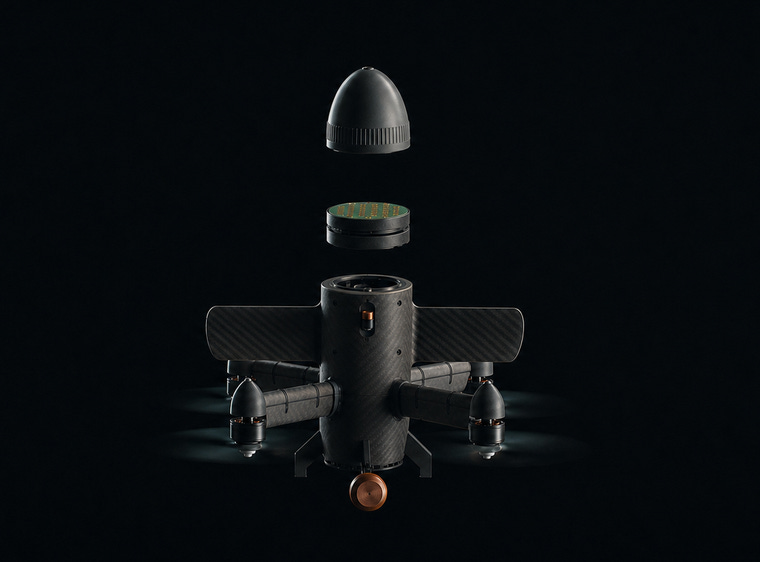
Its Archimedes 1A is an 80-millimeter active radar seeker, operating at 24 GHz, weighing little enough to bolt onto an existing interceptor airframe, and priced around $4,000.
The company has already demonstrated it mounted on Wild Hornets’ Sting.
Flash himself flagged the announcement, and to his credit he didn’t oversell it.
He called miniature radar seekers an extremely difficult engineering problem and said battlefield performance is still an open question. Let’s borrow some of that caution, because Vernius is a very young company making a lot of claims about its own hardware (it also says it landed $500 million in letters of intent and sold an initial batch of 45 units to a Ukrainian special-forces unit within eight weeks of starting).
And here’s the kicker: A radar seeker is normally the single most expensive part of any guided interceptor.
Compress that cost from six figures down to $4,000 and you can strap a serious sensor onto an airframe that itself costs about half as much as the sensor sitting on top of it.
Against a Shahed running tens of thousands of dollars, and against the alternative of burning a more expensive interceptor, like Aster 30 or AMRAAM, on a target Russia can mass-produce, that math still works heavily in Ukraine’s favor.
It’s not one radar doing everything
Vernius describes a layered approach.
The larger ground radar network still does the long-range detection and hands the interceptor a rough cue. Archimedes picks up from there, using its radar to search the small assigned slice of sky, find the target at around a kilometer out, and guide the interceptor closer.
There’s also a simpler mode worth mentioning here: Rather than flying the intercept itself, Archimedes can just feed range and bearing back to a human pilot, essentially handing him an instrument reading that tells him where the target is before his own eyes or camera ever could.
In this use case, the human pilot would be essentially flying by instrument only, the way a commercial airline pilot might fly in bad weather when she can’t see anything outside of the cockpit window.
Just trust the radar seeker to guide you to the target and fly by instrument only. In commercial aviation, this is the IFR equivalent. VFR (Visual Flight Rules) means flying by looking outside at the ground and horizon, while IFR (Instrument Flight Rules) means flying using only the cockpit instruments with help from air traffic control.
Flash has sketched out where this eventually goes: the network detects a Shahed, assigns the nearest interceptor, launches it, steers it with ground radar, and hands off to the onboard radar seeker for the kill.
And that, friendos, describes, you guessed it… a surface-to-air missile; just an incredibly cheap one. Detection, a targeting network, an effector that launches on cue, midcourse guidance, a terminal seeker, and an intercept. Bob’s your uncle.
Ukraine is building it for the price of a high-end bicycle instead of the price of a Dallas builder-grade McMansion.
