


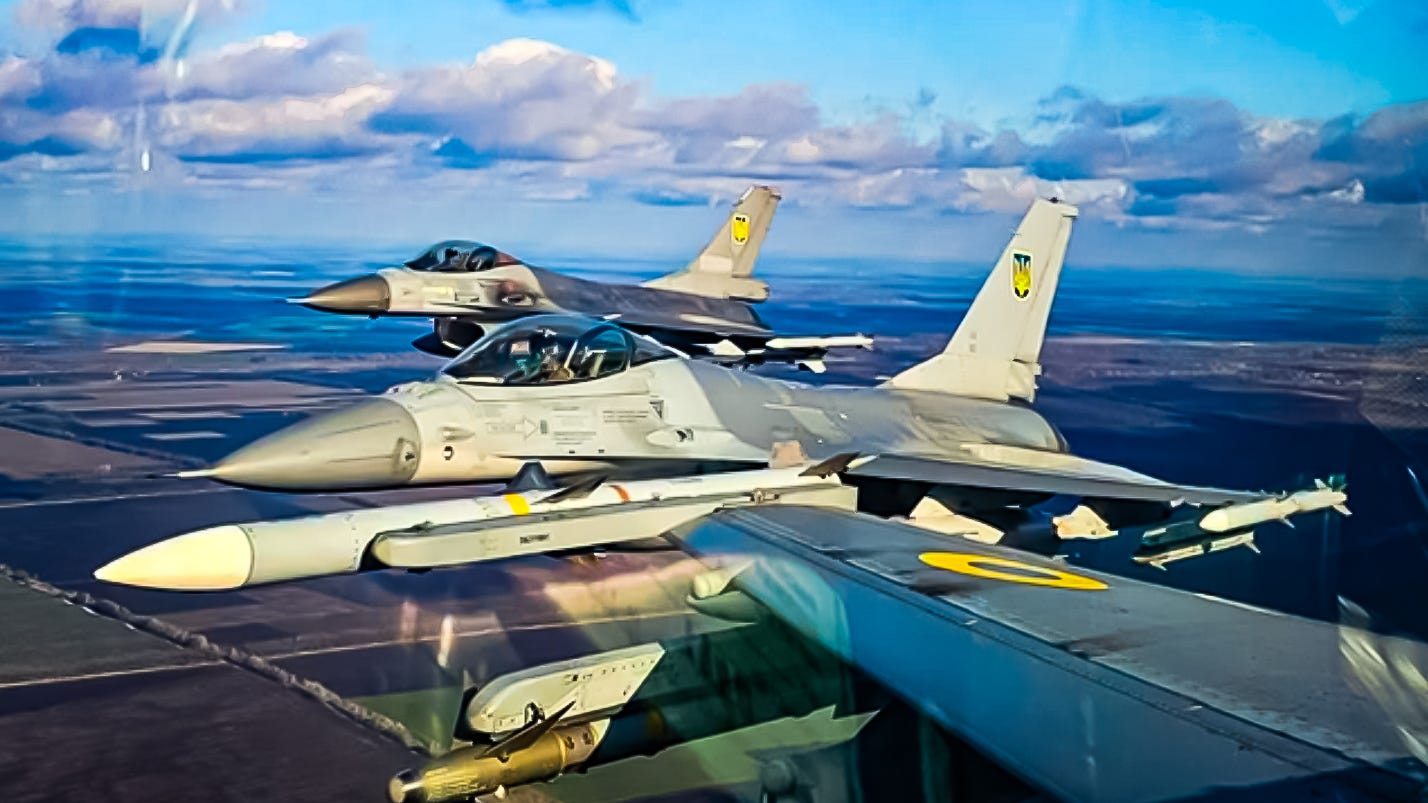
This article is one of three weekly exclusive articles for my paid subscribers. Thank you for continuing to fund independent military analysis with a heavy dose of pro-Ukrainian sentiment and a side of anti-authoritarian humor.
The most important thing happening inside Ukraine’s F-16 training program in the UK doesn’t really concern the machine.
I know. That sounds wrong.
The F-16 Fighting Falcon is fast, lethal, battle-tested, and carries so much NATO symbolism it makes Kremlin staffers want to watch Rocky IV.

But for now, the Viper still the shiniest object in the room; at least until Gripen shows up in Ukraine and starts hunting Russian weekend plans. But two recent reports from Business Insider point to something quieter and more consequential happening inside that training pipeline:
Ukrainian pilots are learning to fly a Western fighter. But they’re also learning to think like Western fighter pilots.
Those are very different things. And right now, I don’t think that difference is getting enough press.
Two skills are getting the most attention from British instructors. First, flying in a GPS-denied environment, because Russia’s electronic warfare systems have turned the electromagnetic spectrum over Ukraine into something resembling Soviet-era plumbing: theoretically functional, actively hostile, and prone to failing at the worst possible moment; (usually after taco night).
Second: pilot autonomy. How to make decisions in the air without waiting for a controller, a commander, or a ground-based authority to walk the pilot through every move; the way the Russians currently fly sorties.
Together, those two things describe a pilot who can keep fighting when the battlefield strips away every comfort that NATO aviation built over the last four decades.
Why GPS-denied flying isn’t fun
The Business Insider reporting notes that Ukrainian trainees in the UK are being taught low-altitude flying without relying on satellite navigation, because Russian jamming has made GPS unreliable in combat.
One Ukrainian trainee described learning to use rivers, mountains, and terrain features during training sorties, calling it “really important.”
That sounds basic until you actually picture it.
You’re at low altitude. Enemy air defenses are hunting you. Your radio may be cluttered or jammed. Your cockpit is throwing tons of information at you. And instead of following a blue line on a screen, you’re identifying a river bend you memorized from a paper map two hours ago and counting seconds until the next checkpoint.
The FAA defines pilotage as navigation by reference to visible landmarks, and dead reckoning as navigation by calculation using course, time, speed, distance, and wind correction.
Western pilots, including USAF pilots, are still taught both pilotage and dead reckoning as a backup.
GPS failure in combat means you’ve potentially lost positional awareness, a weapon misses its target, a formation separates, or your aircraft wanders into an air defense envelope that punishes minor attention lapses.
So the pilot’s pre-flight is more than checking weather and fuel.
It’s studying legs, headings, expected times, terrain features, waypoints, threats, emergency options.
Rivers.
Coastlines.
Ridgelines.
Railways.
Towns.
The pilot builds a mental map and then flies against it, comparing what should be outside the canopy to what actually is, while managing airspeed, altitude, heading, fuel, formation position, and the threat picture simultaneously.
At low altitude, that workload moves at 5x speed. The ground comes up quick. Waypoints arrive before you’re ready for them. A few degrees off heading compounded over several minutes can put you miles from where you think you are.
This is brain surgeon levels of cognitive discipline dressed up as navigation. It’s forcing the pilot to continuously rebuild a mental picture of the fight.
Of course, an F-16 has other tools besides GPS.
The first fallback is the Inertial Navigation System, or INS.
Unlike GPS, which depends on signals from satellites 20,000 kilometers above Earth, INS is entirely self-contained. It uses accelerometers and gyroscopes to track motion from a known starting position, which means Russia can’t jam it, because there’s nothing to jam.
It doesn’t listen to the outside world. It watches itself. That’s the good news.
The bad news is that INS drifts. The physics of the system introduce small errors that compound over time, typically on the order of one to two nautical miles per hour of flight.
