Ukraine's Franken-BMP: Soviet Hull, Spanish Automated Turret, Modern War
Ukraine took a Soviet-era BMP, bolted on a Spanish remote turret with modern optics and a stabilized 30mm cannon, and essentially told the vehicle: congratulations, comrade, you're NATO-ish now.
Olé!
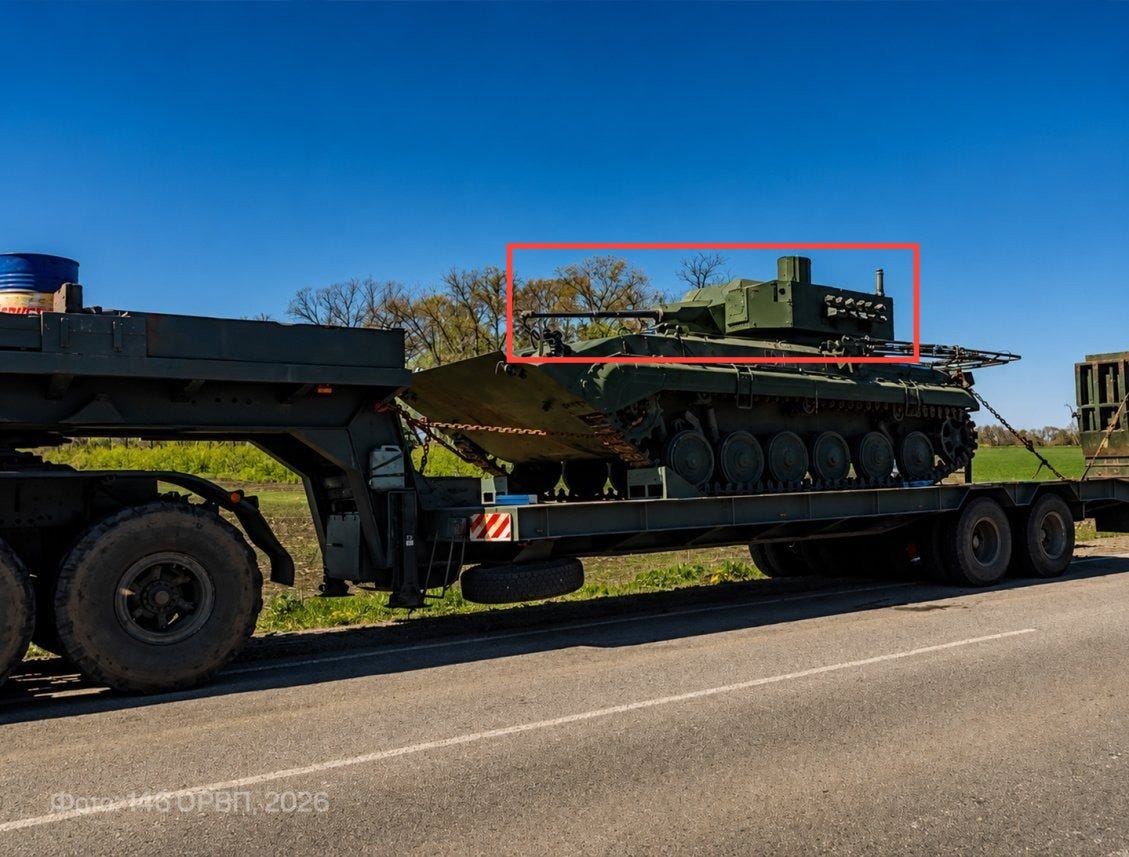
In early June, Ukraine’s 146th Separate Repair and Recovery Regiment posted photographs of a Soviet-era BMP infantry fighting vehicle wearing a turret it absolutely did not roll out of a Soviet factory with.
In place of the original conical Soviet turret sat what defense analysts quickly identified as a Guardian 30, a modern remote-controlled weapon station built by the Spanish firm Escribano Mechanical & Engineering, mercifully shortened to EM&E.
Ukrainian authorities haven’t officially confirmed the turret’s identity, and the vehicle appears to have been photographed during transport rather than mid-firefight, so let me put the appropriate caveats on the table up front.
But the sensor layout, the armored housing, and the overall design all match the Guardian 30, and we already knew these turrets were arriving. Ukrainian officials confirmed back in May 2025 that Guardian 30 stations were being delivered for integration onto Soviet armor.
This photo is the first proof one actually got bolted on.
This is a story of Ukraine doing the thing it has become genuinely world-class at: building a hybrid battlefield machine out of whatever survives, whatever arrives, and whatever European industry can weld onto an old Soviet box.
Let’s call it the Franken-BMP.
Eh, that doesn’t really roll off the tongue. How about El Guardián Rojo? The Red Guardian?
Don BMPote? After Don Quixote?
El Camarada Ibérico… The Iberian Comrade?
Wait, I got it. El Sovietico Picante; the Spicy Soviet!
Ukraine has a lot of BMPs, the Soviet-designed tracked infantry fighting vehicle that has been hauling troops into trouble since the 1960s, and Ukraine inherited a large fleet of them along with everything else the Soviet Union left lying around when it collapsed.
The problem is that most of these vehicles were built for a battlefield that no longer exists. The BMP-1 carries a 73mm low-pressure gun and an antique missile system that modern armies regard the way you’d regard a flip phone at a hackathon.
The BMP-2 is better, with a 30mm cannon that’s still somewhat useful, but it’s paired with dated optics and a manned turret layout that requires a crewman to sit up in the part of the vehicle most likely to be turned into an instant easy bake oven.
And yet Ukraine can’t afford to retire these vehicles, because a tracked armored box that can move infantry under fire is always useful, even an old one. Troops need to get to positions. Wounded need to get out. Assaults need support. Defensive lines need reinforcement. The war eats armored vehicles at a brutal rate, between mines, FPV drones, artillery, anti-tank missiles, and Lancets.
Ukraine needs volume, and volume means keeping the old stuff in the fight.
So the question becomes: how do you make a 1960s design relevant in 2026 without waiting years for Western factories to build you a fleet of brand-new IFVs?
You give it new eyes and sharper teeth.
What the Guardian 30 Actually Changes
The Guardian 30 is a remote weapon station, which is the part that matters most, so let me explain why before I get to the gun.
“Remote” means the gunner operates the turret from inside the protected hull rather than sticking his head and shoulders up into the open air. On a 1960s BMP, manning the gun historically meant exposing a crewman in a manned turret.
In the current era of ubiquitous drones, thermal sights, and shrapnel raining from above, exposing a human being above the armor line is an excellent way to generate a casualty report. Keeping the gunner buttoned up inside the hull while the turret does the shooting is a meaningful survival upgrade all by itself, before you fire a single round.
Now the gun.
The Guardian 30 can mount the 30mm Mk44 Bushmaster II autocannon, a NATO-standard weapon, plus a 7.62mm coaxial machine gun, twelve smoke grenade launchers, and even a two-tube anti-tank missile launcher depending on configuration.
That’s a serious firepower package on a relatively light chassis.
But the most important component is the brain attached to it. The Guardian 30 brings a dual electro-optical sensor system, day-night thermal capability, automatic target tracking, dual-axis stabilization, and a ballistic computer. So, the vehicle can now detect targets in the dark, track them automatically, calculate a firing solution on the move, and hit what it’s aiming at with first-shot accuracy the original BMP gunner could only dream about while squinting through Cold War optics.
Against the targets a BMP actually engages, infantry in trenches, tree lines, firing positions, light vehicles, logistics trucks, this is a genuine combat improvement.
It gives the vehicle more responsive direct-fire support than a heavy machine gun and a more sustainable option than burning anti-tank missiles on soft targets. In poor visibility, at night, or during a fast-moving assault, the sensors and the ballistic computer are the difference between suppressing a position and missing it.
The Detail That Makes This Very Ukrainian
Here’s the clever part.
The Guardian 30 can be configured with the NATO Mk44 Bushmaster, or it can mount the Soviet 30mm 2A42 cannon. And the 2A42 is a weapon Ukraine already knows intimately, because it’s the same gun fitted to the BMP-2 and other Soviet-origin vehicles in the fleet.
Ukrainian crews are trained on it. Ukrainian maintenance units know how to fix it. Ukrainian depots already stock its ammunition.
So Ukraine has a choice. Fit the Mk44 and move the vehicle toward NATO-standard armament, which is great long-term but requires standing up a separate ammunition and support chain.
Or fit the 2A42 and get a fully modern remote turret, modern sensors, and a modern fire-control system wrapped around a cannon and ammo supply the country already runs.
The second option is the logistician’s dream: Western eyes and Western fire control on a gun you never have to think twice about feeding.
For a country juggling a chaotic mixed fleet of Soviet BMPs, captured Russian vehicles, donated Western IFVs, and locally modified Franken-machines, that flexibility is worth a lot. War is rude that way. Sometimes the smartest move is to take the old Soviet box, rip out the bad parts, add Western brains, and keep the gun your supply chain already loves.
One photo of one prototype is a curiosity. The reason this might be a real story sits in a meeting that happened in May 2025.
Ukraine’s Ministry for Strategic Industries sat down with EM&E to discuss localizing the production and servicing of Guardian 30 weapon stations inside Ukraine. Ukrainian Minister for Strategic Industries Herman Smetanin talked openly about EM&E’s interest in doing business in Ukraine and taking real steps toward cooperation.
That’s the development worth watching, far more than the prototype photo. If Ukraine can locally produce, integrate, or even just service these turrets domestically, then the Guardian 30 stops being an oddity and becomes a scalable repair-and-modernization pathway.
Picture the loop: damaged BMP comes off the line, goes to a repair regiment like the 146th, gets stripped of its obsolete turret, receives a locally serviced Guardian 30, and returns to the front as a meaningfully better vehicle. Repeat across a large fleet. That’s an industrial process for regenerating mechanized combat power faster and cheaper than buying new.
For Ukraine, local production also means less dependence on external repair routes and a more resilient support structure when, not if, the vehicles take damage. For Spain and the broader European defense industry, it’s a working model of wartime cooperation built on more than just shipping equipment and waving goodbye.
It’s sustainment, integration, and possibly local manufacturing, which is the kind of partnership that actually lasts.
Just a note of caution:
A Guardian 30 BMP is not a Bradley. It’s not a CV90. It’s not a Lynx or a Marder. The turret upgrade does nothing for the hull, and the hull is the part that gets killed.
A BMP is lightly armored, and no amount of clever Spanish optics changes the fact that a mine, an FPV drone, a well-placed ATGM, artillery, or a loitering munition can still end this vehicle and everyone inside it on any given Tuesday.
Even with the new turret, this BMP is not a frontline assault breakthrough vehicle. It’s an old chassis with better eyes and a better gun.
But “better eyes and a better gun” on a fleet of vehicles you already own, regenerated quickly and cheaply, is exactly the kind of unglamorous math that wins long wars. Ukraine needs every protected vehicle, every stabilized cannon, and every locally repairable system it can put back into rotation, because the tempo of operations is decided as much by how fast you can regenerate combat power as by how good your best vehicle is.
The Guardian 30 BMP is a faster, cheaper way to keep yesterday’s armor lethal enough to matter on today’s battlefield.
Take the old Soviet box. Give it modern teeth. Send it back to work.
Congratulations, El Sovietico Picante. You’re NATO-ish now.
Glory to Ukraine, glory to the heroes, Crimea is Ukraine.


Ukraine has rolling, robotic machine guns. Could this vehicle be modified to be operated remotely?
The main reason why many troopers would rather ride outside is because BMPs are notoriously claustrophobic inside and, when they are moving, the immobile seats, the lack of suspension and the lack of daylight, makes it feel like you're tumbling around inside of a laundry dryer drum. Allegedly, many troopers in the back start vomiting violently when the vehicle is in motion.
The first time ever got in the back of a BMP, I was literally shocked. It's very difficult just getting inside the back of the BMP, and that is when it is empty! Have five or six other people in there as well? Forget about it. Riding in the back of BMP makes siitting in the back of a Bradley like riding in a luxury vehicle.