Ukraine's Navy is Heading to the Strait of Hormuz
Ukraine still has a traditional navy-in-exile that never gets any press
This article is one of three weekly exclusive articles for my paid subscribers. Thank you for continuing to fund independent military analysis with a moderate dose of pro-Ukrainian/ anti-authoritarian humor. If you’re reading this as part of your free preview, please consider upgrading for exclusive deep dives.
Ukraine’s navy, the one Russia was supposed to have crushed in the opening weeks of the war, is preparing to deploy minesweepers to the Strait of Hormuz.
Actual ships, actual crews, for a multinational operation protecting one of the most critical shipping chokepoints on the planet Earth.
On paper, the Ukrainian Navy should’ve been a footnote by now. Russia started this war with overwhelming naval superiority in the Black Sea: Bigger ships, more missiles, deeper logistics, and a legacy fleet anchored in Crimea that had been there since the Soviet era.
Kyiv didn’t try to match it.
Instead of rebuilding a traditional navy, Ukraine built a denial force made of incredibly successful USVs which I’ve covered numerous times.
But Ukraine still has a traditional navy that never gets any press. Let’s call it TRADNAV. (I know, I’m just making up words now, but as autonomy proliferates, we’ll eventually need to differentiate between “traditional X” and ‘autonomous X.”)
Ukraine is building out a future conventional fleet abroad. Its Ada-class corvette Hetman Ivan Mazepa has already undergone sea trials in Turkey, and the second corvette, Hetman Ivan Vyhovskyi, was launched in 2024 and has been reported for later delivery. So the navy still has larger warship ambitions.
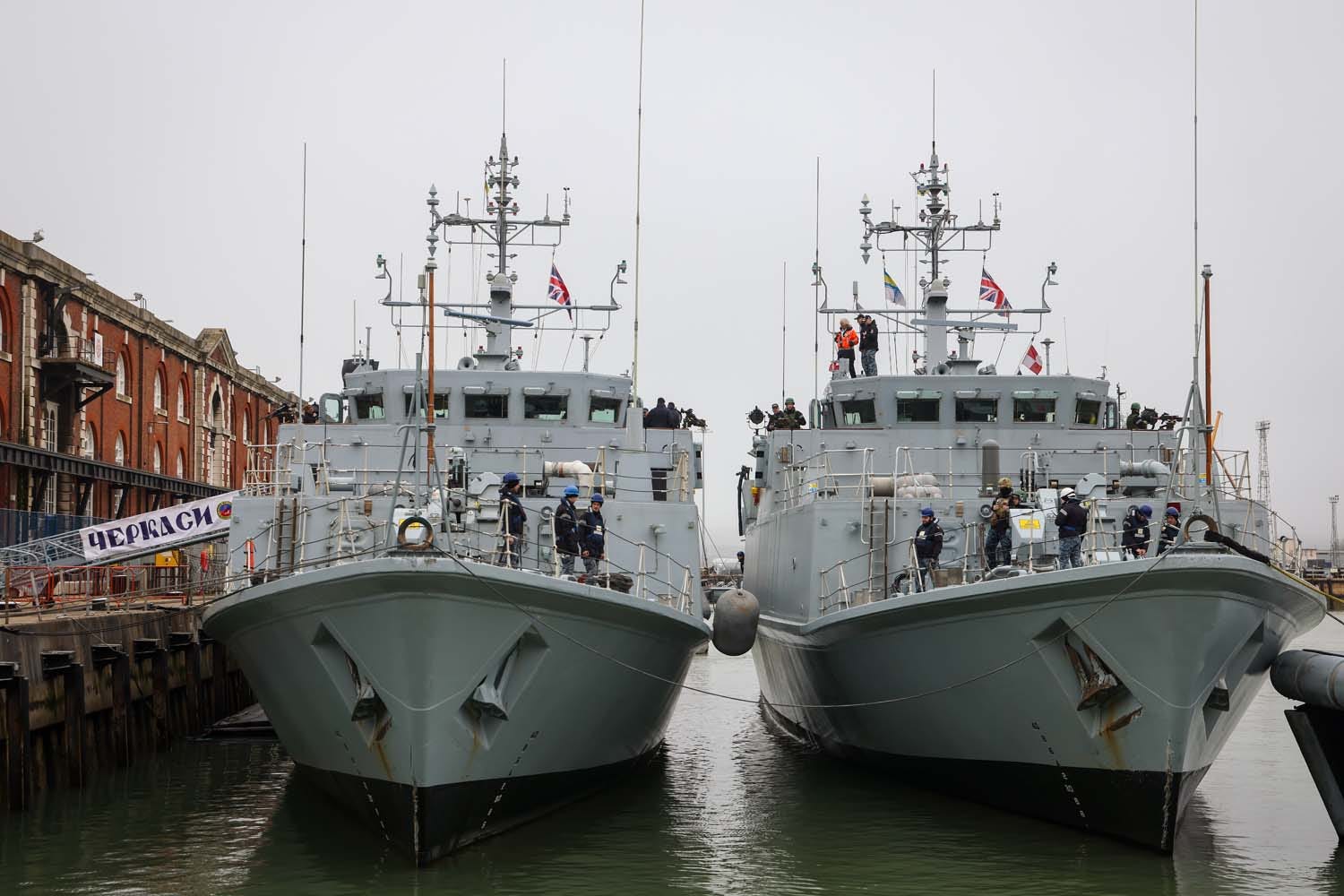
But for now, four Ukrainian minehunters are sitting in Portsmouth, Britain.
A small navy in exile…
Two former Royal Navy vessels, now commissioned as Cherkasy and Chernihiv, plus two more transferred from Belgium and the Netherlands, Mariupol and Melitopol.
All flying Ukrainian colors.
None able to get home, bottled up by the Montreux Convention’s wartime restrictions on warship transit through the Turkish straits. And they likely wouldn’t last long in the Black Sea at present.
So, Kyiv adapted. Again.
If the ships can’t reach the war, send them somewhere they’re needed. But first, let’s get into the nerdy tech details of the ships.
The Sandown class: Cherkasy and Chernihiv
The two former Royal Navy Sandown-class vessels, HMS Shoreham and HMS Grimsby before their transfer, are 52.5-meter single-role minehunters built by Vosper Thornycroft and commissioned in the early 2000s. They displace 600 tons, with a beam of 10.9 meters and a draught of just 2.3 meters; shallow enough to work effectively in coastal waters while remaining stable in open-ocean conditions.
The hull is the first thing worth understanding.
Sandown-class minehunters are built almost entirely of non-magnetic materials using a process called SCRIMP, Seeman Composites Resin Infusion Molding, in which resin is drawn into a sealed fiberglass mold under vacuum.
The result is a hull that won’t trigger magnetic influence mines, which is not a minor design consideration when your job is sailing directly over fields of weapons designed to detonate based on a ship’s magnetic signature.
Propulsion is equally deliberate.
These ships run on Paxman Valenta diesel engines driving Voith Schneider propellers and Schottel bow thrusters; a configuration built for precision maneuvering rather than speed.
Voith Schneider propellers work on a cycloidal principle: rotating blades whose pitch can be changed continuously during rotation, allowing thrust to be vectored in any horizontal direction without repositioning the propeller itself.
In practice, this lets a minehunter hover almost stationary over a sonar contact in a three-knot current and 30-knot winds. Its top speed is 13 knots, but speed is less important when your operational posture is to sit still above something dangerous and kill it carefully.
The primary sensor is the Sonar 2093 Variable Depth Sonar, capable of hunting mines in depths of up to 200 meters, across the entire continental shelf.
Variable depth means the transducer head can be lowered away from the hull on a cable and deployed at different depths to optimize acoustic performance depending on water temperature gradients, thermoclines, and bottom composition.
Sound propagation in shallow warm water, exactly what you encounter in the Gulf, is complicated, and a fixed hull sonar would struggle.
The detachable head solves that problem.
For mine disposal, the Sandowns were originally fitted with the ECA PAP 104 Mk5, a wire-guided underwater vehicle controlled via 2,000 meters of fiber-optic cable, carrying a 100-kilogram disposal charge that can be replaced with a manipulator, plus wire cutters to release moored mines from their anchoring columns.
The vehicle can be deployed to 300 meters depth and carries cameras and sonar to transmit sensor data back to the operations room. Later upgrades replaced or supplemented the PAP with the Atlas Elektronik SeaFox system, which we’ll come back to.
Crew complement is 34, with accommodation for 40. That’s a lean team for the amount of precision work these ships do.
The Alkmaar/Tripartite class: Mariupol, Melitopol, and the incoming Henichesk
The Belgian and Dutch transfers, Mariupol and Melitopol, are Tripartite-class minehunters, known as the Alkmaar class in Dutch service and the Flower class in Belgian service.
This is where the Cold War story of international defense cooperation gets genuinely interesting.
The Tripartite design emerged from an agreement signed in 1973 among the Belgian, French, and Dutch navies. France supplied the mine-hunting and electronics systems. Belgium handled the electrical systems and navigation. The Netherlands took responsibility for propulsion.
Each country built its own vessels to the shared design, resulting in around 40 hulls across three fleets; one of the few genuine examples of multi-nation shared naval construction in the Cold War era.
Principal dimensions sit at 51.5 meters overall length, 8.9-meter beam. Standard displacement around 510 tons at sea, maximum around 588 tons.
Its main propulsion uses a diesel system producing 1,370 kilowatts through a variable and reversible-pitch propeller. The auxiliary electric system runs two ACEC active rudders, each with an 88-kilowatt motor, plus bow thrusters.
Maximum speed is 15 knots under diesel, but during mine hunting operations the ship runs on its quiet electric system at no more than 7 knots; the noise floor of a diesel engine would compromise the sonar.
The dual-propulsion arrangement combined with two Schottel bow thrusters enables the ship to hover accurately over a sonar contact in a three-knot current, 30-knot wind; the same precise positioning requirement as the Sandowns, achieved through different engineering.
The hull is non-magnetic polyester and aluminum, no steel, for the same mine-triggering reasons as the Sandowns.
Original sensor fit was the French DUBM-21B sonar, capable of detecting and classifying objects at distances approaching one kilometer and at depths up to about 80 meters.
Beginning in 2003, the remaining Dutch Alkmaar-class minehunters were upgraded with improved electronics, including the Atlas Elektronik INCMS combat data system, Thales 2022 Mk III hull-mounted sonar, Atlas Seafox mine identification and disposal system, and a Double Eagle Mk III Mod 1 ROV (remotely operated vehicle).
That last piece, the Double Eagle Mk III, is worth a brief note:
It’s a reusable mine identification vehicle; basically a small underwater drone that swims to a contact, interrogates it with sonar and cameras, and returns.
It’s the “look before you shoot” phase of the process.
The Saab Bofors Double Eagle Mk III can also serve as a self-propelled variable depth sonar system, maneuvering in front of or below the vessel, tethered by cable, with its position tracked by an acoustic positioning system.
This gives the operator a mobile sonar platform separate from the hull, effectively solving the same thermocline problem the Sandown’s Type 2093 VDS addresses, through different means.
There is a fifth vessel, the incoming Henichesk, that deserves its own paragraph.
Formerly HNLMS Makkum (M857), laid down February 28, 1983 and commissioned May 13, 1985, the ship served with the Dutch Navy for nearly forty years including NATO exercises such as BALTOPS before decommissioning on November 25, 2024.