Ukraine’s Next Battle: Cleaning Up Depleted Uranium After the War Ends
And yes, Russia should pay for it

Once the shooting stops in Ukraine, another war begins.
It won’t involve trenches, glide bombs, or drone swarms. It will involve clipboards, dosimeters, hazmat suits, and a lot of very patient people walking slowly across fields looking for fragments of radioactive metal the size of a pencil.
I’m talking about depleted uranium (DU).
Not the cartoonish Hollywood version of uranium that glows green. I mean the real stuff: the dull gray, dense, industrial byproduct that NATO has used for decades to punch holes in steel and reduce enemy tanks into discreet charcoal briquettes.
And because the UK and the United States supplied DU penetrators to Ukraine starting in 2023, and because Ukrainian crews have spent the last three+ years turning Russian armored columns into scrap metal, there is a simple, unavoidable truth:
Ukraine is going to inherit a post-war cleanup problem that is bigger, more complicated, and more politically sensitive than anyone wants to admit.
For many in the public, uranium is largely a mystery; except that many automatically attribute the rock to nuclear weapons or radiation. So, in their minds, it stands to reason that its use as a weapon of war must be especially inhumane.
But DU is not some scary, new radiological weapon; it has been used for decades in both civilian and military applications, and yes, even Russia makes these tank rounds.
Natural uranium is a heavy metal.
In fact, the high atomic weight of uranium atoms makes uranium the heaviest natural element.
Depleted uranium is made as a byproduct of enriching uranium using isotope separation and is further produced by recycling spent nuclear fuel.
The resulting DU is about two-and-a-half times denser than steel.
In the civilian world, this weight had some serious advantages: It has been used as radiation shielding, trim weights in aircraft, and even as a sailboat keel; the idea there is that because depleted uranium is so dense, the keel could be thinner for a given weight, which meant less resistance.
In the 1970s, the Pentagon reported (internally at the time) that the Soviet Union had developed tank armor that NATO ammunition could not penetrate. This led panicked US researchers on a quest to develop the ultimate armor-piercing projectile.
After testing various metals, including lead and tungsten, the Pentagon settled on DU.
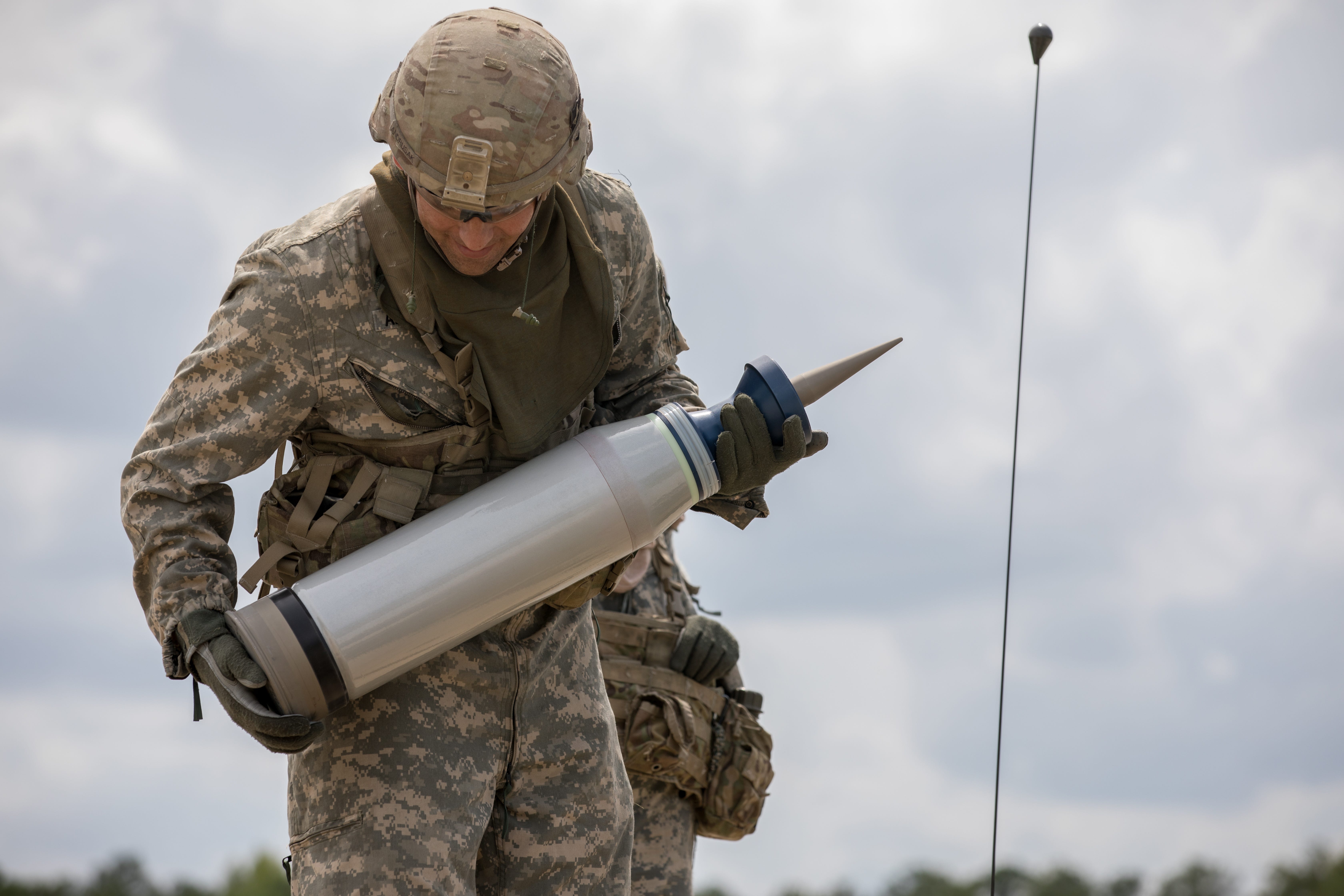
Today, one of the most common uses of DU in war is its incorporation in kinetic energy penetrators. These rounds consist of a long, relatively thin DU penetrator surrounded by a discarding sabot.

The “sabot” helps fill the bore of the gun and allows the DU penetrator round to make its way out of the large 120mm gun tube. After it’s fired, the aluminum sabot splits into three or four “petals” and is discarded.
Just to clarify, the US military initially conceived of this penetrator to… well, penetrate armor. It’s just a really heavy rod of metal… no explosives to speak of.
But some very interesting physics happens when a DU projectile hits a Russian tank at extreme speeds, typically at about 3,500 MPH.
Once it impacts a target, it penetrates the armor and explodes into a spray of heavy metal fragments. In addition, the heat energy of the impact causes the DU to ignite.
According to the military news site Sofrep, US soldiers who used the round in Iraq said, “When it hits the target, it liquefies everything inside the tank. You can technically come in with a hose and rinse out the enemy tank crew; it annihilates human matter.”
Ouch.
Further, they said that, “Targets hit with DU have zero chance of survival.”
Geez, we get the point… Don’t piss off an Abrams crew.
Modern DU tank rounds, like the M829 series, shear, ignite, and aerosolize. At those impact velocities, depleted uranium becomes a cloud of microscopic oxides.
What’s left behind afterward is the real headache:
Dust inside the destroyed vehicle, fragments scattered across fields and tree lines, fine particles carried by wind, rain, and vehicle traffic, and contaminated soil in the immediate impact zone are all potential effects.
The US claims that no human cancer has been recorded from troops exposed to DU, but they still take risk-reduction precautions… In Iraq, they ordered us dumb infantrymen, not to climb around in destroyed Iraqi tanks looking for selfie opportunities (because of the possible DU exposure).
Some veterans’ groups in the US claim DU is the culprit for the mysterious “Gulf War Syndrome.” Even the US Department of Veterans Affairs now has a special DU section on its website for veterans looking to claim disability.
But the effects on civilian populations are still being studied, as are DU’s effects on local food or water supplies.
Depleted uranium munitions were used in the 1991 Gulf War against Iraq’s T-72 tanks, and again in the invasion of the country in 2003, as well as in Serbia and Kosovo.
Studies are ongoing to determine whether there has been any rise in oncological diseases in the civilian populations of those countries due to DU exposure.
A 2003 study by the United Nations Environment Program (UNEP) in Bosnia and Herzegovina stated that low levels of contaminant were found in drinking water and air particulate at DU penetrator impact points.
The levels were stated as “not a cause for alarm.”
Pekka Haavisto, chairman of the UNEP DU projects said, “The findings of this study stress again the importance of appropriate clean-up and civil protection measures in a post-conflict situation.”
Ukraine should bear this in mind if they plan to fire DU around or near civilian population centers on their own territory. Especially if Russian armor can, and has been, easily defeated with other means like FPV drones.
That doesn’t mean the land becomes Chernobyl 2.0. But it does mean that the area has to be treated like any other DU contamination zone from Iraq, the Balkans, or Kuwait: mapped, measured, and cleaned before farmers return, before reconstruction starts, and before Ukrainian kids go exploring inside rusted-out tank hulks.
And Ukraine has thousands of destroyed armored vehicles strewn across the country, many hit by everything from FPVs to cluster munitions. The DU-hit ones need special attention.
Radiation Isn’t the Main Threat, Heavy Metal Toxicity Is
DU is weakly radioactive, but the danger is chemical, not nuclear.
Once DU becomes dust, it’s a heavy metal toxin like lead or cadmium. Inhalation and ingestion are the real pathways, not standing near a burned tank. Cleanup teams know this. NATO knows this. Ukraine’s public health ministry is likely already thinking about this.
Expect to see air sampling in destroyed vehicles, soil core sampling around impact sites, controlled removal of penetrator fragments, hazmat disposal protocols, and restricted zones around the most contaminated areas.
Who Actually Does the Cleanup?
This will fall on three groups:
1. The Ukrainian government
Likely a new joint restoration office combining the Ministries of Defense, Environment, and Health.
2. International bodies
UNEP, IAEA, and the OSCE have all done DU mapping before. They will show up with the same equipment they used in Kosovo and Bosnia.
3. Private specialists
Western firms specializing in UXO (unexploded ordnance) removal will win contracts, not only for mines and cluster bomblets, but also DU.
And yes, there will be arguments.
Arguments about where to clean, how much to clean, who pays for it, how to handle soil disposal, whether an area needs remediation or just fencing and warnings. Every post-war environmental cleanup becomes a political fight long before it becomes a scientific one.
Ukraine will be no different.
And I believe Russia should pay for DU remediation as part of any future peace deal. It’s sort of like a torts problem from my bar-prep study course: You need four elements to achieve tort liability… Duty, breach, causation, and damages. In Russia’s case, they had a duty not to invade their neighbor, they breached that duty, their armored invasion was the proximate cause of the harm inflicted on the Ukrainian countryside, and the damages are the cost of the post-war recovery.
And DU is a tiny slice of Ukraine’s future environmental recovery bill.
Someone will also need to pay for:
Burned petroleum fields, destroyed chemical plants, heavy metals from exploded Russian ammunition dumps, toxic remnants of glide-bomb and missile fuel, massive soil contamination from artillery propellant, and maybe even microplastics from drone fragments.
Compared to that list, DU is annoying, but manageable.
Why Russia’s Outrage Was Always Fake
When the UK first sent DU rounds to Ukraine in 2023, Russia threw a public tantrum, claiming the West was poisoning Slavic soil.
What they didn’t mention was that Russia has produced DU penetrators since the late 1980s, Russian 125mm DU rounds were fielded in 2018, the Russian Army used DU rounds in Syria, the Soviet Navy used DU armor plating in at least one submarine class, and the Kremlin’s “environmental concerns” evaporated anytime DU helped them kill somebody.
The outrage was never about uranium. It was about Russian tanks, the most worshiped objects in their military mythology, being turned into pizza ovens and Russian tank crews were the peperoni.
Ukraine’s battlefield success forced Russia to pretend DU is some kind of radioactive war crime.
Now Ukraine will have to clean up the very same material Russia uses.
Irony is the one resource Moscow has never been short of.
The future reconstruction of Ukraine, the roads, the farms, the villages, the ports, cannot happen until the land is safe.
That means:
Mapping every known DU strike
Marking every destroyed tank believed to have been hit by DU
Performing soil surveys before rebuilding begins
Removing DU residue from armored vehicle graveyards
Recording all cleanup for future health assessments
This is long, boring, unglamorous work. But this is the work that decides whether children can safely grow up in these towns again.
DU cleanup isn’t optional. It’s infrastructure.
In a generation, military historians will study Ukraine for two reasons:
• The dawn of mass autonomous warfare
• The largest environmental remediation of any modern conflict since the Gulf War
Depleted uranium is not the worst thing on Ukrainian soil. What is dangerous is pretending it will magically fix itself.
Post-war Ukraine will need a cleanup plan as detailed as its reconstruction plan. Not because DU is “radioactive death dust,” but because it’s a heavy metal that requires responsibility, not fear.
Ukraine will clean it, Europe will help, and Russia should pay for it.
And someday, years from now, Ukrainian kids will run across those fields again without knowing a thing about DU, penetrators, or armor physics.
Which is exactly the point.
Слава Україні!


Ouch! And they have probably a gazillion of personal / antitank landmines seeded here and there and everywhere. Despite the patriotic aspect of land lost to the russian enemy, Ukraine has better give up what remains of these disputed areas. Simple reason is that the insane cost of rebuilding / cleaning them will fall definitely on the russian bear. If they stay ukranian you gonna have some nice international pledging conferences with biiig amounts placated in front of newspapers and not half will be effectively disbursed. In parallel Gaza rebuild should be adding costs to several countries’ budgets. Haliburton and Co are already salivating… thank you.
Exceptionally informative. Russia SHOULD pay. But the administration is treating Ukraine as if THEY were the aggressor. Hasn’t a clue about history or Russia.