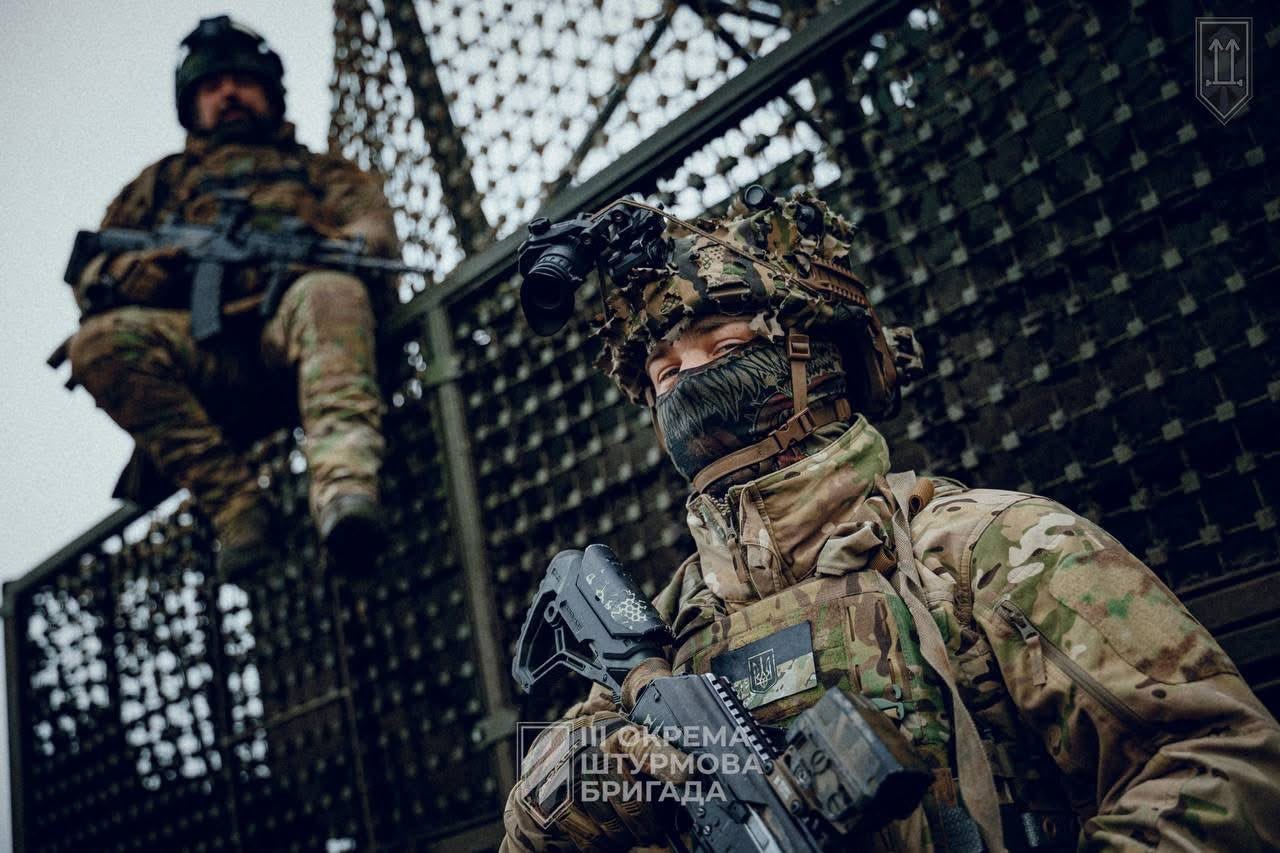
Ukraine’s “Rope-a-Dope” Defense Makes US Army Infantrymen Smile
Move like a butterfly, sting like a bee
Okay, I know my publication here on Substack focuses heavily on technology, but sometimes we have to go back to my roots in the mud.
Longtime readers will know that I served in the 101st Airborne Division as an infantryman before later joining the Air Force after a break in service. Now, Ukraine’s recent defensive tactics across the line of contact have made my infantryman’s Spidey sense tingle… So, let’s talk about it.
Grab your favorite MRE (C-ration for my old-timers) or a can of Rip-its. Let’s examine Ukraine’s rope-a-dope maneuver:
There’s a reason that the Russians lose disproportionately more troops than the Ukrainians across the front lines.
What Ukraine increasingly does looks less like a wall and more like a finely tuned machine that runs on Russian bodies. Russia feeds the machine. The machine grinds on.
The pattern described in frontline reporting is consistent and deliberate.
Russian assault elements, typically 50 to 60 dismounted troops, advance into Ukrainian forward positions that are intentionally lightly held.
Upon contact, Ukrainian squads open fire but simultaneously execute a preplanned displacement rather than a contested defense, vacating the position before decisive engagement.
Once Russian forces occupy the site, Ukrainian ISR assets, primarily persistent UAV coverage, confirm enemy density and disposition.
With the enemy fixed in place, Ukrainian units initiate fires along pre-registered target reference points using a mix of indirect fire, including mortars and tube artillery, supplemented by strike drones and loitering munitions.
Basically, Ukraine annihilates their former position.
As Russian casualties mount and resupply becomes untenable, Russian elements are forced to withdraw.
Ukrainian infantry then reoccupies the position, restores the obstacle coverage, and resets the kill zone for the next assault cycle.
That is systems thinking under fire.
It’s also what we call in the infantry a “rope-a-dope.” (named after the famous boxing tactic, popularized by Muhammad Ali in his 1974 fight against George Foreman, where a fighter leans against the ropes, feigning weakness to absorb punches, allowing the opponent to tire out from throwing powerful, ineffective blows, before Ali would knock that sucka out.)
The US Army has doctrinal language for this, and it starts at the infantry rifle company. In Army terms, a company commander does not “defend a line.”
A company commander builds an engagement area, ties squads and platoons into mutually supporting fires, and uses battle positions, obstacles, and indirect fire as one package.
The phrase that matters is “as a system.” A good defense has geometry. It has timing. It has triggers. It is redundant. It has a plan for what happens when the enemy does the thing you already know he will do, because he has been doing it for four fucking years.
Ukraine’s version is harsher, faster, and drone soaked. But the logic is still familiar.
The Ukrainian Murder Zone, updated for the drone age
Ukraine anchors kill zones with squad-sized elements in fortified positions, with drones constantly patrolling and watching approaches. This lets Ukraine defend wide frontage without stacking bodies into predictable targets.
Russia loves predictable targets. Russia also loves artillery. Ukraine refuses to give them both at the same time.
A kill zone is a deliberately shaped space where the defender wants the attacker to be when the defender starts shooting in earnest. Ukraine’s anti-tank ditches, wire, concrete, mines, exist to do two things.
First, they slow and canalize. Second, they force decision points. A Russian commander either bunches up to breach, or spreads out and loses cohesion, or tries to go around and walks into a second mine belt.
None of these options feels great when drones are watching from above like bored silicon gods with lithium-ion batteries.
The drone layer turns the old defensive problem inside out. For most of modern military history, the defender struggled to see.
If you could see, you could kill. If you could not see, you guessed and hoped.
Ukraine sees. Drones provide persistent observation, fast correction for fires, and immediate battle damage assessment. That means Ukraine can afford to pull back, let Russians step into the freshly “won” position, and then erase them with deliberate fires.
This is also why Russian resupply gets punished so brutally. Once you mine a roadway and seed it with concealed drones waiting on the shoulders, as Ukraine does, you have created a second kill zone that is cheaper than a traditional ambush and meaner than most people want to admit.
The goal is not only to destroy trucks. The goal is to isolate the assault element, starve it, and make the newly occupied position unsustainable.
Ukraine is not defending one trench. Ukraine is defending a network. Russia is trying to solve it with meat.
This next image is graphic. WARNING. But this is what it looks like in practice:

How this compares to my beloved infantry doctrine Stateside
At the company level, US Army doctrine (PDF warning) treats defense as an integrated fight. The company commander organizes positions so squads and platoons can support each other, cover likely avenues of approach, and mass effects without physically massing people.
That is the key. Effects, not bodies.
In practice, that means a company defense includes primary positions, alternate positions, and often supplementary positions.
It includes clear triggers for displacement. It includes engagement area development so that when the enemy enters the wrong place, at the wrong time, squad fires hit in the right sequence. It includes planned indirect fires and the coordination to call them fast, adjust them quickly, and shift them when the enemy tries to crawl out of the blast pattern. Sorry, there’s no escape comrade…
This is where the Ukrainian tactics snap neatly into the US doctrinal frame. Ukraine “gives ground,” then annihilates the occupiers with preplanned fires.
In Army terms, that can look like a deliberate displacement from one battle position to another, or a fall back from a forward position into a main battle area, with fires already registered and targets already plotted.
The beauty is that the ground that gets “given” is often ground that was never the decisive point. It is bait. It is space traded for time and for Russian blood.
A US company commander, if trained well, does not feel emotional about a piece of dirt. He feels emotional about keeping his people alive and making the enemy pay for every meter.
Ukraine’s commanders have learned the same lesson; except they learned it while being shot at by a country that treats human life like an accounting error.
The other doctrinal point that matters is mutually supporting fires.
Sometimes the first Russian wave is only the opening act. Before they finally get pushed out, they try to bolt down their “capture” by bringing in a second wave, usually drone crews and counter-drone teams. The idea is simple: keep the position from collapsing while they plant their own eyes in the sky, start hunting Ukrainian mortar crews and UAV operators in the rear, and slowly chew at the defensive line from behind the front edge.
Ukraine recognizes that and punches it in the mouth. Once Russian drone teams show themselves, Ukrainian units counterattack to clear them out, even though it carries risk and costs lives. The alternative is worse. If those crews stay, Russia gains persistent surveillance and strike capability against Ukrainian rear areas.
So, Ukraine accepts the hard fight early, denies Russia its aerial foothold, and keeps the kill zone firmly under Ukrainian control.
That is triage.
Ukrainian defense also leans heavily on obstacle belts, mines, and survivability. That is where US Army FM 3-34, Engineer Operations becomes the cleanest doctrinal mirror.
Army engineers support operations across the spectrum, and the manual is explicit about what engineers do for commanders: assure mobility, enhance protection, enable force projection and logistics, and build partner capacity.
That “enhance protection” piece is the one Ukraine has turned into an art form, because the battlefield punishes exposed humans at a rate that makes old assumptions feel quaint.
FM 3-34 also describes engineers as enablers for hardening facilities and constructing protective obstacles.
When you read that alongside what Ukraine is doing, the connection is obvious. The obstacle belts are not passive. They are part of the fire plan.
Mines do not “stop” an assault by themselves. Mines shape an assault into a place where drones can find it, and indirect fires can destroy it. Wire and ditches do not “hold a line.” They slow, they channel, and they buy seconds.
Ukraine has layered “counter-mobility” in a way that forces Russian infantry to dismount early, bunch up, and spend time solving problems under observation. In older wars, that might still have been survivable. In this war, it’s a countdown timer and when you hit zero, a Russian conscript dies.
The Ukrainian method also uses obstacles against resupply routes, which is pure engineer logic applied offensively. Mine the road. Force predictable detours. Watch those detours. Strike the trucks with drones or anti-tank munitions. Starve the front.
The beauty, if you can call it that, is how cheaply the defender can do it compared to the cost Russia pays in vehicles, fuel, time, and morale.
Morale is not a soft factor here.
Morale is physics.
If Russian troops believe that every advance ends with them getting hunted in place by drones and artillery, they either stop advancing or they advance like men walking to a funeral they can already hear.
Descriptions of Russian officers sending small teams to plant flags to “color in the map” fits that psychology perfectly. It is theater for higher headquarters. It is also a symptom of a force that cannot translate sacrifice into actual control.
I know it’s hard, but try to put yourself into the mind of the average Russian conscript ordered to take a Ukrainian position. You’ve seen that none of your comrades have come back from previous assaults, and you wonder if you should take your chances against the Ukrainians or risk getting tied to a tree and dying from exposure for desertion…
How Ukraine’s defense keeps casualties low
Ukraine’s casualty reduction comes from refusing to accept the old bargain of defensive warfare, where defenders absorb the first punch and hope the line holds. Ukraine often avoids the first punch by leaving before the punch lands, then counterpunching with effects that do not require bodies to be exposed.
Ukraine didn’t invent the tactic, but they damn-near perfected it, especially at the small unit level.
Russia actually did something similar on a larger scale with the “Surovikin Line.” There, the main goal was to slow down Ukraine’s mechanized forces with anti-tank ditches and dense minefields. This was particularly effective in the Zaporizhzhia region in 2023.
But today, as the attacking force, Russia no longer has a mechanized force to speak of, at least not one that can get close, so they resort to dismounted assaults. Ukraine’s defenses are specifically designed to punish dismounts.
There are a few practical mechanics inside that worth unpacking.
First, dispersion. Small units, separated, fortified, and networked through drones and radios, reduce the payoff for Russian artillery. Russia can still hit something, but it often cannot hit enough of something at once to break the defense.
Second, preplanned fires. When Ukraine withdraws and then strikes its former position, it is not improvising from scratch. It is exploiting registered targets and known terrain. The moment Russians occupy, Ukraine already has the coordinates, the observation, and the munitions queued. It knows the terrain better than the invader because it Ukraine used to live in that position.
Third, persistence of observation. Drones turn Russian movement into a visible problem.
Once you can see the assault, you can time the withdrawal.
Once you can see the occupation, you can time the destruction.
Once you can see the resupply, you can strangle it.
It is hard to overstate how much this changes the math.
Fourth, disciplined counterattacks. Ukraine counterattacks for control of the kill zone, especially against the second wave that tries to establish Russian drone operations. That is a fight over who gets to see and who gets to shoot.
Put those together and Russia makes marginal gains while paying obscene losses in human bodies, and Ukraine preserves force by choosing when and where humans have to be in the open.
Russia’s shift toward small fire-team assaults and the use of ground robots is logical. It is also late. Small elements can bypass some defenses, complicate targeting, and hunt for drone operators and mortar teams in the rear. Robots can do the suicidal tasks without morale problems.
But there are serious constraints with that: Tiny teams struggle to mass fire and hold ground once contact begins.
They also require competent junior leadership and reliable comms… Russia’s track record on both is abysmal at best.
Robots suffer from range, terrain, electronic warfare, and the fact that even the unluckiest Ukrainian FPV pilot can treat them like a moving tip jar.
In other words, Russia is trying to adapt around a defensive system that keeps evolving. Ukraine has a feedback loop. Russia has a bureaucracy and a body count.
If you stack Ukraine’s practice next to US doctrinal thinking at the rifle company level, the overlap is not accidental; the US Army spent years between 2017 and 2022 training Ukrainian soldiers. The difference is that Ukraine has been forced to execute that logic in the most hostile surveillance environment in modern warfare.
That pressure has pushed Ukraine toward extreme economy of force, extreme reliance on unmanned observation, and ruthless discipline about when to fight close and when to let fires do the killing.
And “discipline” is the whole shebang, my friends. Arguably the single greatest gift the US military ever gave me.
The uncomfortable lesson for any Western infantryman is that the old instinct to “hold at all costs” can be a liability when the enemy can observe you continuously and deliver massed fires quickly. Sometimes the bravest thing is to leave the position, let the enemy take it, and then destroy him while he congratulates himself.
Russia keeps choosing the same door. Ukraine keeps setting the same trap.
And if the Kremlin has learned anything from this war, it has done a fantastic job hiding it.
Слава Україні!


Wow, Wes. This was an amazingly well-written piece, both in its technical analysis and its morality.
Exceptional breakdown of this defensive system. The comparision to Army doctrine really clarifies how Ukraine turned geometry and timing into an attrition multiplier. Most folks miss that drones dont just add visibility, they totally shift the cost equation becuase defenders can trade cheap munitions for expensive manpower. Seen this kind of feedback loop in other domains but dunno if anyones ever executed it this brutally at scale.