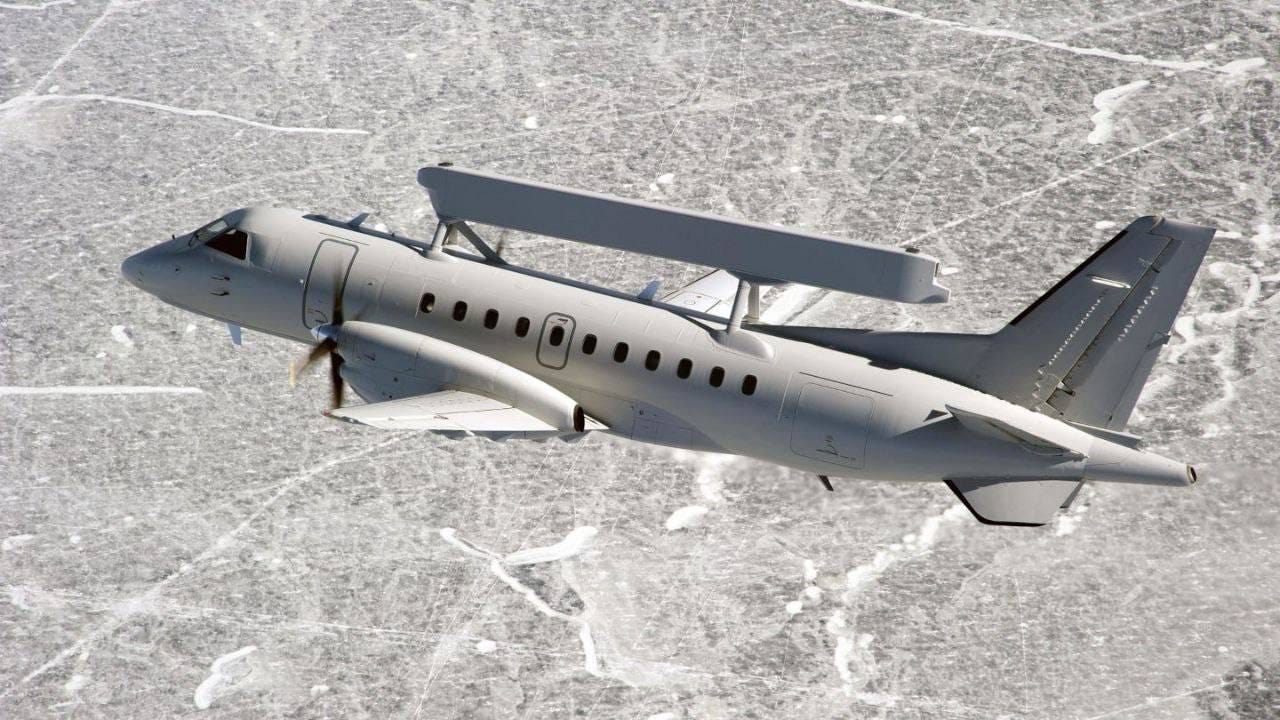
Ukraine's Saab AWACS Spotted Flying Over the Country!
What is it and how can it help Ukraine?
Last year, my first video on YouTube to break 100,000 views overnight was on Sweden’s Saab AEW&C transfer to Ukraine. There is definitely a lot of interest about how these capabilities will help Ukraine in its fight.
But for the past year, the Saab 340 AEW&C, known in service as the ASC 890, or as the S 100D Argus, has been one of those Ukraine transfers that made defense analysts quietly optimistic.
Now footage has surfaced that appears to show one of these aircraft operating over Ukrainian territory. The date and location of the video have not been independently confirmed, and the footage itself remains unverified; although I should note that The War Zone broke the story and they’re pretty good about only posting things that they’re reasonably certain about.
So these aircraft may finally be flying in Ukrainian operational service, which arrives on exactly the training and integration timeline that analysts expected when Sweden announced the transfer in May 2024.
I want to stress that this represents something Ukraine has never had before: a persistent, elevated radar node that can see the sky from above rather than through it.
In this war, that’s a structural awareness change for Ukraine.
Sweden announced the transfer of two ASC 890 aircraft to Ukraine in May 2024 as part of its sixteenth military aid package, then its largest, valued at approximately $1.25 billion.
But the dollar figure alone undersells the intent.
The package was explicitly structured around strengthening Ukrainian air defense and command-and-control, and the Swedish government stated it would include training, technical equipment, and methodological support specifically for air surveillance and control functions.
I think it’s worth noting that governments don’t spend political capital on training pipelines and methodological support for a mere photo-op donation. They do it when they’re trying to transfer a hard capability; usually because their own security benefits.
The training and integration timeline was always going to be roughly a year, which pointed toward late 2025 and into 2026 as the operational window; exactly where we are now.
Ukraine is believed to have received two aircraft.
Their heart is the PS-890 AESA radar made with the Erieye system, an active electronically scanned array mounted in that distinctive above-fuselage fairing that looks like a balance beam. The system can detect air and sea targets at approximately 280 miles (unclassified), which, by the way, is about 30 miles further than the publicly stated range of the E-3 Sentry. The E-3’s full range is also classified.
The Saab operates effectively at around 20,000 feet and can reportedly track up to 1,000 airborne and 500 surface targets simultaneously.
The Ground Radar Problem
Most people, when they hear “AWACS,” think fighter control.
Things like big bomber intercepts and giant air-to-air engagements managed from above by a flying command post. That model is real, it’s what the E-3 Sentry was designed for, but it’s almost entirely irrelevant to what Ukraine actually needs in 2026.
What Ukraine needs is help seeing low-flying things.
Note: I use AEW&C (Airborne Early Warning and Control) interchangeably with AWACS (Airborne Warning and Control System). This is a bad habit. AEW&C is the general, functional term for any aircraft designed to detect targets and manage battlespace. AWACS is a specific, high-capability brand or type of AEW&C system, typically referring to radar systems mounted on Boeing E-3 or E-767 platforms. So basically, all AWACS aircraft are AEW&C, but not all AEW&C aircraft are AWACS.
We’ve talked about ground clutter before here, but a ground-based radar sees the world through obstacles.
Hills, forests, buildings, the curvature of the earth; all of it creates masked approach paths and blind spots where low-flying targets can survive long enough to blow something up.
Terrain masking is a legitimate tactic in drone and cruise missile warfare. Shaheds fly low because low is survivable.
An elevated radar changes the trigger-nometry.
It peers down into the masked approaches that confuse ground stations.
It closes the gaps that low-flying threats are designed to exploit.
It’s why “look-down” radar capability was one of the most consequential technological developments in Cold War air defense, and it’s why elevated sensors keep appearing in every serious analysis of Ukraine’s low-flying drone and cruise missile problem.
Even on the E-3 Sentry, the look-down maritime function, which allowed us to see surface vessels on the water, wasn’t developed until the mid to late 1980s (more than a decade after the plane was introduced).
The Erieye family is explicitly built around this.
Detection of cruise missiles, detection of low-observable targets, and wide-area coverage from altitude… The capabilities read like a checklist of Ukraine’s most pressing defensive needs because, in many ways, it is.
Ukraine has spent three years improvising its air picture under fire using ground radars, forward observers, fighters operating on fragmented situational awareness, and SAM batteries doing the best they can with incomplete information.
The results have been genuinely impressive; Ukraine’s air-defense performance has consistently exceeded external expectations, but the improvisation has always had a ceiling.
That ceiling is mostly defined by geometry. You can’t see below the horizon from the ground.
The Saab 340, flying at altitude with the Erieye looking down, changes the geometry, and changing the geometry changes what Ukraine can intercept before the bad guy kills something.
A note on Russian glide bombs
Russia’s glide-bomb campaign has been one of the defining tactical features of the 2024 and 2025 ground war.
FAB-series bombs fitted with UMPK glide kits. and their evolving variants, have been falling on Ukrainian front-line positions, towns, logistics nodes, and fortifications at a scale that has directly shaped the attritional picture at the front.
Russian Su-34s and other strike aircraft approach the front, pop up briefly at standoff range, release the bomb, and turn away.
The bomb then glides unpowered into its target while the aircraft that dropped it retreats beyond the most threatening portions of Ukraine’s air-defense coverage.
Once the bomb is in the air, stopping it is genuinely difficult, especially when releases are massed, timed, or coordinated across multiple launch points simultaneously.
The instinct is to focus on intercepting the bomb. But the smarter play is to threaten the delivery chain.
Find the bomber earlier, track its approach sooner, vector fighters or alert SAM batteries with more time and a cleaner fire-control picture, and force Russian strike crews to launch from worse profiles like longer ranges, different altitudes, under more uncertainty about whether they’ve been spotted and what is waiting for them on the other side of the horizon.
Even small degradations in launch parameters translate into real reductions in bomb accuracy and sortie flexibility.
This is where the Saab 340 starts paying off. Russian Su-34s approaching their release lines aren’t invisible. They have radar signatures, they fly predictable staging and routing patterns informed by their own threat assessments, and they approach under constraints that leave patterns in the data.
An airborne radar platform orbiting in western Ukrainian airspace, away from the densest Russian strike coverage, can extend the detection picture far enough east to make those approach patterns visible earlier than ground-based systems allow.
Granted, there is a range limitation and Ukraine is a big place. Flying the Saab in the far west of Ukraine isn’t going to allow you to see deep into Russian territory; but you might be able to see into Russian-occupied Ukrainian territory.
The constraints are real but they don’t cancel the benefit
Ukraine only has two of these aircraft. That is not enough for continuous coverage of a country roughly the size of Texas.
Ukraine is almost certainly operating the two Saab 340s conservatively, likely from airfields in the far west of the country and moving them between locations to reduce exposure to Russian long-range strike.
With a two-aircraft fleet, round-the-clock coverage is simply not achievable. One aircraft may need to be held on alert during the most intense drone and missile barrage periods.
The other flies. They rotate. The coverage is real, but it is not omnipresent.
Russia understands this vulnerability better than most. Ukraine spent a good chunk of the war hunting Russia’s own A-50 Mainstay AWACS fleet for precisely the same reason: the A-50 is a combat enhancer and a strategic asset, and killing it degrades Russian air-management capacity measurably.
The lesson runs in both directions. Ukraine is not going to park or fly its two precious ASC 890s in eastern orbit. These aircraft are going to be treated like the irreplaceable strategic assets they are, or at least, treat them better than the Americans treat their Sentries in Iran.
But limited coverage is not no coverage, and limited coverage still changes behavior.
Russian strike crews now have to operate with some uncertainty about whether an airborne radar is helping Ukraine build a cleaner picture of their approach.
That uncertainty doesn’t require Ukrainian coverage to be continuous. It just requires it to be plausible. And given that Ukraine has now demonstrated these aircraft are flying, the plausibility is established.
Russian mission planners cannot confidently assume the Saab 340 isn’t overhead on any given sortie. That uncertainty has operational costs: It may push launch points farther back. It may force lower-altitude routing that degrades the bombers’ own situational awareness. It may require more escort.
All of those things are friction, and friction is how you make a numerically superior adversary start paying interest on every sortie.
The Saab doesn’t have to be everywhere. It just has to be somewhere, and now, evidently, it is.
The Link 16 question
Link 16 is a secure, high-speed, jam-resistant digital data link network used by US and NATO militaries to share real-time tactical information, including positions and imagery. Oh, and voice I believe.
On the E-3 Sentry, Link 16 was actually a higher classification than the radar system… as in “Top Secret” instead of just “Secret.”
So, the ideal version of this capability would have the Erieye’s radar picture feeding directly to Ukrainian F-16s, Mirage 2000s, and Western-linked air-defense systems in near-real time via Link 16.
In that configuration, a pilot in a Ukrainian F-16 cockpit would see the Saab’s radar picture on his display as a continuous, fused, near-real-time air situational awareness feed.
The AWACS spots the threat. The fighter sees it almost instantly. The intercept rates improve dramatically.
But there’s a problem.
Reporting in late 2024 suggested Ukraine’s F-16s may have had Link 16 capability removed or disabled over concerns that the system could be compromised, specifically, that Russian capture of Link 16 encryption material could expose NATO data-link protocols more broadly.
That’s a legitimate concern, I suppose.
But, more recent reporting, from around March 2025, timed to the AWACS delivery timeline, tied the arrival of these aircraft to ongoing modifications on Ukraine’s F-16s.
The clear implication is that some kind of networking issue was being worked through in parallel with the Saab integration.
That could mean Link 16 in some modified or protected form.
It could also mean a functional equivalent using different protocols.
What it almost certainly does not mean is that the networking question was left unaddressed.
Even without Link 16, the ASC 890 is operationally useful. It still feeds information through ground-based control networks, which is slower and more cumbersome than a direct datalink to the cockpit but still vastly superior to not having the picture at all.
The baseline capability, extended detection range, improved geometry against low-flyers, better air-picture fusion, exists regardless of how the data gets distributed downstream.
With Link 16 or a functional equivalent live, the system moves from useful to genuinely serious. Ukrainian F-16s stop hunting with one eye closed and start receiving a fused air picture from a platform whose entire purpose is to see farther and hand off targets more effectively.
What happens if there’s SAR?
This article is already getting a bit long, but I wanted to mention the SAR possibility.
Totally speculative, and worth tagging as such, but later variants of the Erieye family can incorporate synthetic aperture radar and ground moving target indication (SAR/GMTI) functions that extend the platform’s value beyond air surveillance into battlefield observation.
We’ve talked about SAR here before, mostly from the satellite perspective, but SAR can produce high-resolution ground imagery; GMTI can detect and track moving vehicles, equipment concentrations, and other surface targets through weather and at night.
It is not publicly confirmed whether Ukraine’s aircraft have these capabilities. They may not. The Swedish transfer was described primarily in air-defense terms, and the baseline Erieye mission is air and maritime surveillance rather than ground observation.
But if those functions exist, even in limited form, the ASC 890 starts helping Ukraine watch the battlefield beneath it like tracking Russian ground movement, building operational awareness of logistics patterns, and making the kind of large-scale repositioning that precedes offensive action less invisible.
That would represent a big expansion of Ukraine’s intelligence picture, not just its air-defense picture.
Worth watching. Not worth overstating. But worth watching.
What Actually Changes
Okay, so Ukraine has spent three years building an air-defense architecture through improvisation and attrition. The results have been remarkable, but they have always been constrained.
The Saab 340 does not make Ukraine’s air-defense problem disappear. But what it does is add an elevated, wide-area surveillance layer that makes the sky more legible.
It improves detection of the low-flying threats that have defined Russian long-range strike tactics.
It gives the network a better picture of the bombers that are making Ukrainian lives at the front genuinely miserable.
It makes the integrated air-defense system work more like a system and less like a collection of talented operators sharing incomplete information.
The value for Ukraine is structural and cumulative: more intercepts, better-positioned defenders, more friction in Russian strike planning, more pressure on launch profiles that have previously been almost comfortable for Russian crews.
Russia has spent this war counting on comfortable thanks to an inherent laziness found inside the Russian command structure.
Comfortable approach routes.
Comfortable standoff ranges.
Comfortable assumptions about what Ukraine can see and how quickly it can react.
At least one of those assumptions just changed.
Слава Україні!


little wonder that zelensky is so bullish towards trump