Hey friends.
Let me be up front here: I’m a Skyranger stan.
One of my first “viral” videos on YouTube was a story on Skyranger back in early 2025. Since then, I’ve had a special place in my heart for Rheinmetall’s little air defense beast.
I’ve also written a lot about Ukraine’s layered air defense, but I haven’t spent much time explaining where each individual system actually fits into the stack. And I think understanding that stack is the key to appreciating what Rheinmetall’s Skyranger 35 brings to the fight now that it’s finally, confirmed, in Ukrainian hands.
I’m always mindful of operational security here, but we’re on safe ground, because Zelensky himself has publicly described Ukraine’s air defense as a layered system built around aircraft, electronic warfare, interceptor drones, and mobile air-defense teams.
So let me lay out the belts the way I think about them.
At the bottom sit the cheap, numerous, slow threats, the propeller-driven Geran-2 and Shahed-type drones that Russia launches by the hundreds. Ukraine increasingly wants interceptor drones, electronic warfare, machine guns, and autocannons handling those, because they’re too cheap to justify anything expensive.
In the middle sit cruise missiles and faster threats that the cheapest systems can’t reliably catch, and that’s where F-16s and medium-range SAMs like NASAMS earn their keep.
At the very top sit the threats Ukraine has almost no answer for. A ballistic missile gets a Patriot, or it would if Ukraine had a deeper magazine.
Skyranger occupies an interesting seat in the middle of all that.
Its 35mm gun has far more reach (4 km), sensor sophistication, and lethality than a guy sitting in the bed of a pickup truck with a machine gun. But it doesn’t need to throw an expensive guided missile at every drone that wanders into its sector, either.
It’s the bridge between the cheapest defenses and the scarce missile layer.
The delivery nobody announced
Europe is betting heavily on Skyranger 35 as one of its main answers to the drone problem.
At least five European militaries, Germany, Austria, Denmark, the Netherlands, and Romania, have already placed orders.
But every one of those discussions came with the same nagging asterisk attached *
Ukraine wasn’t publicly operating the system, so nobody could actually say whether it worked in combat or just worked at a range in Deútschland.
That changed on September 3.
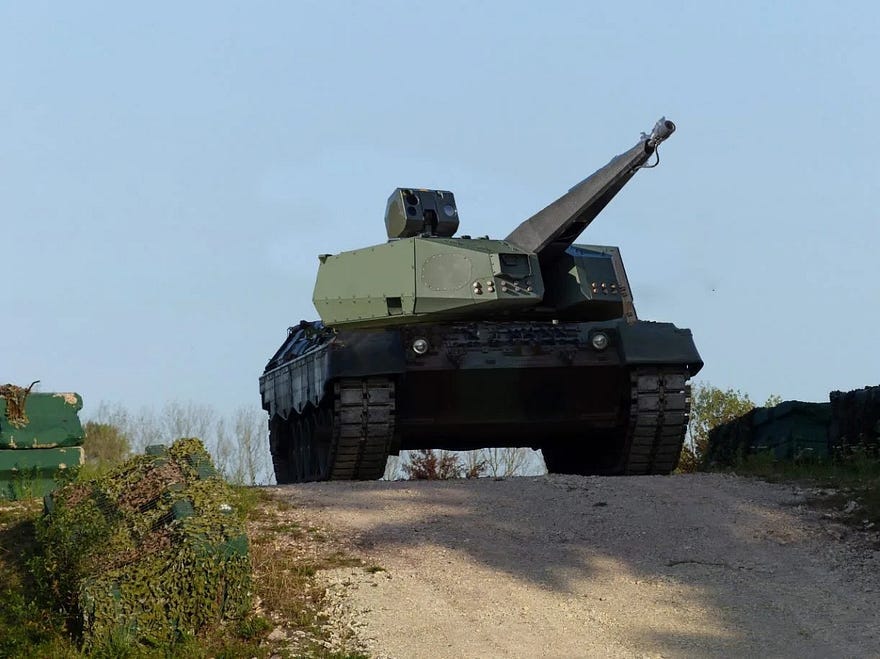
Ukraine’s 1020th Anti-Aircraft Missile Regiment released the first official Ukrainian footage of the Leopard 1-mounted Skyranger 35, showing the vehicle, its crew compartment, and, crucially, a short sequence of the system engaging aerial targets, with reporting indicating the crew was going after Shahed drones specifically.
Defense Express noted that the digital fire-control system can be seen automatically tracking the target in the video.
Defense Express also estimates the video was actually filmed back around March, based on the bare vegetation and the cold-weather uniforms the crew is wearing.
And more telling, the Ukrainian commander describes his unit as having received “one of the first” Skyrangers, wording that quietly implies several were already in country when the footage was recorded.
So, Ukraine has likely been operating one of Europe’s newest air-defense weapons for months, quietly, while the rest of us were still waiting for the delivery announcement to turn into an actual delivery.
Rheinmetall publicly announced the Leopard 1 Skyranger contract on October 10, 2025, a deal worth a three-digit-million-euro figure, financed by an unnamed EU country using proceeds generated from frozen Russian assets under the bloc’s windfall-profits mechanism.
Rheinmetall Italia handled production and integration in Italy, and the company never disclosed how many vehicles were involved.
If Defense Express has the recording date right, operational examples were in Ukrainian hands only months after the contract was signed, which is moderately fast by any European procurement standard.
It’s like poetry… Russia invaded Ukraine. Europe froze Russian assets in response. And some of the proceeds from those frozen assets have now come back around as 35mm ammunition pointed directly at Russian drones.
What Skyranger is supposed to do
The Ukrainian configuration mounts Rheinmetall’s Skyranger 35 turret on a refurbished Leopard 1 chassis.
That’s a tracked vehicle, which means its slow, but can go a lot of places wheeled vehicles fear to tread.
The gun itself fires 35x228mm ammunition at a cyclic rate of up to 1,000 rounds per minute, with an effective range of about four kilometers, and the whole package combines search and tracking sensors with digital fire control that lets it operate either as a standalone shooter or as a node inside a larger air-defense network.
Its AMMR multifunction radar (PDF warning) runs in the S-band across five antennas for full 360-degree coverage, backed by Rheinmetall’s passive FIRST detection system, which spots small targets without radiating any signal an enemy could home in on.
I walked through the engineering in an earlier piece, so I won’t drag you through Rheinmetall Air Defense 101 again. But the one detail worth repeating is the ammunition, because it’s the whole shebang.
Skyranger’s signature round is called AHEAD (another PDF warning), and each 35mm AHEAD projectile carries 152 tungsten-alloy subprojectiles weighing about 3.3 grams apiece.
The system measures each shell’s actual muzzle velocity as it leaves the barrel and programs an electronic timer in the projectile on the fly. Near the calculated intercept point, the round bursts and releases those 152 subprojectiles directly into the target’s flight path.
A drone, in other words, has to fly through an expanding cloud of angry tungsten bees. (I hate bees… Yes, I know they’re pollinators. They still suck)
So, you just need the drone and the cloud to occupy the same patch of sky at the same instant, and the fire control does the math to make that happen. (I also hate math. That’s why I went to law school)
Why real combat changes the exam
A training ground hands Rheinmetall control over nearly everything: Known target, known flight path, prepared sensors, clean weather, clean electromagnetic conditions, maintenance crews standing by, and all the AHEAD ammunition you could want.
A Russian drone raid offers none of those niceties.
In Ukraine, Skyranger has to acquire targets approaching from unexpected bearings and altitudes, sort them out of ground clutter and civilian radio traffic, avoid shooting down Ukraine’s own friendly drones or F-16s sharing the same airspace, and do all of it while Russian electronic warfare is actively trying to blind and confuse its sensors, sometimes against several threats arriving at once.
The real measures of success will be how quickly the system acquires a target, how often the first burst gets the kill, how many rounds each engagement actually burns through, and whether the radar can reliably tell a friendly aircraft from a hostile drone under pressure.
Ukraine will also be quietly logging how the thing performs in fog, rain, and snow, whether it can chew through multiple targets in rapid succession.
Plus, how fast crews can reload, and whether the radar stays reliable after weeks of continuous operation rather than a single scripted afternoon.
Also, that 1,000-rounds-per-minute figure looks impressive at Eurosatory, but operationally, nobody actually wants Skyranger firing anywhere close to 1,000 rounds.
The entire point of wrapping a mature autocannon in sophisticated sensors, predictive fire control, and programmable ammunition is to fire a short, precise burst that puts exactly enough tungsten in the intercept basket and not one round more.
So, the metric to watch was never cyclic rate… It’s rounds per kill, because AHEAD is not thrift shop ammunition. Rheinmetall isn’t flinging cheap dumb shells into the sky, so the air-defense economics of this whole concept hinge almost entirely on how many of those expensive smart rounds Skyranger needs to reliably knock down one drone.
Five rounds per kill and thirty rounds per kill produce wildly different cost curves once you multiply them across several thousand drone engagements over a winter.
And even if the per-kill economics look good, ammunition supply is its own separate problem.
Rheinmetall had to stand up entirely new 35mm production lines for Ukraine after Switzerland blocked the transfer of Swiss-made Gepard ammunition earlier in the war.
Germany initially ordered 300,000 replacement rounds and later added another 180,000 rounds on top, with deliveries stretching into this year.
Ukraine can only ever fire what Europe can actually manufacture and ship, and that lesson, that owning the gun is only half the fight because you still need mountains of ammunition to feed it, is one Ukraine has already paid to learn once.
Ukraine is now running Europe’s live-fire evaluation
Europe has already committed hard to Skyranger, and Rheinmetall says demand has climbed high enough that it plans to expand annual Skyranger turret capacity from roughly 100 units up toward as many as 400.
Romania alone ordered 24 Skyranger 35s on tracked Lynx KF41 vehicles back in June, bundled into a larger Rheinmetall package.
That buying spree makes Ukraine’s combat experience disproportionately important, because those European militaries are purchasing a weapon designed largely to solve lessons Ukraine itself surfaced.
Now Ukraine is the one field-testing the solution.
Combat feedback from these vehicles could reshape ammunition loads, sensor configurations, radar software, crew requirements, whether to bolt on Stinger or Mistral missile launchers, how the vehicles get positioned, the paper doctrine for using them, and ultimately how many each country decides to buy.
The Europeans placed their orders before Ukraine’s report card came in. Now they’ll all be hoping for high marks.
For the past few years, Skyranger has represented Germany’s answer to a question Ukraine forced NATO to start asking again. How do you protect troops and infrastructure from thousands of cheap aerial threats without bankrupting yourself?
Rheinmetall has offered its answer: A proven 35mm cannon, programmable ammunition, a modern sensor suite, and enough mobility to put the whole package wherever the threat shows up.
And now Ukraine gets to grade it.
One successful engagement won’t tell us much. Neither will a polished combat video shot back in March.
The performance numbers surface slowly, over a hard winter of continuous operations.
Ammunition expenditure.
Kill probability.
Availability.
Survivability.
And whether Ukrainian commanders come to trust these vehicles enough to park them beside the assets they genuinely cannot afford to lose. That’s when we’ll finally know whether Skyranger solved part of the drone problem or just built a very expensive way to shoot at it.
Either way, the laboratory phase is finished. The experiment has moved to Ukraine.
Now, I think it’s time for a new Skyranger video on my channel. Hopefully my partner won’t mind me destroying this photo for my true love:
Слава Україні!


Great piece! Go Skyranger! Slava Ukraini!
Something in the dreaded Ammunition PDF caught my eye. It appears to say that the round will self-destruct after 8.2 seconds or around 5 km.
That sounds like a good safety feature to avoid ground casualties. Is that the way you read it?
What's the estimated price per single round?