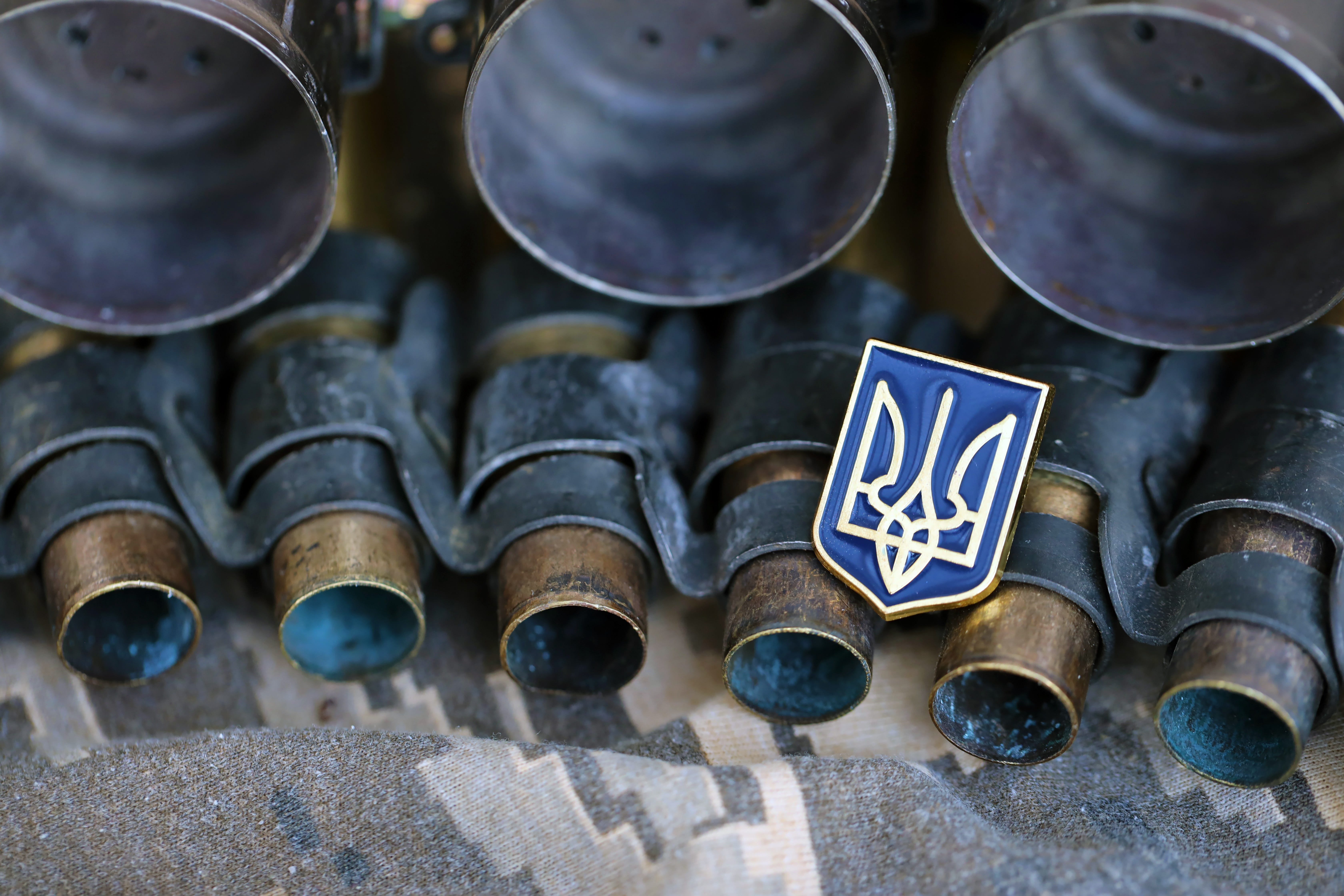
Ukraine's Survival is More Important Than You Think
Ukraine’s fall is unthinkable because it means my children will be fighting the next global war in their lifetimes
I remember exactly when Ukraine stopped being just “another headline” to me. It was early 2016, and I was watching the excellent field dispatches of then-Vice journalist Simon Ostrovsky and his series called “Russian Roulette.”
It is absolutely worth a watch, even today, because this is the playbook that Putin would use in Estonia or Latvia tomorrow. The series covered Putin’s “little green men” invasion of Crimea and the Donbas.
A year later, I would be interviewing five Ukrainian soldiers who were actively fighting against Russian separatists in Donetsk, and many friends of mine who were still active duty in the US military spent training rotations in Ukraine to get their army more doctrinally aligned with NATO.
These US Army rotations are likely some of the most underreported deployments between 2014 and the full-scale invasion, but they were ESSENTIAL to preparing Ukraine for what was to come.
Then, on a late winter morning in 2022, I was scanning feeds like any geopolitical junkie when something in a grainy, user-posted video stopped me.
Civilians, not soldiers, scrambling through rubble. Mothers holding children in the back seat of a car with shattered glass glittering like snow. Russian invaders intentionally driving tracked vehicles over civilian cars with Ukrainians still inside.
This didn’t make any sense. I have a bachelor’s in international relations, concentrated on Russian language, history, and literature, but my brain had difficulty understanding how a modern army would intentionally target unarmed civilians…
Maybe it was my military training? In the US, we go to great lengths to protect civilians. It’s not a perfect system; sometimes civilians get hurt, sometimes they die, and many others get displaced. But I can personally attest to the steps we take to protect the lives of the innocent people impacted by war.
When Russia targeted civilians in Ukraine, my first reaction was shock, followed by confusion: Are the Russians attacking civilians because they are bad at warfighting? Or just bad in general?
The answer turned out to be a little bit of both, with a heavy dose of Soviet-era culture (a lesser value of life over state) thrown in for good measure.
Since then, my interest has never been casual. It’s personal in a way that surprises journalists who work conflicts for a living. Because Ukraine is the moment where history, morality, and the future of the international system all collide in one place.
And what we’ve seen from Moscow, not just on battlefields but in towns and villages, is exactly why support matters.
Let’s be super clear, here… Russia’s invasion in February 2022 was not a border dispute.
It was not a “special operation.”
It was a naked bid to overwrite sovereign choice with imperial ambition.
The pretext was based on propaganda: “denazification,” “liberation,” historical grievances and other Kremlin bullshit; but the reality was tanks crossing frontiers and missiles flattening homes.
Since that first day, every official insistence from Moscow has been disproven by the next satellite image, the next intercepted call, or the next wrecked civilian street.
And it didn’t take a PhD in Cold War history to see it. It just took paying attention.
I didn’t come to Ukraine via think-tank seminars or policy papers. I came through footage of civilians trying to carry on with life while air-raid sirens screamed overhead. The dissonance was jarring to me. People who should have been at work, walking dogs, arguing about grocery prices instead looked at the sky like it was a predator.
That’s fear you can almost hear.
Once you’ve seen that, you don’t go back to viewing Ukraine through the sterile lens of analysis. You begin to see it as a test of whether the world still believes in basic principles like sovereignty, dignity, and the idea that a state’s borders aren’t merely suggestions.
Russia’s War Crimes, Not Allegations, But Documented Reality
The atrocities we’ve documented over the past nearly four years are patterns.
International bodies have spent years collecting evidence of indiscriminate strikes, targeting civilians, use of prohibited weapons, and widespread torture and unlawful confinement. These are acts that meet the definitions of war crimes and, in some cases, crimes against humanity.
United Nations inquiries have documented such violations attributable to Russian forces, including excessive incidental deaths, willful killings, and inhuman treatment.
This is the Independent International Commission of Inquiry on Ukraine telling the world what investigators on the ground already tearfully know.
And make no mistake, these are real people: pensioners killed while waiting for pensions, families erased by strikes on apartments, children killed in attacks on residential areas.
This is why international law matters. Without accountability mechanisms, from the International Criminal Court to proposed special tribunals for the crime of aggression, powerful states can act with near-impunity. Ukraine has pushed for tribunals specifically to prosecute Russian aggression because without accountability, war is just another tool in the strong man’s toolbox.
Peace Talks. Thanks, But…
2025 has been a year of diplomatic fever dreams and cautious optimism, topped by heavy doses of reality.
The headline story now is that Ukraine and the United States have been working on a 20-point peace framework, and President Zelenskyy is heading into high-stakes talks with President Trump as 2025 winds down.
The plan reportedly includes security guarantees, economic reconstruction commitments, even ideas about a demilitarized Donbas; but, notably, nothing about ceding territory. Ukraine insists it will not legally surrender parts of its sovereign land as the cost of peace.
Russia’s response has been circumspect at best, hostile at worst. Putin has reiterated demands for recognition of territorial gains and refusal to stop military operations while negotiations proceed.
What’s key here is the continuity of Russian demands from 2022 to today: Ukraine must give up territory, give up options like NATO membership, and effectively rewrite its own sovereignty in ways that reward aggression.
That’s capitulation.
This is why many analysts, and many Ukrainians, are deeply skeptical of peace talks that don’t enshrine a full Russian withdrawal and accountability measures.
A “peace” that legitimizes conquest is a strategic pause in a much larger plan.
There is a simple truth completely absent from the West’s (mostly the United States’) rush to achieve peace by the end of the year: Russia will use any pause to remilitarize.
Also, ask yourself, why is the Trump administration pushing so hard for a peace agreement before 2026? For no other reason than to satisfy the ego of a single man… That is, to be able to say, “look at all I achieved in my first year.”
Trust is a currency Russia has spent and not earned. Not once. Repeatedly. Methodically.
This isn’t a vibes-based argument. It’s a pattern you can trace across two decades of broken signatures and violated ceasefires.
Start with the Budapest Memorandum. In 1994, Ukraine gave up the world’s third-largest nuclear arsenal in exchange for explicit guarantees from Russia, the United States, and the United Kingdom that its sovereignty and borders would be respected.
Those assurances were the entire deal. In 2014, Russia annexed Crimea anyway. In 2022, it launched a full-scale invasion. That was Moscow tearing up a document whose sole purpose was to prevent exactly this outcome.
Then there’s Georgia. In 2008, Russia agreed to a ceasefire brokered by the European Union after its war with Georgia. The ink was barely dry before Russian forces entrenched themselves in Abkhazia and South Ossetia, recognizing them as independent states in direct violation of the agreement’s terms.
Russian troops never withdrew. The ceasefire became a pause. The occupation became permanent.
But Ukraine itself offers the most damning case study.
The Minsk agreements were supposed to stop the fighting in eastern Ukraine. Russia signed on. Then it armed, funded, and directed separatist forces anyway.
Heavy weapons that were supposed to be withdrawn stayed in place. Ceasefires were announced and broken so frequently they became background noise. Moscow denied direct involvement the entire time, even as Russian equipment, officers, and eventually entire units appeared on the battlefield. Minsk was Russian theater at its worse.
Zoom out further. Russia violated the Intermediate-Range Nuclear Forces Treaty by secretly developing and deploying prohibited missile systems while publicly accusing the United States of bad faith.
The treaty collapsed not because diplomacy failed, but because one side treated compliance as optional until it got caught.
The same pattern shows up in Syria, where Russia promised de-escalation zones and humanitarian corridors, then helped bomb them into rubble.
It shows up in arms control, cyber agreements, and grain export deals.
Signature first. Violation later. Denial always.
Let me reiterate: Russia cannot be trusted; at least, not with the current regime.
So, when the Kremlin now insists it wants peace, demands territorial concessions, and insists Ukraine accept “new realities on the ground,” context matters. This is the same government that promised not to invade while massing troops on Ukraine’s border in early 2022. The same leadership that called the invasion a training exercise until missiles started landing in Kyiv.
And that’s the problem with trust. Once it’s gone, even a sincere proposal looks indistinguishable from a setup.
Ukraine has shown willingness to talk about security guarantees, demilitarized zones, and risk reduction around nuclear facilities. That’s not obstinance. That’s pragmatism. But nothing in Moscow’s record suggests it would respect Ukrainian sovereignty once international pressure eases or headlines move on.
A deal that leaves Russian troops on Ukrainian soil, or accepts territorial conquest as a bargaining chip, doesn’t end the war.
It freezes it.
It teaches Moscow that aggression works if you wait long enough.
History is brutally consistent on this point. Settlements that reward militarism don’t create stability. They create countdown clocks.
We’ve seen that playbook before. And Ukraine is right not to want a rerun.
Why I Still Support Ukraine
My support isn’t born of ideology alone. It isn’t a reflexive alignment with one side or against another.
It’s born of a simple, stubborn belief in the principle that nations have the right to choose their future… A principle that matters even when it’s inconvenient, even when the geopolitics are complex, and even when the cost of defending it is high.
Ukraine isn’t fighting for some abstract glory on a distant plain. It is fighting for its very right of existence: its language, its people, its cities, its right to walk in the world as itself.
And make no mistake: the outcome here will matter beyond Ukraine’s borders. If a powerful neighbor is permitted to redraw maps by force and then negotiate terms that legitimize its conquest, then the much-touted post–World War II order, however imperfect, really is a quaint relic.
History does not wait politely. It punishes the complacent. It rewards those who act before the problem is on their doorstep.
I’m not a warhawk. Peace is worth striving for, but peace that comes without justice, without accountability, and without restoration of sovereignty is merely the lull before the next storm.
I believe in a dying order: the post World War II rules-based order. It brought the longest stretch of relative peace and prosperity the modern world has known. We can joke that the US was the “world police” and had too big a military, with too many foreign bases. But that strength largely kept a possible World War III at bay for 80 years.
To me, Ukraine’s sovereignty represents that rules-based order. Ukraine’s fall is unthinkable because it means my children will be fighting the next global war in their lifetimes.
So as long as Ukraine is willing to fight for its future, so will I.
Слава Україні!


I think the bit you were missing in 2014-2022 was just how deep the Russian prejudice against Ukraine runs. I learned of this while doing expat work in Russia, and it really surprised me. I didn't see it as virulent, but it was deep and persistent. Ordinary Russians really think Ukraine is Nazis. It was as deep a misunderstanding as the American misunderstanding of Iraq was.
Thank you for all your analyses. While I did not see the seriousness of Putin's military actions until after the 2022 invasion, it immediately became apparent to me that this was today's equivalent of 1937 in Spain. I completely agree with the global significance you have outlined here. Glad to see people saying it out loud. Thank you again.
I now understand why your beliefs are so personal with regard to Ukraine and its future. Why can’t the “so called diplomats” Witkoff and Kushner read your article and gain the proper insight. Of course, they know all this and couldn’t care less pertaining to their transactional goals. History will ultimately treat them very cruelly and accurately. And your president will be included.