Hey friends.
I’ve done some weird things to keep my jets flying. I’ll keep the obscener and more sacrilegious things to myself, but here’s an example of how a security forces airman’s burrito saved an AWACS mission…
So, every E-3 Sentry mission requires a radar pre-flight inspection by someone trained and qualified to do so. The checklist is long and I won’t bore you with it here, but one task is to check the desiccants in the waveguide and make sure they’re blue, not white.
A desiccant removes moisture from the waveguide, which is normally filled with sulfur hexafluoride; a heavy, inert gas used as a dielectric insulator and cooling medium to prevent electrical arcing and cool high-power components within the massive rotating radar system.
If the desiccants are white, they are saturated with moisture and need to be replaced with fresh ones.
One day, I was tasked to get on a flight from Tinker AFB (in Oklahoma City) to Davis-Monthan AFB (in Tucson, Arizona) to do a radar preflight inspection on a Sentry that had been stranded there for a few days.
Without a radar preflight, the jet was NMC or non-mission capable. Essentially, just a passenger jet.
So, I arrive, grab my tools and head out to the jet on the flightline. Once I get to the desiccants, I see that they are white. And it is at that exact moment that I realized Davis-Monthan AFB wasn’t going to have a desiccant resupply just lying around.
WHY DIDN’T I BRING MY OWN DESICCANTS FROM TINKER?!
I emptied the bad desiccants into a Ziploc bag and started walking back into the ready room when I bumped into the pilot on the way in.
“Uh, sir. You’re not going to be able to fly a mission. You can’t turn on the radar system.”
To which he says, “Well, that’s fucking great, sergeant. Do you want to tell the commander?”
In my mind, I’m thinking ‘God no, I hate that guy…’
Right then we passed by the security forces shack which guards access to the flightline, and I glance over and see an airman stuffing his face with a steaming hot gas station burrito.
DING! A light bulb goes on above my head.
I ask him, “Hey man, was that burrito frozen?”
His mouth is full so all I get back is some mumbling, and then he jerks his head over his shoulder at his microwave.
The pilot is still standing next to me, and I pour out the desiccants into a plastic bowl and pop them into the microwave. Within seconds, they turn from white to blue.
“Hey sir. Disregard. Radar is FMC (fully mission capable). You’re good to go.”
Off we go, into the wild blue yonder!
I wrote back in February about the $235 million Sabena maintenance contract, when Washington locked Ukraine’s F-16 fleet into the fight through 2029. At the time I focused on why sortie rates and engine cycles are the slow math of airpower that Russia has never been good at.
Today I want to talk about the engineering underneath that commitment, because the actual mechanics of keeping these jets airborne are kind of interesting.
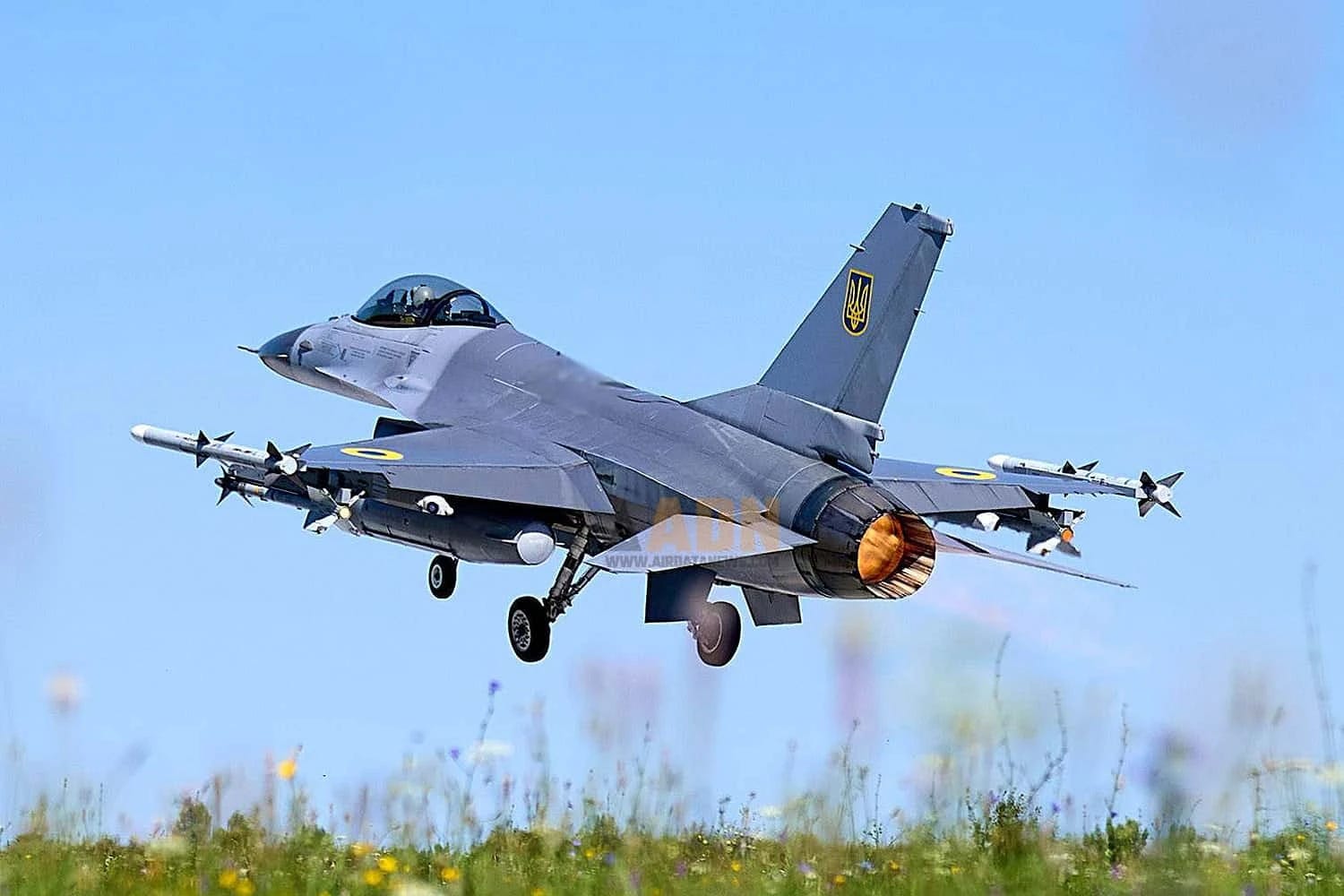
Ukraine is operating a fleet of roughly 40 to 60 older F-16s in an active war zone, every one of them a secondhand European airframe with thousands of flight hours already on the clock, and every one of them sitting somewhere on a countdown that started ticking long before it ever wore Ukrainian markings.
The F-16’s standard structural life, as guaranteed by the manufacturer, sits at 8,000 equivalent flight hours.
Equivalent doesn’t mean just clock time in the air. The calculation weights every flight hour by how hard that hour was on the airframe, with high-G combat maneuvering, heavy weapons loads, and aggressive takeoff-and-landing cycles all eating through the budget faster than a gentle ferry flight across the North Sea.
A jet that’s spent most of its career pulling 7 Gs in Danish air-combat training has consumed its structural life a bit faster than one that mostly flew straight-and-level patrol missions.
In the Air Force, it doesn’t mean the wings fall off at 8,001. It just means the manufacturer’s engineering confidence that every structural component will remain safe without extraordinary intervention runs out at that point.
Past it, the safety margins shrink, the inspection intervals tighten, the maintenance labor per flight hour climbs steeply, and the aircraft demands a fundamentally different relationship with its ground crews than a younger jet does.
Think of it less like a food expiration date and more like the mileage at which your mechanic stops saying “it’s fine” and starts saying “we should probably look at that more carefully from now on.”
The jet essentially starts costing a great deal more attention to keep flying safely.
Falcon STAR gave Ukraine a buffer
Before any of these legacy Block 15 or Block 20 MLU jets were ever handed over by Denmark, the Netherlands, Belgium, or Norway, most of them went through a US Air Force program called Falcon STAR, which stands for Structural Augmentation Roadmap.
Every airframe develops weak points over time, specific bulkheads, wing-root fittings, skin panels, and structural brackets where metal fatigue concentrates and cracks begin forming. These are the predictable consequences of thousands of hours of vibration, G-loading, pressurization cycles, and thermal stress.
Falcon STAR proactively targeted 13 of those known structural weak points across the F-16 fleet, replacing aging bulkheads, wing attachment hardware, skin panels, and structural brackets with fresh components specifically designed to push the airframe past its original 8,000-hour guarantee.
Belgium, Denmark, the Netherlands, and Norway, exactly the four countries now feeding jets to Ukraine, were all part of this program from the start. By the time Ukraine received its first aircraft, the worst of the structural clock had already been partially reset by somebody else’s maintenance budget, giving Kyiv an airframe buffer it never had to pay for or schedule itself.
But that buffer is finite. Falcon STAR doesn’t make a jet immortal. It buys time, and time is exactly the commodity Ukraine is trying to stretch to get to Gripen.
The Belgian pit stop
Also, Ukraine can’t perform deep structural overhauls inside a war zone.
Depot-level maintenance, the kind where you open an airframe up to its bones, inspect every load-bearing component for microscopic fatigue cracking using techniques like magnetic-particle or eddy-current inspection, swap out exhausted engine sections, landing gear, and flight-control actuators, and then reassemble and test the whole thing, requires a climate-controlled facility with specialized tooling, trained depot technicians, and enough air defense that nobody has to worry about a cruise missile arriving during a compressor inspection. Whew.
So, when a Ukrainian F-16 approaches its structural limits or develops critical component wear, it gets flown or transported out of the country to Sabena Aerospace Engineering’s facility near Brussels.
The $235.5 million contract, awarded in January on a sole-source basis and running through January 2029, covers both intermediate-level work (the complex repairs and component swaps that exceed a normal squadron maintenance shop) and full depot-level overhauls (the deep structural teardowns that can take months per airframe).
At the time of signing, roughly $69.7 million was immediately obligated, with the rest available through the contract ceiling as work demands it.
The Air Force Life Cycle Management Center at Hill Air Force Base manages the whole arrangement under the Foreign Military Sales framework.
That setup creates its own logistics challenge. Every jet sent to Belgium is a jet not flying combat sorties over Ukraine for however long the depot work takes.
A ferry flight or ground transport across multiple countries, each with its own overflight permissions and security arrangements, carries its own calendar cost. Ukraine has to balance how many jets it can afford to have out of the fight at any given moment against how many it can afford to keep flying without the deep maintenance that keeps them from becoming dangerous to their own pilots.
Russia has spent years targeting fixed airfield infrastructure with missiles, drones, and standoff weapons, for the obvious reason that a jet sitting in a known hangar at a known base is the easiest possible target.
Ukraine responded by dispersing its F-16 operations away from predictable locations, spreading the fleet across smaller, less obvious sites and moving aircraft frequently enough that no single location becomes worth a missile.
That dispersal creates its own maintenance problem.
A squadron spread across three or four improvised sites can’t rely on one centralized, well-equipped maintenance facility the way a peacetime air force does.
So Ukrainian military engineers, working alongside nonprofit partners at the Come Back Alive Foundation, developed truck-mounted mobile maintenance complexes, workshop rigs that can test avionics, troubleshoot flight-control systems, load munitions, perform component swaps, and handle routine inspections right alongside wherever the jets happen to be parked that week.
These mobile units move with the aircraft, setting up in dispersed, camouflaged positions rather than sitting inside a fixed structure someone can put a coordinate on.
In this sense, Ukraine is sort of “Gripen-izing” its F-16 fleet. (The USAF would implement its Agile Combat Employment or ACE doctrine in 2022 which set the stage for operating from austere airstrips and constant movement. But Sweden has been planning to operate like this for 50 plus years.)
Here’s a video I made last year on Ukraine’s dispersed ops plan for its F-16s:
I spent enough time around flight-line operations to appreciate what that actually demands of the people doing the work remotely. Maintenance on a fighter jet is exacting, intolerant of error, and usually performed with extensive reference to technical orders and computerized diagnostic equipment that needs stable power, clean lighting, and a floor that isn’t made of mud.
Doing that same work out of a truck, in the field, potentially in the dark, while monitoring for incoming threats, is a different kind of professionalism than what peacetime maintenance culture trains for.
The fact that Ukraine has made it work well enough to keep flying combat sorties from dispersed locations for well over two years now says something about the caliber of the ground crews involved.
Ukraine rotates aircraft across its fleet to balance flight hours, which is normal fleet management.
What’s less polished but equally important is cannibalization.
Aircraft that are closest to their structural limits, have sustained minor combat or operational damage, or have developed component failures that would take too long to fix through normal supply channels get systematically stripped of working spare parts to keep the healthier jets flying.
A landing gear actuator from one grounded jet goes onto a flyable one.
An avionics box, a hydraulic pump, an engine accessory, a flight instrument, each migrates from the donor airframe to whichever aircraft needs it most urgently.
Every air force does this to some degree, even in peacetime.
The US Air Force has struggled with cannibalization rates across its own aging fleets for years, and it’s always a sign that the supply chain can’t keep pace with demand. In Ukraine’s case, the math is starker. These are secondhand European jets operating in a war that consumes parts, engines, and airframe life at a rate no peacetime supply pipeline was ever built to sustain.
A grounded F-16 that’s given up its best parts to three other jets is performing its last useful service for the fleet even though it will never fly again.
Ukraine’s leadership isn’t under any illusion that these F-16s are the permanent answer.
These are expendable wartime assets, European airframes whose remaining lifespans are being deliberately consumed to hold the line while Ukraine works toward acquiring newer, longer-term fighter options like Gripen, more Mirages, and other Western airframes yet to be announced.
Belgium alone plans to transfer all 53 of its F-16s to Ukraine by 2029, and when those jets arrive they’ll enter the same cycle of fly, maintain, rotate, strip, and stretch that the Danish and Dutch aircraft are already running through.
The F-16 is the bridge, and right now, every mobile workshop, every Belgian depot visit, every cannibalized actuator, and every structural inspection is another day that bridge holds weight.
In my mind, the engineering challenge is maintaining these jets long enough to get Ukraine across the bridge to the Gripen.
Thankfully, they shouldn’t need a microwave to do it.
Слава Україні!


Great piece. Had similar fun with desiccants and electronic gas combustion analyzers using the same drying method, ie the lowly microwave oven.
Fascinating. Thanks to people like you learning never stops for readers.
With thanks from Australia.