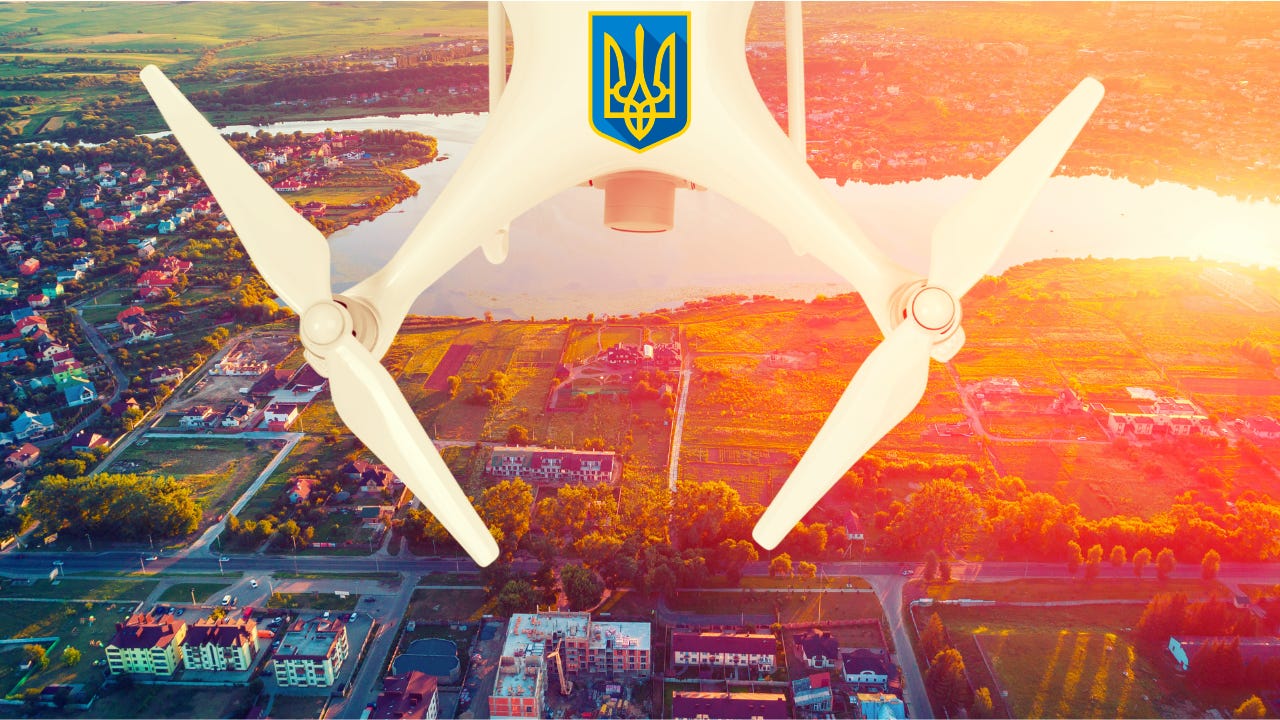
Ukraine’s Wartime Drone Industry Could Go Consumer
America Banned new DJI drones. Ukraine Should Fill the Gap. Here’s How.
For a decade, if you wanted a small drone that could shoot clean, stabilized 4K footage, hit “return-to-home” without drama, and generally behave like a responsible adult in the sky, you bought DJI.
If you were an amateur filmmaker or commercial videographer, you bought DJI. If you were a firefighter, a roof inspector, a farmer, or a bored dad with a YouTube channel, you bought DJI.
China built the “Toyota Corolla of the air,” then sold it to the entire planet.
Now the United States is trying to pry itself loose from that dependence, and the timing could not be more awkward. Because, if you’re not aware, DJI makes an excellent drone.
And, the war in Ukraine has created the world’s most aggressive drone innovation engine, and the West has created an opening in the consumer market that someone is going to fill.
The question is whether Ukraine can become that someone, not by replacing DJI’s entire empire overnight, but by building a Western-acceptable, Mavic-class filmmaker drone that is not made in China, not dependent on Chinese components at the parts level, and not radioactive to American regulators.
That is a tall order. But Ukraine has pulled off taller.
First, let’s confirm the problem is real.
As of late December 2025, the US Federal Communications Commission moved DJI onto its “Covered List” framework in a way that blocks authorization for new DJI drone models, which effectively bars import and sale of new, not-yet-authorized DJI products into the US market.
Existing DJI drones are still legal to own and operate, and plenty are still for sale because inventory and already-authorized models are a different issue.
The choke point is “new.”
The United States did this, presumably, because as a Chinese-owned company, DJI could, in theory, become beholden to the Chinese Communist Party and be forced to hand over its customer data… This isn’t just your name and email address; it’s GPS locations and potentially cloud storage of video files that American consumers have accumulated.
Do I personally think there is any serious security issue here? No, I think the whole thing is a masterclass in American Sinophobia.
But Uncle Sam has a problem with it, so this is the sandbox we have to play in.
If you’re a filmmaker, hobbyist, or drone enthusiast, the “new” drone restriction matters more than it sounds. It means the DJI pipeline into the US becomes a puddle.
The world doesn’t suddenly run out of Mavics, but the upgrade cycle breaks and replacement fleets get complicated.
Everyone else starts doing that math you do when your best tool might become a regulated headache.
So yes, the “ban” is real in the only way that counts for markets: it changes incentives, it changes supply, and it creates demand for a replacement that feels familiar.
How big is the market that Ukraine would be walking into?
Market research estimates put the global consumer drone market in the low single-digit billions and growing.
One widely cited estimate pegs 2024 around $5.2B, with growth projected through the next decade. Just to clarify, this is a separate and distinct number from the huge drone market for military applications.
That’s “walking-around” money, so to speak, and it’s a category where one company historically sat on a huge share of the “good enough for most people, excellent for creators” segment. Even some of the better datasets tracking drone detections, rather than sales, show DJI showing up overwhelmingly in the wild, which matches lived experience in the field.
Side note: I’ve been saying “walking around money” for years to indicate a sizable amount of cash. I have no idea where I picked it up from or where it originated, so I looked it up: “Walking-around money,” also known as “street money,” refers to cash handouts in American politics given by campaigns to local officials or workers to fund get-out-the-vote efforts, such as paying for canvassing, gas, or meals. While often used for grassroots logistics, it historically implies, or is used for, bribing voters or workers on Election Day. Fun! And now you know!
If the US market tightens for DJI’s next models, that demand does not disappear. It reroutes.
This is where Ukraine enters the chat.
Ukraine already has one of the fastest-scaling drone ecosystems on Earth, forged in a war where failure means you do not get to try again.
In fact, DJI Mavic-family drones were widely used by Ukrainian units at small-unit and artillery level (often alongside other brands like Autel) for the first two years of the war.
The country can iterate hardware, software, and tactics at a speed that makes peacetime defense procurement look like a museum exhibit. The problem is not imagination or engineering talent. It is components, supply chains, and the brutal economics of scale.
A lot of “Ukrainian” drones are still heavily dependent on Chinese guts, especially in the electronics stack: cameras, video transmitters, certain boards, thermal imagers, and the little modules that make modern drones feel magical rather than homemade.
Ukraine is pushing localization hard, and it has made real progress on things like frames and housings, plus meaningful movement in comms and control modules.
But the gaps are still there, and Western buyers notice.
They like the combat footage. They do not love the bill of materials.
If Ukraine wants to sell a filmmaker drone into the US and European markets, the product cannot be “Chinese drone with a Ukrainian passport.” The whole point is trust.
That takes us to what I think is the heart of the business case: Ukraine does not need to beat DJI at everything. It needs to beat the post-ban market’s anxiety.
A Ukrainian-built “Mavic-class” drone that is demonstrably non-Chinese at the critical component level, with clean documentation, Western-auditable supply chains, and strong software support could land in a sweet spot.
The value proposition is not novelty. It is reliability, safety, and political survivability.
I have flown the Mavic-class drones. They are excellent. They behave. They make you look competent. You can focus on the shot, not on whether your aircraft is about to freestyle itself into a tree.
I would happily buy a Ukrainian version of that, because I would rather put my money into a country fighting for its life than into a system that may or may not end up as a policy football every election cycle.
But wanting something and building it are two different sports. So, let’s talk about what “Mavic-class” really means, in plain English, without the marketing confetti.
Filmmaker spec sheet, translated into real requirements
A filmmaker drone is a camera platform first and an aircraft second. The aircraft exists to put a stable sensor where your tripod cannot go.
Camera and image quality: You need true 4K that holds up in editing, with a sensor that does not fall apart in low light. You need usable dynamic range so skies do not blow out and shadows do not turn into mush. You need a raw codec and bit rate that does not punish color grading. You need predictable color science, because professionals do not have time to fight their footage.
Stabilization: A proper 3-axis gimbal, with smooth movement, no jitter, and no weird horizon drift. This is the difference between “cinematic” and “my uncle bought a drone.”
Flight behavior and safety: Rock-solid GPS and multi-constellation GNSS support, with reliable position hold. Obstacle avoidance that works well enough to prevent common accidents, not perfect, but honest. Return-to-home that you trust when you are tired, cold, and trying to pack up before Area 51 security asks questions.
Range and link resilience: A digital video link that stays stable in cluttered RF environments, urban or industrial, with latency low enough to frame shots properly. In the West, the link also has to play nicely with regulations, which means proper equipment authorization and a compliance posture that does not scare people who wear badges.
Battery and endurance: Real-world flight time that supports actual work. Not “marketing minutes,” but enough to get multiple takes without constant battery swaps. Batteries also need to be safe, consistent, and available, because a drone you cannot keep powered is a paperweight with propellers.
Software and workflow: A controller experience that does not feel like a beta test. An app that is stable. Firmware updates that do not brick your gear. A workflow that gets footage off the aircraft cleanly, with metadata intact.
Support and parts: A repair pipeline. Spare props. Spare gimbals. Spare batteries. Warranty terms that do not require prayer. DJI built loyalty partly because the ecosystem was there.
If Ukraine can deliver that, it can compete. If it cannot, then it sells to enthusiasts, not working creators, and the market stays open for someone else.
In the above video, an amateur videographer shows the stunning footage you can get with a DJI Mavic.
Now, the hard part: building it while simultaneously fighting a war.
Ukraine can design and prototype a Mavic-class filmmaker drone while at war. Ukraine can even produce it in meaningful numbers while at war. What Ukraine cannot do, at least not quickly and not cheaply, is replicate DJI’s peacetime industrial machine while taking cruise missiles to the power grid and sending its best engineers to funerals.
Those are different operating environments.
War complicates this in three specific ways.
First, electricity and continuity. Consumer electronics manufacturing wants stable power, stable logistics, and stable staffing. Ukraine gets none of those on a guaranteed schedule. You can mitigate it with distributed production, generators, hardened facilities, and redundancy, but every mitigation adds cost.
Second, labor allocation. Ukraine’s drone sector has grown fast because the war demands it. The talent pool is being pulled hard toward military needs: FPV production, EW integration, secure links, navigation workarounds, explosive payload integration, and manufacturing throughput. A filmmaker drone is not irrelevant, but it is not first priority when Shaheds are trying to turn apartment blocks into rubble. The opportunity exists, but it competes against immediate battlefield requirements.
Third, the component pipeline. Even if Ukraine can build frames and assemble systems, the chips, sensors, precision gimbal parts, and high-quality camera modules still have to come from somewhere.
If the “somewhere” is China, then the product fails the whole trust test that makes this idea attractive in the first place. If the “somewhere” is the US, Japan, South Korea, Taiwan, or Europe, that is workable, but it requires partnerships, volume commitments, and predictable procurement. War is not famous for predictable.
So how does Ukraine actually do it?
The wartime path looks like “design and assemble in Ukraine, source key electronics from trusted partners, and localize what can be localized without killing the schedule.”
That can work if the West treats it like a strategic industrial program, not a feel-good Kickstarter. If Western governments and buyers want a non-Chinese “Mavic-class” alternative, then they have to accept two things at once: the price will be higher at first, and the scaling will be phased.
Otherwise, the market will default to whatever is cheap and available, which is how DJI became dominant in the first place.
There is also a hidden advantage to wartime Ukraine that people in comfortable offices miss. Ukraine has learned how to build resilient production. Distributed workshops. Modular designs. Fast iteration. Redundant suppliers. Teams that assume disruption and plan around it.
That mindset is brutal, but it is useful. It produces hardware that is maintainable, repairable, and less fragile than a lot of glossy consumer tech.
A filmmaker drone built with that mentality might actually be better for professionals. A little less sleek, a little more serviceable.
More like a working camera body than a fashion accessory.
But there is a caveat that needs to be said out loud. If you want a drone that hits the filmmaker spec sheet and also hits Western trust requirements, Ukraine cannot do it alone while at war. Not because Ukrainians are incapable, but because electronics supply chains are empire-level projects.
The West would need to help with component sourcing, certification pathways, and guaranteed orders that justify scaling. Without that, Ukraine can still build something, but it will either be too dependent on Chinese modules or too expensive to compete outside a niche pro market.
So yes, Ukraine can build it during war, with limits. The winning play is a phased product: start with a professional-grade drone that prioritizes trusted components and reliability, sell it at a premium to creators and enterprise customers, then scale down price as supply chains mature and localization increases.
That is how you build a Western-aligned DJI alternative under missile attack.
It sounds difficult because it is. Ukraine has been doing difficult things for a while now.
So, Ukraine’s path probably looks like a phased approach.
Phase one is a credible “non-Chinese enough” drone aimed at pros and semi-pros who will pay more for supply chain trust. That could mean a higher price than a Mavic, but with a clear story: audited components, Western firmware review, secure manufacturing, and a company that is not going to get kneecapped by US regulators.
Phase two is scale, which only happens if the West treats this as industrial policy, not charity. If the US and Europe want a non-Chinese consumer drone ecosystem, they are going to have to do something that makes Americans break out in hives: help build it.
Grants, pre-orders, guaranteed procurement for public safety and infrastructure inspection fleets, and regulatory fast lanes for compliant platforms.
The FCC angle is not a side note here. It is the gate. The reason the DJI situation matters is because drones are radio devices and regulatory authorization is the bottleneck for selling new models. If a Ukrainian manufacturer wants to sell broadly in the US, it has to build compliance into the product from day one, not as an afterthought.
Ukraine’s drone industry has been forced to internalize a discipline that consumer tech companies often lack: rapid iteration under consequences.
In peacetime, a firmware bug is a bad B&H review. In Ukraine, a firmware bug gets someone killed. That pressure has produced a culture of fast feedback, modular upgrades, and a bias toward practical solutions over pretty slides.
That is a competitive advantage when you are trying to build a tool for working professionals. Filmmakers are not asking for miracles. They are asking for a system that behaves the same way every time.
There is also a branding reality that the West should not underestimate. A “Made in Ukraine” filmmaker drone is not a gimmick. It is a statement that a democratic country under invasion can still build high-end technology, and it gives buyers a moral and strategic reason to switch.
People do not buy products only for specs.
They buy stories, identities, and alignment.
DJI has the “best tool.”
Ukraine could have the “best tool built by the people who invented modern drone warfare”
If Ukraine can build a filmmaker drone that hits those plain-English requirements, and if the West is willing to treat this like a serious industrial project instead of a press release, then the post-DJI market gap becomes more than a political talking point.
It becomes a real business, with real products, and a real shift in who owns the sky at the consumer level. This could also help diversify Ukraine’s post-war exports beyond military hardware, sunflower oil, and wheat.
And selfishly, as someone who has used the Mavic class for years, I want that Ukrainian option.
I want to open a case, pull out a clean, compact drone, and know that the footage will look great, the GPS will behave, the gimbal will stay level, and the supply chain behind it does not lead back to the same place we are all trying to decouple from.
If Ukraine is going to build the future of drone warfare, it might as well build the future of drone filmmaking too.
Слава Україні!


I hope Ukraine can make it happen. If it means new skills and extra income to fight Putin, I fully support.
I’m more worried about the data the US government is storing on US people in US databases than anything China is doing.
Fantastic breakdown of the opportunity here. The point about Ukraine already having the battle-tested iteration culture is lowkey the biggest competitive edge that people overlook. I've worked in supply chain before and getting the 'non-Chinese enough' certification lined up while under attck sounds nightmarish but Ukraine's been pulling off impossible logistics for years now. Kinda rooting for a Mavic alterantive that doesn't make me paranoid about firmware updates.