US Plans to Cut NATO’s Rapid Response Force
The US wants Europe to carry more of the alliance's rapid-response burden. The problem is that the missing pieces are the hardest ones to replace

Somewhere inside NATO’s military headquarters at SHAPE (Supreme Headquarters Allied Powers Europe), there are planning documents that describe exactly how the alliance would respond to a Russian attack on a member state tomorrow.
Those documents list specific forces: fighters, tankers, submarines, maritime patrol aircraft, carriers, drones, destroyers.
They assign readiness timelines.
They assume which nations provide which capabilities within the first ten days, the first thirty days, the first six months.
Those plans may soon be wrong.
Not catastrophically wrong. Not “learn Russian” wrong, yet.
But wrong in a technical and uncomfortable way, because several of the forces those documents assumed would show up are no longer going to show up in the numbers the planners used.
On May 22, Pentagon official Alexander Velez-Green notified NATO allies in Brussels that the United States would be reducing its contribution to the NATO Force Model, the system that assigns allied capabilities to NATO’s defense plans across crisis timelines.
The notification was a closed-door meeting at NATO headquarters, and allies spent the next several days asking each other what the actual fuck just happened and how bad it really was.
Last week, SACEUR (Supreme Allied Commander Europe) General Alexus Grynkewich answered that question publicly at the June 2-3 force-sourcing conference at SHAPE.
US fighters down by a third. Strategic bombers cut by half. Tankers reduced. Destroyers fewer. Submarines capable of launching cruise missiles: gone entirely. P-8 Poseidon maritime patrol aircraft: reduced. Reconnaissance drones cut by half. One of the two US carrier strike groups assigned to NATO: removed.
Then Grynkewich said, “There has been an unhealthy co-dependence in the NATO Force Model on US forces.” He then told European allies and Canada to fill the gap. Quickly.
Let’s unpack this.
First, What NATO’s “Rapid Response” Does
Before anyone panics, or before anyone dismisses this as routine alliance housekeeping, “NATO’s rapid response force” is one of those phrases that means something specific and complicated while sounding like a simple and reassuring thing.
It also sounds vaguely like a 1980s Saturday morning cartoon: Eagle Force! Defending freedom from French tyranny in Europe.
NATO replaced its old Response Force structure with the NATO Force Model, a larger and more flexible system that organizes allied contributions into readiness tiers.
Tier one: forces available within ten days of alert.
Tier two: within thirty days.
Tier three: within 180 days.
Inside that model, the Allied Reaction Force is the spearhead, a high-readiness multinational capability spanning land, maritime, air, special operations, cyber, space, and logistics.
Germany’s Bundeswehr describes the ARF as mission-ready within ten days of alert. Also, am I the only one who loves the word Bundeswehr? I could walk around Costco all day and just say BOON-dus-vare to complete strangers and have a blast.
Anyways, this system is a giant readiness promise spread across 32 countries, multiple domains, and enough acronyms to satisfy the tacti-cool airsoft community. It’s a planning architecture that assumes certain nations will contribute certain capabilities on certain timelines when the call comes.
And it’s that planning architecture, specifically the assumption layer of it, where the US reductions land hardest.
Just to clarify here… The cuts are already happening in the sense that Washington has notified allies. They have not necessarily all happened yet in the visible, physical sense of ships sailing away, aircraft being reassigned, or units packing up tomorrow morning. The dangerous part is the middle zone: NATO planners now have to build defense plans around US capabilities that may no longer be available on the old timeline.
What America Is Pulling Back, and Why Each Piece Matters
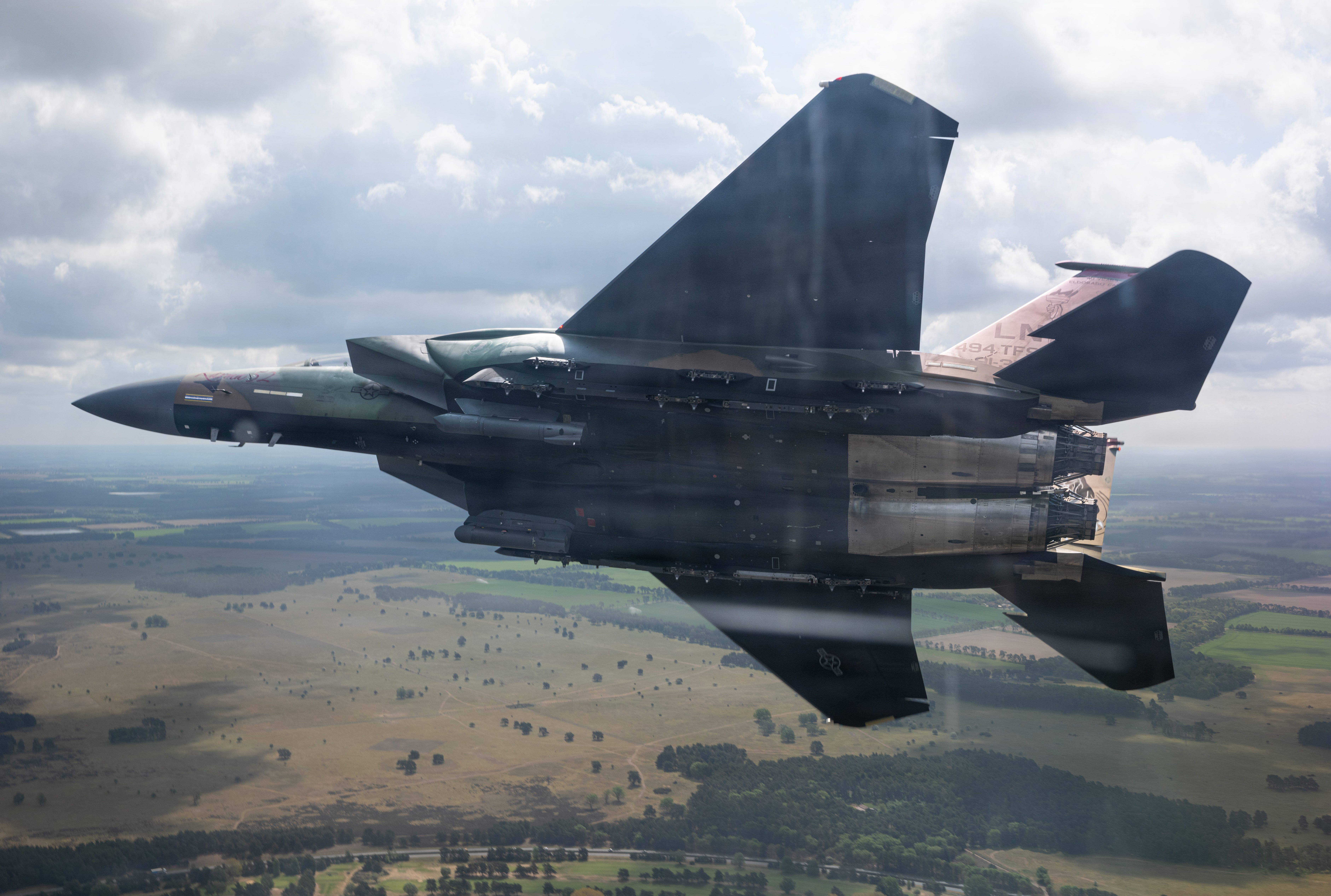
Fighters, down by a third. That’s air defense, strike, escort, and air policing missions that either don’t happen or fall to European air forces that are already stretched.
The specific numbers: F-15/F-15E available to NATO falling from 153 to 99.
Strategic bombers, cut by half. Long-range strike. The ability to threaten Russian targets at depth from outside the range of Russian air defenses. The weapon that makes Moscow nervous about what’s coming even before a war starts.
Aerial tankers, cut from 79 to 63. This one doesn’t get enough attention. Tankers are the gas station that makes airpower possible. Without tankers, fighters have shorter legs, strike packages cover less ground, combat air patrols are fewer and shorter, and the entire operational radius of allied airpower contracts.
Every tanker you remove makes every other aircraft slightly less capable.
Cruise-missile submarines: gone entirely from the NATO contribution. Zero.
Public reporting doesn’t reveal how many US submarines were previously assigned to NATO’s crisis-response force pool. That number sits inside classified force-generation planning. What matters is the direction of travel: whatever NATO planners previously assumed they could draw from US submarine forces, that contribution is now reduced to zero.
These are boats that can sit quietly in deep water somewhere in the Atlantic or Mediterranean and launch Tomahawk missiles at Russian command nodes, air-defense systems, ports, ammunition dumps, and missile launch infrastructure, from ranges and positions that Russian air defenses can’t easily reach.
They’re a “first-night” weapon, the kind that degrades Russia’s ability to fight before the ground war even starts. Removing them from the NATO plan is not a small thing.
P-8 Poseidons, reduced. The P-8 is the aircraft that hunts submarines. It’s also a maritime surveillance and anti-surface platform. Fewer P-8s means weaker coverage of the North Atlantic, the Baltic Sea approaches, the Arctic, and the Mediterranean.
Russia’s submarine fleet is not dormant. Russia’s Northern Fleet, which operates some of the most capable boats in the world, uses those waters as its operational playground.
Reconnaissance drones, cut by half. Eyes. The things that watch the battlefield and tell commanders what’s moving, where, at what speed, with what equipment. Fewer drones means less battlefield awareness at exactly the moment when awareness is most valuable.
Carrier strike group, one of two removed. A carrier is a floating airbase with its own air wing, escort ships, and strike capacity. It gives a commander flexibility, sea control, airpower projection without needing a land base inside the theater, and a deterrent visible enough that every satellite watching the Mediterranean or the North Sea can report its position to Moscow.
One carrier is not two carriers…
Put it together and the US is removing the wiring, the plumbing, and several of the load-bearing beams.
The Trump administration’s 2026 National Defense Strategy is explicit. US forces will focus on homeland defense and the Indo-Pacific and by God, the middle school bullies currently running my country are actually executing it.
Europe should take primary responsibility for its own conventional defense, with “critical but more limited” American support. Grynkewich framed it as “correcting a dependency,” not abandoning an ally.
Sure, I guess… But that quote is not entirely wrong. The United States has carried European defense disproportionately since 1949. The argument that Europe needs to grow up militarily is correct on the merits. It was correct when Obama made it, when Biden made it, when every NATO secretary general has made it with increasing frustration for thirty years.
The problem isn’t necessarily the destination. It’s the speed of the handoff and the condition of the road.
Europe doesn’t currently have a carrier strike group to replace the American one. It doesn’t have an equivalent number of cruise-missile submarines. It has fewer tankers than the cuts require it to cover.
It has gaps in maritime patrol, strategic bombers, long-range drones, and munitions stockpiles that can’t be filled by pressing a button or signing a contract this month. RUSI’s analysis of the cuts is diplomatic but clear: Europe can eventually fill these gaps if it moves urgently, but urgency and European defense procurement have historically not been on speaking terms.
Actually, I think the cuts fall heaviest on maritime and air assets, not on land forces. There are no reports of US brigades being pulled from Poland or the Baltics.
The conventional ground deterrent on the eastern flank, the one that’s supposed to make Russia calculate that invading Estonia involves fighting Americans, is not the thing being reduced (yet).
The immediate pain shows up somewhere else: the Atlantic, the Arctic, the Mediterranean, and the Baltic Sea approaches.
So, my readers who champion European independence from the US may be applauding this move. That’s fine… But there is real danger in the transition phase.
European officials have been worried for months about a potential Russian window of opportunity in the late 2020s, when Russia’s reconstituted military might feel capable enough to test NATO’s resolve while the alliance is still absorbing the cost and complexity of rearmament.
Whether the specific years 2028 or 2029 are right or wrong, in Putin’s mind, the underlying logic is sound: transitions create vulnerability, and vulnerability creates temptation.
The question is whether Europe can fill the gap fast enough to prevent the transition period from looking like an invitation.
If the US reduces its NATO contribution faster than European nations can commission A330 tankers, order P-8 equivalents, expand submarine fleets, and actually deliver munitions stockpiles that could sustain high-intensity operations for more than a few weeks, then deterrence thins exactly when it needs to be thickest.
I think the more interesting thing about the reshuffle here is that the Indo-Pacific is currently quiet, while there’s an active land and missile war going on in Europe. If you add that together with Trump’s proposed $1.5 trillion (42% increase) defense budget proposal for next year, I’d like to ask just what in the hell is all that US hardware going to do if the US has no interest in confronting Putin?
Maybe all this new hardware is just to get us on par with China?
An invasion of Cuba wouldn’t need new ships, aircraft, missiles, drones, AI infrastructure, Golden Dome missile defense, munitions stockpile replenishment, and pay/personnel increases. (Actually, I’m all for pay increases for the troops.)
But my point is that seems like a big investment in military power, just to have an idle military. Or, if Trump’s worst ambitions are realized, and he really does want the entire Western hemisphere under the stars and stripes, well, let’s just say that we’ll need all that hardware if he picks a fight with Canada and all of South America.
The Tomahawk Reversal Shows the Handoff is Already Getting Ugly
One last thing… The US decision to cancel sending Tomahawk-capable systems to Germany makes the NATO Force Model story much more serious.
Germany wanted Tomahawks because Europe has a long-range strike problem. Russia has spent years fielding systems that can hit deep into Europe from protected positions.
Iskander missiles in Kaliningrad already put Poland, Lithuania, and large parts of Central Europe under threat. The reported deployment of Oreshnik systems in Belarus only sharpens the problem.
Moscow has spent the last decade building a conventional and nuclear-capable missile threat that can hold European capitals, airbases, ports, logistics hubs, and command centers at risk.
Germany, meanwhile, is trying to rebuild a military that spent the post-Cold War era being slowly converted into a museum exhibit in Erlangen.
That’s why Berlin’s interest in Tomahawks and the Typhon ground-based missile system was kind of a big deal. Tomahawk-class weapons would give Germany the ability to hold Russian military targets at range; the kinds of targets that matter in the first days of a war, when NATO would need to blunt Russian momentum before it turns into another “temporary” occupation that lasts 70 years.
Now Washington is backing away, officially “out of fear that Moscow would view the deployment as escalatory.” But unofficially because Trump got his feelings hurt by Germany’s chancellor.
If we go with the official version, it’s too late to worry about escalation. Russia has already invaded Ukraine. It leveled cities. It moved nuclear-capable systems into Kaliningrad. It’s used drones, missiles, glide bombs, cyberattacks, sabotage, assassinations, energy coercion, and the usual Kremlin buffet of war crimes and deniable weirdness.
Moscow doesn’t need NATO restraint to not feel threatened. It feels threatened by countries existing without permission.
The other explanation may be more practical and just as alarming: the United States may not have enough missiles to spare. But for Germany, the message is ugly either way.
If Washington is withholding Tomahawks because it fears provoking Russia, Europe has a political reliability problem. If Washington is withholding them because US stocks are too thin, Europe has an industrial reliability problem.
The Upside, If Europe Can Move
I want to be fair about one thing, because this piece would be incomplete without it.
The Trump administration’s delivery on this issue has the verbal finesse of Bobcat Goldthwait. His tone is transactional, the words are often contemptuous of allies who have died alongside Americans in Afghanistan, Iraq, and Africa, and the timing is about the worst imaginable, given where Russia currently sits on the escalation ladder.
All of that is legitimate criticism.
But the strategic direction is not crazy. Europe spending more on its own defense, building genuine independent capability in tankers, maritime patrol, strike, submarines, and industrial production, is the right outcome.
The positive version of this story is that Europe accelerates procurement of A330 MRTT tankers, builds or buys P-8 equivalents, expands its submarine fleets, invests in long-range strike missiles, grows its air-defense industrial base, and develops the command-and-control systems that stop needing American architecture to function.
In the meantime, if Ukraine keeps bleeding Russia dry, Putin’s window of opportunity may never come. So it’s in Europe’s best interest to support the hell out of Ukraine.
Still, Europe is waking up and starting to slowly march in step.
The US reduction could be the shock that turns the European direction of travel into an irreversible structural shift. Or it could create a gap that Russia exploits before Europe fills it.
In my crystal ball, both outcomes are genuinely possible. Which one arrives first is the question that will define the next ten years of European security.
Слава Україні!


Europe has long range strike - FP-5. Germany should (assuming they haven't already) sign a contract to buy 500 FP-5s. Add in partnership between MBDA or similar European missile manufacture to upgrade the terminal and guidance electronics you'd have something that works and works as needed. Germany can even pay for a 2nd factory in Germany to expand manufacturing capability.
…so US absolutely sure it’s not going to need any help at any point right?
…Europe is on its way to upgrade its military capabilities using recent and on going experience in Ukraine to serve itself better without the US, and i’m absolutely sure that that in the future trump will crawl back asking for help
…arrogance and ignorance is no substitute for intellect