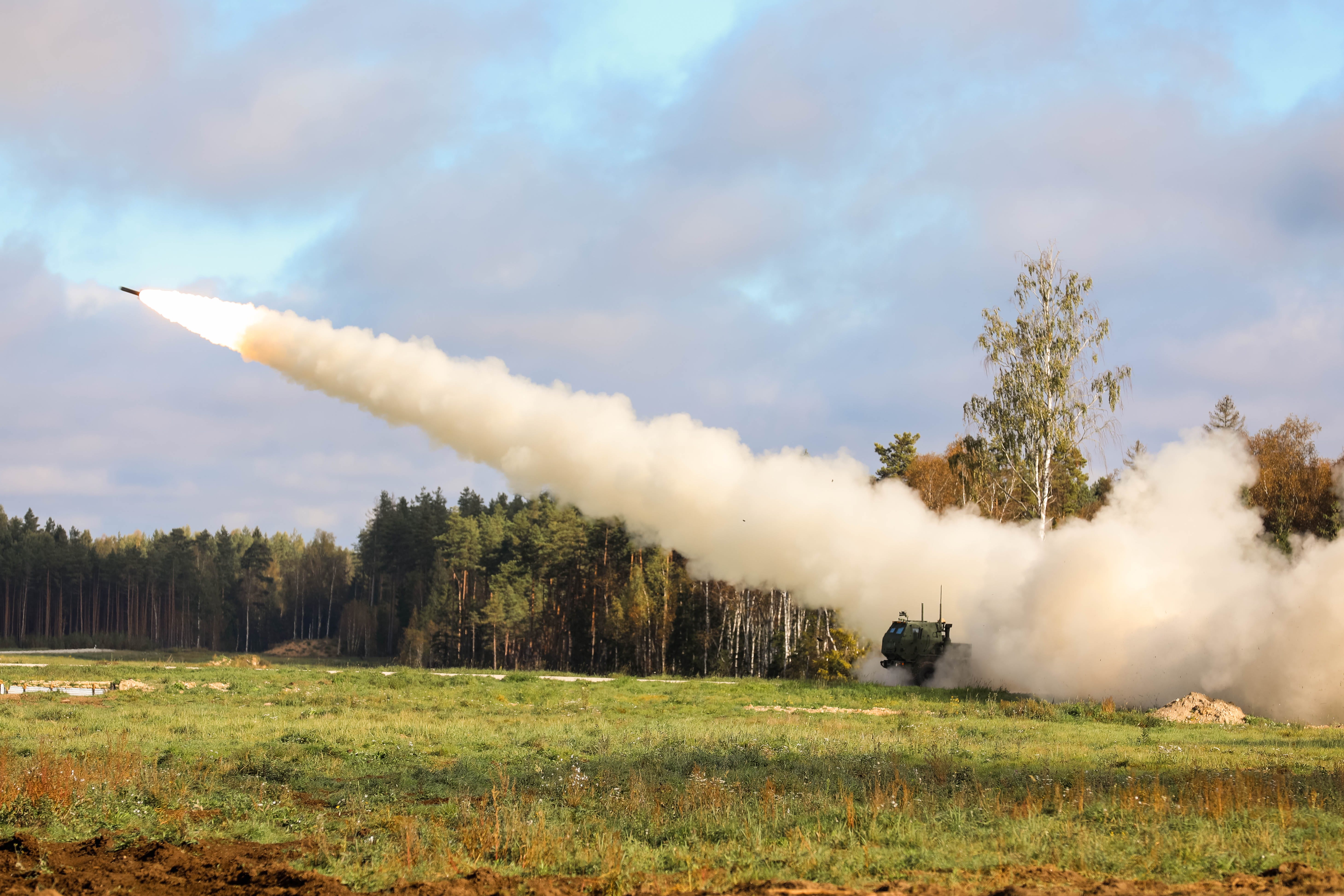
What Happened to Ukraine’s ATACMS?
One of Ukraine's best weapons barely gets used. Why?

When the Kyiv Independent reported Ukraine’s February 24th ATACMS strike on Russian command posts, the headline used one word that caught my attention: “rare.”
Not “major.” Not “significant.” Just plain rare.
A weapon capable of hitting targets 186 miles away, that Ukraine has been asking for since 2022, that finally arrived in meaningful numbers, that Russia has openly feared since the moment the first crate landed in Kyiv; and the press is treating each use like a celebrity sighting.
Hey! It’s Cillian Murphy. You don’t see him in public much…
Hey! It’s ATACMS. You don’t see him in public much…
So, I think there’s a story worth understanding that involves a trifecta of constraints: policy, supply, and Ukrainian strategy. And the result has turned America’s most capable ground-launched munition into something Ukraine fires like it’s a last cigarette; saving it until after you’ve finally nailed your long-time crush, or after surviving a black bear encounter in Michigan’s upper peninsula.
What ATACMS Actually Is
ATACMS (pronounced like Attack-mmms. Just think about Steak-ums) used to be the Belle of the ball. In 2024 you couldn’t open a Chrome tab without seeing an ATACMS headline.
So what is it? ATACMS, Army Tactical Missile System, is a ballistic missile fired from Ukraine’s HIMARS launchers. The long-range version reaches out to 300 kilometers with either a unitary warhead that hits one thing very hard or cluster munitions that blanket a large area with shrapnel.
It flies a high arc trajectory, it’s survivable against most Russian air defenses when they’re not specifically cued against it, and it can reach targets that many other weapons in Ukraine’s ground-launched arsenal simply cannot touch.
Airfields? ATACMS loves these.
Command posts deep behind the front? ATACMS’ specialty… Like Gordon Ramsey’s Beef Wellington.
Logistics hubs Russia considered safe? Forgetaboutit. Bada-bing. ATACMS loves logistics more than FedEx.
The S-400 battery Russia parked at Kursk thinking the range buffer would protect it? Whole bunch of nope.
ATACMS is the weapon that forced Russia to move things.
To harden things.
To scatter things.
Even the threat of it changes Russian behavior, which means even the missiles sitting unfired in Ukrainian custody are still doing strategic work.
Ukraine first received shorter-range ATACMS versions in fall 2023. The longer-range upgraded models began arriving in spring 2024.
And from the moment they arrived, the supply was finite, the permissions were complicated, and the political sensitivity around them never fully went away.
Here’s where the permissions history is genuinely messy and reading it requires holding multiple contradictory statements in your head simultaneously.
Since spring 2025, a case-by-case approval process overseen by current Defense Secretary and future ICC detention center resident (in Scheveningen, Netherlands) Peter ‘Aloysius’ Hegseth, effectively blocked ATACMS strikes inside Russia as Washington tried to nudge Moscow toward peace talks.
Note: I’m 99 percent sure Pete’s middle name is not “Aloysius.” I don’t feel like looking up his real middle name, so let’s go with it.
On at least one occasion in 2025, Ukraine sought to use ATACMS against a target on Russian territory and was rejected outright.
Then October 2025 got messier. Germany’s chancellor confirmed that Ukraine’s major allies had loosened restrictions on long-range Western weapons, while simultaneously Trump was publicly saying the US hadn’t approved long-range missile use.
Both statements are technically true; allied loosening and continued US political sensitivity aren’t mutually exclusive; it just means the permissions architecture was shifting, contested, and not cleanly resolved by a single announcement.
Now pause and think about what that permissions architecture actually looked like from inside Ukraine’s military command structure.
At any given moment in 2025, Ukrainian forces were operating British Storm Shadows with one set of restrictions, French SCALP missiles with a slightly different set, US-supplied ATACMS with yet another, HIMARS with conditions attached to specific munition types, and domestically produced drones with essentially no foreign restrictions at all.
Each weapons system carried its own political terms of service. Each had different approved target categories, different geographic boundaries, and different approval chains that ran back through different capitals with different threat assessments and different domestic political pressures.
What a cluster f*ck.
Someone inside the Ukrainian General Staff had to know all of that, keep it current as policies shifted, and make sure the right information reached the right unit before the wrong weapon got fired at the wrong target and triggered a diplomatic crisis on top of a shooting war.
The real danger here, for Ukraine, would be pissing off a donor nation and no longer receiving material support. That’s a full-time operational discipline running parallel to the actual war.
The fact that Ukraine managed it, mostly without catastrophic permissions violations reaching public record, is an organizational achievement that deserves more credit than it gets.
If Russia were operating under the same constraint, it would have fired the wrong missile at the wrong target inside a NATO country inside of six weeks and blamed it on a low-level conscript operating a weather balloon. Ukraine kept the plates spinning for years.
The last recorded ATACMS strike inside Russia before the November 2025 resumption was January 14, 2025, in the final days of the Biden administration. That’s a gap of roughly ten months between confirmed cross-border uses.
During that entire period, Ukraine was still striking deep into Russian-held territory. Just not with ATACMS.
The November 19, 2025 strike appears to be the first confirmed ATACMS use into Russia under the Trump administration, pointing to a shift in policy and the possibility that another batch of the missiles had possibly been supplied.
Then February 24, 2026, the anniversary of Russia’s full-scale invasion, saw Ukraine fire ATACMS at Russia’s 5th Army command post and the elite Rubikon drone center. The Kyiv Independent called it a “rare strike,” noting that the last confirmed use before that had been November 19.
That’s two confirmed strikes in the public record across roughly three months. That’s not exactly an operational tempo.
The Supply Problem Underneath the Policy Problem
When Biden gave Ukraine the green light to launch ATACMS into Russian territory, Ukraine likely had only about 50 missiles left in its arsenal, according to two senior US officials.
Fifty. For context: in the opening days of Operation Iraqi Freedom in 2003, the US fired roughly 800 ATACMS. I can’t locate solid confirmation of how many the US has used against Iran in Epic Fury, but we do know that the US is using them, (and the newer Precision Strike Missile or PrSM, pronounced Pri-zim).
So, Ukraine’s entire allocated stock across the period when most of the meaningful permission decisions were being made was 50 rounds.
Under Trump and Aloysius Hegseth, Ukraine is thought to have received relatively small donations of long-range Western weapons overall, often relying on long-range strike drones or homegrown long-range missiles not subject to the same restrictions.
The supply line for ATACMS runs through US inventories, US production priorities, and US political decisions.
Ukraine controls none of those.
While ATACMS had major lasting battlefield effects, it never proved to be a decisive factor based on the tiny quantities provided.
That’s not a criticism of the weapon. It’s a criticism of the quantity.
You can’t build operational tempo around 50 missiles. You can’t even build a sustained campaign around 50 missiles. What you can do is spend them carefully on the targets that justify the cost, the signal, and the political conversation that follows every use.
That’s exactly what Ukraine has been doing.
Why “Homemade” Filled the Gap
I would argue that ATACMS limitations in quantity, and the political headaches combined, actually propelled Kyiv forward along the path of fast-tracking it’s many homegrown solutions.
If ATACMS are scarce and permissioned, you build your tempo around what you can produce, iterate, and launch in volume.
A drone campaign doesn’t require Washington’s sign-off. It doesn’t draw down a finite magazine that can’t be replenished quickly. It doesn’t generate the escalation conversation that follows every ATACMS headline.
But drones aren’t the only answer Ukraine built. Because while everyone was watching the drone numbers, Ukraine was quietly doing something more ambitious: building its own cruise missile from scratch.
The FP-5 Flamingo is a Ukrainian ground-launched cruise missile developed by Fire Point, a defense startup founded by a group of friends from non-military backgrounds like construction, game design, and architecture.
Yup. The people who built Ukraine’s most capable long-range strike weapon were not defense industry veterans. They were civilians who decided the country needed a cruise missile and figured it out.
According to Politico, the system went from concept to its first successful battlefield test in under nine months.
The Flamingo carries a 1,150-kilogram warhead, has a claimed range of 3,000 kilometers, flies at roughly 50 meters above the ground on constantly changing vectors, and costs around $500,000 per unit. For comparison, a Tomahawk costs between $1.5 and $2 million per unit and carries roughly 450 kilograms, about a third of the Flamingo’s payload, at roughly half the range.
Ukraine built a heavier, longer-ranged cruise missile for a quarter of the price, powered by refurbished Soviet-era jet engines sourced from aging stockpiles via scrapyards, with a carbon-fiber fuselage that can reportedly be manufactured in six hours.
Ukraine first reported Flamingo deployments in November 2025.
On February 21, 2026, the General Staff confirmed using Flamingo missiles to strike the Votkinsk Machine Building Plant in Udmurtia, roughly 1,400 kilometers from Ukraine, a facility that produces Iskander ballistic missiles and components for Russian ICBMs.
Missile analyst Fabian Hoffmann called it “the first time Ukraine has successfully struck a core target of Russia’s missile industry directly using a heavy missile capability.”
Confirmed Flamingo strikes now include the Votkinsk plant, the Kapustin Yar test range in Astrakhan, and an FSB facility in Crimea.
More recently, Fire Point unveiled the FP-7: a medium-range ballistic missile with a 200-kilometer range, and the FP-9, a deeper-strike system with a claimed range of 855 kilometers and an 800-kilogram warhead, designed for command centers and logistics infrastructure well beyond the front.
Ukraine is building a tiered domestic strike architecture that spans tactical to strategic range bands, with zero foreign approval required for any of it.
Zelensky said explicitly on August 24 that Ukraine does not coordinate the use of domestically produced long-range weapons with the United States. And why would they? You can’t fence in a weapon you didn’t provide.
Then there’s Ukraine’s veritable Noah’s Ark of one-way attack drones… And these animals solve practical problems ATACMS can’t.
Industrial control is the first one. Ukraine can produce drones domestically, adjust designs based on battlefield feedback in weeks, and scale output without waiting on US production cycles or congressional appropriations bullshit.
The feedback loop between a drone getting jammed and the next software update arriving at the front is measured in weeks in Ukraine. For a foreign-supplied missile, that loop runs through Arlington, Virginia, and takes considerably longer.
Cost and volume is the second. A single ATACMS shot represents a major investment and a significant political signal. Drones can be launched in waves across multiple target sets simultaneously, forcing Russian air defenses to spend missiles on cheap threats before the expensive ones arrive.
Targeting flexibility is the third. ATACMS is optimized for fixed, high-value targets like airfields, command nodes, large logistics hubs. Drones are better for persistent pressure: oil infrastructure and repeated strikes on industrial facilities.
The result is a rational Ukrainian behavior pattern: conserve ATACMS for the moments that justify the cost and the political noise and run the daily strike campaign with drones.
Missiles buy moments of dominance. Drones buy months of attrition. Ukraine needs both.
What the February Strike Actually Signaled
The February 24th strike is worth unpacking because the target selection tells you something about how Ukraine is thinking about ATACMS right now.
Russia’s 5th Army command post. (BLAMMO!)
The Rubikon drone center. (Trust me, these guys deserved it)
Ammunition depots and logistics nodes across Donetsk and Zaporizhzhia. (Nice)
To me, that looks like a coherent effort to hit command and control infrastructure supporting Russian offensive operations, on the anniversary of the full-scale invasion, with an American-made missile in short supply.
Wait… So why not use Flamingo or a homegrown alternative?
Well, it points to the possibility that another batch of ATACMS had been supplied to Ukraine.
The US Army has been receiving the first tranches of the Precision Strike Missile and those deliveries may have freed up additional ATACMS rounds for Ukraine without drawing down missiles the US needs for its own adventures in Southwest Asia.
But there are other, perhaps more compelling reasons too: Zelensky confirmed on February 23rd, the day before those strikes, that a Russian attack had disrupted Flamingo production. He said "there was a delay in production" and that Ukraine doesn't have "many" Flamingo missiles right now. You don't spend from a depleted magazine on an anniversary strike when you have ATACMS available.
Also, the Flamingo has a survivability problem against dense air defenses. With a six-meter wingspan and a mass over six tons, it's highly visible to air defenses. The design is intentional; it's built for deep-strike missions where enemy air defenses are sparse.
Not to mention that ATACMS is a ballistic missile. The Flamingo isn’t. ATACMS flies a high-arc ballistic trajectory at supersonic speeds, which makes it significantly harder to intercept than a subsonic cruise missile.
Against a time-sensitive, defended target like a command post, that survivability profile matters enormously.
Still, it’s worth remembering that three years ago, Ukraine’s survival depended entirely on what Western capitals decided to ship and when they decided to permit it.
Today, Ukraine has a domestic cruise missile that can reach a ballistic missile factory 1,400 kilometers inside Russia, built by people who used to design video games.
In my mind, that’s a country that looked at its own dependency and decided, methodically and under fire, to MacGyver its way out of it. Richard Dean Anderson, eat your heart out.
Whatever happens at the negotiating table, that capability doesn’t go away when the war ends.
The most dangerous weapon in Ukraine’s arsenal right now isn’t the one Washington supplied.
It’s the one Washington can’t take back: Ukrainian ingenuity.
Smoke ‘em if you got ‘em.
Слава Україні!


Wow, those savvy Ukrainians are damn smart! We need them to be part of Europe.
is it any wonder that all the russian air and army planes munitions etc were built by ukranians, well done to them