


Exclusive for Paid Subscribers every Wednesday and Sunday. Thanks for helping support independent analysis. -W
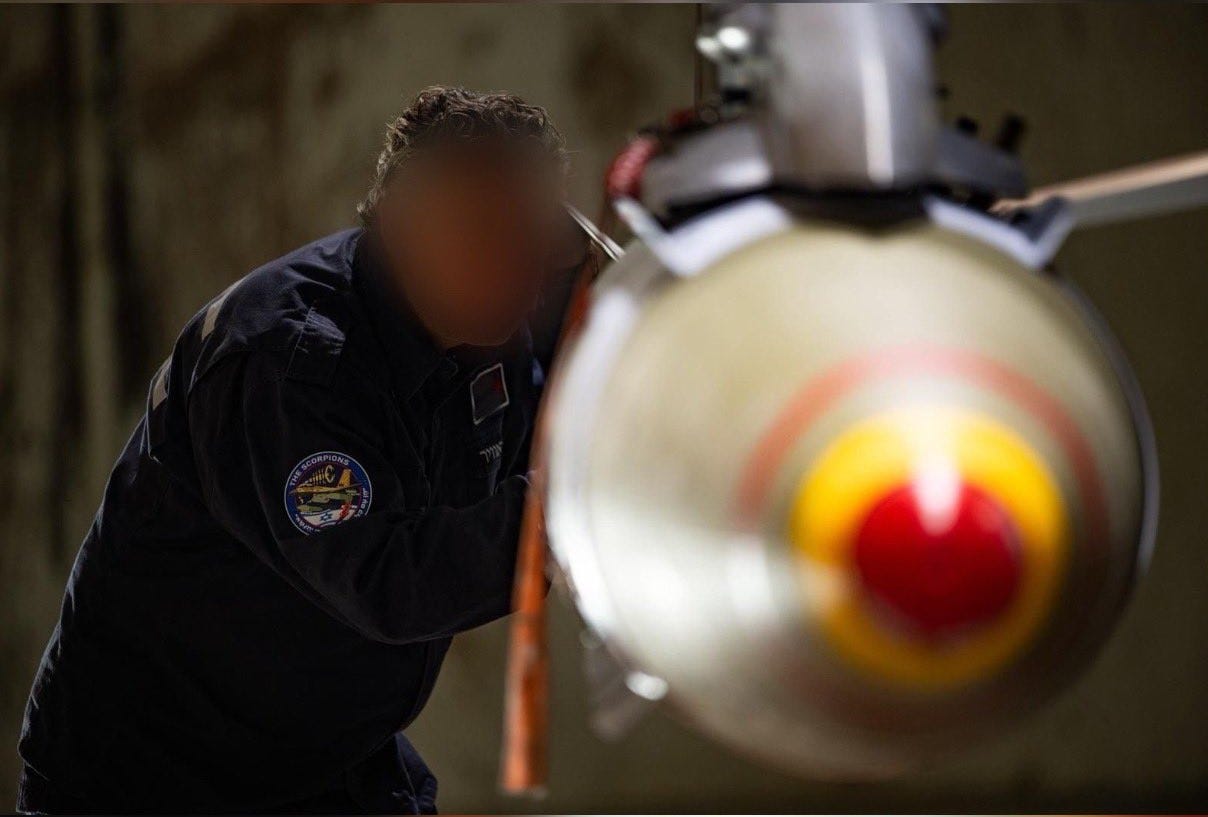
The IAF posted imagery on their official X account showing an F-16C/D Barak returning from a mission deep into Iranian territory, including over Tehran itself.
Standard wartime communication. Morale content.
The commander of Ramat David Air Base included a statement: “We are flying deep into enemy territory and over its capital city, Tehran, with determination and a profound sense of mission. We will not stop.”
Inspiring stuff. One wrinkle: the bombs visible under the wing of that F-16 are not standard bombs.
Then the photos were quietly taken down shortly after posting. But by that point, the open-source intelligence community had already downloaded, zoomed in, and started asking questions that neither Israel nor the United States appear eager to answer.
First: What Is a JDAM, and Why Does This One Look Different?
Before we get into the mystery, a quick foundation for readers who aren’t ordnance nerds. No shame in that, I wasn’t either until the Air Force made me one.
A JDAM is not actually a bomb. It is a guidance kit. The Joint Direct Attack Munition system takes an existing dumb bomb body, most commonly from the Mk 80 series, which includes the 500-pound Mk 82, the 1,000-pound Mk 83, and the 2,000-pound Mk 84, and converts it into a precision-guided weapon by bolting on a GPS-guided tail section with control fins and stabilizing strakes.
The result glides toward a GPS-designated target with a circular error probable of about five meters. Boeing manufactures the kit.
The US has transferred thousands of them to Israel and an unspecified number to Ukraine.
The bomb in the IAF imagery is a GBU-31, which is the designation for a standard Mk 84 2,000-pound bomb body mated to a JDAM guidance kit.
You have seen GBU-31s in virtually every conflict photograph from the last twenty years. They are workhorses. They are also, in standard configuration, not particularly mysterious.
What makes this one interesting is the color.
Military ordnance markings are not decorative (unless you’re writing a custom message for your enemies). They are a standardized communication system, because when you are loading 2,000-pound bombs onto aircraft in low light with ground crews who may not speak the same language, color-coding is the difference between the right weapon on the right target and a catastrophic loading error.
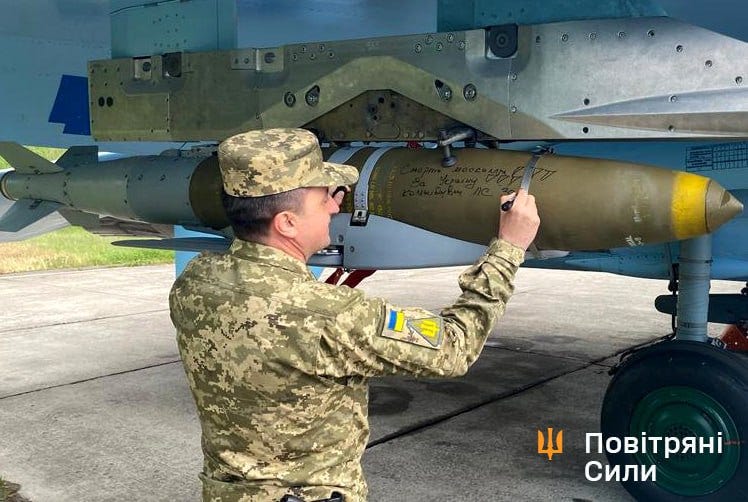
Under US standard munitions marking conventions, the yellow band visible near the front of the bomb is familiar and expected. Yellow indicates a high-explosive filling.
