


Hey friends.
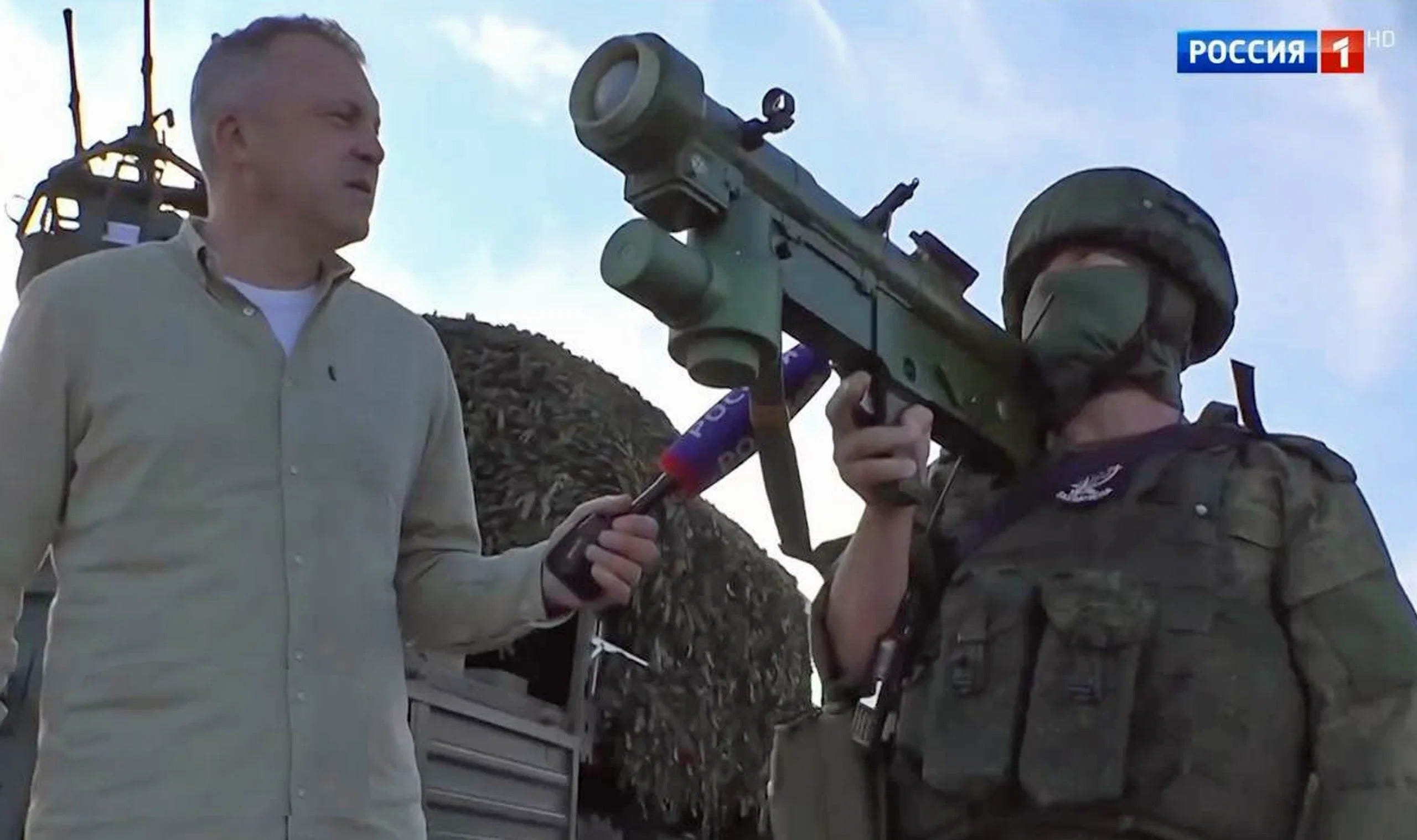
Russian state television recently aired what was presumably supposed to be a reassuring segment about the brave Ruski men protecting the skies over Rostov.
Instead, somebody watching the footage noticed that one of the soldiers was holding an air-defense missile that apparently nobody outside Russia had seen before.
The War Zone’s Thomas Newdick dug into the imagery and found something strange. The shoulder-fired launcher does not look like Russia’s familiar Igla or Verba MANPADS. Russian personnel in the footage reportedly called it “Iva,” which means willow in Russian, an amusing botanical cousin to Verba, another kind of willow and the name of Russia’s current 9K333 shoulder-fired missile.
Very Russian.
If your new missile looks suspiciously foreign, apparently the first order of business is to give it a tree name and hope nobody asks too many questions.
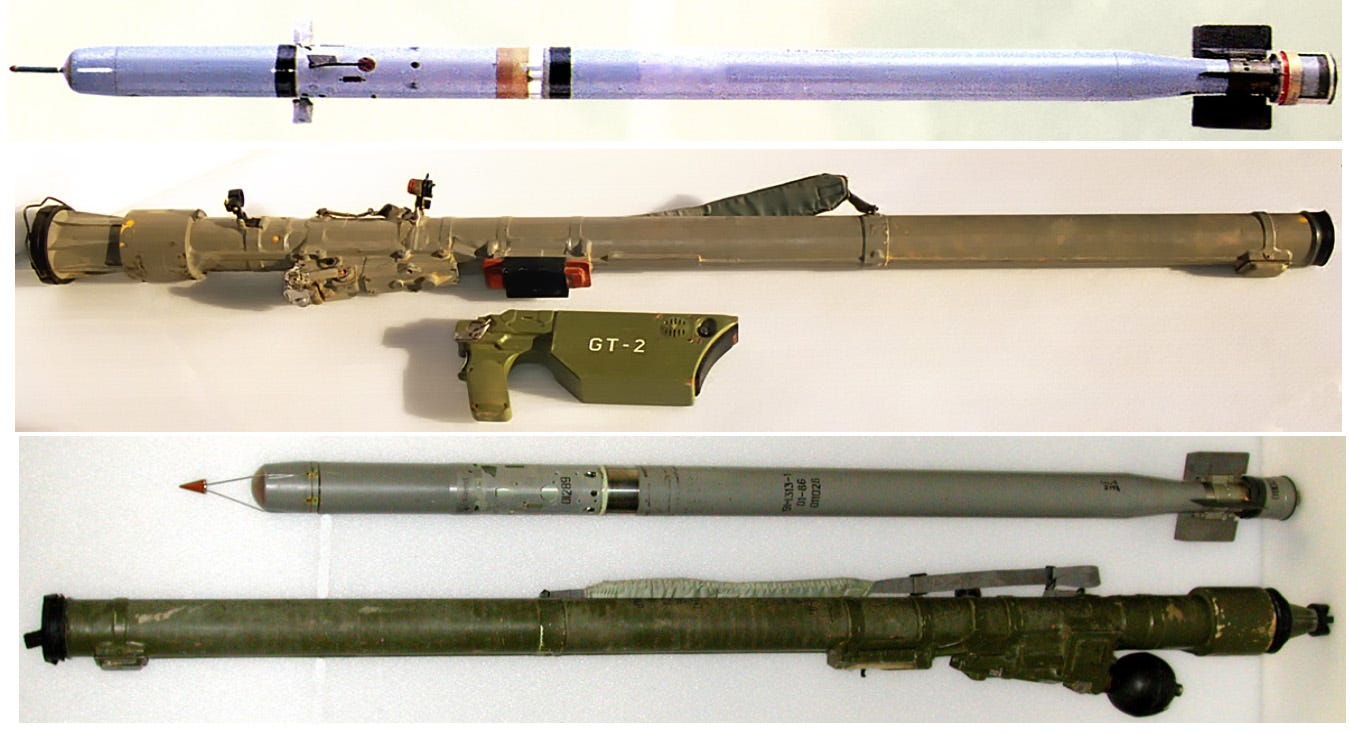
Open-source analysts have compared the launcher to China’s QW-series MANPADS, especially the QW-18, QW-18A, and QW-19. The box-shaped component beneath the forward portion of the launch tube appears particularly similar to Chinese designs.
Iranian Misagh missiles remain another possibility because Iran’s MANPADS family itself descends from Chinese technology.
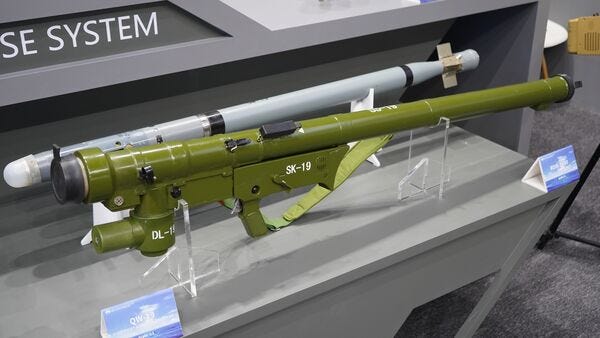
We don’t know what the weapon is yet.
It might be Chinese. It might be Iranian. It could be a Russian-made derivative, something acquired for evaluation, or even a system that reached Russia through some convoluted arms-transfer route that future historians will spend several years untangling.
But there’s another possibility that interests me more.
Why is a mystery MANPADS showing up with a Russian mobile air-defense group in Rostov in the first place?
In mother Russia, air defense is becoming infantry work
I spent part of my military career as an infantryman, and MANPADS have always made me giddy for the same reason Javelins do: They democratize killing something very expensive.
Infantry work is usually a zero sum proposition. One human from Country A shooting a bullet at another human from Country B.
But give private Joe Snuffy a MANPAD, and it’s game on.
You can spend tens or hundreds of millions of dollars designing an aircraft capable of doing all kinds of spectacular bullshit, and somewhere underneath it may be a 19-year-old grunt standing next to a tree with a launch tube on his shoulder, and he’s pissed because he just smoked his last cigerette.
War occasionally has a dry sense of humor.
A grunty MANPADS team doesn’t need a dedicated search radar, a command vehicle, a convoy of support trucks, and forty people keeping the whole air defense machine alive.
A small team can move into position, watch a sector, receive warning from another sensor, and fire when a suitable target appears.
That tactic becomes useful when the thing you are trying to defend is enormous.
Russia is enormous.
Ukrainian drones have attacked oil refineries, military airfields, fuel depots, logistics hubs, weapons factories, and other infrastructure deep inside Russian territory. The Security Service of Ukraine said its September 17 operation struck three aircraft, three helicopters, and other targets at Rostov-Central airfield before hitting the Yaroslavl refinery in the same operation.
Russia can’t possibly park a Pantsir beside every refinery, ammunition warehouse, substation, airfield, fuel tank, and factory across eleven time zones.
So, it’s starting to hand more grunts launch tubes instead.
Welcome to the party, pal. Ukraine spent years developing mobile fire groups because it had no other choice.

Small teams began roaming likely flight paths with heavy machine guns, thermal optics, searchlights, MANPADS, acoustic sensors, technicals, and whatever else might put enough metal between a Shahed and its destination.
Those mobile groups became one layer in a much larger air-defense network.
Russia is now facing the same economic problem from the opposite direction.
Ukrainian long-range drones cost far less than the high-end Russian missiles required to engage them. They also arrive in enough numbers that even a capable air-defense network can become saturated.
Meduza’s examination of Russian defenses around Moscow earlier this year concluded that Russia still lacked the kind of integrated drone-defense architecture Ukraine has spent years constructing. Among the gaps were detection coverage, automated information sharing, interceptor drones, and enough mobile fire teams armed with cheap weapons to protect widely dispersed infrastructure.
ISW reached a similar conclusion during the spring, assessing that Russia had not yet deployed enough mobile fire teams and other low-cost distributed defenses to protect the large number of facilities vulnerable to Ukrainian long-range drones.
The Kremlin finally appears to have noticed.
In April, authorities in Russia’s Leningrad region announced plans to create 54 additional mobile air-defense groups (PDF) on top of roughly 80 already operating there. Officials specifically recruited veterans and reservists after Ukrainian drones repeatedly hit oil and export infrastructure in the region.
By September, the Kremlin was going even further.
The Financial Times reported that Russia was pressuring private companies to defend their own infrastructure against Ukrainian drones. Businesses have been spending money on electronic warfare, nets, detection systems, and other counter-drone measures as the Russian state struggles to protect everything Ukraine might decide to attack.
Imagine being the manager of a Russian widget-maker and discovering that missile defense has somehow become another line item between payroll and industrial maintenance.
Welcome to the war, comrade. Oops, I mean special military operation.
So where did “Iva” come from?
Okay, so, the launcher shown in Rostov has some obvious similarities to Chinese QW-series weapons.
China has produced several generations of shoulder-fired air-defense missiles, and those designs have traveled widely. Iran imported Chinese QW-1 and QW-18 systems beginning in the 1990s and later assembled related weapons domestically as the Misagh-1 and Misagh-2.
Small Arms Survey research has documented (PDF) Chinese-designed MANPADS appearing across the Middle East, sometimes through networks associated with Iran.
Then there is Iran’s newest shopping list.
In July, Tehran was preparing to receive between 300 and 400 Chinese-made MANPADS under a contract valued at roughly $60 million. The package included QW-12 and FN-16 systems and was arranged through a Hong Kong-based intermediary.
For their part, Chinese officials called the report groundless, while Pakistan denied reports that the weapons would transit its territory.
That doesn’t necessarily mean the Russian weapon came through Iran. Arms supply chains are rarely that simple.
Russia could have purchased the weapons directly. Iran could have supplied a derivative. Moscow could be testing a foreign design. Russia might be manufacturing its own version. The launcher could even represent a tiny batch that tells us nothing about wider procurement.
We need more photographs, markings, packaging, or captured hardware before anyone gets too excited.
Still, the possible lineage fits a much bigger wartime pattern: Russia has turned increasingly toward foreign suppliers since 2022.
Iran provided the original Shahed architecture that Russia adapted into the Geran family.
North Korea has supplied enormous quantities of artillery ammunition, ballistic missiles, and other equipment.
China has become an important source of machine tools, electronics, and dual-use components that keep Russian factories operating despite Western sanctions, although Beijing denies providing lethal military assistance.
A Chinese-derived shoulder-fired missile appearing in Russian hands would hardly be the strangest development. There’s also a bit of irony here: Chinese MANPADS have already shown up in Ukraine.
Everybody apparently owns a Chinese MANPAD now

Late last year, Ukrainian troops were photographed with Chinese FN-6 MANPADS. One Ukrainian mobile fire group reportedly used an FN-6 during an engagement against a Russian cruise missile.
Then, in May, Ukraine’s 160th Mechanized Brigade published photographs showing FN-16 systems with its air-defense troops.
Nobody has established where those weapons came from.
China didn’t announce a shipment to Ukraine. Several countries operate Chinese MANPADS, and weapons can migrate through third-party transfers, captured shipments, intermediaries, and decades-old stockpiles in ways that make tracing them remarkably difficult.
Hell, you can probably buy them right now on Alibaba.
So, we may now have Chinese-designed shoulder-fired missiles appearing on both sides of the Ukraine war, neither with a particularly transparent supply chain.
Globalization has finally achieved something… Unfortunately, it’s distributed short-range air defense.
But… Russia already makes decent MANPADS, which makes this stranger.
Russia is not a banana republic desperately trying to develop its first shoulder-fired missile; it’s been building MANPADS for decades.
The Igla family has been exported around the world, and the newer Verba is a modern Russian system designed to engage low-flying aircraft and drones.
So why would Russia bother with a foreign weapon?
There are several possibilities:
Quantity may be the simplest explanation.
Russia’s factories have been operating under enormous wartime demand for more than four years. Every production line has opportunity costs. If Moscow can buy a few hundred acceptable short-range missiles from somewhere else, those weapons can protect a refinery or airfield while Russian plants concentrate on higher-priority systems.
It could also be an evaluation.
Russia has spent this war pulling useful foreign technology apart, incorporating components, copying designs, and modifying weapons faster than peacetime procurement systems would normally tolerate.
Perhaps “Iva” offers something Russia likes.
Perhaps the seeker performs better against particular drone signatures.
Perhaps somebody found a warehouse full of them at a price the Russian Defense Ministry found attractive.
Perhaps Russia simply needs more tubes than its existing manufacturers can provide.
One appearance can’t answer any of that.
The launcher could eventually turn out to be Chinese, Iranian, North Korean, Russian, or assembled by three companies registered above restaurants in Dubai.
I certainly want to know.
But the soldier holding it still tells us something important. Ukraine’s long-range strike campaign has forced Russia to disperse air defense into places where Moscow once assumed strategic depth would protect it.
That, my friends, is expensive.
Every soldier watching the sky over Moscow is a soldier doing something else instead of fighting in Ukraine. This is what successful long-range strike campaigns do even when the attacking drone misses…
They force the defender to spend money everywhere.
Слава Україні!
Could Manpads be an effective Ukrainian air defense approach against high intensity jet drone attacks?
I really wonder about soviet era left over IFF signals🎛️ and signatures⚡ if VLAD is handing out hundreds (thousands / tens of thousands?) of MANPADS to moderately trained ivans 🏗️🏭 🛤️🚂 at the local factory or railstation? 📡💥 This just sounds like another 😬 friendly fire recipe for disaster. (Malaysia Air, Commercial Aircraft, military transports, etc) ⚰️ One itchy trigger finger and that's a mess! Kiev, so far, has avoided that since 2022 for the most part, not sure Russia can show the same kind of 🎯🛑 discipline across that much geography....