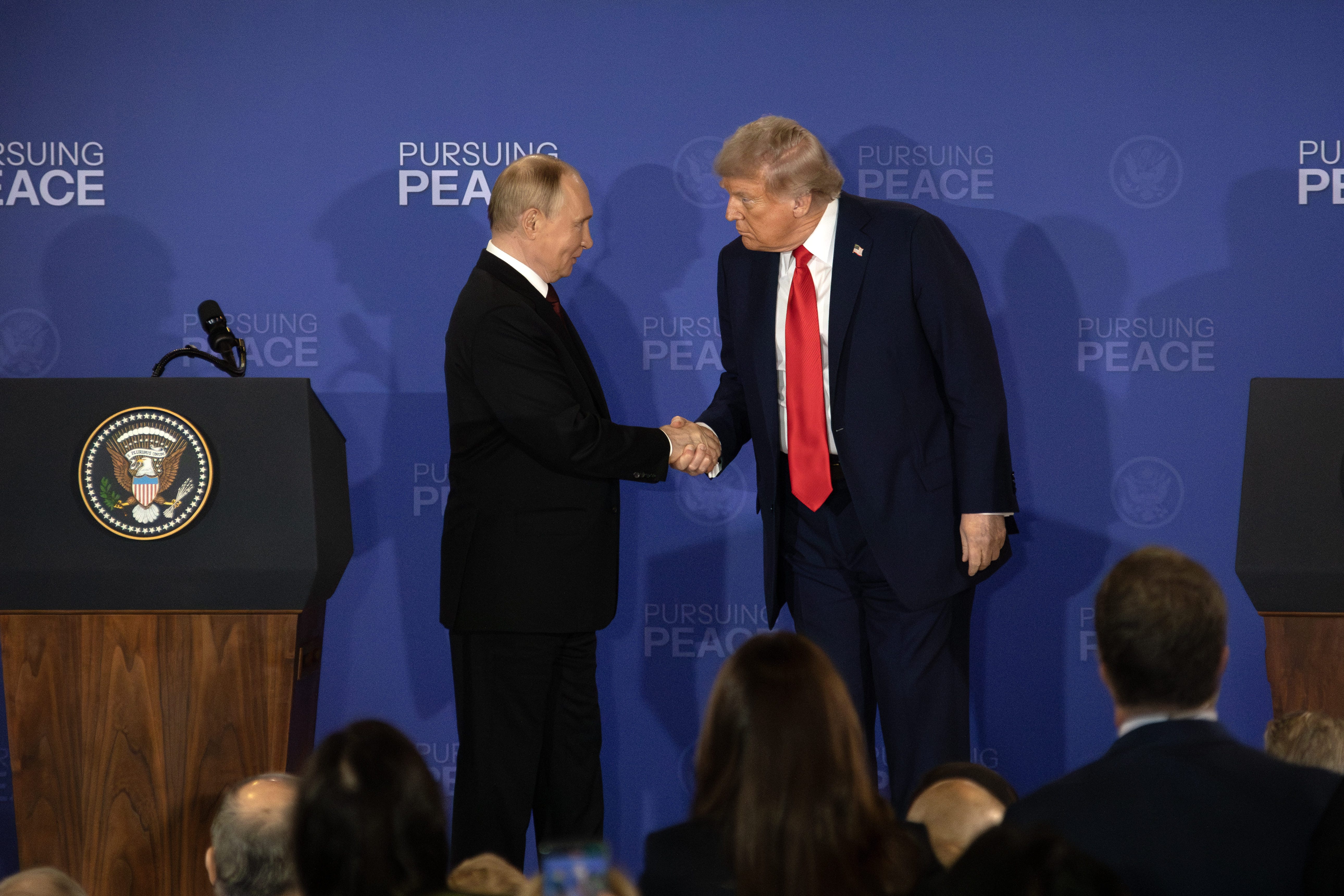
Trump May Have Accidently Made Ukraine Much Stronger
Trump set out to shrink America’s fingerprints on this war. Ukraine responded by shrinking America’s grip on it.

Trump’s indifference to Ukraine accidentally freed Kyiv to fight the war it always wanted to fight.
Let’s call it… permission independence. Under Biden, every long-range Ukrainian strike had to clear an invisible checkpoint in Washington, staffed by Biden officials terrified that the wrong missile at the wrong refinery might be the thing that finally convinces Putin to go “all nukey.”
Under Trump, that checkpoint didn’t really get braver. It got absolutely abandoned, because the guy who used to work it stopped showing up for his shift.
And Ukraine, being a country fighting for its life, did the only sane thing available to a nation that can no longer count on its biggest patron: it built its own checkpoint, then quietly demolished the old one.
The cage Biden built out of good intentions
Let’s be fair to the previous administration here, because the restraint was based on fear, and in the first year of this war, the fear wasn’t entirely crazy.
The Biden administration pushed roughly $175 billion in total assistance out the door for Ukraine, the largest American aid commitment to a foreign war since the Marshall Plan rebuilt Europe after World War II.
That money bought Javelins and Stingers in the war’s first desperate weeks, then HIMARS by summer 2022, giving Ukraine the ability to hit Russian ammo depots and command posts from 50 miles out for the first time.
Then came Patriot batteries, at over a billion dollars a system, which went on to do something nobody thought possible and shot a Russian Kinzhal hypersonic missile clean out of the sky, a weapon the Kremlin had marketed as unstoppable.
Then Abrams tanks, Bradleys, cluster munitions to cover a 155mm shell shortage, and eventually F-16s, routed through allied training pipelines even when Washington wouldn’t send the jets directly.
Thirty-six countries sent major arms to Ukraine in this stretch of the war, and the United States carried roughly half that weight alone. None of that happened because Biden was indifferent. The opposite of Trump’s disinterest is exactly what Biden gave Ukraine, for better and for worse.
But here’s the catch: Every one of those systems arrived bundled with a use permission slip, and the slip usually showed up months after the weapon did.
Take ATACMS, the Army’s long-range ground-launched missile, capable of hitting targets nearly 200 miles out.
Ukraine asked for it within weeks of the 2022 invasion. Washington said no for a year and a half, worried that handing Kyiv a missile that could reach deep behind Russian lines would read in Moscow as the kind of provocation that gets the nukes warmed up.
Of course, this was preposterous at the time, and I wrote extensively about it on Medium. The so-called “escalation” and worries about crossing Putin’s “red lines” were always bullshit.
I even made the case that even if Putin were suicidal, half or more of Russia’s strategic arsenal likely remains inert due to the widespread grift and corruption which became evident after 2022. After all, nuclear bombs are expensive as fuck to maintain, and effective deterrence only requires the opponent to believe the nukes work. Maskirovka at its finest.
Only in October 2023, after Ukraine had already been quietly firing French and British missiles of similar range without triggering the apocalypse everyone feared, did Biden relent, and even then, he handed over only the shorter-range variant, capped at about 100 miles, while the longer version Ukraine actually wanted sat in a warehouse.
The extended-range missiles didn’t show up until April 2024. And once Ukraine had the things in hand, it couldn’t point them anywhere useful.
Permission to fire ATACMS into Russian territory itself, rather than just at occupied Ukrainian land, didn’t arrive until November 17, 2024, roughly two and a half years into the war and barely two months before Biden left office.
F-16s ran the same obstacle course. Ukraine asked for modern fighters within the first couple of months of the invasion, warning that without them it couldn’t defend its own sky.
Washington sat on the request for over a year, again citing escalation risk, before Biden finally cleared the way for allied transfers and training in August 2023. The jets themselves didn’t reach Ukrainian pilots until the following year.
In the earliest months of the invasion, there was a real, sober fear that a cornered Putin, watching his conventional army get humiliated outside Kyiv, might reach for a nuclear weapon (maybe tactical) to salvage the situation.
Except that specific danger point passed in the fall of 2022, right around the time Russia got its ass thrown out of Kharkiv and Kherson and the sky didn’t fall.
Putin didn’t go nuclear. He just kept losing conventionally, and Washington kept treating every subsequent request like it was still February 2022. Ukraine went on to send drones to bomb Moscow directly and marched ground troops into Kursk Oblast in August 2024, planting Ukrainian boots on Russian soil for the first time since World War II.
Still no mushroom cloud.
Still, Washington inexplicably kept the leash on a notch longer than the moment justified, and Kyiv paid for that caution in land and in lives, one grinding month at a time, all while Pokrovsk and a dozen other towns fell at a cost of roughly 1,500 Russian casualties a day.
So, Biden should absolutely get the credit for sending Ukraine an arsenal. But Biden also built the leash, and kept it fastened roughly a year and a half longer than the actual threat picture justified, and cost Ukrainian lives.
That cage kept a lid on escalation that, in hindsight, mostly needed to stay on for the first six months and then didn’t need to exist at all. It also kept a lid on Ukraine’s ability to actually punish the country trying to erase it, for nearly the entire length of a war that has now run longer than World War I.
Trump’s allergy, and why it might be the accidental gift
Trump’s disinterest in this war goes back a ways. Chatham House’s Orysia Lutsevych traces it to his first impeachment in 2019, the sleazy Ukraine phone call, the aid he held over Zelenskyy’s head while chasing dirt on Biden.
Trump doesn’t want to be reminded of any of it. Every time the topic of Ukraine comes up, Trump gets a faint pang of anxiety as his aging brain involuntarily connects Zelenskyy with his own harrowing impeachment experience.
But the Ukraine allergy is really just one flare-up of a much older condition. Trump has spent a decade publicly admiring the exact kind of leader most presidents keep at arm’s length in front of the cameras.
Back in 2016, on the trail, he praised Putin’s political instincts directly, calling him “very smart.”
By 2018 he was standing next to the man at a G20 summit joking about how Russia doesn’t have Trump’s press problems, to which Putin, enjoying himself, agreed. That same year Trump called Xi “a very, very good man” and a friend.
He’s said Kim Jong Un “likes me” and praised the “total dominant control” a man in his twenties managed to seize over North Korea, all while waving off a direct question about Kim’s history of executing people with “he’s a tough guy.”
Sure, Donald. Everyone’s “tough” when they wield absolute power over their citizens.
Hungary’s Viktor Orban, previously the EU’s most consistent obstacle to unified action against Russia, gets called “one of the most respected men” in Europe.
As recently as late 2025, Trump was still doing the same bit on Fox, calling Xi and Putin “top of the line” and tapping his own head to make the point.
A Brookings fellow put his finger on what actually separates this from ordinary diplomacy: Every American president manages relationships with dictators, since that’s simply the job description. What’s unusual with Trump is that he seems to genuinely admire them, not merely tolerate them.
He secretly wishes he had the same authority over his own countrymen so he doesn’t have to deal with pesky things like rights and checks & balances.
That pattern, not just one bad phone call in 2019, is the real allergy.
Add his well-documented habit of skipping the intelligence briefings (unless they have a lot of pictures) on a war he doesn’t believe Ukraine can win, and you get a president who’s functionally checked out of managing the details, because the details keep contradicting a story he’s told himself for a decade.
St. Andrews’ Marc De Vore offers the funniest and most accurate read I’ve seen: Trump, in his telling, never updated his mental model of Russia past 1985. He still pictures Moscow as Ivan Drago, the unstoppable Soviet wrecking machine from Rocky IV; too big and too resourced to lose to anybody.
He must have skipped the end, where the scrappy American (spoiler alert) defeats the Russian.
That flawed mindset survived his own failed effort to strong-arm Iran, and it means he simply can’t process the idea that a smaller, poorer country with better drones might be beating the guy he’s spent ten years calling a genius.
When Iran started actually inflicting pain on the US, Trump grew annoyed and listless.
So, he’s disengaged, from both Iran and Ukraine, treating the both as background noise he doesn’t need to referee anymore.
For Ukraine, the gift is that a president who isn’t watching closely isn’t managing closely either. And a war that isn’t being managed from Washington is a war Kyiv gets to run on its own.
Omsk is what permission independence looks like in practice
On July 6, Ukrainian drones hit the Omsk refinery, Russia’s single largest, sitting about 2,700 kilometers from Ukrainian-held ground and closer to the Kazakh border than to anything Ukraine controls.
It was the last of Russia’s eleven biggest fuel producers still standing untouched, and now it isn’t. Fire Point, the Ukrainian company behind the strike, called it a world record for a strike drone, not just a Ukrainian one.
Omsk is deep enough into Siberia that hitting it requires a drone built, financed, and flown entirely on Ukrainian terms, with an airframe that never once had to clear a State Department use-condition, because no American component or American permission slip was ever attached to it in the first place.
Nobody in Kyiv called Washington to ask if Omsk was allowed to be a target today. That’s my whole argument, delivered in one burning refinery.
So, here’s where the money actually comes from now…
The European Commission is now running a €90 billion Ukraine Support Loan for 2026 and 2027, split into €30 billion for keeping the Ukrainian state functioning and €60 billion for defense procurement.
Of that defense slice, €28.3 billion is earmarked for 2026 alone, and the first tranche, €3.9 billion, went straight into drone production at the end of June. Von der Leyen’s own words were blunt. Ukraine has the ingenuity. Europe is buying it scale.
Meanwhile the mechanism called PURL, which lets NATO allies pool money to buy American-made weapons and send them to Ukraine without Washington footing the bill, has pulled in more than $6 billion in allied commitments since it launched last August, with more than 20 countries chipping in.
That’s a genuine role reversal. The United States isn’t giving Ukraine weapons anymore so much as selling them to European buyers who then hand them over.
Washington gets to stay disengaged and still cash the check. How magnanimous…
And the manufacturing numbers tell the same story from a different angle. Ukraine built somewhere around four million drones in 2025 and is aiming for seven million this year, dwarfing America’s own combat drone output, which sits closer to a few hundred thousand units annually.
Three things that change when the permission slip disappears.
First, the kill chain gets less political.
An American-supplied ATACMS or a Patriot interceptor arrives wrapped in policy fights, stockpile anxiety, and whatever mood Trump happens to be in that week.
A Ukrainian-built long-range drone has exactly one question attached to it: Can it reach the target and hurt Russia’s war machine. Simple. Bada bing. Bob’s your uncle.
That’s a simpler operating environment for a country trying to fight and win, and it’s the reason Ukraine can now hit places like Omsk without a single diplomatic phone call.
Second, Europe gets dragged from sympathy into production. This isn’t Brussels writing checks and hoping for the best anymore. It’s Brussels co-financing Ukrainian factories, Ukrainian drone lines, and Ukrainian adaptation cycles, with the explicit goal of folding Kyiv’s defense industry into Europe’s own industrial base.
The relationship has shifted from patron and client to something closer to partners building the same supply chain. In my opinion, this is one of the more interesting defense developments in Europe since the Cold War.
Third, and this is the part that should worry anyone still hoping to pressure Ukraine into a bad peace deal, Trump may have quietly cut off his own leverage.
He can still hurt Ukraine: Slowing Patriot deliveries and air defense flows remains a real and dangerous lever, since interceptors are one category Ukraine genuinely cannot fully replace with its own factories, yet (they’re working on solving this with Fire Point’s Frejya missile).
I made a video about Frejya just two days ago. Check it out:
But the parts of this war Ukraine now builds itself are simply outside his reach. You can’t hold a permission slip over a country that stopped asking for one.
And here’s the irony underneath all of it: Trump wanted less American ownership of somebody else’s war. What he got instead was a Ukraine that needs less American control of it.
Under Biden, Kyiv lived inside a Washington-managed escalation cage, every long-range strike weighed against what Putin might do next and what the White House feared might happen if he did it.
Under Trump, that cage weakened because Washington grew unreliable, and a country fighting for its own survival adapted the only way it could. It built its own tools, deepened its European financing, and started striking Russia’s war economy with weapons that don’t need anybody’s signature but its own.
That’s the thing both Moscow and Washington seem to have missed here.
Trump set out to shrink America’s fingerprints on this war. Ukraine responded by shrinking America’s grip on it, and those two goals only look identical from a very safe, very comfortable distance.
Слава Україні!


If the west had supplied Ukraine with everything they needed and permission to use them exactly how they saw fit, the war most certainly would have been over in 2023.
Ukraine was forced to fight a much bigger aggressor with their feet glued to the floor and one arm tied behind their back! Now, with their own tools they can fight as they see fit and they are going to win.
I imagine that from this point forward, Ukraine will be the world leader in modern warfare and innovation and when they are able to rebuild Ukraine will be a leader in many civilian technologies and industries as well.
слава Україні🇺🇦🇺🇦🇺🇦
героям слава💛🙏🏻💙🙏🏻
It is the same style of conflict management that crippled American decision making in Vietnam. If we blow up the pile of coal next to locomotives the North Vietnamese will know what we can do and won’t want to escalate. That or they will conclude their opponent is playing not to lose and an idiot. The Biden people may have had credentials but it seems clear they learned nothing. We would be better served if coal miners ran the responses.
Also, don’t forget how Obama mused about what he could do if he had the powers of the PRC leader for 24 hours. What ifs are a staple of human thinking. It doesn’t make Trump unique, it makes something worse to his detractors, normal.