Why Don’t Western Countries Shoot Down Drones Over Sensitive Sites?
Across the world, enemy drones are increasingly encroaching on sensitive military and civilian sites with impunity. It's time to do something.

If you’re like me, you’ve read or watched a news story about an unidentified drone incursion into a sensitive area and asked, “Why don’t they just shoot it down?”
For years, NATO countries have treated unidentified drones the way a homeowner treats a strange noise in the attic: everyone hears it, nobody wants to be the one who opens the door and deals with whatever is inside.
The recent drone incursion in Ireland that threatened the life of President Zelenskyy puts an exclamation point on the issue, but this has been going on for some time.
Since at least 2019, the US Navy alone logged at least eight separate multi-drone incursions off California that year; some tied to intelligence collection, others blamed on civilian hobbyists, which says more about our uncertainty than their intent.
What is clear is the trend line: companies like DroneSec report a sharp worldwide rise in swarm activity since late 2019, with roughly 151 documented incidents in just the last two years.
Most of these events aren’t teenagers with quadcopters. Criminal networks are using swarms to overwhelm security systems; one US prison incident involved fifteen drones deployed simultaneously to distract guards while contraband was delivered.
DroneSec analysts say this tactic is spreading: one drone probes defenses like a canary, then the rest move in once a weakness is confirmed.
And the technical challenge isn’t trivial.
Many ships involved in the 2019 Navy encounters lacked operational counter-drone systems! Detecting small UAVs requires specialized radar and RF tools, and even those struggle in cluttered environments.
The Pentagon has been pouring money into directed-energy weapons and C-UAS programs because commanders in the field, from Syria to the Gulf, are now calling drones the most important tactical threat since the rise of the IED in Iraq.
Meanwhile, adversaries like China are investing heavily in maritime swarm capabilities, treating them as potentially decisive in a future peer conflict.

Even at home, drone swarms have probed nuclear plants, industrial sites, and critical infrastructure.
And then there was the New Jersey drone incident last year which still has a ton of unanswered questions. Here’s one: Did any government agency attempt to shoot down these drones? No.
The cultural piece doesn’t help. Years of UFO stigma trained service members to avoid reporting what they can’t immediately identify. Some of the Navy’s own documents reveal that investigators did have data on potential origins during several serious incidents, contradicting the public narrative that no one had any idea who was flying these craft. The answer? China.
Still, what we’re left with is a simple, uncomfortable fact: whoever is operating these drones; state, criminal, or something in between… they’re conducting active surveillance over sensitive naval and industrial sites near US shores. And they’re doing it often enough for the pattern to be undeniable.
This is the backdrop against which France’s decision to open fire at Île Longue suddenly looks less like a one-off and more like a potential turning point.
On the night of December 4, French marines opened fire on a swarm of unidentified drones flying over Île Longue, the heart of France’s nuclear submarine fleet.

Five drones were spotted just after 7:30 p.m. drifting over the one place in France you really don’t want uninvited guests.
This is the fortress where Paris maintains and services its ballistic missile submarines, the bedrock of its nuclear deterrent. At least one of those boats is always at sea. The other three live here.
Officials told Le Figaro that a “counter-drone and search operation” kicked off immediately and that marine infantry units securing the base “carried out several anti-drone shots.”
They didn’t say whether anything was hit, or where the drones came from, or who might be reckless enough to poke at a strategic nuclear facility under a full supermoon. I think it’s safe to say at this point this was very likely Russian gray zone warfare.
Drones have appeared around this perimeter before, including a sighting over the Crozon Peninsula in November, but none this brazen. And none that triggered gunfire.
It’s part of a wider pattern.
Across Europe, mysterious drones keep showing up over critical infrastructure with the regularity of a bad Netflix villain.
Power stations in the Netherlands, Norwegian oil rigs, German military depots; the sightings pile up, and officials fall back on the standard line about “ongoing assessments.”
Everyone suspects the same culprit, but gray-zone warfare thrives in the space between suspicion and certainty, and Moscow knows how to exploit that gap.
But Île Longue is the sanctuary of France’s nuclear strike capability, guarded by maritime gendarmes and marine battalions who don’t get paid to tolerate unknown aircraft overhead. This time, instead of shrugging at the radar screen, someone decided enough was enough.
If this is indeed the first shoot-down attempt of a hostile drone over European nuclear infrastructure, then NATO’s posture toward these incursions may be shifting.
And it couldn’t come at a better time. France’s newest M51.3 submarine-launched ballistic missile just entered service, signaling Paris’ intent to modernize its deterrent.
That also makes Île Longue an even more tempting target for anyone looking to test Western resolve without crossing a formal red line.
The era of watching drones from the ground and hoping they go away may finally be ending.
That’s the good news. But why, until now, have Western nations been so hesitant to shoot down unidentified drones?
Legal and Regulatory Constraints
Western airspace is an intricate spiderweb of overlapping jurisdictions, civilian oversight, and post–Cold War legal caution designed to prevent trigger-happy mistakes. The result? A drone can loiter for hours over a restricted area, and everyone authorized to pull the trigger is too busy checking the rulebook.
The American Dilemma
In the United States, the military doesn’t get to act like it’s in a warzone just because something unidentified enters domestic airspace. The Posse Comitatus Act, the dusty old law that keeps the armed forces out of civilian law enforcement (for now), prevents soldiers and sailors from playing Duck Hunt over Kansas City.
Unless a drone poses a clear, imminent threat to human life or critical national security infrastructure, the Pentagon’s hands are tied.
There are exceptions, but they’re narrow. The 2018 FAA Reauthorization Act granted certain agencies, like the Department of Homeland Security and the Department of Energy, authority to “mitigate” drones under specific conditions, like one approaching a nuclear site or flying into the restricted airspace around the Super Bowl.
Even then, the bureaucratic choreography is excruciating. Officers must determine if the drone poses an immediate risk, confirm the airspace status, assess potential collateral damage, and coordinate with the FAA before taking action.
The ridiculous process can outlast the drone’s battery life.
The Department of Defense also operates under its own counter-UAS (unmanned aerial systems) policies, which require verification of threat intent before engagement. In other words, unless that drone is armed, broadcasting hostile signals, or on a direct path toward an asset of national importance, it’s legally just another aircraft.
Shooting it down could be considered destruction of private property or even an act of unlawful force under domestic and international law. And if there’s one thing that Americans get fired up about, it’s their property rights.
Get off my lawn, damn whipper snappers!
Civilian Airspace: The No-Fire Zone
Now, move that scenario to an airport.
Even if a drone is hovering over the runway at 200 feet, there’s virtually no scenario where law enforcement will open fire. The Federal Aviation Administration has made it abundantly clear: safety of flight operations is paramount. One stray round that misses the drone could puncture a fuel tank, hit a parked aircraft, or cause mass panic.
That’s why you see airports shut down instead of going kinetic.
In 2018, Gatwick Airport in the UK famously ground to a halt for three days due to drone sightings. The British Army deployed counter-UAS systems, but no one fired a shot. The reason wasn’t indecision… it was legal red tape and liability.
If the shooter misses, or even if the drone falls in the wrong place, the government owns the chaos that follows.
The same logic applies across the US and most of NATO. A missed shot doesn’t just mean bad optics, it means lawsuits. Civilian drones are often privately owned, and unless a clear national security waiver is in effect, the owner can claim unlawful seizure or destruction of property.
Shockingly, the FAA, in coordination with the Department of Justice, has consistently warned police departments that indiscriminate drone takedowns can violate federal law. Insane.
European Airspace: Patchwork Sovereignty
Cross the Atlantic, and the legal confusion only multiplies.
In Europe, each state governs its own airspace, and until recently, few had legal frameworks that even allowed the military to shoot down drones.
France and Germany long relied on outdated statutes that treated drones like model airplanes. Sweden’s laws required police to seek judicial authorization for kinetic takedowns, which is about as useful as a court order in a dogfight.
Romania only passed a shoot-down law in February 2025, after Russian drones repeatedly crossed its border and crashed on NATO soil. The law finally gave the Romanian Air Force authority to destroy “hostile or unidentified aerial objects” without waiting for political clearance.
Other NATO states, like Germany, are still in legislative limbo. Berlin’s new drone defense bill, introduced in January 2025, proposes allowing the Bundeswehr to use force against illegal drones, but only under “proportionality and necessity” clauses that require real-time risk assessments.
This patchwork approach creates an enforcement gap across the alliance. A drone crossing from, say, Polish into Slovak airspace could fall under different engagement thresholds in each country.
NATO’s integrated air defense network isn’t designed to make snap decisions about unarmed, unidentified aircraft flying 100 meters off the deck… it’s built to intercept ballistic missiles and fighter jets, not toy-sized UAVs.
The Air Navigation Paradox
At the civilian level, international air navigation laws, specifically those governed by the International Civil Aviation Organization (ICAO), prioritize safety and de-escalation above all else.
Shooting at anything in controlled airspace is considered an absolute last resort. Even in cases where the aircraft is violating flight restrictions, member states are urged to intercept and communicate, not destroy.
That’s exactly what happened in Copenhagen. When several drones appeared over Denmark’s main airport in late 2025, police declined to engage.
Their reasoning was pragmatic: “The risk was too great,” one official told Danish media. “There are planes with people, fuel, and housing on several sides of the airport.” So instead of engaging, they shut down the airport for hours, rerouted flights, and waited for the drones to disappear.
Meanwhile, the Kremlin is sitting back and laughing their happy asses off. They just shutdown travel over a major airport without firing a shot.
It was a perfect illustration of the Western dilemma, better to let Russia disrupt commerce than to risk carnage.
All of this creates fertile ground for gray-zone warfare. Adversaries have learned that Western rules of engagement are their best camouflage.
A few off-the-shelf drones flown from a fishing trawler or an unmarked van can paralyze major infrastructure without triggering a military response. These aren’t random hobbyists; they’re testing radar coverage, reaction times, and political thresholds.
A Presidential Flight Path Becomes a Test Case for Europe’s Drone Problem
If you want to understand how vulnerable Europe remains to gray-zone drone incursions, look at what happened when President Volodymyr Zelenskyy’s aircraft approached Dublin on December 1, 2025. The plane landed safely and slightly ahead of schedule, but that timing may have been the only thing that prevented a much bigger international incident.
Between four and five military-style quadcopters appeared at the exact spot and moment his aircraft was originally expected to pass through. These weren’t hobby drones drifting on a breeze; witnesses described them as advanced platforms flown by operators who knew exactly what they were doing.
The drones entered restricted airspace around Dublin Airport and then shifted toward the LÉ William Butler Yeats, an Irish Naval Service vessel quietly stationed offshore for Zelenskyy’s protection.
After the aircraft safely passed, the drones circled the ship in what looked less like curiosity and more like a deliberate probe of Irish security posture.
Ireland had a naval asset in position, but it didn’t have the one thing modern VIP security increasingly depends on: operational counter-drone systems. Shooting them down over land was ruled out due to the collateral-damage risk.
Shooting them down over water wasn’t possible because the vessel lacked the capability. That’s right, the LÉ William Butler Yeats was largely unarmed… I’m just going to pause for a moment because you’re likely as exasperated as I am.
So, the enemy drones stayed aloft, unchallenged.
The breach sparked a major security alert. Garda Síochána and the Defense Forces immediately launched an investigation, but as with most gray-zone incidents, attribution gets murky fast. Irish officials confirmed no hard evidence exists, yet multiple government sources told national media they consider Russian security services the most likely actor. The profile fits: military-grade drones, precise timing, and a target that symbolizes NATO–EU unity.
Moscow, predictably, denied everything.
Zelenskyy later acknowledged that his delegation had been informed about the drones. Ireland’s Justice Minister, Jim O’Callaghan, stated bluntly that the operators were no amateurs and that the flights were intended to pressure “EU and Ukrainian interests.”
It was the closest thing to an open accusation that Ireland has made in any drone-related incident to date.
The Irish government has refused to publish operational details, but they confirmed the overall security operation succeeded in its core mission: the Ukrainian President arrived safely. Yeah, look buddy; no disrespect to my Irish cousins in my ancestral homeland, but that’s basically taking credit for conditions outside your control. The plane arrived early thanks to favorable weather conditions.
The message left hanging in the air is the same one echoing across Europe: drones are showing up exactly where they shouldn’t, flown by people who know exactly what buttons they’re pushing. And once again, no one fired a shot.
Until those same Western nations modernize their drone engagement laws, and give military and police units clear, rapid authorities to act, those gray-zone tactics will keep working. NATO’s most advanced weapons may be useless if the people authorized to use them are still asking for permission.
Technical and Operational Challenges
Even when the legal hurdles are cleared and the political will is there, NATO nations still face a more basic problem: the toolbox isn’t ready for the battlefield that drones have created.
Detecting a drone is relatively easy compared to disabling it without causing a different kind of disaster.
Most of these craft fly low, slow, and inside the clutter of civilian airspace where radar returns get swallowed by buildings, terrain, or surface reflections.
Over water, the problem gets worse. Naval radars are designed to track aircraft and missiles, not a shoebox-sized quadcopter skimming the waves at twenty knots. By the time a ship’s sensors register something that small, it’s usually already too close for comfort.
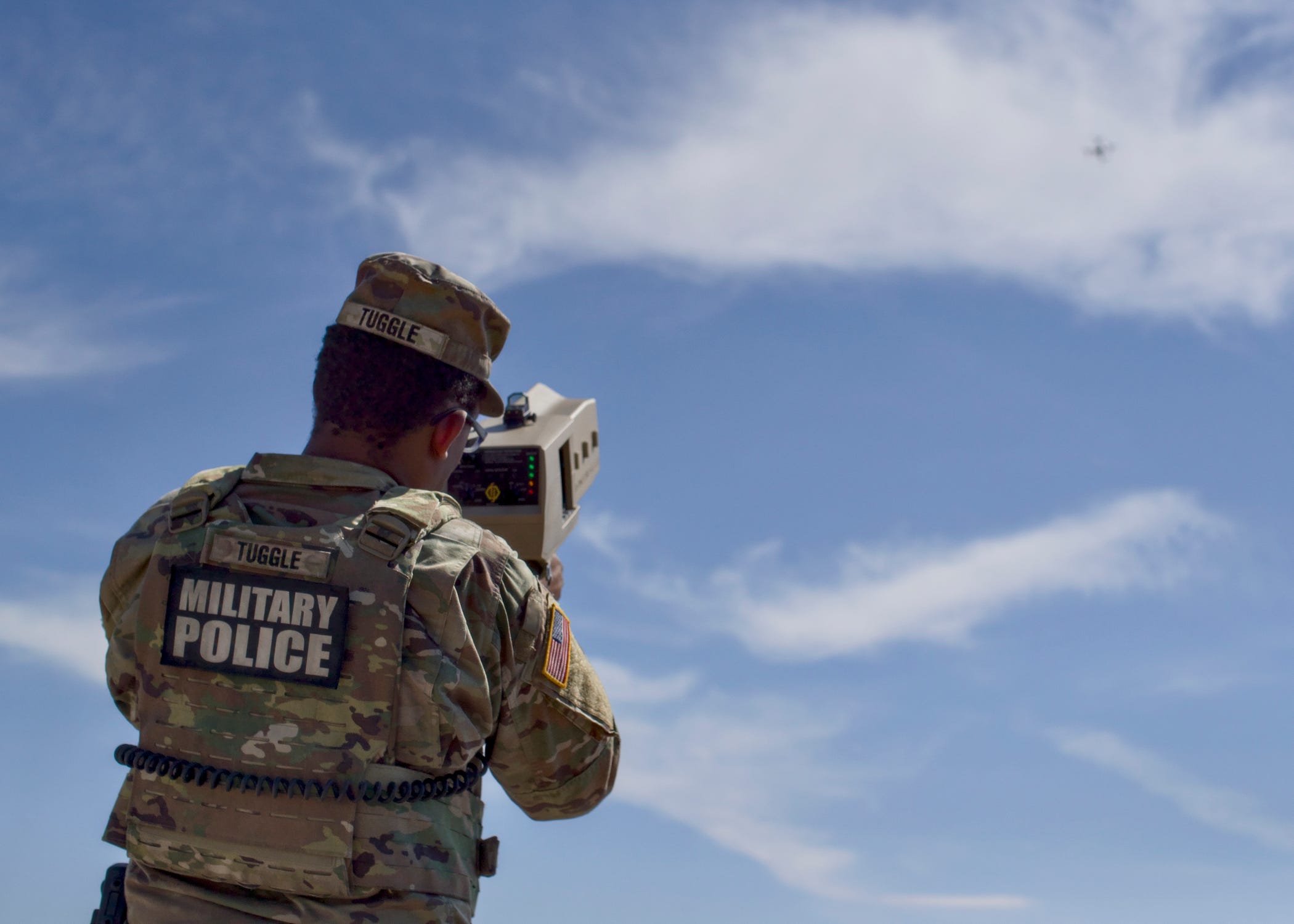
Even if you spot the drone, engaging it safely is a different problem altogether. Western militaries are slowly starting to employ counter-UAS weapons like lasers, programmable airbursts, and shotgun-style interceptors, but deploying those in a crowded city or a busy harbor is a liability nightmare.
The safest kill mechanisms are designed for war zones, not suburb-adjacent airports.
And so the fallback option is usually electromagnetic jamming.
On paper it’s elegant: cut the drone’s link to its operator and force it to drop or return home. In practice it’s a mess. Jamming can bleed into civilian frequencies, interfere with air traffic control, disrupt GPS, or knock out communications on the very ships and aircraft trying to defend themselves.
Even the US military admits that jamming near domestic bases is sensitive enough that commanders often avoid it unless they’re out of alternatives.
This gets even harder when drones operate in groups. A swarm doesn’t behave like a single object; it behaves like a coordinated pack. Some drones may be decoys. Others may be scouts testing radar patterns or response times. One might be programmed to switch to autonomous mode if it senses jamming.
Deciding which of them is the real threat becomes a tactical puzzle with consequences measured in lives and national security.
And the uncomfortable truth is that the technology to reliably counter these drones, cheap, expendable, hard to track, has not kept pace with the technology to field them.
Adversaries like Russia in Europe and China’s shenanigans against the US Navy in the Pacific, are exploiting that asymmetry with increasing frequency.
When French marines opened fire at Île Longue, it wasn’t just another drone incident. It was a signal that the era of watching and waiting may be ending.
For years, NATO states have treated unidentified drones as legal curiosities or technical oddities; annoying, persistent, but not worth the political or physical risk of a kinetic response.
That restraint made sense in a world where most drones were toys. It makes far less sense now that hostile actors are probing nuclear sites, naval bases, airports, and presidential flight paths with precision-timed, military-grade platforms.
Russia, China, and non-state groups have already internalized the lesson: drones thrive in the seams of Western law. They exploit the airspace between what’s legal to shoot and what’s safe to ignore. They hide behind ambiguity, deniability, and the West’s fear of causing collateral damage.
France’s decision to fire may become a footnote… or it may become the first crack in NATO’s old posture.
Because the gray zone isn’t getting smaller. The drones aren’t going away. And every week that passes without a coherent alliance-wide policy hands adversaries another data point, another loophole, another test they know we’re hesitant to answer.
The battlefield is evolving in real time. The only question now is whether NATO’s rules, technologies, and political instincts can evolve fast enough to match it.
Слава Україні!


The day has come when countries are going to have to decide whether national security is more important than 100% safety. One of these days, those drones will be armed and fire the opening shots of a war. What if those drones over the French nuclear sub had been armed? One hit on it would disable a vital warship for relative pennies.
I spent a large part of my career in airline operations. I get it. It's going to be hard to figure out the rules of engagement. We're going to have to adapt to a rapidly changing world of threats with equally rapid countermeasures. We have no other choice.
Glad you’re opening a wider discussion. Inattention to gray warfare tactics will possibly result in millions of dollars of civilian losses.