



Hey friends.
On September 14, Polish troops pulled a Russian drone out of the Baltic Sea near the beach at Rusinowo, its nose damaged, otherwise remarkably intact.
Bomb disposal technicians rolled out a portable x-ray rig to look inside before touching anything; standard procedure for a foreign military object that might be carrying an explosive charge. But the x-ray couldn’t see through it.
Polish military sources told the radio station RMF FM that the drone’s skin, what they called the poszycie, simply wouldn’t transmit the beam.
No usable image.
No way to confirm what was sitting inside before someone had to open it up by hand.
Two days later, on September 16, prosecutors got their answer. The aircraft was a Russian-made Gerbera-2, and it was carrying a live, roughly four-kilogram high-explosive fragmentation warhead complete with a working detonator, which sappers carefully separated from the airframe and destroyed on the beach that evening.
So, the drone was hiding something that could have killed the people trying to look at it.
Now… I want to head off the fun version of this story immediately, because it’s already spreading, and it’s almost certainly wrong.
Some of the bad claims I’ve seen say Russia engineered some kind of x-ray-blocking material to foil exactly this type of forensic examination.
Not impossible, but it is implausible.
The original Gerbera is a comically cheap airframe; mostly plywood-and-foam with a maximum takeoff weight around 18 kilograms (40 lbs), built purely for low cost and mass production.
Ukrainian technicians who’ve torn apart recovered examples found exactly that inside: plywood structure wrapped in foam. Nothing about that construction should stop a portable x-ray beam.
Carbon fiber, the material I’ve seen suggested in some reporting, doesn’t solve the mystery either.
It feels like a lifetime ago, but when I left the Air Force, my first job was with a little German company called Siemens. They loved sniping American veterans right after separating from active duty, especially those with electronics skills.
I didn’t even have to apply. I had my resume posted publicly to Career Builder dot com, and a private headhunter for Siemens contacted me because of my previous experience in surveillance radar.
At Siemens, my job was to respond to hospitals around Texas whose x-ray machines had gone down, swoop in and troubleshoot, tear the machine apart if need be, and keep the hospital up and running.
Fluoroscopy was my specialty (that, and a medical robot called the Zeego). These machines would shoot continuous x-rays to display a live video of the inside of the body on a monitor. This was mostly to help surgeons guide catheters, stents, or pacemakers into position, but had some other uses like barium swallows or angiography.
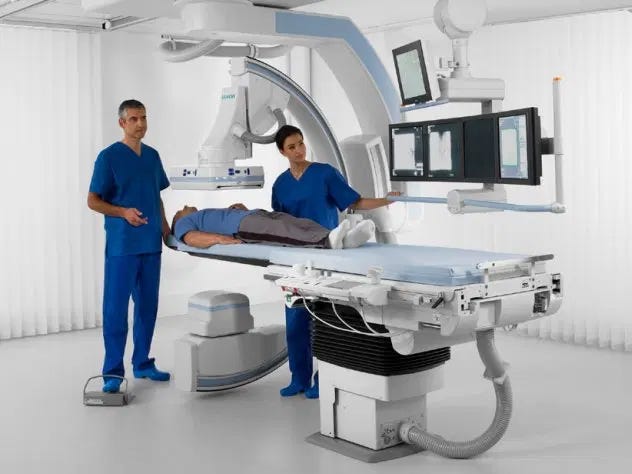
Some of my fellow veterans got assigned MRI machines, which is a completely different science. I understand how those work at a conceptual level, but don’t ask me to fix one.
Anyways, I mention all of this because I just want you to know I’m not pulling my knowledge of x-ray imaging out of my ass. I have a history here, lol
Back to carbon fiber…
Radiology departments specifically use carbon fiber for x-ray tables and cassette housings because carbon is relatively transparent to x-rays, not opaque. This is settled science. Whether a beam gets through a material comes down to photon energy, the atomic number of what it’s passing through, density, and how much material the beam has to traverse.
NIST’s own attenuation tables show a massive gap between low-atomic-number materials like carbon and heavier elements like lead. Carbon fiber sits on the transparent end of that scale. I say all of this because if someone eventually tells you, “The Russians switched to carbon fiber, that’s why,” that explanation alone doesn’t hold up.
Interestingly, RMF’s report never specified which x-ray system Polish technicians used, its energy level, or the geometry of the shot.
Portable EOD x-ray generators aren’t exactly hospital CT scanners or industrial accelerators. Battery-powered field units typically run somewhere between 150 and 370 kVp. As a real-world benchmark, a commercial 270 kVp portable unit is rated for roughly an inch of steel penetration, and a heavier 370 kVp system pushes that closer to an inch and three-quarters.
These are limited tools built for speed and portability, not laboratory-grade imaging power.
Okay, with that out of the way, here are my possible explanations:
