


The most important sound in the footage is the one you never hear.
No countermunition fires.
No interceptor detonates.
No fragmentation blast tears the drone apart before it reaches the hull.
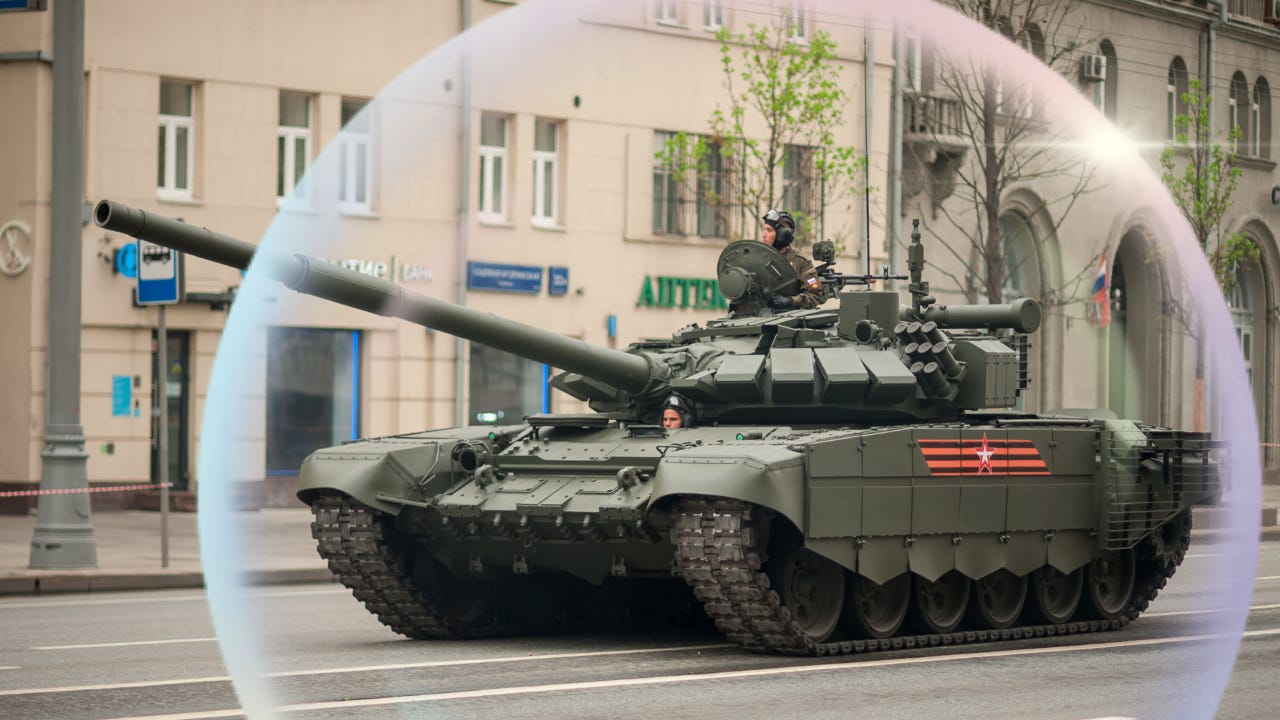
A Ukrainian FPV drone gets within range of the Russian T-72B3A in the village of Maiak, Donetsk Oblast, and the most advanced tank dome that Russia developed for three decades (and at a cost of enormous sums of rubles) has absolutely nothing to say.
The drone hits. Two others follow.
On July 24, the National Guard of Ukraine published the video below. This T-72 was in a column of ten T-72s, which supposedly lost at least nine crew members in the same engagement. The T-72 was also equipped with an Arena-M, which completed its acceptance and testing in 2024, and only began arriving at the front-line units in the summer, and was even designed and upgraded to counter the same threat that destroyed it.
Can we get a slow clap for Russian engineers squandering their Soviet tech legacy?

This appears to be the first publicly documented combat encounter between an Arena-M-equipped tank and an FPV drone, and on the evidence available, it’s also the system’s first documented failure.
Admittedly, one video can’t tell us whether the system was switched off, damaged, out of countermunitions from an earlier engagement in the same assault, or simply looking the wrong direction when the drone arrived.
What it can do, however, is put a face on a warning Russian analysts had already raised months earlier… that Arena’s radar might be running headfirst into a problem it was never built to solve.
That’s right… This is a radar story disguised as Russian failure. Let’s jump in!
What Arena-M is actually supposed to do
Picture a miniature air-defense system bolted directly onto a tank turret, because that’s essentially what Arena is.
Radar sensors watch the space around the vehicle.
A processor figures out whether an incoming object is a threat. Then, the system fires an explosive countermunition that throws a directed group of fragments into the object’s path, all without a human approving the individual shot.
The crew can switch Arena on or off. Once it’s live, the engagement happens on its own.
Russian descriptions put Arena’s interception zone at roughly 20 to 50 meters from the tank.
Compare that to a normal air-defense engagement, where an interceptor might get several kilometers of warning and several seconds to classify friend from foe. Arena gets a few dozen meters and, depending on the target’s speed, a window that can shrink to fractions of a second.
A radar picking up a reflection off some object in the sky is not the same thing as that radar identifying a drone.
And identifying a drone isn’t the same as building a stable track on it.
A stable track doesn’t automatically mean the system has determined the object is on a collision course with the vehicle.
And even a confirmed collision track might sit outside whatever narrow arc the countermunition launchers can actually cover.
There’s a real difference between a search-quality return, which tells a system that something might be out there, and a fire-control-quality track, which tells it precisely where that object will be a fraction of a second from now, precisely enough to trust with an explosive.
Arena needs the second kind. When Russian sources talk about the radar struggling to “see” FPV drones, the more accurate version of that sentence is probably that the radar can’t reliably turn a weak, ambiguous return into a track clean enough to fire on without also endangering the tank’s own crew or nearby infantry. After all, you don’t want Areana firing every time a bird flies by.
