


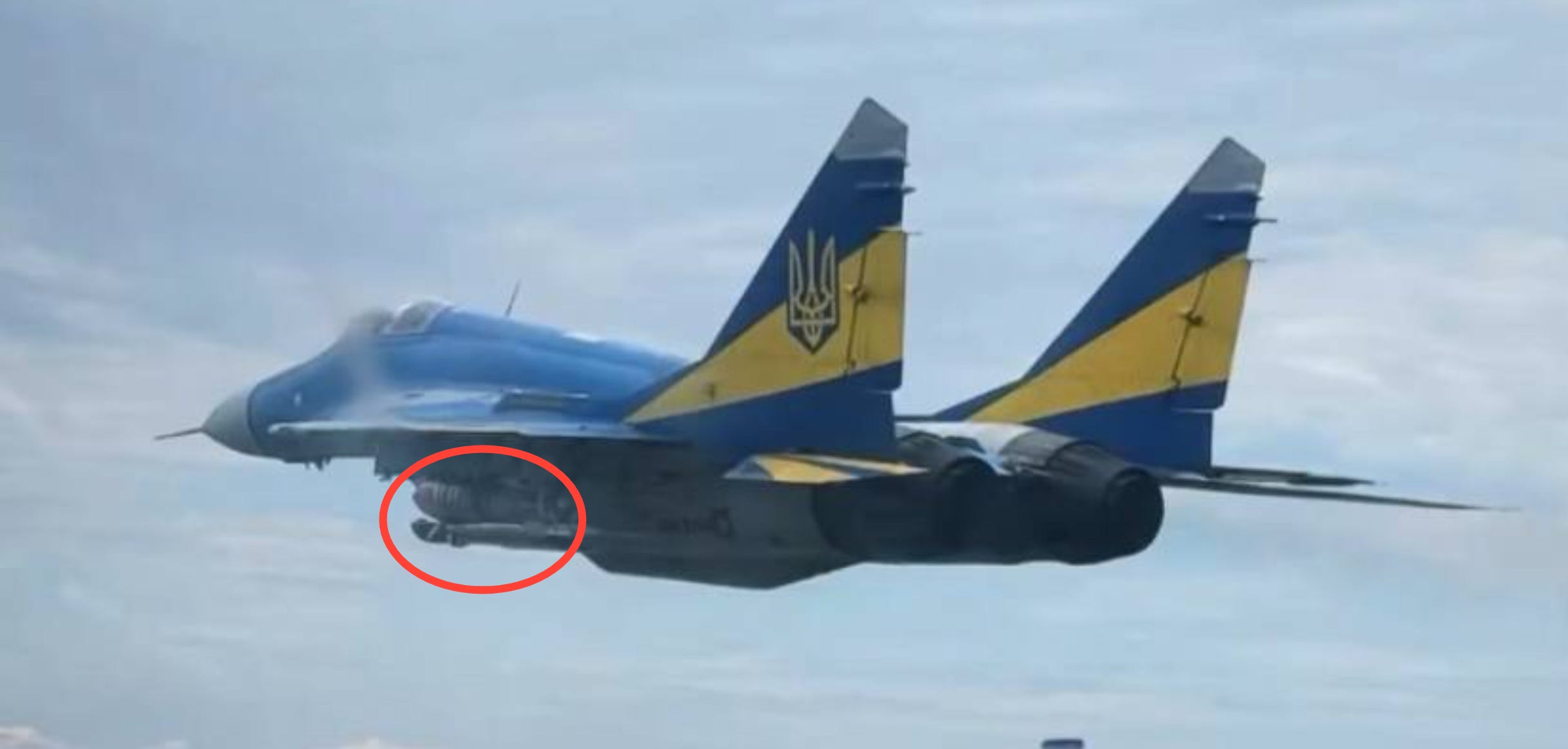
In September, a Ukrainian MiG-29 Fulcrum, painted in a high-visibility blue-and-yellow scheme usually reserved for airshows, was photographed carrying something new under its wing.
Hanging off the port wing is what appears to be Ukraine’s long-rumored answer to Russia’s UMPK glide bomb kit.
Same general idea. Same blunt logic.
Take a dumb bomb, bolt on wings and guidance, and turn it into a standoff weapon that lets pilots kill targets without volunteering for a Wild Weasel engagement.
This is the quiet part of Ukraine’s air war finally becoming visible.
Russia’s UMPK has been a headache for Ukraine since early 2023. Not because it’s elegant, or accurate in a Western sense, or technologically impressive.
It isn’t.
It’s crude. Cheap. And brutally effective at one thing: allowing Russian aircraft to lob heavy explosives from outside Ukrainian air defense coverage.
Actually, my very first YouTube video was a video about how Ukraine could use its new F-16s to push back the engagement zone of Russia’s glide-bomb-carrying fighter bombers, rendering them useless. Great in theory, but Ukraine has too few F-16s and Russia has too many glide bomb delivery vehicles.
Here’s a fun fact: That first video’s comments were so vile that I almost stopped posting to YouTube completely. It was my audience right here on Substack in September of 2024 that encouraged me to keep posting on YouTube. My very next video “went viral” and kicked off an incredible community on that platform. (That viral video, by the way, was on the UK Starstreak missile system that was delivered to Ukraine. I should probably see how that system has been doing and do a follow-up.)
Anyways, Ukraine has spent the better part of two years eating those Russian glide bomb strikes. This is what learning looks like.
The weapon seen on Ukraine’s MiG-29 closely mirrors the Russian design philosophy. A standard free-fall bomb, likely in the 500-kilogram class, attached to a self-contained guidance and wing module. After release, the kit deploys its wings, stabilizes, and glides toward the target using satellite navigation.
No rocket motor. No fancy propulsion. Just altitude, wings, and time.
It’s the kind of weapon that thrives in wars of attrition.
What makes this sighting significant isn’t just the bomb itself. It’s the platform carrying it.
Ukraine has been testing similar glide weapons on the Su-24 for months. That made sense for early experimentation since the Fencer has payload capacity and room to spare.
But the MiG-29 is the workhorse. It’s everywhere. It’s familiar to Ukrainian pilots. It’s already been adapted to carry Western weapons it was never designed for. Plus, Poland is about to send Ukraine more Fulcrums as I reported here.
If you want scale, you integrate with the Fulcrum.
Ukraine needs something it can build, field, and lose without breaking the bank. Western standoff weapons like JDAM-ER, SDB, and AASM Hammer are powerful, but they cost more than the targets they sometimes destroy.
The Kremlin learned this bitter lesson the hard way.
By mid-2022, Moscow was already burning through its most valuable precision munitions at an unsustainable rate.
Iskanders were expensive and finite.
Kinzhal launches made for good propaganda clips but terrible economics.
Kalibr stocks were shrinking faster than factories could replace them, especially under sanctions that quietly strangled electronics supply chains.
What Russia did have, in obscene quantities, was dumb steel.
Hundreds of thousands of unguided Soviet-era bombs sat in depots across the country. FAB-250s. FAB-500s. Dumb bombs built for Cold War mass aviation doctrine, designed to be dropped in large numbers from aircraft that expected to fly straight into NATO air defenses and probably not come back.
Those bombs were supposed to be obsolete.
Instead, they became Russia’s workaround.
The logic was brutally simple. If you can’t afford to keep firing high-end precision weapons, and you can’t safely fly aircraft over defended targets, then you stretch the bomb’s reach instead of the plane’s courage.
Bolt wings onto the bomb. Add a cheap guidance package. Let gravity do the rest.
The Unified Gliding and Correction Module, the UMPK, turned a weapon that cost a few thousand dollars into something that could be released 40 kilometers behind the front line.
Not accurate by Western standards.
Often unreliable.
Sometimes wildly off.
But good enough for Russia.
This wasn’t innovation. It was rationing. And it worked, at least tactically. Russian aircraft could lob glide bombs from the edge of Ukrainian air defense coverage, saturating positions with cheap explosives while forcing Ukraine to decide whether to spend scarce air defense interceptors on weapons that cost a fraction of the missile used to shoot them down.
That exchange rate favored Moscow.
What Russia stumbled into, almost by accident, was a doctrine of quantity-based standoff. Precision took a back seat to volume and persistence.
I imagine some jerkoff Russian air force colonel in mid-2022 thinking to himself, “If only we could spend airborne munitions in the same way we spend human bodies… Mass quantity! It’s always been our go-to solution! дерьмо!”
No one knows who that nameless Russian officer was who invented the UMPK, but it’s now produced by Russia’s JSC Tactical Missiles Corporation (KTRV), led by its Bazalt Design Bureau.
