


Oj då!
Hey friends.
Europe can build spectacular jet engines:
Rolls-Royce builds the EJ200 that powers the Typhoon.
Safran builds the M88 that powers the Rafale.
GKN Aerospace helps manufacture components flying inside some of the most advanced military aircraft on the continent.
But none of that expertise, it turns out, was solving the problem that 2026 may eventually become known for: we need more disposable jet engines!
In April, reporters interviewed more than a dozen weapons experts, company executives, and government officials about Europe’s supply of a much less glamorous piece of hardware: the tiny turbojet engines that power expendable long-range attack drones.
The consensus was consistent.
A Ukrainian defense-industry source told reporters the shortage was probably the main factor limiting Ukraine’s missile-drone production. Fabian Hoffmann, a senior research fellow at the Norwegian Defense University College and someone I’ve quoted numerous times, said, “Europe has a massive bottleneck in mini-jet engine production,” adding that solving it mattered for reducing the continent’s reliance on the United States too.
It’s not Europe’s fault. Before 2022, nobody on earth needed tens of thousands of disposable jet engines.
The big aerospace primes chased lucrative aircraft propulsion contracts while a tiny handful of specialist firms serviced whatever small market existed for miniature turbojets.
Then a war broke out that suddenly wanted thousands of them a year, and Europe discovered it had maybe three companies capable of building them at any real scale.
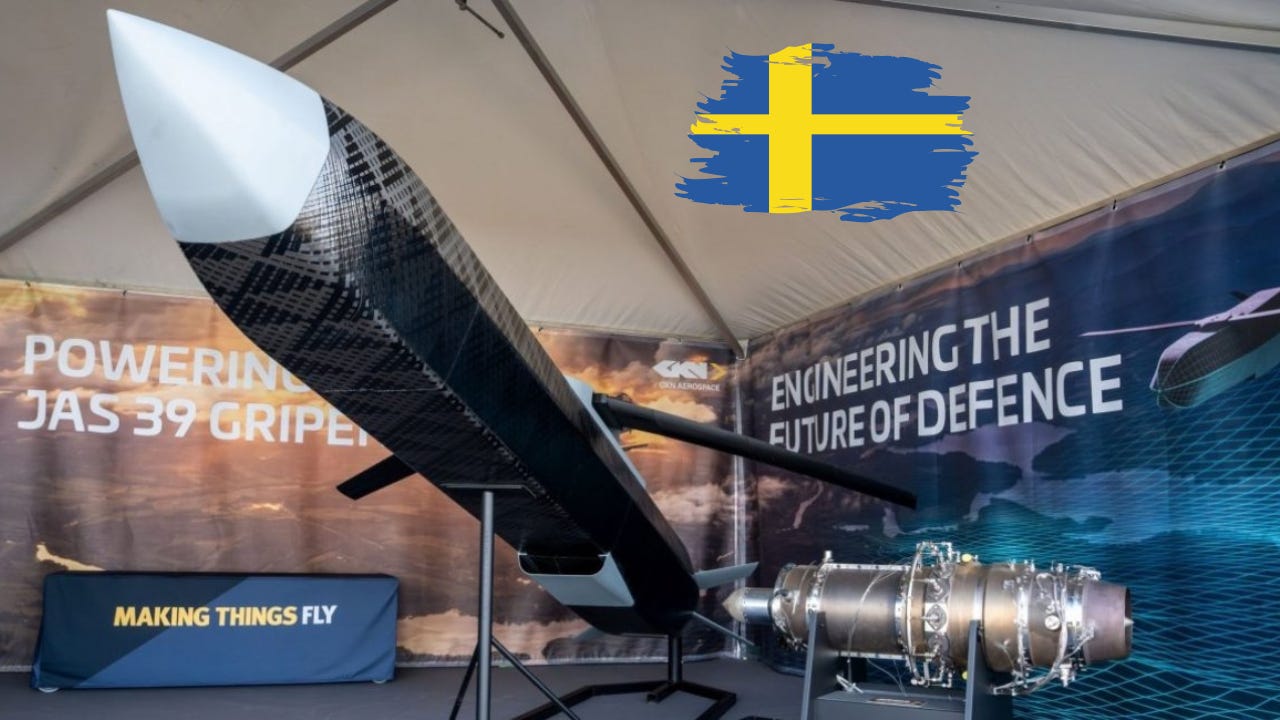
Four months later, on August 21, GKN Aerospace showed up at Malmen Air Base in Sweden with something unusual. A full-scale mockup of a long-range unmanned aircraft demonstrator, and sitting right beside it, a completely new 3D-printed turbojet engine, built from scratch, purpose-designed to power it.
Both had gone from a blank sheet of paper to physical hardware in roughly nine months.
Sweden’s answer to the disposable turbojet shortage was characteristically Swedish: “Fine. We’ll make one ourselves.”
