


Rockstar Games spent thirteen years making Grand Theft Auto VI. It finally landed on November 19, and everybody wanted a piece of the hype.
Then the Russian Ministry of Defense showed up with a recruitment poster.
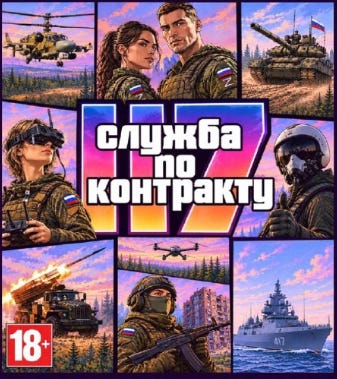
Somebody in Moscow had taken the GTA VI cover and swapped its cast of criminals and Florida lunatics for Russian soldiers, tanks, rocket launchers, drones, and a warship.
The title became the Cyrillic version of “Contract Service.”
The soldiers wore the Z. In the middle ran a slogan: “Choose your mission!”
I laughed. Of course I did.
Rockstar spent decades building games where you steal cars and rob banks with zero real-world consequences, and the Russian defense ministry looked at that and saw a recruiting pipeline.
My assumption was that a bored intern in the ministry’s social media shop had been told to make something the kids would like, opened a pirated version of Photoshop, and clocked out.
I wasn’t going to write about it.
Then I started pulling the thread on how Russia actually recruits gamers, and the dumb poster turned out to be the welcome mat on a machine that’s been running for years:
University administrators.
Military recruiters.
Drone tournaments.
Online gaming communities.
Plus contracts that are a lot harder to walk out of than the ad implies. There are patents, which is my favorite thing to find in a story where I wasn’t expecting patents.
And underneath all of it is a simple math problem.
BBC Russian and Mediazona have named roughly 286,000 Russian military dead through early November, and the real number is likely far higher because naming the dead only catches part of the losses. Moscow needs bodies. Young men who spend their nights flying virtual aircraft or robbing video game banks are a very appealing place to go shopping.
Choose the right skin
Actually, the Russians weren’t even original.
On November 16, three days before the GTA launch, Ukraine’s Azov Brigade ran its own GTA bit that opened with “The whole world is waiting for the release of GTA VI. Azov is setting its own rules of the game!”
The difference is that Azov is one unit with a website and a sense of humor, the post itself said war is not a game, and nobody in Ukraine’s defense ministry ordered it.
The Russian poster came straight from the ministry, which has been working this angle since at least 2022, when it told gamers to come experience combat with “no cheat codes or saves.”
Having spent time around the real thing, I can report that the missing save function is one of the military’s least charming features.
The Plekhanov university campus in Volgograd cut a recruitment spot that flips between a gamer and a drone operator under the caption “choose the right skin.”
For my non-gamers: a skin is a cosmetic outfit you buy so your character looks like a space marine instead of a guy in his underwear. The ad is telling kids to trade the virtual costume for a real uniform.
