


Hey friends.
Buried inside a long Atlantic piece by Simon Shuster this week sits what may be the single most consequential paragraph written about this war in months, and nobody is talking about the implications.
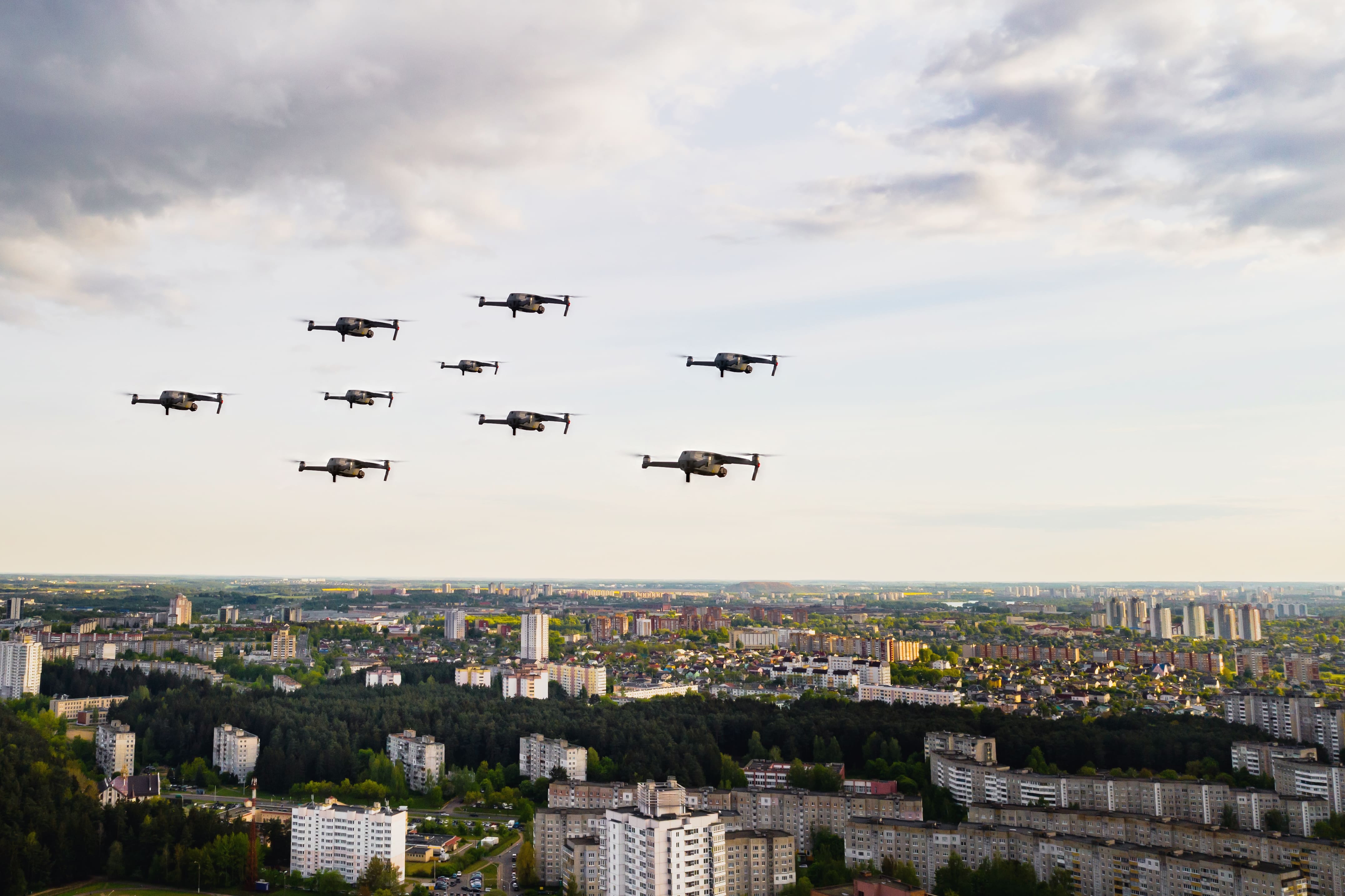
Ukrainian officials proposed a plan to swarm Moscow’s airports with up to a thousand drones a night, hoping to shut down international air travel in and out of the Russian capital and isolate Putin’s elite from the world.
It was to be called Operation M&Ms, named for the small, cheap, nearly identical delicious drones the mission would require.
Zelensky presumably heard the pitch, raised serious concerns about the risk to civilian aviation, then reportedly allowed preparations to continue anyway. The plan was suspended after Fedorov’s dismissal in July.
Now, it’s worth noting that Zelensky’s own presidential office called the entire account “total nonsense.”
But the bombshell, and the reason Zelensky rejected the program, is that these drones would have been 100% AI operated; as in, they would have been deciding, on their own, what and who to kill.
If executed, the plan would have marked a sobering milestone in the history of warfare; an attack in which swarms of autonomous drones equipped with AI-based guidance systems would seek out, pick, and strike their targets without a human pilot controlling their movements.
We’re talking autonomous drones that would independently locate and strike targets without human involvement in the engagement.
What the Atlantic reported
The Atlantic’s account comes from two people described as familiar with the plan. According to those sources, Ukrainian officials came to Zelensky in early 2026 with a proposal to expand the ongoing deep-strike campaign beyond refineries, military bases, and logistics infrastructure to include Moscow’s airports.
The concept called for launching waves of cheap AI-enabled drones at the airfields serving the capital, with the stated goal of closing Moscow’s airspace to civilian flights for an extended period, effectively cutting off the Russian elite from international travel.
The sources said the drones could identify targets despite heavy Russian GPS jamming, which is an important technical detail I’ll come back to.
One source described the idea as isolating Putin’s inner circle the way sanctions were supposed to but never fully did, by making Moscow’s airports operationally unusable rather than merely occasionally disrupted.
When the plan was presented to Zelensky, he expressed what the sources described as serious concerns. He feared a drone could hit a passenger aircraft. He worried about killing people in and around the airports. And then, according to The Atlantic’s sources, he allowed preparations to continue.
The operation never launched. Fedorov’s dismissal in July removed the official who had been assembling the development team, creating the AI guidance systems, and securing production funding.
One source told The Atlantic the project could be revived with a new team in roughly three months.
Zelensky’s presidential office flatly denied the entire account. A representative called it “complete nonsense,” saying Ukraine lacked long-range weapons reliable enough to strike airports without posing undue risk to civilians.
It doesn’t really matter if you put more weight behind the Atlantic’s two sources, or Zelensky’s refusal. This technology is here and will be used by someone in the very near future.
It’s quite possible it’s already been used and we don’t know about it yet. When the wreckage was examined, Ukraine’s Major General Vladyslav Klochkov called Russia’s MS001 drone a “digital predator” that “sees, analyzes, decides, and strikes without external commands.” So Russia may already be stumbling drunk toward this very capability.
This also opens a bit of a Pandora’s Box that I think we, as a society, should be discussing. China is likely very close, if not having already achieved, fully AI-driven drones where the AI will decide who to kill.
Do you think teh PRC is going to let a pesky thing like ethics stand in the way of a massive capability leap over the Americans?
The technology is moving far faster than our laws and treaties can keep up.
Every serious military power on earth is chasing autonomous weapons. What’s new here, or what would have been new, is deploying it at scale against a populated city with the explicit intent that the machines find and strike their own targets.
So how does a machine actually ‘decide’ to kill?
The brain of these systems, at least in 2025 and 2026, is an Nvidia Jetson Orin module. It’s a palm-sized computer roughly the size of a credit card, designed and marketed by Nvidia for robotics, autonomous vehicles, and industrial automation.
It was built to help warehouse robots avoid running into shelves and to let self-driving cars recognize a stop sign.
Before the drone ever launches, an operator or a planning system loads it with a target library: a database of images, thermal signatures, and shape profiles representing the things the drone is authorized to hit.
For an airport mission, that library would contain runway surfaces, radar installations, navigation antennas, taxiway infrastructure, terminal buildings, fuel facilities, whatever the mission planners decided counted as a valid target.
Each entry is essentially a digital flashcard the AI has been trained to recognize.
Once the drone is in the air, its onboard camera, either visible-light or thermal, feeds a continuous video stream directly into the Jetson Orin. The processor runs that video through a convolutional neural network, which is the same basic category of software that lets your phone recognize a face in a photograph, except this one has been trained on military targets.
The network compares what the camera sees against every entry in the target library, frame by frame, dozens of times per second.
When the neural network identifies something in the camera feed that matches a target profile above a preset confidence threshold, let’s say 92 percent certainty that the object below is a radar antenna rather than a water tower, the system generates what is functionally a kill recommendation.
In a human-in-the-loop system, that recommendation would go to an operator who approves or rejects it.
In a fully autonomous system, the recommendation goes straight to the flight controller.
The drone adjusts its trajectory, commits to a terminal dive, and strikes.
No human sees the target.
No human approves the engagement.
No human even knows the drone found something until after the detonation, if anyone checks at all.
The navigation side of this runs in parallel and solves the GPS-jamming problem that makes autonomy necessary in the first place.
Instead of relying on satellite signals Russia can jam or spoof, the drone uses computer vision to navigate, comparing what its camera sees on the ground against a library of preloaded terrain imagery and elevation data.
The Jetson Orin runs that comparison continuously, essentially asking “does the ground below me look like the ground I expected to see at this point in my flight?” and correcting its course whenever the answer drifts.
Ukrainian intelligence found that Russia’s V2U drone carried only a single GPS module, suggesting the designers had already accepted that GPS would be unreliable and had built the system to navigate primarily by sight instead. That’s the same approach The Atlantic’s sources described when they said M&Ms drones could “identify and strike targets despite jamming.”
Every piece of hardware I just described, the Jetson Orin, the camera, the neural network, the terrain-matching navigation, already exists.
Ukraine doesn’t need to invent autonomous targeting from scratch.
And by the way, the confidence threshold, (that 92 percent number I used as an example), is a setting somebody chooses before the drone launches.
Set it at 99 percent and the drone rejects most of what it sees, reducing false positives but also reducing the number of targets it engages.
Set it at 80 percent and the drone becomes an aggressive little bastard, striking more frequently but also more likely to misidentify a civilian structure as a military target.
That single number, buried inside a configuration file on a circuit board the size of a queen of hearts playing card, is where the entire moral weight of autonomous warfare collapses into an engineering decision… made by someone who will never personally see what the drone hits.
A thousand drones a night, each carrying its own copy of that threshold, each making its own decision over a city of twelve million people.
That’s what M&Ms would have looked like from the inside.
And remember, there is currently no binding international treaty prohibiting lethal autonomous weapons.
