


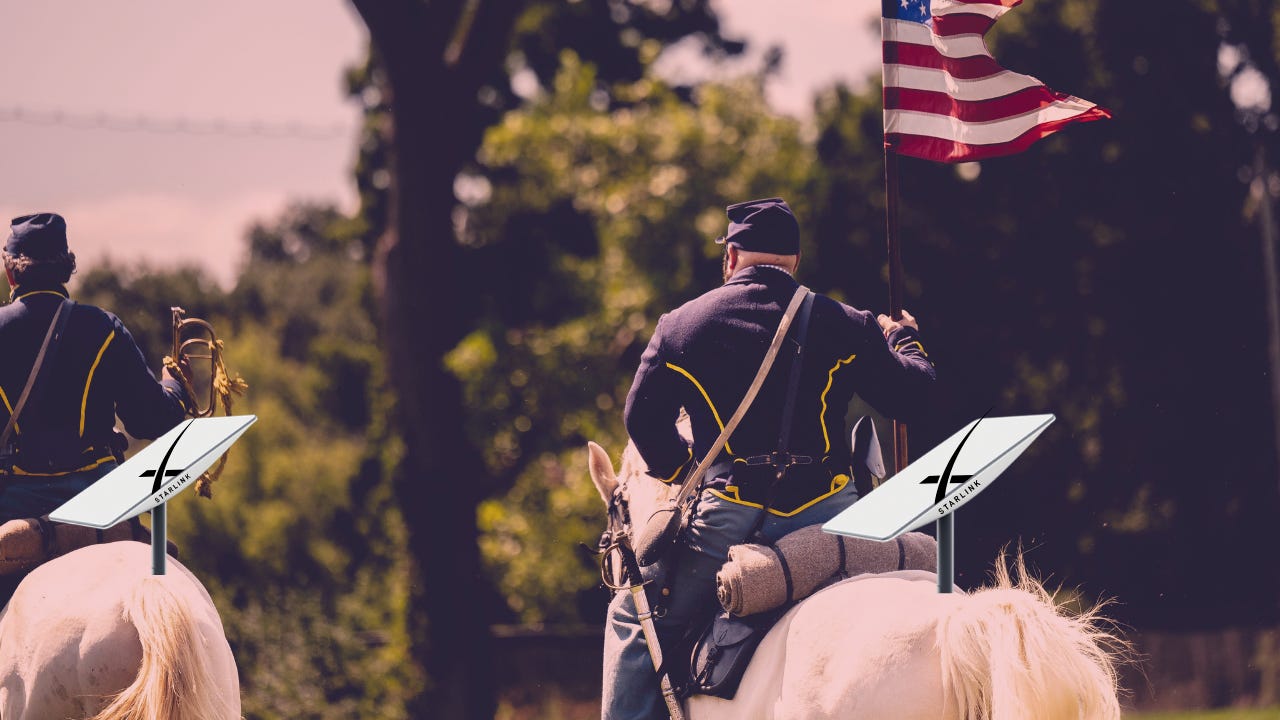
By now you’re likely aware that Elon Musk, a private citizen and CEO of a corporate defense contractor, unilaterally crippled a US ally’s battlefield communications. Presumably, he felt he had the support of the presidential administration. So I have to ask… what happens when there’s an administration in charge that doesn’t align with his far-right sensibilities?
I’ve been thinking about that ever since.
Military communications fail all the time: Radios break, antennas get shot to hell, satellites leave line of sight, the enemy jams something… I spent enough time around military communications to know that when you absolutely need a radio to work, that’s usually when it fucks off to radio heaven.
This was different. Musk changed a permission.
An ally’s battlefield capability disappeared in mid-flight because Musk possessed the administrative authority to change what the network allowed a drone to do.
That, my friends, is an extraordinary amount of military power for somebody outside the military chain of command to possess. Someone with no accountability to taxpayers, mind you.
When Ukraine first reported the Starlink restrictions, Elon Musk pointed directly at Washington.
“Starshield systems are owned and controlled by the US government,” he wrote, adding that limits on speed or usage were decided by “the US military and ultimately POTUS.”
Hold up… Why shift the blame unless you knew you were doing something wrong?
The Wall Street Journal reported on October 20 that Musk personally ordered the slowdown of the military-grade SpaceX service Ukraine was using. The Journal cited US officials and people familiar with the matter, some of whom believe Musk acted unilaterally.
Others said he and President Trump discussed the situation. Defense Secretary Pete Hegseth says Washington never withdrew Ukraine’s access and has suggested the disagreement involved SpaceX’s terms of service.
Right. Those dastardly ToS that nobody ever reads.
Connectivity for Ukrainian forces moving at speed was partially restored on October 15. Nobody has publicly explained whether all the previous limits are gone.
A bipartisan group of senators has now asked the Pentagon Inspector General to determine what actually happened. Republicans Thom Tillis, Susan Collins, Lisa Murkowski, and John Cornyn joined Democrat Jeanne Shaheen and others in asking whether SpaceX independently imposed the restrictions and whether doing so complied with its federal contracts.
Good. That’s exactly the investigation that should happen.
Still, I can’t shake this feeling of unease. I wanted to know whether America had ever encountered anything remotely similar in its many previous wars.
That sent me down a historical rabbit hole.
Lincoln’s internet problem
When the Civil War began in 1861, the United States government didn’t own the country’s telegraph network. Private companies did.
Before the war, if a federal official in Washington wanted to send a telegram, he walked down to a commercial telegraph office and paid like everybody else.
Then the armies got enormous and the distances got absurd, and the telegraph went from a business tool to the nervous system of the Union war effort. For the first time in history, a president could read reports from his generals hundreds of miles away within hours, and sometimes minutes, of the events they described.
Lincoln famously haunted the War Department’s telegraph office during major battles, leaning over the operators’ shoulders waiting for the next dispatch.
It was the 1860s version of watching a drone feed.
Washington’s answer to depending on privately owned wires was to hire them. Anson Stager, a Western Union executive, developed the cipher system the War Department used and became superintendent of the US Military Telegraph.
The operators who ran it were mostly civilians. The expertise stayed private.
The authority didn’t.
On February 25, 1862, Lincoln issued an order through the War Department stating that the president “takes military possession of all the telegraph lines in the United States.”
Messages about military operations were banned unless the War Department or commanding generals approved them. The order said that it wasn’t meant to interfere with the companies’ ordinary business. Congress backed it up that winter with legislation authorizing the president to take possession of railroad and telegraph lines when military necessity required it.
The government used that power, too.
On May 1, 1863, Secretary of War Edwin Stanton ordered Major General John Wool in New York to take “immediate military possession” of the Independent Telegraph Company’s lines between Philadelphia and Boston.
The company had been passing along information about the Army of the Potomac’s movements. The deal on offer was simple: If the company agreed to send no military information without War Department approval, it would be left alone to run its business. If it didn’t, the people responsible would be arrested and locked up at Fort Delaware.
But private citizens holding battlefield power wasn’t limited to wires. The Civil War is full of civilians who controlled capabilities the Army came to depend on, and the best example floated in the sky.
Thaddeus Lowe was a self-taught scientist and balloonist who talked his way into the war in 1861.
In June of that year, he went up about 500 feet in a tethered balloon in Washington and telegraphed a message straight down the tether to the White House.
In September, he used flag signals from a balloon to walk Union artillery onto targets the gunners couldn’t see, years before anyone had a term for a “forward observer.”
At the Battle of Seven Pines, also called Fair Oaks, in 1862, his observations of Confederate movements helped McClellan rush reinforcements across a flooded river to a corps that was being cut off.
Lowe was a civilian. He was never commissioned in the military, and he and his men worked under a contract. He’d turned down $30 a day and asked for $10 in gold, roughly a colonel’s pay, so he could build better balloons.
In 1863, the Army put the Balloon Corps under tighter control, and a captain named Cyrus Comstock, who resented a civilian making more money than he did, cut Lowe’s pay to $6 a day in paper currency, worth about $3 in gold.
Lowe protested, nobody backed him, and he walked away that spring.
The corps limped along under less capable leadership, and by August 1863 the Union Army had stopped using balloons altogether. The National Museum of the US Air Force says the end of Army ballooning deprived the Union of “a useful military tool.”
Just to clarify here, Lowe isn’t Musk.
Lowe didn’t ground the balloons because he disagreed with Lincoln’s war aims, and he wasn’t running a trillion-dollar empire with a federal service contract. The structure is eerily familiar, though.
A private specialist builds a capability, the military comes to depend on it without ever owning it, a dispute breaks out, the specialist makes a personal decision, and the capability disappears.
The Civil War also shows that power running the other way.
John W. Garrett was president of the privately owned Baltimore & Ohio Railroad, whose employees were scattered all over Maryland and Virginia, watching everything. In the summer of 1864, B&O workers spotted Jubal Early’s Confederate army moving toward Washington, and Garrett passed that intelligence straight to Union commanders.
It helped Major General Lew Wallace grasp what was coming, and his badly outnumbered force lost the Battle of Monocacy but delayed Early long enough for reinforcements to save the capital.
Garrett owned a private railroad and a private telegraph, and employed private people who generated private intelligence, and his decision to share it changed the course of a campaign.
Then there’s Allan Pinkerton, a private detective who became George McClellan’s intelligence chief without ever holding military rank; operating under the alias “Major E.J. Allen.”
His wildly inflated estimates of Confederate strength fed McClellan’s existing gift for imagining a Rebel soldier behind every shrub. Historians still argue over how much blame Pinkerton deserves for McClellan’s caution, but nobody disputes that a private intelligence operation was shaping decisions by the commander of the Army of the Potomac.
Garrett used his power to help the government, Pinkerton used his badly, and Lowe walked away. None of them, as far as I can find, did what Musk did, which is change a capability a military ally was actively using, against the Pentagon’s wishes, while the shooting was underway.
Wilson, the Railroads, and a Gateway in Hawaii
By World War I, the wires had become national infrastructure, and Washington had stopped beating around the bush.
In July 1918, Congress passed a joint resolution authorizing the president to take control of any telegraph, telephone, marine cable, or radio system when he considered it necessary for national security.
Wilson signed a proclamation on July 22, and federal control took effect at midnight on July 31. Postmaster General Albert Burleson ran the systems through their existing managers and employees. The companies kept their names, kept paying dividends, and got compensated, and the lines went back to their owners in 1919.
During the congressional debate, cabinet officials argued that even a few hours of communications interruption could seriously damage the war effort.
That’s practically the Starshield argument, written 108 years early.
The government did the same thing with the railroads.
In December 1917, Washington took control of nearly the entire private rail network because a patchwork of competing companies couldn’t move wartime traffic efficiently. The US Railroad Administration ran the system as one network until it returned the railroads to their owners in 1920.
The pattern across all of this is consistent: Private ownership of critical wartime infrastructure was normal. Private veto power over it was not.
Fast forward to the satellite era.
When Iridium’s commercial satellite phone constellation went bankrupt around 2000, the Pentagon became one of its most important customers, and Iridium phones went on to become everyday tools in Afghanistan and Iraq.
The interesting bit is how the military structured it.
The Defense Department routes its traffic through its own dedicated gateway in Hawaii, which the government owns and operates. The Defense Information Systems Agency described the arrangement as commercial satellite infrastructure running through a gateway under US government control.
The Pentagon didn’t really need to own Iridium. But it did insist on holding the keys to the sensitive part.
When I worked on the E-3 AWACS, every data link and radio net we used ran on government-controlled crypto, loaded by government custodians who signed for every key. I can’t imagine anyone in my crew assuming a contractor back in the States could reach in and change how those links behaved mid-mission.
That’s not how any of this works! (Cue this mid-2000s commercial from Esurance):
Then there’s my favorite precedent, from October 2001.
As the United States started bombing Afghanistan, the Pentagon got nervous about Space Imaging’s privately owned IKONOS satellite, which could photograph Afghanistan at roughly one-meter resolution and sell the pictures to anyone.
Washington had a legal power to order “shutter control” over commercial satellites in wartime.
It didn’t use it.
It bought exclusive rights to the imagery instead, spending millions to make sure nobody else got it, an approach that analysts later nicknamed “checkbook shutter control.”
Washington looked at a private space capability with battlefield consequences and effectively said, we’re paying you, and for the duration of this operation, we decide.
The Starshield situation is the mirror image of that.
Who Owns the Switch?
What makes this story strange isn’t necessarily that SpaceX is a private defense contractor. Lockheed Martin is private, and so are RTX and Boeing. Microsoft runs software across the Pentagon.
Private industry has built nearly every weapon the American military has ever carried.
The strange part is a contractor apparently keeping operational discretion after its product becomes part of a live kill chain.
A Lockheed executive can’t decide an F-16 may no longer fly faster than 400 knots because he dislikes the mission. Raytheon’s CEO can’t switch off a Patriot battery because he disagrees with the mayor of the city being protected. Once those weapons are delivered, they belong to the people using them.
Software-defined services completely break that model.
Starshield is delivered and paid for continuously, month after month, and SpaceX controls the satellites, the software, the network management, and much of the infrastructure carrying the signal.
Current government procurement notices buy Starshield throughput, peering and support services from SpaceX. The manufacturer never really leaves the capability. That’s convenient when you need a software patch at three in the morning, and fucking terrifying when the CEO has opinions about the war.
Does that mean the Pentagon should nationalize SpaceX?
I don’t think so. Lincoln didn’t nationalize Western Union, Wilson handed the phone lines back, and the Pentagon never bought Iridium.
What all of them insisted on was the switch.
A modern version might look like a government-controlled management layer for Starshield, government-held authorization keys, contract language that flatly bans unilateral service changes during military operations, (even for allies), guaranteed continuity, independent audit rights, and enough redundancy, from European and other providers, that no single company becomes a single point of failure.
Iridium gives us a partial model, the Civil War telegraph gives us the philosophy, and Wilson’s wire seizure gives us the emergency option nobody wants to use.
None of those historic examples require Washington to own SpaceX.
All of them require the Pentagon to know exactly who owns the godforsaken switch.
Right now, Musk’s politics happen to overlap with much of the current administration’s worldview.
What happens when they don’t? What happens when a future president decides to support an ally, conduct an operation, or enforce a policy that SpaceX’s CEO personally considers dangerous or immoral?
Will US soldiers die because Musk doesn’t like the deployment?
If one private citizen can push a button and get the soldiers of a US ally killed, all because he agrees with Washington today, the same authority still exists when he disagrees with Washington tomorrow.
But the problem isn’t Elon Musk’s bullshit ideology. The problem is that his bullshit ideology can matter at all.
We need to fix this.
Слава Україні!
The problem is that all the company needs to do is move it’s HQ and ground stations out of the USA and that’s the end of it. No one will domicile here ever again. You have to work this stuff out in advance, not once the satellites are in orbit. Like Musk left California when they targeted him, he can walk on outta here just as easily.
Nicely laid out. Follows the rule to first historicize.