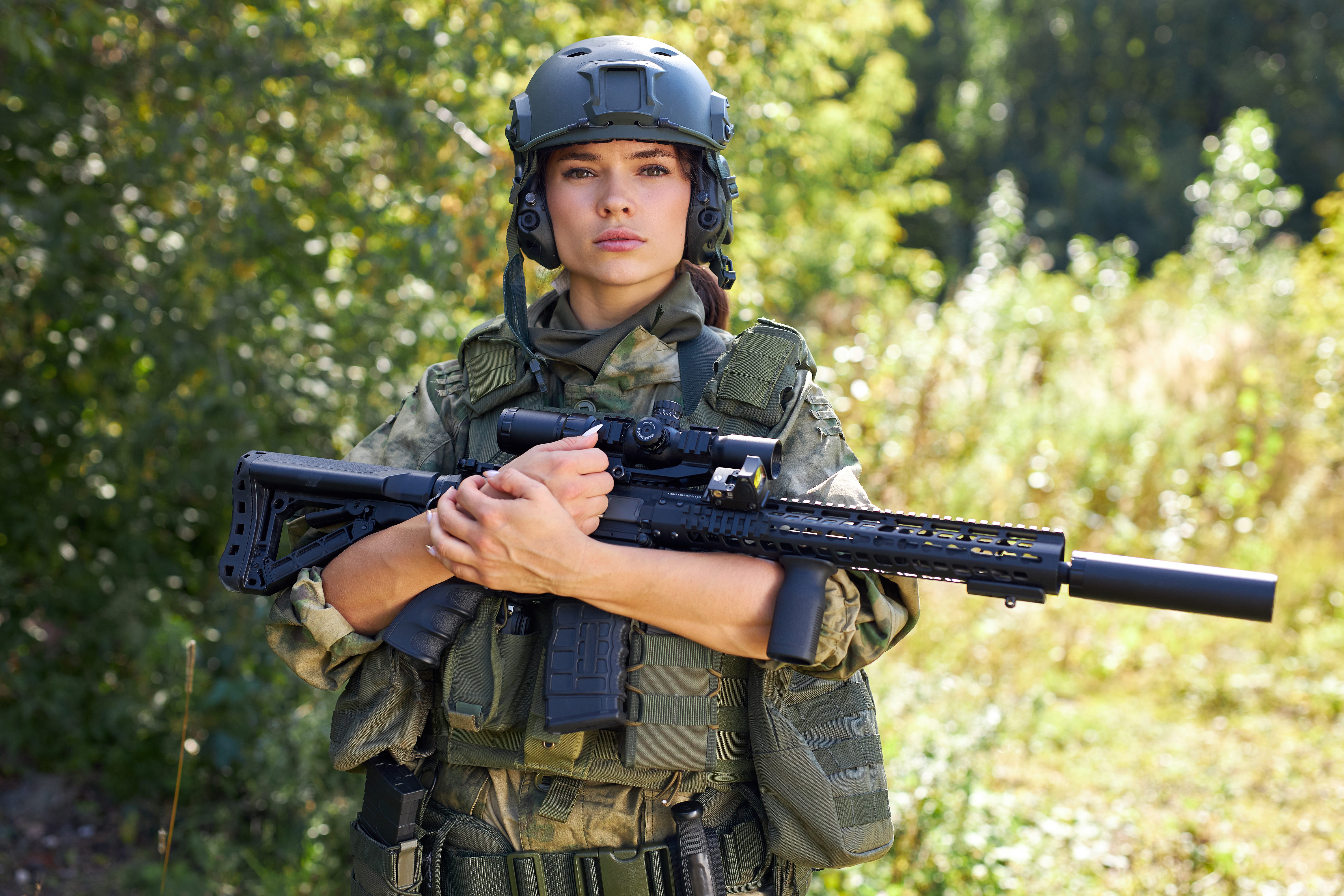
Canada’s “Boring” Aid That Keeps Ukrainian Women Soldiers Fighting
Uniforms that fit mean fewer preventable mistakes, fewer preventable injuries, and a little more endurance in a war that punishes friction
In 2024, Canada announced it would fund and manufacture properly fitted uniforms and protective gear for women serving in Ukraine. It sounded like the kind of story people file under “Canadians being nice, again,” then scroll past to get back to missiles and tanks. It aged fast.
By 2026, after years of drone-saturated trench warfare, constant movement under fire, and an injury rate that never shows up in the daily map updates, this program reads like what it actually is: combat readiness.
Fit is function. Function is speed. Speed is living through contact.
When you’ve carried kit for a living, you don’t need a study to understand this. A uniform that binds at the knees, snags on gear, or bunches under armor isn’t annoying, it’s a tax on every movement.
A plate carrier that rides wrong doesn’t just feel wrong, it shifts, leaves gaps, blocks a clean rifle mount, and steals breath when you need it most. In a war where the enemy is a drone with infinite patience, you don’t get extra seconds to sort yourself out.
Canada sent one of the most boring forms of combat power: fewer preventable mistakes, fewer preventable injuries, and a little more endurance in a war that punishes friction.
This is a survivability story. The very fact that so many Ukrainian women soldiers are combat effective in 2026 shows how important this donation was a year and a half ago.
Back in 2024, Canada announced a $20 million initiative to manufacture Canadian-made personal protective equipment and uniforms specifically sized for women serving in the Armed Forces of Ukraine, with the goal of outfitting 30,000 service members.
This expanded a smaller pilot program announced in 2023.
Ottawa’s public language was straightforward: appropriately sized gear for women soldiers.
And it happened alongside other Canada-backed efforts focused on women in and after the war, including a five-year, $2 million Women Veterans Reintegration in Ukraine project led by Saskatchewan Polytechnic and funded by Global Affairs Canada.
At the time, this news slipped under the radar because “uniforms” and “PPE” don’t sound like combat power.
For decades, “unisex” military gear has often meant “male baseline, scaled down.” That creates predictable problems for women in combat roles.
Ukraine’s front line is constant movement: climbing in and out of trenches, sprinting between cover, hauling ammo, dragging wounded, sprinting again, then doing it under drones that never get tired.
In that environment, poorly fitted gear slows you down, wears you out faster, and increases the chance you take a hit where the armor isn’t.
That’s why the Canadian package mattered. It’s “equipment” as force preservation.
Hell, even the men don’t always get right-sized gear.
My own experience in the US Army illustrates the mindset of government issue.
Imagine two hundred new infantrymen standing in line at reception battalion in Ft. Benning, Georgia, waiting to get their first uniforms issued.
If you were of average height and average build, as I am, you were in luck. Uncle Sam had plenty of large, regular fit uniforms.
But if you were a bigger guy, (maybe you were a body builder), welp… too bad beefcake, we’re fresh out of XXL long. Looks like you’ll be squeezing your ass into a regular.
Same issue for my short kings, but in reverse. The diminutive men looked like Dopey from the rancid live action Snow White remake, with uniforms two sizes too big.
Look, a combat uniform is a system.
It has to work with body armor, a belt kit, a chest rig, cold weather layers, rain gear, gloves, and whatever field-expedient nonsense you’ve added to survive the week.
When a uniform is oversized, sleeves and pant legs bunch under armor. Fabric folds create pressure points. Knees bind. Waistlines float. Straps slide. You lose clean movement at the exact moment you need clean movement.
Women-specific cuts address basic geometry: waist-to-hip ratios, shoulder width, sleeve length, inseam, rise. That sounds like tailoring but it’s actually mobility.
It also reduces snag hazards.
In a trench, snag hazards are real. In a vehicle egress, snag hazards are deadly. Snagging an oversized cargo pocket on a Bradley egress door while bullets are whizzing by like angry steel bees would be a sad way to go out.
Then there’s body armor and ballistic plates.
This is the big one.
“Female-fit” armor isn’t about vanity. It’s about plate placement and carrier stability.
If the plate sits too low, it exposes upper thoracic areas you don’t want exposed.
If it sits too high or rides wrong, it can restrict shoulder movement, interfere with shouldering a rifle, or force awkward shooting positions that reduce accuracy and increase fatigue.
Women simply have a different chest shape than men.
Chest contouring and carrier design can reduce the tendency for armor to shift under movement. Shifting armor is a problem because it can create gaps. Murphy’s Law says gaps are where fragments and rounds go.
Even with perfectly sized armor, soldiers carry a lot: mags, water, comms, medical, batteries, cold weather layers, tools. Poor fit shifts weight to the wrong place, increases strain, and causes overuse injuries faster.
In a long war, injuries are an attrition weapon.
They remove trained people from the line.
They also pull medics and logistics into avoidable problems.
Gear that fits reduces the injury tax.
Canada said this funding was enough to outfit 30,000 women AFU soldiers.
To me, thirty thousand is an industrial number. That’s standardization. That’s distribution. That’s the difference between “a nice gesture” and “this becomes normal across units.”
This is about making Ukraine’s entire force more lethal by removing the little failures that compound over time.
And the fastest way to understand that is to picture what happens when armor doesn’t fit during a drone contact.
Think about it like this:
A Shahed strike hits a substation. A second wave follows. A unit scrambles to cover an approach road because Russia loves to pair drones with follow-on effects.
If your armor shifts when you sprint, you slow down.
If you can’t shoulder your rifle cleanly, your first shots go wide.
If your uniform binds at the knees, you hesitate climbing into a fighting position.
If your kit snags as you move, you lose seconds.
This is why many European militaries increasingly treat fit as a warfighting requirement, not a comfort preference. Hopefully the US Army has changed its process since I was last there.
Ukraine wins a lot of fights by refusing to accept “that’s just how it is.”
Most militaries treat small problems as background noise. Gear fits poorly, boots shred feet, pouches don’t sit right, comms batteries die too fast, medical kits come missing the one item you actually need. Oh well. “Suck it up,” they say.
In peacetime, those failures get buried under process. In wartime, those failures become casualties.
Ukraine learned early that survival is cumulative…
It’s not one heroic moment. It’s a hundred small improvements that reduce friction, reduce injuries, reduce mistakes, and keep people functioning after month twelve.
That mindset shows up everywhere.
It shows up in the way they’ve built a national drone ecosystem, where commercial parts become combat systems. It shows up in their layered air defense, where everything from Patriots to pickup trucks with machine guns has a role.
And it shows up in the quiet logistics decisions that don’t get headlines.
So, what does this mean for Ukraine and for allies watching?
Well, it’s recognition of reality.
Ukraine has tens of thousands of women in uniform. They’re in logistics, intelligence, air defense, medical, drones, artillery support, and combat roles. A force that size cannot run on hand-me-down sizing logic.

Modern militaries want retention. They want recruiting. They want professionalization. Equipment that fits the people wearing it signals that the institution is serious about keeping them.
That matters for morale in a grinding war.
The West loves headline aid, and Ukraine survives on the stuff that doesn’t trend.
You can’t build war endurance on weapons alone.
You build it by treating small frictions as real threats, because in a long war they compound into broken bodies and slower reactions.
Russia tries to win by exhausting Ukraine’s people and breaking Ukraine’s infrastructure.
Programs like this fight back in a quieter way. They keep more soldiers functional, mobile, and alive, day after day, in the cold, in the mud, under the buzz of drones that never take a lunch break.
So yes, it’s uniforms. It’s PPE. It’s sizing charts and plates and stitching.
It’s also combat power.
And if more allies want to help Ukraine in 2026, they should copy this mindset.
Send the flashy stuff, sure. Also, be like Canada and send the boring competence that keeps a force in the field when the war stops being cinematic and starts being arithmetic.
Слава Україні!


I was an Army nurse from 1989 to 2005. BDU’s and combat boots never fit me very well. Kudos to the Canadians for acknowledging reality. . . and doing something to remedy that!!!
But but but… isn’t this some DEI scheme? A waste of money instead of improving the lethality of the warriors.. of wait. It is improving the survivability and lethality. Impressive thinking. And it should be obvious, but isn’t. Thank you for this Wes. (And yes I have noticed that female chests are somewhat different from men’s…)