


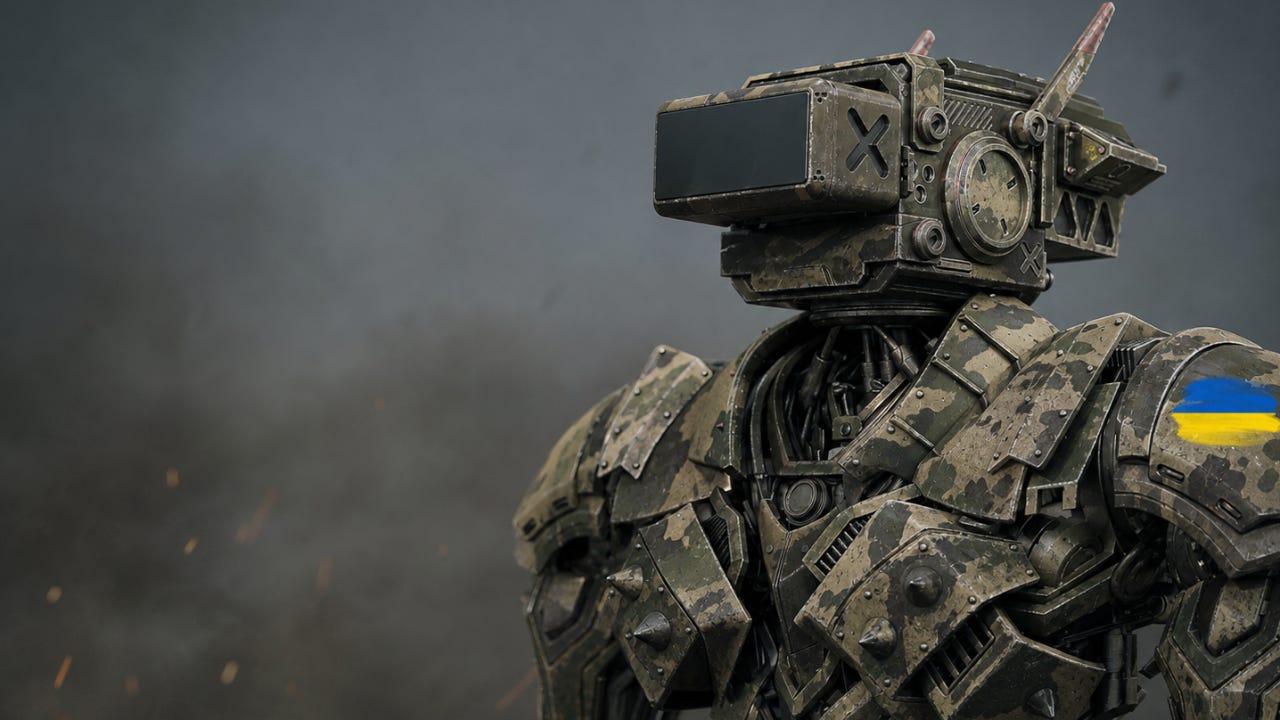
Mykhailo Fedorov stood up at the IT Arena conference in Lviv on Saturday and announced that within six months, he wants a humanoid robot killing a Russian soldier.
That’s quite the headline.
The internet knows what to do with that…
What caught my attention were the boring jobs Fedorov mentioned immediately afterward: reloading a machine gun, changing a battery, and installing a sensor.
His new Army of Robots project is supposed to teach machines to perform those kinds of tasks so Ukrainian soldiers don’t have to expose themselves doing them. Within a year, he wants robots and drones conducting an assault together without infantry physically entering the position.
Not gonna lie… That sounds incredible. Then my infantry brain kicked in.
First of all, I can’t wait to mess with the FNG: “Hey, Sierra29, can you go find me some headlight fluid? Oh, I also need a charger for these chem lights.”
Actually, when I was in the Air Force, we had convinced a young airman that the rotodome of the E-3 Sentry actually detaches during flight and flies around like a flying saucer collecting radar returns. He believed us. I’m not shitting you.
(What the hell are they teaching kids in high school these days? Is there any science education at all?!)
But something as simple as reloading a gun sounded almost comically mundane sitting next to “kill an enemy soldier.”
Although, reloading a weapon under fire is mundane in about the same way landing an Airbus A320 is mundane. Sure, people do it every day. You’d still prefer that the person doing it knows what the actual fuck they’re doing.
I spent time in an infantry unit before I ever swapped out a klystron power amplifier (KPA) on AWACS, and there are tasks your hands eventually learn better than your monkey brain, like feed the belt, clear the jam, change the barrel, get the weapon back on target, aim center mass.
In daylight, on a range, everything is civilized. At night, exhausted, wearing gloves, with somebody shooting back, Elvis has left the building.
Changing a battery sounds even sillier as a robotics challenge until you think about where that battery is. Maybe it powers a signal repeater for drones. Maybe it belongs to an acoustic sensor. Maybe that sensor has been sitting in the same location long enough for Russian reconnaissance to notice activity around it.
Now a soldier has to make the long walk over there.
That long walk is the mission.
And that’s where I started wondering whether the humanoid robot was actually the important part of Fedorov’s announcement, because Ukraine already has a robot army. But I think Fedorov is proposing something more specific: giving part of that army a human-shaped body and enough dexterity to interact with equipment designed for human hands.
Still, there’s something to be said for Ukraine’s existing clankers.
Back in April, drone operators from Ukraine’s 60th Mechanized Brigade spotted a 77-year-old woman walking alone through the gray zone near Lyman.
She was using crutches.
The road around her was cratered. Russian fire made a normal vehicle evacuation too dangerous. She’d lived in her home for 53 years before the war finally made staying there impossible. So, the Cerberus unmanned-systems unit sent a ground robot.
The soldiers apparently worried, quite reasonably, that an elderly woman who had already spent years living next to a war might not react enthusiastically to a tracked machine rolling out of nowhere toward her.
They covered it with a blanket.
On the blanket they wrote:
“Grandma, get on.”
She did.
The robot brought her out.
Three other civilians leaving on foot were later escorted by drones to an evacuation point, where an armored vehicle picked them up.
There’s something about that operation I can’t get out of my head: Fedorov’s six-month benchmark is a humanoid killing a Russian soldier.
Meanwhile, one of the clearest demonstrations of battlefield robotics I’ve seen involved an elderly Ukrainian woman climbing onto what looked like an industrial riding lawnmower wearing a quilt.
Ukraine’s Defense Ministry says ground robots carried out nearly 24,500 missions during the first three months of 2026. More than 9,000 happened in March alone. By June, the monthly total for logistics and evacuation missions had climbed above 16,000. Earlier this year, the ministry set a goal of eventually shifting as much as 100 percent of frontline logistics onto unmanned systems.
The 1st Separate Medical Battalion reportedly conducted six robotic casualty evacuations in a single day earlier this year, with two unmanned vehicles covering roughly 300 kilometers combined. Ukraine is also fielding dedicated medical systems like MAUL, built specifically to retrieve wounded troops quickly enough to reduce exposure to Russian drones.
Ukraine’s robots are getting weirder
There’s an entire family of these things now.
Ratel H was designed for logistics and casualty evacuation. Ukrainian troops have used one example for dozens of missions, hauling tons of supplies while surviving FPV strikes and mine blasts.
TERMIT is a modular tracked platform that can be configured for logistics, evacuation, engineering work or combat support. Ukraine has fielded dozens of UGV designs, most of them developed around some variation of the same question: how do we send machinery into places where sending another Ukrainian is becoming suicidal?
Then, this week, Ukraine announced that one of its units had completed an operational logistics mission using an amphibious ground robot.
The machine traveled more than 40 kilometers across land and water while carrying ammunition and supplies.
Of course it did…
We’ve reached the stage of this war where somebody apparently looked at Ukraine’s growing fleet of tracked robots and said, “I think it needs more cowbell… and the ability to swim”
So now the robots swim.
And this is where I’m skeptical of humanoids.
Not dismissive. Just skeptical.
Sure, there are jobs where having arms and hands could be extremely useful.
A machine designed around existing human infrastructure could manipulate equipment nobody ever intended for a robot. It could open ammunition boxes, operate latches, move cables, install sensors, handle batteries, or reload weapons designed for human operators.
You don’t have to redesign every object on the battlefield around the robot.
The robot adapts to the objects already there. That’s a legitimate engineering argument for a humanoid.
Unfortunately, Ukraine’s front line is also one of the least hospitable places imaginable for something trying to walk around on two legs.
There’s mud that swallows boots, collapsed trenches, wire, roots, broken masonry, snow, ice, shell craters, damaged vehicles, abandoned equipment, and random battlefield debris everywhere.
I remember enough movement through miserable terrain with two perfectly serviceable human legs to know I would’ve happily accepted tracks. I’ve had my feet look like crumpled white washcloths after someone squeezed the water out of them.
And you want to throw Sierra29 into that shit? Well, maybe…
But a low tracked machine has a low center of gravity, can carry substantial weight for its size, and doesn’t get embarrassed when the ground stops being flat. Humanoid robots, however, inherit several problems evolution spent a few million years solving for us, and even the human ones still fall down occasionally; usually after tequila.
The Chinese have been working on this problem too
China gives us a useful preview of how engineers are trying to make two-legged robots less ridiculous once the floor stops being perfectly flat.
Unitree’s H1 is probably the best-known example. It is a full-size humanoid weighing about 47 kilograms, with high-torque electric joints, 3D LiDAR, a depth camera, and enough power in the legs to run at more than three meters per second.
Unitree specifically advertises the H1 as capable of walking and running autonomously across complex terrain, and researchers have demonstrated impressive performance on stairs, obstacles, narrow surfaces, and uneven ground. That’s still a very different standard from surviving a Ukrainian trench line.
Its smaller G1 uses the same general philosophy: powerful joint motors, multiple degrees of freedom in each leg, onboard perception, and software constantly adjusting the robot’s balance as the terrain changes underneath it.
The important part is the software.
Older walking robots were largely executing carefully engineered gaits. Modern humanoids increasingly learn locomotion through reinforcement learning, first spending absurd amounts of simulated time falling over where nobody has to pay for replacement parts.
Researchers working with Unitree machines have demonstrated control systems that let humanoids traverse stairs, boxes, hurdles, narrow surfaces, and mixed terrain by continuously changing foot placement and moving the upper body to recover balance. One 2026 project using a Unitree G1 demonstrated terrain-aware locomotion across stairs, obstacles, and combinations of uneven surfaces using onboard perception.
Another team used a full-size H1-2 to maintain balance on extremely narrow terrain and recover from unexpected disturbances.
So basically, the robot stops relying entirely on rigid, preplanned choreography and starts approximating something much closer to the way you and I constantly adjust our balance without thinking about it. A foot lands slightly wrong, the torso shifts, the other leg compensates, and the arms may move to keep the center of mass from departing the area where physics would prefer it to remain.
That’s definitely impressive.
But a Ukrainian trench is still a bit more challenging than a robotics laboratory.
Mud changes consistency. Dirt collapses beneath your foot. Wire catches ankles. Snow hides holes. Rubble moves after you step on it. Then somebody starts firing artillery at you, the communications link gets jammed, and the robot discovers that the object its perception system confidently identified as “ground” was actually a sheet of corrugated metal resting over a crater.
There is another clue in Unitree’s own product lineup that I find telling.
When the company designed its G1-D platform for industrial manipulation, where customers presumably prefer the robot to arrive at its workstation rather than perform a dramatic recovery maneuver on the factory floor, Unitree put the upper body on a wheeled base.
Even a company very good at building robot legs has apparently noticed that wheels remain effective.
China’s quadruped robots make the same point. Unitree’s Go2 uses LiDAR, learned locomotion, self-righting, and dynamic balance to move across gravel, slopes, and obstacles, while four legs give it a much larger stability envelope than a humanoid standing upright on two feet.
Unitree’s quadrupeds have also appeared in Chinese military exercises, although that is a long way from proving they could independently operate across an artillery-chewed Ukrainian battlefield.
So, I would not say China has solved the terrain problem.
But for now, if the choice is between a beautiful humanoid that can reload a machine gun and a tracked box that can reliably cross 500 meters of Ukrainian mud while carrying a wounded soldier, gimme the tracks.
So, my guess, and it’s only a guess, is that Ukraine’s first genuinely useful humanoids won’t be charging trenches with rifles.
They’ll probably appear farther back.
They may reload weapons, move equipment, service sensors, handle ammunition, or perform repetitive jobs at positions where Ukrainian soldiers currently expose themselves for no particularly good reason. If somebody eventually sends one forward with a weapon, I won’t be shocked.
I’m just not convinced that’s where the military value starts.
Ironically, the more I looked at this, the more those boring tasks became the strongest argument for the humanoid. Killing a soldier doesn’t require a human-shaped machine. Reloading a weapon designed for human hands might.
And then there’s the kill chain
Fedorov’s broader vision is actually more interesting than the humanoid.
The idea is to connect sensors, UAVs, ground robots and strike systems so machines can increasingly work together. His project is being developed outside government after his departure as defense minister this summer, and he has also announced a new defense-tech company with Palantir CEO Alex Karp as its first major investor.
The Army of Robots itself is being presented as an ecosystem that will invest in companies, develop technology, test systems with military units and scale whatever survives contact with reality.
Fedorov describes a future battlefield in which a sensor detects a threat, a robot enters the danger zone, and the system acts.
Having spent part of my military career aboard the E-3 Sentry, I get nervous whenever someone compresses the middle of a kill chain into a convenient arrow on a slide.
Finding something is useful, absolutely.
But maintaining the track long enough to identify the target, passing that information to the right unit, keeping the communications link alive under Russian electronic warfare, assigning the correct weapon, getting the machine there before the target moves, and ensuring the robot does not get hung up on a ditch, lose its connection, select the wrong object, or arrive ten minutes after the Russians have already left all have to happen correctly.
That middle portion is where most of the engineering misery lives.
And Ukraine knows this better than almost anyone at this point. Its entire wartime defense industry has been built around prototypes discovering, often violently, that something which worked beautifully at a trade show behaves differently after Russians begin interfering with it.
That’s why I’m more interested in the robot army Ukraine already has than the human-shaped one in the launch video.
About that six-month deadline
I understand why Fedorov chose the benchmark he did.
“Humanoid robot kills Russian soldier within six months” gets attention.
“Humanoid robot successfully changes lithium-ion battery in muddy communications position” gets you nineteen views on YouTube, seventeen of them from electrical engineers.
Fedorov is also operating in the private sector now, recruiting engineers and looking for capital. A dramatic technical objective is partly a recruiting tool because it gives investors, engineers, and soldiers something measurable to chase.
Fair enough.
The benchmark may even be reached.
Ukraine has spent nearly five years taking things people dismissed as gimmicks and turning them into normal components of industrial warfare.
FPV drones became routine, naval drones started sinking warships, bomber drones evolved into serious strike platforms, fiber-optic drones spread across the battlefield, interceptor drones became a new air-defense layer, and ground robots began hauling ammunition and retrieving casualties.
Of course, knowing Ukraine, somewhere in a remote workshop somebody may already be teaching a machine with knees how to manipulate a rifle.
I am far more interested in what happens after the demonstration.
Can an ordinary military unit maintain it?
Can it survive rain, mud, snow, and shell fragments?
Can it stand back up after falling?
How long does the battery last in winter?
Can somebody replace a damaged actuator twenty kilometers from the front, or does the entire robot have to go back to a specialized repair facility?
Can it operate under Russian electronic warfare?
Can it carry a wounded soldier whose leg is broken without making the injury worse?
Can a nineteen-year-old Ukrainian soldier teach it a task faster than he could simply perform the task himself?
Those questions likely won’t make the product launch video.
Ukraine already has a pretty good method for answering those questions: build something, hand it to soldiers, watch the battlefield expose everything the engineers got wrong, fix it, and send it back.
That process has already produced a ground-robot force conducting tens of thousands of missions without anyone needing to make the machines look remotely human.
Maybe humanoids eventually earn their place too.
I’m open to it.
I’m just having trouble getting past that blanket near Lyman; a 77-year-old woman standing alone in the gray zone with a little tracked robot rolling toward her, and three words telling her what to do.
For now, apparently, saving lives doesn’t require knees.
Слава Україні!
How could you be so cruel to a new recruit? Mind you, we would send them to the quartermaster (QM) to get the keys to the square (so we could march), or to ask him for a brush & paint to ‘paint the last post’.
I saw the article and video and, not being military, am very concerned. I understand the practical applications but think it’s a rather bad idea to program robots to kill humans. It’s that AI could wipe out humanity within a decade plays into this concern. The other factor is how interested Musk and the apocalyptic fantasizing billionaires are in this advancement. Oh boy! Musk with Terminator! What could possibly go wrong???!!!
I agree that there are limitations to robotics, and as a Canadian living in the Great White North, I am comforted by the fact that the batteries and joints won’t survive a -40 C winter week. A lack of decent roads and the power outages that happen with most storms. Oh, and beaver dams and Canadian geese.
However, whatever Ukraine develops Russia adapts and starts using as well and I imagine that China would love to see how their tech works on the battlefield too. I also have fears that Russian controllers could very well add this type of evil to their already sadistic civilian safari drones list.
There is no going back, but I do hope that this Pandora’s box doesn’t contain even more unexpected suffering as it is opened.