


Ukraine just signed an agreement with Finland to explore something that sounded fairly boring a month ago, and suddenly got extremely important:
Satellite communications that Ukraine actually controls.
President Volodymyr Zelenskyy and Finnish Prime Minister Petteri Orpo oversaw the signing of seven agreements in Kyiv yesterday (October 22) covering defense production, drones, transportation, construction, and space. The agreements have a combined estimated value of around €300 million.
The document that caught my attention was signed by Ukraine’s Ministry of Defense, Nokia Defense, and ICEYE.
According to Zelenskyy, the three parties signed a letter of intent aimed specifically at developing Ukraine’s satellite communications capabilities. Zelenskyy said Kyiv had agreed to make “greater use of Finland’s satellite capabilities” for both defense and national resilience.
I think that wording undersells what Nokia and ICEYE are proposing.
They’re really talking about helping Ukraine develop sovereign satellite communications.
The wake-up call came when Musk throttled Ukraine’s Starshield service, and as of October 23, 2026, Ukraine says the restrictions remain in place.
(Even though Musk says service has been restored.)
I’ve spent a lot of ink this past week writing about who possessed the contractual authority to change those settings, but the larger lesson keeps bothering me more.
Ukraine built an enormous portion of its battlefield communications architecture around a satellite network it didn’t control; because it trusted the supplier.
And Starlink has been extraordinary technology for Ukraine. It survived Russian electronic warfare, attacks against terrestrial infrastructure and the general abuse of operating in the world’s nastiest electromagnetic environment. Ukrainian soldiers have wired the system into command posts, vehicles, boats and increasingly drones.
Then, infuriatingly, Musk changed a software permission.
That is the vulnerability Nokia and ICEYE say their new system is intended to remove.
And interestingly, they started building it before the Starlink mess.
In an incredible bit of foresight, Nokia and ICEYE announced their sovereign satellite communications partnership on October 1, nearly two weeks before Ukraine began experiencing the SpaceX restrictions.
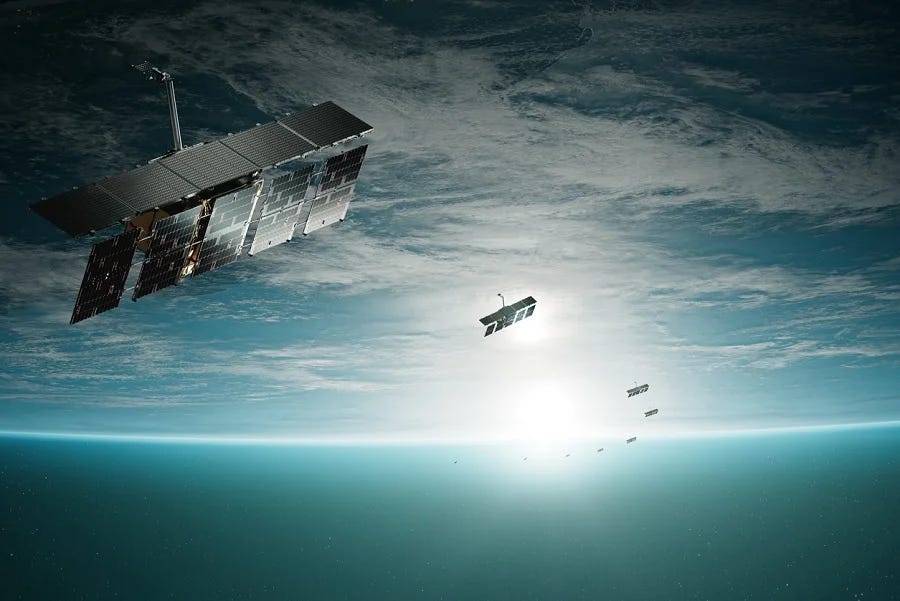
Their proposal is a broadband low-Earth-orbit communications system intended specifically for governments, defense organizations, border agencies, and emergency services.
The first communications satellites are expected to launch in 2028.
So, Ukraine hasn’t suddenly panic-ordered a Finnish replacement for Starlink. The project was already moving. The Starlink episode just demonstrated the requirement in the most spectacular way possible.
ICEYE says the goal is to provide Ukraine with secure satellite communications “that it controls.” Nokia says the same basic thing from the networking side: governments need communications that remain available under pressure while national authorities retain control over the connectivity their military depends on.
That gets us to the technical question of today’s piece...
What does sovereign satellite communications actually mean? Well, your country has to own the important bits.
Ukraine already knows ICEYE extremely well.
In August 2022, the Serhiy Prytula Charity Foundation purchased access to ICEYE’s synthetic aperture radar constellation and transferred the capability to the Ukrainian government. The deal gave Ukraine full use of one ICEYE satellite already in orbit along with access to imagery from the broader constellation.
That satellite became known in Ukraine as the “People’s Satellite.” Kind of like The Rock Dwayne Johnson used to be the “People’s Champion” in wrestling before he became a movie star.
Ukraine’s military intelligence said within months of getting access, ICEYE imagery had helped identify thousands of pieces of Russian military equipment, including tanks, artillery, helicopters, air-defense systems, and Iskander positions.
Then the relationship kept growing.
In January 2026, ICEYE announced another agreement expanding Ukrainian access to high-resolution SAR imagery for tactical military decision-making. So Ukraine already understands what it means to integrate Finnish commercial space technology into military operations.
But the new project changes the mission. ICEYE has historically looked down.
Now, with Nokia, it wants to help governments talk through space too.
Nokia brings the nervous system
If ICEYE provides the spacecraft and space experience, Nokia brings much of the communications architecture connecting everything together.
That means secure networking, network orchestration, ground infrastructure, and terminals; the whole shebang.
The two companies say their planned system will integrate satellites, ground stations, and ruggedized end-user terminals into one sovereign architecture.
ICEYE says its approach gives governments ownership and operational control over the satellites, ground segment, and terminals. Its own description of the service goes even further: customer data can remain entirely inside approved national or allied infrastructure, without dependence on a foreign commercial operator’s terms of service.
That’s a nice little middle finger to Elon.
So, I think there are three ways Ukraine could do this…
One is a dedicated national constellation.
Ukraine owns the satellite system and operates it for Ukraine. That’s the purest form of sovereignty and probably the most expensive.
A second option is a coalition constellation shared among allied countries. That possibility gets really interesting. Imagine Ukraine, Finland, Poland, the Baltic states, and perhaps several other European countries collectively operating a low-Earth-orbit military communications constellation.
Each contributes funding and infrastructure and the network provides overlapping coverage. Control remains within the coalition rather than residing with a foreign commercial provider.
The third option is what ICEYE calls a “hosted sovereign service.”
That would presumably allow a government to gain protected capacity more quickly without immediately funding an entire constellation from scratch, while still preserving much tighter national control over data and service than a conventional commercial subscription.
We don’t yet know which model Ukraine is considering, the October 22 document is just a letter of intent.
Plus, the first Nokia-ICEYE communications satellites aren’t expected to launch until 2028 and Ukraine still needs Starlink today.
I have to admit that I didn’t fully appreciate the vision when I first learned about Starlink. But remember, back then, Ukrainian-style drone war hadn’t been invented yet. My biggest concern was the sky pollution hampering astronomers’ observations.
But now the benefit is obvious… Starlink’s enormous advantage is scale.
SpaceX operates more than 11,000 satellites across Starlink’s constellation, giving it coverage and capacity that no competitor can immediately reproduce.
Ukraine has thousands upon thousands of terminals already distributed across its military and civil infrastructure.
Its soldiers know how to use them.
Its units have built tactics around them.
Replacement terminals exist.
Commanders know roughly what the network will tolerate.
A new Finnish satellite system isn’t going to magically replace all of that in 2027, nor are Nokia and ICEYE claiming it will. Their own literature says the sovereign constellation is intended to complement commercial and governmental networks rather than replace every other system.
That’s probably how Ukraine should approach it…
Military communications shouldn’t have one backbone, but several.
Starlink can be one. ICEYE-Nokia can become another. Europe’s IRIS² and GOVSATCOM infrastructure can eventually add additional paths. Terrestrial fiber and microwave links remain important. Military radio still works in a pinch, when Ivan’s not jamming shit.
Different systems overlap so that losing one doesn’t suddenly blind an entire battle group.
That’s just redundancy, (like we had on the AWACS):
There were two complete radar chains starting with two different high power amplifiers (Klystron Power Amplifiers or KPAs) all the way up to the antenna element in the rotodome. It was up to the on-board radar tech which chain, A or B, you’d be flying that day; but if one went down, you could switch to the other chain with no mission interruption. (When both chains went down on the same flight, the mission fails… but you get to go home early.)
Plus, there’s a second story happening underneath all of this.
Finland and Ukraine are developing a strange defense relationship, and I mean that in the best possible way.
In the same package of agreements, Ukrainian and Finnish companies agreed to explore joint production of unmanned military systems inside Finland. Patria is involved. Ukrainian drone companies are involved. Zelenskyy says measures worth around €200 million are already underway under the broader Ukraine-Finland Drone Deal.
Then there are the locomotives.
Finland agreed to give Ukraine ten Dv12 diesel locomotives and spare parts free of charge, becoming the first country to donate locomotives directly to Ukrzaliznytsia.
Ukraine says Russia has damaged or destroyed nearly 600 locomotives since the full-scale invasion, including more than 300 diesel units.
I’m deliberately not going down that rabbit hole here because I think Finnish locomotives quietly joining Ukraine’s war deserve their own video. I’ll be filming this for next week’s YouTube slate.
Anyways, taken together, these agreements show Finland doing something increasingly common among Ukraine’s northern European partners: integrating Ukrainian wartime experience into Finnish industry while giving Ukraine access to capabilities Finland happens to be very good at building.
Remember, Finland spent decades designing a society around the assumption that Russia might eventually become everybody’s problem again.
Turns out, there was some wisdom in that.
Слава Україні!
Given that russia will try and destroy anything that Ukraine has and Ukraine will do the same I am watching through my fingers how close the russian satellite is getting to one of the the ICEYE ones at the moment. When one of the ICEYE staellites becomes Ukranian and if the 3 day SMO is still on-going I can imagine things becoming very kinetic up there very quickly.