


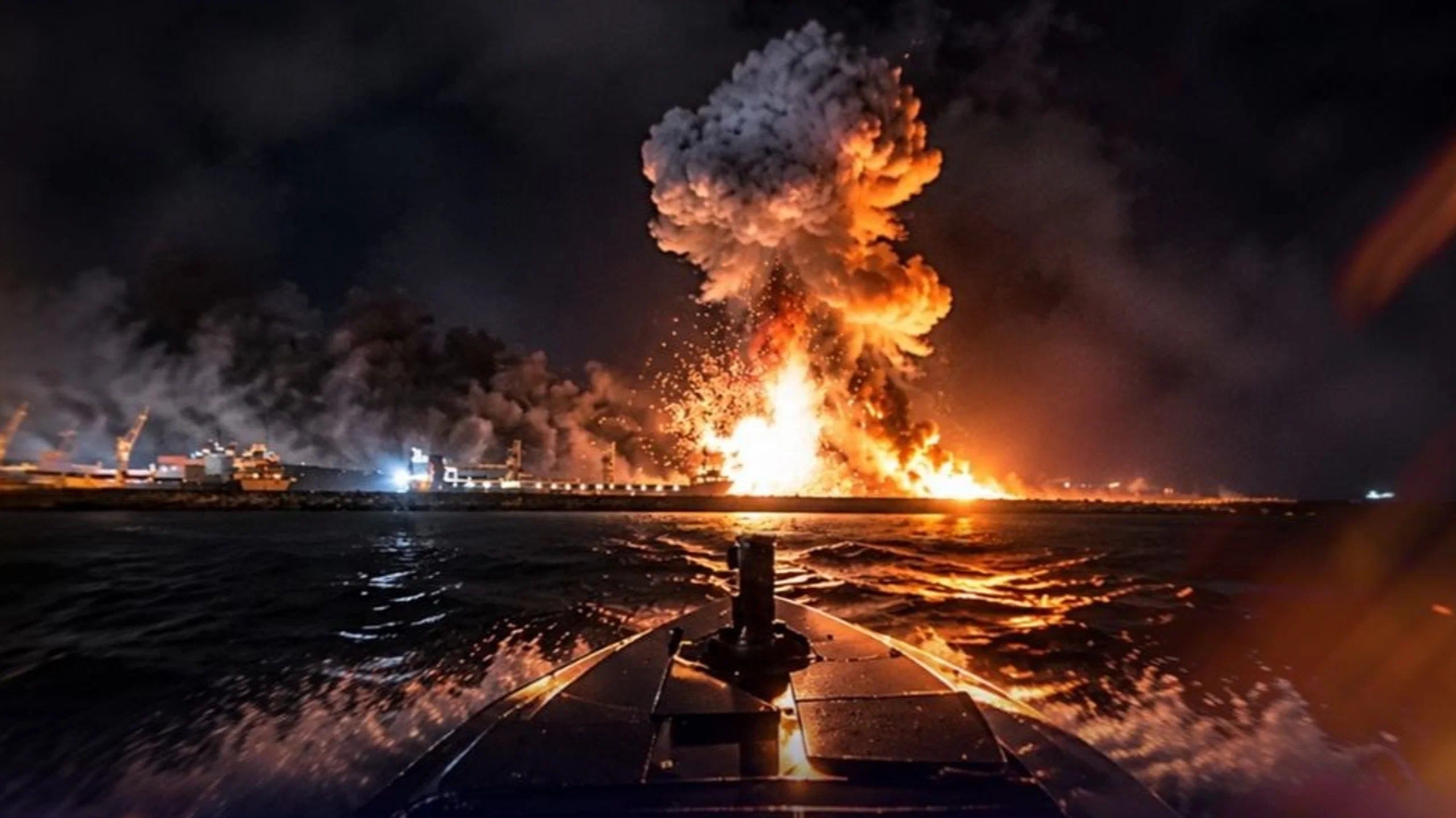
On July 30, 2023, Vladimir Putin stood before the Russian Navy in St. Petersburg and celebrated the commissioning of a new guided-missile corvette named Merkury.
The ship had inherited the name of a “legendary” Russian sailing vessel that defeated two Ottoman warships in 1829. Actually, “defeated” is too strong here. The brig Merkuriy damaged two Ottoman ships rather than sinking them. Russian tradition frames it as a victory, but “fought off” would be more accurate.
Regardless, on this occasion, Putin was suffering from acute smugness. One might say, as smug as a pig in shit. He loved every second of this empire building stuff, because reviving naval traditions scratched a very particular itch: Returning the motherland to its former Tsarist glory.
He described the St. George’s naval ensign flying above the new Merkury as “a sign of the firmness of our naval traditions, a symbol of the courage, bravery, and steadfastness of military sailors.”
Interestingly, several African heads of state attended the celebration. If not foreshadowing than at least mildly poetic…
Now, three years later, the Merkury is lying on its side in the harbor at Benghazi, Libya, courtesy of seven Ukrainian explosive drone boats.
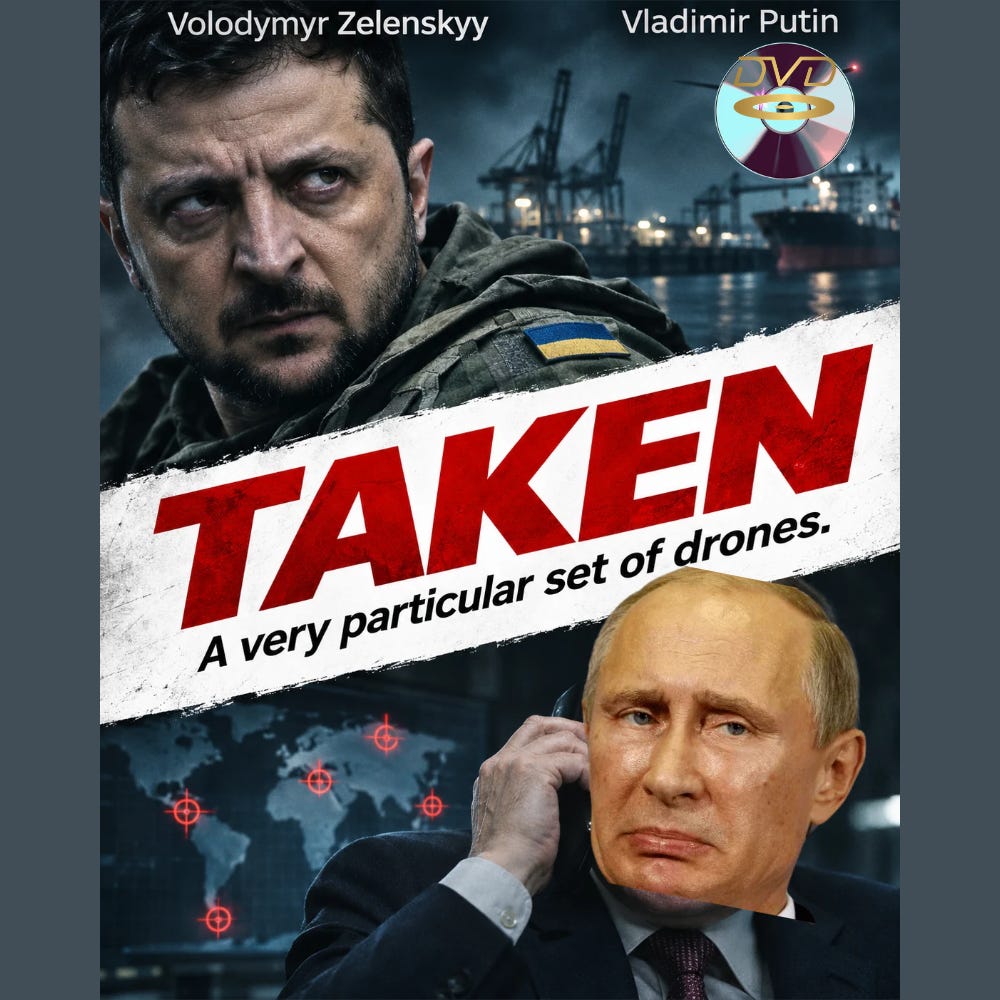
Hmmm. Benghazi… Where have I heard that name before? Ah, yes, it was a Michael Bay movie I never saw… I think this was the poster:

Longtime readers know I love a good mystery. So, how the hell did Ukraine get seven explosive drone boats all the way to Libya?
Let’s go on a voyage of discovery together. I’ll be Meriwether Lewis to your William Clark.
In case you missed it, on November 22, 2026, Ukrainian naval drones attacked Merkury while it sat at a base in Benghazi, Libya. By the next day, satellite imagery showed the corvette lying on its side in the harbor with its superstructure underwater.
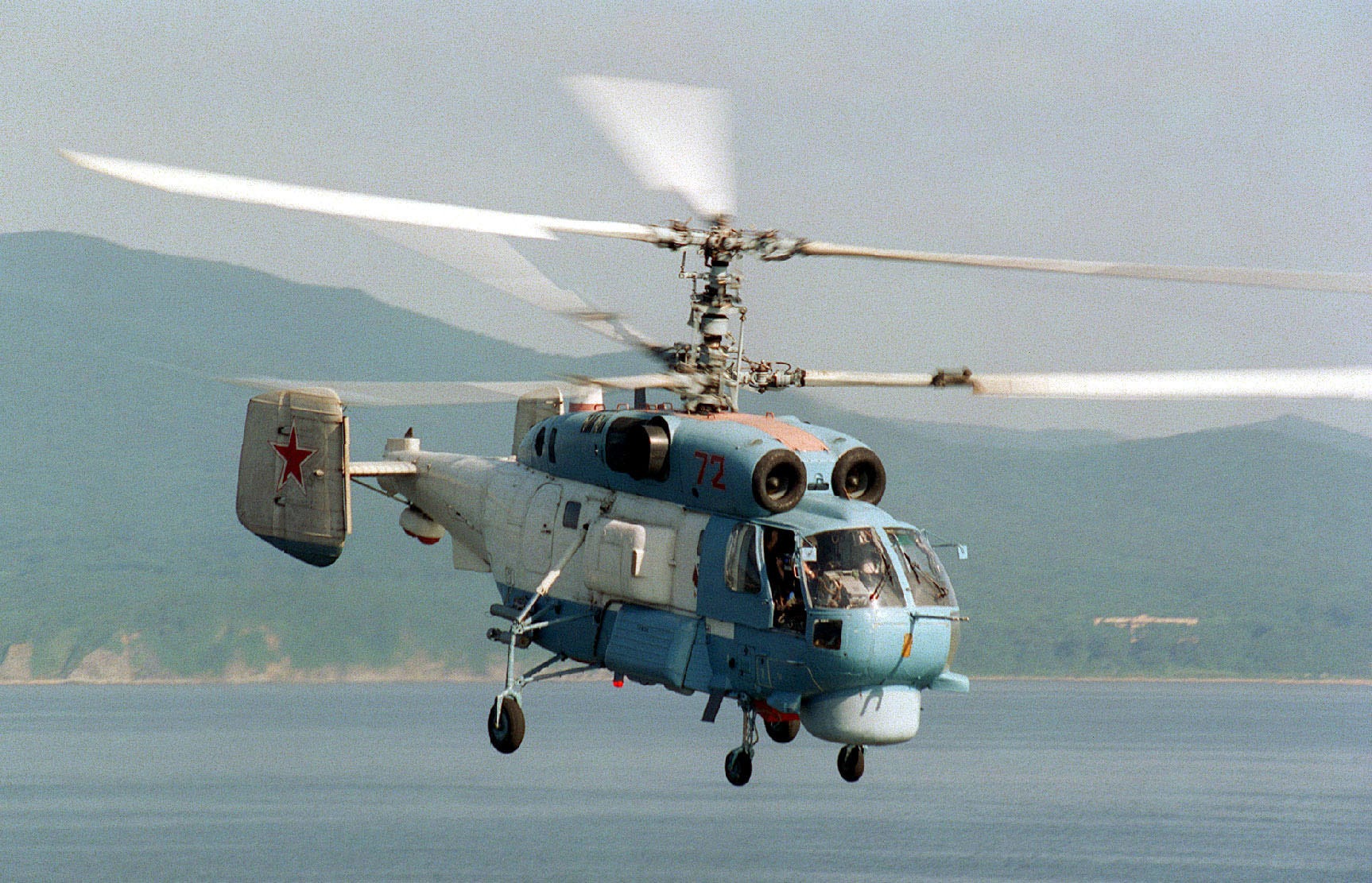
Ukraine says a Kamov Ka-27 combat helicopter went down with it.
Good riddance. Let’s be honest… The Ka-27 is an ugly little fucker. If it were a man, you would feel a primal urge to punch it square in the face for no reason.
The SBU, Ukraine’s security service, said the Merkury had been escorting Russian cargo ships, and that a second target, a cargo vessel called MV Angara carrying military equipment, was hit in the same operation.
The SBU released video of the Sea Baby II drone boats closing on the ships before everything got all explodey.
We’ve watched these uncrewed boats gut Russia’s Black Sea Fleet for years now, so the footage wasn’t new. But the location was… Anyone familiar with geography will see the same challenge I did. Benghazi is on Libya’s Mediterranean coast, more than a thousand miles from anywhere Ukraine’s robot navy normally operates.
So, the attack is impressive, sure. But the question that grabbed me was the possible routes these attack craft took to get there.
The SBU dropped one tantalizing detail: The seven drones were carried to the area and launched from what it called a mothership, a larger vessel that hauls smaller craft most of the way and releases them near the target.
The SBU named no ship.
It didn’t say what flag the carrier flew, where the boats went in the water, or where the voyage began.
So, we’re left with a logistics mystery, and the fun kind. (The mothership could also be misdirection because, naturally, the SBU isn’t an organization in the habit of giving away operational details of successful missions.)
Still, my first guess was overland.
Maybe truck the boats from Ukraine through Poland or Romania, down to some Mediterranean port and load them there? But that drags a NATO country’s territory into a clandestine attack, and there’s a difference between shipping Ukraine weapons, (which NATO does constantly and lawfully), and staging a strike from your soil.
I think the EU may still be too timid for that, but to their credit, they are slowly stirring from their deep slumber.
Hold on… Ukraine already touches saltwater.
The 90-year-old treaty in the way
To get from Odesa to the Mediterranean, you sail the Black Sea, thread the Bosporus at Istanbul, cross the Sea of Marmara, and pass through the Dardanelles. Except Ukraine is at war and Turkey has been enforcing the Montreux Convention since the invasion began.
Montreux, signed in 1936, governs who gets through the Turkish Straits. When Russia invaded in 2022, Ankara formally recognized a war was “on like Donkey Kong” and invoked Article 19, which bars warships belonging to the warring countries from transiting.
In practice, the door shut on Russian and Ukrainian naval vessels alike.
And Turkey means it. In January 2024, two former Royal Navy minehunters that Britain handed Ukraine were denied passage, NATO membership and all, and London accepted they wouldn’t reach the Black Sea until the war ended.
So, if Ukraine sailed a warship full of drones toward the Bosporus, Turkey would turn it around.
But I went back and read the convention, and Article 4 draws a line that Article 19 doesn’t. While Turkey is not itself at war, merchant ships keep their freedom of passage regardless of flag or cargo.
So, a Ukrainian warship hauling seven drones is blocked. A merchant vessel carrying seven drones as cargo is a different legal animal entirely. Load the boats as freight on a qualifying merchant ship and their military nature doesn’t automatically bar the trip.
Now, a civilian ship converted into a military launch platform and run under military control is a murkier case.
I’m also not convinced the mothership passed the Bosporus at all. It might have already been in the Mediterranean. But the merchant-cargo route would let Ukraine move its boats by sea, from its own coast, without a NATO country’s roads. After all, Russia has spent the whole war using merchant shipping to run military gear through those same straits. Ukraine may have just borrowed Moscow’s own trick to sink Moscow’s ships.
Ukraine has been in Libya for months
While I was chasing transport routes, the story quietly changed shape on me, because it turns out the mothership might not be the whole answer.
Remember… The Ukrainians have a particular set of skills. They will find you.
In April 2026, French broadcaster RFI reported that more than 200 Ukrainian military officers and specialists had deployed to western Libya and were working from facilities around Misrata, Tripoli, and Zawiya, alongside forces loyal to Libya’s internationally recognized government in Tripoli.
The deal, as described, was expertise and training in exchange for access.
Libya is currently split. The recognized government holds the west from Tripoli. The east, including Benghazi, answers to Khalifa Haftar, who is cozy with Moscow.
So picture it: Ukrainian personnel in the west, Russian ships using Haftar’s ports in the east, on the same coastline. The AP reported the same month that Ukrainian drone specialists were operating out of a Misrata airbase under an arrangement with Western backing. In September, CNN quoted a Ukrainian naval drone operator who said his unit had been running Misrata as a base for strikes on Russia’s shadow fleet in the Mediterranean.
Do you know who else is in Misrata?
Turkey has troops there. So does Italy. Both the United States and the UK have an intelligence presence there, and likely a small contingent of special forces.
The plot thickens.
And then there’s the boat the Greek fishermen found.
In May, near the island of Lefkada, fishermen pulled up a mystery unmanned vessel that Greek authorities identified as Ukrainian-built. CNN later reported, citing a Ukrainian intelligence source, that the boat had slipped its operators’ control… ahem, operators who were based in northwestern Libya.
So, I think the mothership might have been one moving piece of a standing operation, not a lone ship creeping out of Odesa with seven boats.
But who was driving during the attack?
Now I’m just getting nitpicky… Let’s file this under shit we may never know.
Can you steer a drone boat from another continent?
Sure. Ukraine’s naval drones started as explosive speedboats with cameras and remote control, and they’ve grown teeth since: machine guns, sidewinder missiles, versions that carry smaller drones or do electronic warfare.
The naming is a mess of Sea Baby, Magura, Sargan, and Sea Wolf, all used loosely across media outlets, and naval analyst H. I. Sutton pegged the Benghazi craft as a Sargan-3000 variant rather than the plain Sea Baby some first reported.
What I care about is the radio.
A remote boat needs a way to take orders and send video home, and Ukraine has run maritime drones over satellite links for years.
A good satellite connection reaches far past line-of-sight, so in principle an operator in Ukraine could babysit a boat in the Mediterranean.
Two weeks ago, the UK’s Secretary of State for Defense, and a man with whom I share two names, Wes Streeting (Wesley Paul William Streeting), just steered a Magura sea drone, that was sitting in waters 1,500 miles away, from the HMS Prince of Wales in Oslo, Norway.
I made a video about that:
So, if Ukraine so chose, they could have piloted the Merkury strike while riding It’s a Small World at Disney’s Magic Kingdom in Orlando.
Equally, a local team could drive them from Libya; Ukraine clearly had regional support, and crews sitting in Libya would make this whole thing far easier to run.
Why was a Russian warship in Benghazi anyway?
When Bashar al-Assad’s government fell in Syria in December 2024, Russia’s grip on its Tartus naval base and Hmeimim airbase, its longtime Mediterranean footholds, got shaky.
Libya picked up the slack.
Russian transports and cargo ships began shuttling gear between Syria and Libya, Moscow deepened its ties with Haftar, and eastern Libyan ports became staging points for the whole African operation that Africa Corps inherited from Wagner.
That machine runs on fuel, ammunition, spare parts, and ships to carry them. The SBU says the Angara was working Russia’s “Syrian and Libyan Express” supply runs and the Merkury regularly rode shotgun for those cargo ships.
That’s why a modern corvette was parked in Benghazi.
And here’s the tell. Russia has spent years ringing its Crimean harbors with booms and barriers against exactly these drones; Sevastopol bristles with the stuff. The Merkury’s berth at Benghazi, according to The War Zone, had almost none of it.
The barriers only showed up after the ship was on the bottom, when small boats appeared across the harbor to block it off.
Some lessons apparently don’t sink in until the warship does. ZING!
Ukraine says both vessels were fair game for supporting Russia’s war, and a commissioned warship like the Merkury plainly is; a cargo ship hauling military equipment can be too.
But striking inside another country’s territorial waters raises some sovereignty questions that don’t vanish because the targets were legitimate.
Libya’s recognized government says it authorized no such operation, and the eastern authorities obviously condemned it. I can applaud sinking a Russian warship while simultaneously cautioning Ukraine to be cognizant of global ops that may turn public opinion against them.
Anyways, let’s step back and look at the arc: Russia invaded in 2022 with crushing naval superiority. Ukraine answered with cheap explosive boats, made Sevastopol the kind of neighborhood you drive through with your windows rolled up, and pushed much of the fleet out of Crimea.
Now, in late 2026, those same boats have reached across the Mediterranean and put a corvette on the seabed in Africa.
I love it… Chef’s kiss. Let me dig up that Leo clapping meme to close this out, one sec:

Whether it was cargo on a merchant ship through the straits, some European route to a mothership in the Mediterranean, or launched from a Ukrainian detachment already dug into North Africa; I’m not exactly sure. Maybe a mix. And maybe the SBU will reveal something more definitive that settles the question.
But the thing the operation proved doesn’t depend on solving the mystery.
Russia’s overseas reach runs on ports, airfields, cargo ships, and handshake deals with foreign governments, and Ukraine just showed that part of that network is as exposed as the Black Sea Fleet ever was.
Every ship and port Moscow now visits must spend resources on defensive measures.
Those are resources that won’t be spent in Ukraine, so that’s a win in my book.
I like to imagine Ukraine’s SBU channeling Liam Neeson’s character in the movie Taken when he says, “I have a very particular set of skills... I will look for you, I will find you, and I will kill you.”
Слава Україні!
I use AI extensively in my research. Tools like God’s Eye View and SITDECK help me monitor hundreds of news feeds and open-source intelligence sources simultaneously. I also use Claude to help check factual claims and locate supporting sources. I still examine the underlying evidence, verify the reporting personally, and write my articles myself. After writing, I use Grammarly’s AI tool to correct punctuation and spelling.
I’ve disabled Substack’s AI detection feature because I don’t believe a computer can reliably determine who wrote something by examining the finished prose. I’ve had explainer articles I personally wrote in 2017 flagged as partially AI-generated. Apparently, a younger Wes had access to technology from the future. For another example, I wrote a book on writing and public speaking in 2020 called “Own the Crowd” where I have a chapter dedicated to the power of using threes to make a point stick; yet three of anything is now a signature of AI writing? I’m calling BS. I don’t believe in forcing human writers to prove their humanity to an algorithm.
I’m including this blurb at the bottom of every Substack article. I’ve explained my reasoning in greater detail here: Substack’s AI Detector Wants Me to Write Worse. Stay frosty.