Is Patriot Really the Only Thing That Can Stop a Ballistic Missile in Ukraine?
What about SAMP-T, NASAMS, or Ukraine's S-300s?

It appears Patriot is the belle of the ball.
Everybody wants the lass but even the mighty United States is scraping the bottom of the barrel thanks to Gulf War III: The Search for More Oil.
I’ve seen reports that the US is down to about 300 actual interceptors in inventory. Once this leaked to the press, Trump reportedly had a tantrum in the Oval, fuming that this would hurt his negotiating position with Iran.
So even if Zelensky wanted to pay full price for Patriot effectors, they’re simply not for sale. Not to mention all of the other Patriot customers in the queue ahead of Ukraine.
What makes ballistic missiles so hard to hit?
Well, a ballistic missile is hard because once it’s coming down, it’s moving so face-meltingly fast that the defender has almost no room for error.
The interceptor is not “chasing” the missile.
It has to detect the launch or incoming track, classify it, predict where the missile will be several seconds from now, launch an interceptor, guide that interceptor into the right basket of sky, and then either hit the missile directly or detonate close enough that the fragments destroy it.
That sequence has to happen before the missile reaches the target.
Here are the core problems:
A ballistic missile spends much of its flight outside the reach of local air defenses, then re-enters or descends into the defended area very quickly. If the defended city only sees it late, operators may have seconds to react.
Seconds.
Not “scramble jets” time. Not “let’s call the boss” time. The missile is already inbound, and the decision chain has to be nearly automatic.
This is because the missile can be moving several times the speed of sound in its terminal phase. Which is why its funny that Putin calls some of his ballistic missiles “hypersonic.” Like, no shit, Sherlock. All ballistic missiles are technically hypersonic, but the real determining factor for true hypersonics is their ability to maneuver.
Anyways, at those speeds, tiny timing errors become huge miss distances. If your radar track is a little late, your fire-control solution is a little stale, or your interceptor makes its turn a little too slowly, the target is already buggered.
So, an interceptor has a limited “engagement envelope.” It can only climb so fast, turn so hard, and reach so far.
If the ballistic missile is coming in steeply, the interceptor has to meet it at a very specific point. Too early, no shot. Too late, no shot. Wrong angle, no shot.
The defender is trying to hit a descending spear with another spear.
Then there’s the track quality. The radar has to provide a precise enough track to predict the intercept point. “There’s something inbound from that direction” is not good enough. You need range, speed, altitude, trajectory, and constant updates fast enough that the fire-control system isn’t aiming at where the missile used to be.
Against slower aircraft or drones, a proximity warhead can be forgiving. Against a ballistic missile, “close enough” gets much harder.
The target is moving so fast that the engagement window is tiny. Hit-to-kill systems like Patriot solve this by physically smashing into the target.
So, for most of the Ukraine war, the answer to “what can actually shoot down an incoming ballistic missile” has been short:
Patriot. Basically just Patriot.
Now, this month gave us three separate pieces of a much bigger story arriving almost on top of each other:
Lockheed unveiled a cheaper, dumber Patriot interceptor at Farnborough.
The US Army is quietly shopping for something even cheaper than that.
And in Paris, Ukraine and nine European countries formally launched a coalition to build an entirely new anti-ballistic missile from scratch, with real money attached… FREYJA.
What PAC-3 MSE actually is
Let’s start with why the expensive missile is so expensive.
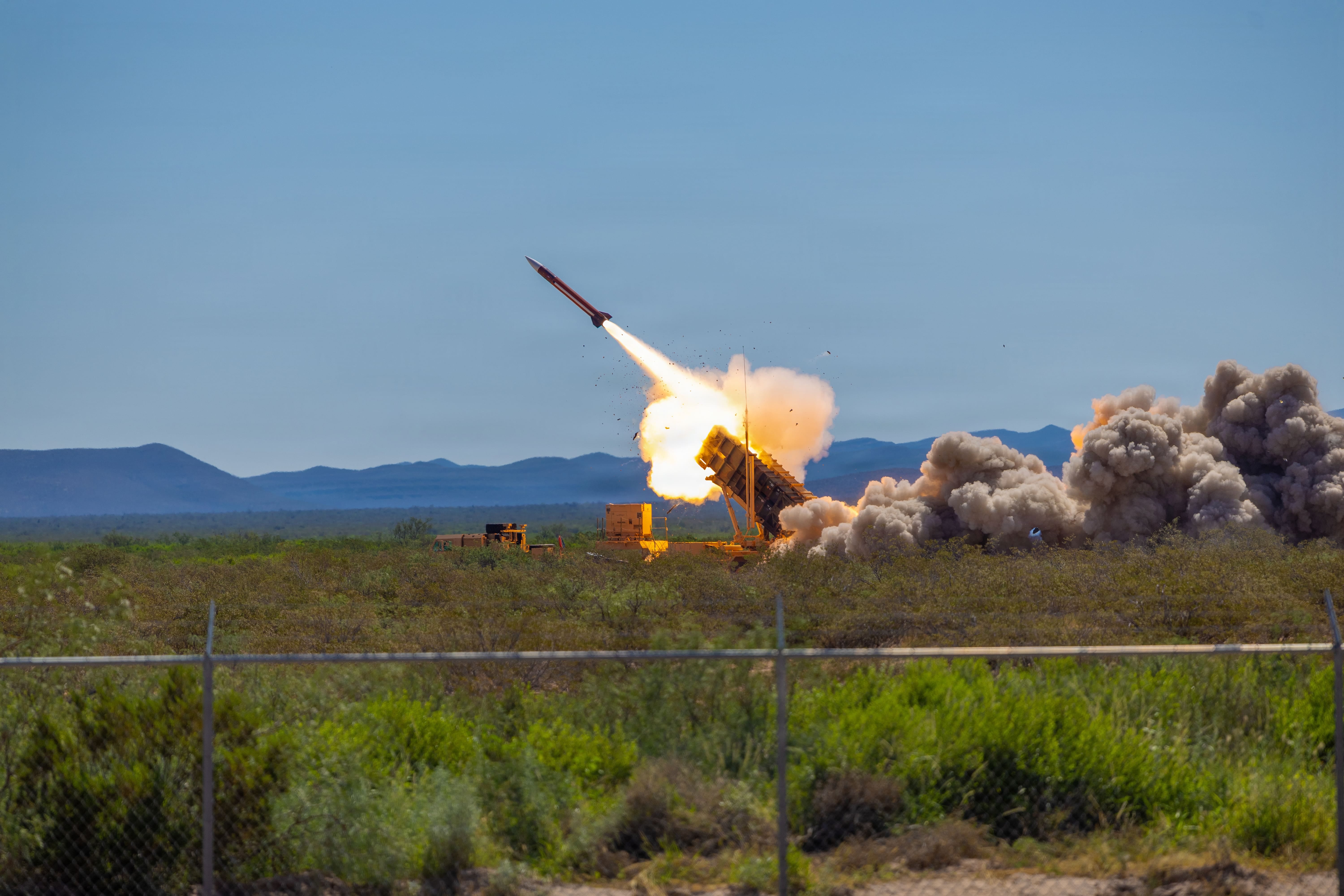
PAC-3 MSE is a hit-to-kill interceptor, meaning it doesn’t detonate near an incoming missile. It flies directly into it.
MSE pulls it off using a ring of small rocket thrusters mounted forward on the airframe, called the Attitude Control Section, that let the missile shove its own nose sideways almost instantly in the final moments of the intercept, faster than aerodynamic fins alone could manage.
Pair that with a large dual-pulse rocket motor, one that holds propulsion energy in reserve for a second burn rather than spending it all at once, and you get a missile with exceptional range, altitude, and maneuverability.
None of that comes cheap, and none of it comes fast.
L3Harris builds MSE’s rocket motor, attitude-control motors, and lethality enhancer.
Boeing builds the seeker, and Boeing alone has landed multibillion-dollar contracts just to triple its own seeker output.
Just some Patriot b-roll that’s kinda cool
Every one of those components requires specialized tooling that only a handful of facilities on Earth can actually build. The Army’s own FY2027 budget documents price a single MSE round at roughly $5.3 million, with earlier procurement batches running closer to $4 million depending on what’s bundled in.
A missile with extraordinary specifications sitting on a factory floor in Huntsville three years from now does Ukraine exactly zero good tonight.
The “throttle back” missile
At the Farnborough airshow on July 20, Lockheed introduced the PAC-3 Adapted Capability Effector, or PAC-3 ACE, and priced it at less than half of MSE’s per-unit cost, working out to somewhere around $2 million to $2.65 million depending on which figure you’re comparing it against.
Tim Cahill, who runs Lockheed’s Missiles and Fire Control division, told reporters the company is deliberately dialing back two of MSE’s most expensive components, the rocket motor and the seeker, to hit that price.
That phrase, throttle back, tells you almost everything you need to know.
Lockheed is building a less capable missile on purpose, because it correctly bet that not every target actually needs MSE’s full performance envelope.
ACE runs on the existing Patriot fire-control architecture, fits the same M903 launchers at the same twelve rounds per launcher, and plugs straight into the Integrated Battle Command System.
Lockheed says it’ll handle aircraft, cruise missiles, and close- and short-range ballistic missiles, with initial production targeted for 2028.
The company hasn’t disclosed ACE’s actual range, altitude ceiling, or seeker architecture, and analysts at The War Zone spotted something telling in Lockheed’s own rendering of the missile.
It appears to be missing MSE’s forward Attitude Control Section entirely, those little thrusters that give MSE its blistering terminal maneuverability.
Nobody at Lockheed has confirmed that omission outright, so treat it as a bunch of OSINT nerds reading of a press photo rather than a published spec sheet.
ACE isn’t even the cheap one
Two months before Lockheed’s Farnborough announcement, the Army quietly published a request for information called MOSAIC-26-03, asking industry for a Patriot-compatible interceptor priced under $1 million with individual components like the rocket motor, seeker, and fire-control system each capped at $250,000.
The Army wants it integrated with the existing M903 launcher and IBCS network, and it wants the government to own the intellectual property outright, so multiple manufacturers can compete to build components rather than the Army getting locked into a single prime contractor for the next twenty years.
That’s arguably as big a story as the missile itself, because a government-owned design is a different procurement philosophy than anything Patriot has run on before.
The Missile Defense Agency is running a parallel, separate effort of its own, launched back in August 2025, chasing a prototype within eighteen months at a $750,000 target price.
So as of this summer, there are three distinct low-cost interceptor tracks moving simultaneously inside the American defense establishment: Lockheed’s roughly $2 million ACE, the Army’s sub-$1 million MOSAIC effort, and MDA’s sub-$750,000 program.
Unfortunately, ACE doesn’t fly until 2028 at the earliest.
The Army’s sub-$1 million effort is even further from fielded hardware. So, to fill the immediate gap, the United States did something it hadn’t done in three decades: It reordered PAC-2 GEM-T missiles.
In April, the Army handed Raytheon a $441.6 million contract modification for new GEM-Ts, driven partly by how hard Patriot stocks got hit during the Iran conflict earlier this year.
Raytheon confirmed in July that this marked the first new domestic PAC-2 production order in more than thirty years. GEM-T is a genuinely different animal from MSE.
It’s a bigger missile using the older blast-fragmentation approach rather than MSE’s direct hit-to-kill design, meaning it detonates near the target and relies on shrapnel rather than requiring an exact collision.
Modern GEM-T variants carry much-improved seekers and fuses, and Raytheon says the broader GEM family has logged more than 90 confirmed ballistic-missile intercepts in combat since 2015.
I wouldn’t call it obsolete.
It’s just older. Europe is scaling up GEM-T too, with a Raytheon-MBDA joint venture landing a contract worth up to €5.1 billion for as many as 1,000 missiles out of a new German facility, and Ukraine separately signed a $3.7 billion GEM-T deal this April.
So the Patriot family is stretching in three directions at once right now.

Why SAMP/T isn’t the easy answer everyone assumes
This is usually where people ask the question: What about SAMP/T? Doesn’t Europe already have a non-American system that does this job?
Sort of…
SAMP/T is the Franco-Italian system built around the Aster missile family, and MBDA markets the newer SAMP/T NG variant specifically as protection against tactical ballistic missiles alongside aircraft and cruise missiles.
Ukraine has fielded a small number of SAMP/T batteries already.
The problem was never whether Aster 30 works… It’s scale.
One or two batteries protect a bubble around whatever they’re guarding. They don’t solve a national ballistic-missile-defense problem for a country the size of Ukraine, because you’d need dozens of batteries, hundreds of trained crews, and a deep interceptor stockpile to actually cover the whole country, and Ukraine had none of that at meaningful scale.
But at the Paris summit on July 13, France and Italy agreed to license Aster 30 production directly inside Ukraine, with the stated goal of beginning that work before the end of this year.
Zelensky also came out of bilateral talks with Macron holding commitments for licensed production of SCALP cruise missiles, AASM Hammer guided bombs, and sixteen French Rafale fighters, on top of the Aster licensing.
I actually made a video about that:
And I think it’s worth walking through the rest of the world’s ballistic-missile-defense catalog, because plenty of systems technically exist that Ukraine simply cannot use.
THAAD is optimized for higher-altitude terminal defense BUT isn’t in Ukrainian hands.
Aegis, running the SM-3 and SM-6 interceptors, is built around naval or fixed-site architecture; again Ukraine doesn’t have access.
Arrow belongs to Israel.
David’s Sling is politically complicated and has never entered Ukrainian service.
None of these are systems sitting in a warehouse somewhere waiting to be plugged into Kyiv’s air-defense grid. The world does have ballistic-missile-defense technology. Ukraine simply doesn’t have enough of the specific systems it’s actually allowed and able to use.
NASAMS and IRIS-T are valuable systems, built around AMRAAM, AMRAAM-ER, and AIM-9X effectors, but they’re designed for aircraft, cruise missiles, and drones.
Kongsberg has talked about expanding NASAMS toward a broader threat spectrum including tactical ballistic missiles someday, and that’s a future roadmap conversation, not a claim that Ukraine’s fielded NASAMS batteries can reliably down an Iskander today.
Germany’s Diehl is working on a longer-range IRIS-T variant that Reuters reports could eventually reduce Patriot dependence, and again, that’s tomorrow’s capability, not tonight’s.
F-16s can help against cruise missiles and drones but are simply the wrong tool against a ballistic missile in terminal descent, which isn’t a maneuvering target you chase with an AMRAAM the way you’d chase a wandering Shahed.
Interceptor drones, brilliant against Shaheds, are solving an entirely different physics problem and have no role here.
And while some Soviet-legacy systems, particularly the S-300V family, technically carried limited anti-ballistic roles in certain variants, Ukraine’s actual public combat record against Russia’s modern ballistic attacks hasn’t shown those older systems filling the Patriot or SAMP/T role at any meaningful scale.
The stocks are old, the missiles are limited, and Russia has had years to study exactly how those systems work and thus, how to defeat them.
All in all, the best bet might be Ukraine hitting the Russian launchers, the missile storage sites, the fuel infrastructure, the guidance-component factories, and the command nodes feeding Russia’s ballistic campaign; this is the so called “left-of-launch approach.”
Kill the archer before he releases the arrow.
The Ukrainian answer nobody expected to be this far along
Which brings us to FREYJA, and this is where the story turns hopeful.
On July 13 in Paris, Ukraine and nine European countries, Denmark, France, Germany, Italy, the Netherlands, Norway, Spain, Sweden, and the UK, formally launched what they’re calling the Integrated Anti-Ballistic Missile Coalition, with FREYJA as its flagship project.
Zelensky set an aggressive twelve-month target for a working prototype, with the stated goal of the system entering initial operation sometime in 2027.
Major European defense firms showed up to the launch meeting and signed on, including MBDA, Thales, Saab, Leonardo, Eurosam, Diehl Defence, and Kongsberg, alongside Ukraine’s Fire Point as the lead integrator.
The architecture, based on Fire Point’s own published material, reads like a distributed European project rather than one country’s wish list. At the center sits the FP-7.x interceptor itself, a 7.25-meter rocket built partly on recycled Soviet-era S-300 technology and reengineered around modern Western components, carrying a semi-active imaging infrared seeker supplied by Germany’s Diehl Defense and reaching speeds of 1,500 to 2,000 meters per second.
That missile launches from a light, Ukrainian-built mobile launcher.
Oh, I almost forgot, I made a video about this too…
Long-range early-warning radar comes from a shortlist of very serious European systems like Saab’s Giraffe 8A/4A, Thales’s Ground Master 400, or Hensoldt’s TRML-4D; the same radar family already running Ukraine’s IRIS-T batteries in combat.
Closer-in illumination and tracking radar comes from either Weibel’s GFTR-2100/48 or Leonardo’s KRONOS Land system.
Command and control runs through a Kongsberg Fire Distribution Center built on open architecture, with everything stitched together over a Link-16 network, the same NATO-standard data link that lets American, European, and eventually Ukrainian systems all talk to each other without a translator in the loop.
Fire Point is targeting a production run of 2,000 FP-7.x interceptors a year at roughly $700,000 each, against a PAC-3 MSE running $3.8 to $5.3 million.
If that price point survives contact with actual production, and I want to be honest that plenty of ambitious missile programs don’t, Ukraine and its European partners would be building interceptors at something close to a fifth of MSE’s cost, designed from day one by people who’ve spent years debugging their own hardware under live nightly missile fire, which is a testing environment no Western defense contractor could replicate in a lab if they tried for a decade.
One recent policy analysis called the coalition’s ambitions laudable but its promises unrealistic, correctly noting that Fire Point built its reputation on strike drones and cruise missiles, not interceptors, and that those are very different engineering disciplines requiring different skills, different testing regimes, and different failure modes.
A twelve-month prototype timeline for an entirely new interceptor family is aggressive by any defense-industry standard, and FREYJA’s own backers describe it explicitly as a complement to Patriot and SAMP/T, not a replacement for either.
Nobody serious is claiming FREYJA solves tonight’s problem. It’s a bet on next year’s problem, running in parallel with the Aster 30 licensing and the American low-cost interceptor programs, rather than against them.
The tiered magazine, and why that’s actually the right answer
As recently as Operation Epic Furry, the idea was to shoot Patriot MSE at everything in the sky, regardless of whether it was gross overkill.
That’s what got the US into this mess in the first place.
But the emerging model looks a lot more like a tiered ammunition rack.
Save PAC-3 MSE, the most capable and most expensive interceptor, for the hard targets, a maneuvering ballistic missile that needs every ounce of that attitude-control performance to actually catch.
Use PAC-3 ACE against threats that don’t require MSE’s full envelope, cruise missiles and less demanding ballistic threats where giving up some seeker sophistication and terminal maneuverability doesn’t cost you the intercept.
Use GEM-T, and eventually the Army’s sub-$1 million interceptor, against the next rung down.
And hand the cheapest, most numerous threats, the Shaheds and Gerbera decoys clogging up the sky in every major Russian barrage, to interceptor drones, gun trucks, and systems that were never meant to burn a multimillion-dollar missile on a target that costs twenty thousand dollars.
Picture a real Russian raid under this future architecture.
Cheap counter-drone systems handle the Shahed swarm.
GEM-T or the eventual low-cost interceptor deals with the easier air-breathing threats. PAC-3 ACE or FREYJA’s FP-7.x takes the cruise missiles and the less demanding ballistic targets.
PAC-3 MSE stays in reserve for whatever needs its extreme reach and maneuverability, the threats nothing else in the rack can actually catch.
The radar network and IBCS become the quarterback deciding, engagement by engagement, which interceptor gets thrown at which target, spending the expensive round only where the physics actually demands it.
Sprinkle in a little Ukrainian ingenuity and some AI-powered command and control for good measure, and Ukraine could be close to closing its skies by late 2027.
The irony here is that after three decades spent making PAC-3 progressively more sophisticated, layering on better seekers, bigger motors, and sharper terminal maneuvering, the breakthrough the West actually needs right now might be figuring out which expensive parts it can take back off.
For Ukraine specifically, that shift, (cheaper interceptors arriving in real volume), may end up mattering almost as much as another jump in MSE production ever could.
Ballistic missile defense was never going to stay a story about one perfect missile. It was always going to become a story about how many imperfect ones you can afford to keep in the rack.
Слава Україні!


This morning I was wondering what was out there (if anything) to counter the current ballistic missile threat to Ukraine? A few days ago I had a similar thought about glide bombs.
And there you are covering both topics in the last two days. Maybe I am beginning to tune into your way of scanning the defence horizon?
Excellent detail in the one btw.
Thank you for all the hard work you’re putting into your articles Wes!
I just listened to this one and the voiceover saying „epic furry“ instead of fury made my evening 😂