Japan Just Put a Weapon in Ukraine's War, and It Cost $2,500
Tokyo-based Terra Drone, working alongside Ukrainian partner Amazing Drones, began operational deployment
This story is BIG if for no other reason than this is the first “weapon” the famously pacificist country has sent to Ukraine.
But Japan has been in Ukraine’s corner for a while now, politically, economically, and diplomatically.
Still, April 17, 2026, marked something different.
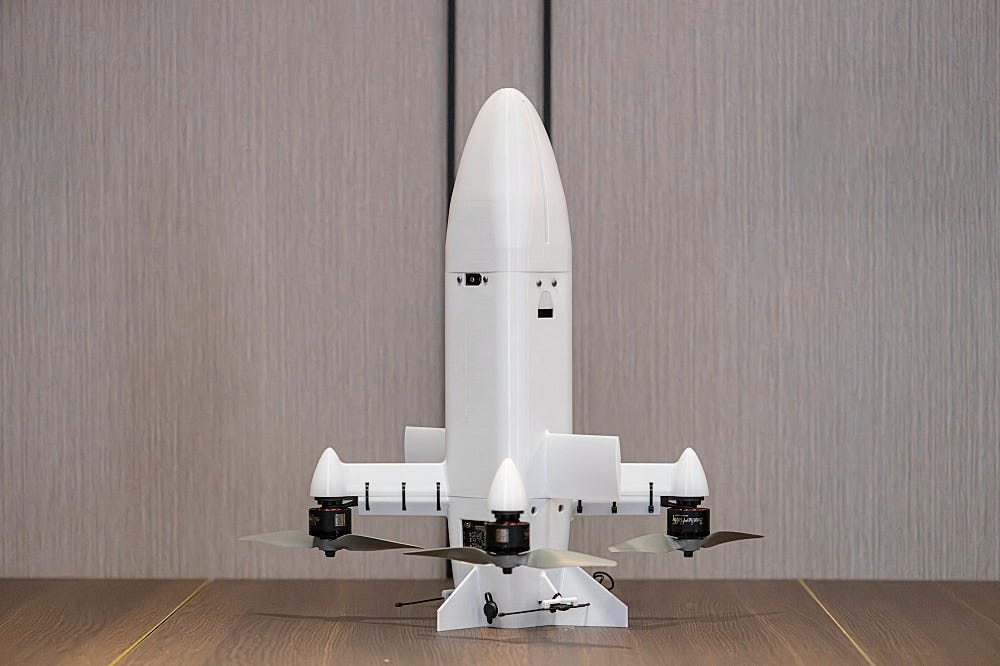
That’s when Tokyo-based Terra Drone, working alongside Ukrainian partner Amazing Drones, began operational deployment of their jointly developed interceptor drone with a Ukrainian unit tasked with hunting Russian uncrewed systems.
This is a Japanese company investing in a Ukrainian defense startup, co-developing a battlefield system, and putting it into a live war.
Putin noticed. Russia summoned the Japanese ambassador earlier this month to protest Terra Drone’s investment in Amazing Drones. When the Kremlin starts lodging formal complaints about someone’s startup portfolio, you’ve touched a nerve.
Aww, is Vlad upset that his old adversary is helping those dastardly Ukrainians?
Of course he is…
Since 2022, Tokyo has quietly stepped up in ways that would put some NATO members to shame.
Humanitarian Gear
Japan has delivered the kind of equipment that keeps soldiers alive and civilians functioning through the grind of war.
This includes drones for reconnaissance, protective helmets, and ordnance-handling kits for clearing unexploded munitions.
Add to that tents for displaced families, winter clothing for soldiers and civilians in freezing conditions, and medical supplies that blunt the humanitarian disaster of Russia’s missile barrages. These aren’t headline-grabbing donations, but they’re the lifeline that makes battlefield survival and recovery possible.
People-Focused Aid
Japan has also opened its doors to Ukrainian evacuees, something many countries far closer to the war zone struggled to manage.
Ukrainian families in Japan have received visas, housing, language training, and even employment support. For a nation known for its historically strict immigration policies, this was a huge shift.
It shows not just solidarity on paper but a willingness to take on the human burden of the conflict, helping Ukrainians rebuild lives even as the war rages.
Economic Pain for Russia
On the economic front, Japan has joined the sanctions coalition with teeth. Russian assets have been frozen, financial pipelines cut, and Tokyo has steadily decreased its reliance on Russian energy, once a cornerstone of its import mix.
Russia counted on Asian buyers to cushion the impact of Western sanctions, but Japan made it clear that it wouldn’t bankroll Putin’s war effort through gas and oil purchases
The SAR Card: Eyes That Never Blink
But here’s where Japan really moves the needle: space. Specifically, synthetic aperture radar (SAR) satellites.
Unlike optical satellites, SAR doesn’t care if it’s cloudy or midnight; it uses radar to paint a high-resolution picture of the ground. Japan’s private company iQPS has already inked a deal to give Ukraine access to its SAR constellation.
I wrote about it here:
That means Ukrainian commanders can see Russian tank movements through cloud cover, track convoys at night, and even monitor camouflage attempts that fool ordinary imagery.
Japan has also sent Ukraine the Morooka PC-065B: the most tactically useful vehicle you’ve never heard of.
But this current aid is a bit of a shift as it’s the first time Japan is co-developing a weapon with Ukraine.
Albeit, a defensive weapon, but still a weapon.
That’s probably why the fielding model is deliberately cautious… perhaps too cautious in my opinion. Japan is sending one unit first, then wider distribution if the system holds up under real combat conditions.
Japan’s Longest Constitutional Pivot
Article 9 of Japan’s postwar constitution renounced war and constrained its military to a Self-Defense Force in name and doctrine.
For decades, Tokyo layered export restrictions on top of that like limiting arms transfers to five non-combat categories: rescue, transport, warning, surveillance, and minesweeping.
Lethal systems stayed home. Japan was a defense consumer, not a supplier. That posture held through the Cold War, through the Gulf Wars, through the rise of China’s military.
It held right up until it didn’t.
The unraveling has been deliberate and incremental. Shinzo Abe rewrote the foundational framework in 2014. Defense spending got pushed to 2% of GDP, a benchmark that would have been politically unthinkable a decade ago.
Then, on April 21, 2026, the Japanese Cabinet lifted the postwar ban entirely, scrapping the five-category restriction and opening the door for exports of warships, missiles, and other weapons; the biggest overhaul of Japan’s defense export rules in decades.
But removing regulatory barriers does not automatically translate into export competitiveness. Japan’s defense sector has long relied on domestic demand, resulting in limited production scale, and insiders describe a “triple bottleneck” of limited production capacity, fragile supply chains, and a shortage of skilled labor.
Which is exactly why the Terra Drone model is interesting.
Rather than trying to export a legacy system through a new regulatory framework, Terra Drone went and found a partner who’d already solved the hard part, the engineering, in a contested, EW-heavy combat environment.
They brought capital, manufacturing credibility, and global distribution reach. Amazing Drones brought the knowledge that no laboratory can replicate.
The Partner Nobody’s Talking About
Amazing Drones gets one line in most Western coverage of this story. That’s a mistake.
CEO Maksym Klymenko described the company’s origin: “What began as a Ukrainian volunteer initiative by engineers and soldiers has now evolved into a manufacturing hub dedicated to defending our nation.”
Like many Ukrainian defense startups, Amazing Drones built its technical foundation inside one of the harshest drone operating environments on earth: active combat in Ukraine, where GPS jamming, radio-frequency spoofing, and signal denial are daily realities.
Their systems are specifically designed for rapid deployment in conditions where electronic warfare and communication jamming are commonplace.
A drone that fails under Ukraine’s EW conditions will fail in the Gulf, will fail in the Taiwan Strait, will fail anywhere that a peer or near-peer adversary is contesting the electromagnetic spectrum.
Amazing Drones’ engineers have been iterating on hardware with direct frontline feedback, running short development cycles that no traditional procurement process can match.
The company’s own roadmap includes continued improvements to speed, maneuverability, and combat payload; driven by what operators are actually reporting from the field, not what a requirements document written three years ago says they should need.
Terra Drone CEO Toru Tokushige said he personally visited wartime Ukraine multiple times to assess the engineering expertise before committing to the investment.
Meet the Terra A1
The drone itself is called the Terra A1, and the published specs are fairly telling.
Electric propulsion, 300 kilometers per hour top speed, 32-kilometer range (about 186 mph and a roughly 20-mile range for my American readers). It has a low acoustic and thermal signature and VTOL capability.
The Defense Post noted it can accelerate to 200 kilometers per hour in 10 seconds.
Ukrainian operators have specifically praised its handling during sharp turns.
Put that together and you’re not looking at a slow surveillance loiterer. You’re looking at a fast, agile point-defense interceptor, designed to scramble, acquire, and kill, and optimized for quick launch from improvised sites.
Terra Drone is marketing the A1 at roughly 400,000 yen, which is about [carry the one] $2,500.
When this story first broke, Gulf interest in the Terra A1 was framed as “exploratory.”
Saudi Arabia and the UAE, the reporting said, were looking at cheaper options for countering Iranian drone attacks.
As of April 1, 2026, Iran had fired a total of 438 ballistic missiles, 2,012 drones, and 19 cruise missiles at targets in the UAE alone, according to the UAE Ministry of Defense.
Bahrain, Kuwait, Qatar, and Saudi Arabia all took incoming fire.
In the UAE and Saudi Arabia, drones accounted for roughly 85 percent of strikes, with Iran using drones for persistent, low-cost pressure and missiles where speed or signaling against military facilities was prioritized.
For the first time in history, all the GCC states were targeted by the same actor within 24 hours. Their long-standing nightmare scenario materialized, and they burned through interceptor stockpiles doing it. Terra Drone’s CEO noted a massive surge in inquiries from Middle Eastern clients since the conflict began.
The math the Gulf states are now running is identical to the math Ukraine has been running for two years.
Sophisticated air defense systems, even very good ones, are not designed to sustain a campaign against hundreds of cheap drones per day. As my audience definitely knows, (because I’ve been ranting about it for ages), the missile economics break down at scale.
What the Gulf needs, what Ukraine has been field-testing out of necessity, is a cost-matched response. Kill a cheap drone with a cheap drone.
Terra Drone has said it may eventually localize production in the Gulf region. If that happens, the Ukraine-Japan partnership stops being a bilateral story and becomes something more structurally significant: a new template for how combat-proven drone technology moves from a hot war into allied markets with genuine near-term demand.
What “Combat-Proven” Actually Buys You
In the defense procurement world, those two words, “combat-proven,” are worth something close to a golden ticket.
Defense ministries and their procurement bureaucracies are, as a rule, deeply risk averse.
They will run a system through years of trials, certifications, red teams, and exercises before committing to a contract. All of that due diligence is designed to answer one question: will this thing work when it matters?
Combat experience answers that question in a way no test range can replicate, because Ukraine’s electronic warfare environment, the jamming, the spoofing, the signal denial, is more demanding than anything a procurement official can construct on a budget and a timeline.
It’s why European and American defense firms have been sending prototypes to Ukraine for the better part of four years. Ukraine gets to get its hands on bleeding edge Western tech before those countries’ own forces, and these firms can see how their weapons hold up in real combat.
For their part, the Russians have graciously volunteered to be on the receiving end of these weapons. How magnanimous…
But a system that survives that gauntlet carries a credential that is genuinely rare and genuinely valuable.
It’s also why Ukrainian drone companies are now selling globally, why the US and European militaries are paying close attention to Ukrainian UAS doctrine, and why Terra Drone’s CEO flew to a war zone to find his next business partner rather than attending a trade show in Paris.
Okay, so here’s the skinny: If the Terra A1 continues to perform, if the phased fielding validates the concept and wider deployment follows, Japan has entered the combat-proven drone defense business.
That’s a credential that opens doors in Riyadh, Abu Dhabi, Warsaw, Seoul, the Baltics, and Washington.
Japan’s answer to the cheap drone problem, built with a lot of Ukrainian help, appears to be this: build something cheaper, faster, and meaner than the thing you’re trying to stop. Then prove it works in the hardest possible environment. Then sell it to everyone who’s facing the same problem.
That’s a market that, as of early 2026, has suddenly gotten very large.
Слава Україні!


I had no idea Japan was this interested or involved. Thanks, Wes!
it reminds me of the tesco supermarket add, every little thing helps, this helps quite a lot