Let's Count the US Military Assets Moving Toward Iran
By my count, roughly thirty percent more naval and air assets than the Venezuela raid

Trump’s latest surge into the Middle East looks big on a map and even bigger on a logistics spreadsheet.
Let’s count the assets…
Two carrier strike groups by themselves are a headline, but there’s more: a visible uptick in fighter deployments, a tanker conga line of fuel birds, a baker’s dozen destroyers, and enough precision munitions to make Putin envious.
Interestingly, I should also note what’s missing: ground troops.
That fits the governing instinct we’ve seen from the Trump administration: avoid mass ground commitments, keep the footprint politically light, and lean hard on airpower, maritime strike, and the kind of special operations work that can be more or less bloodless for the American side.
This is actually the same trap President Obama fell in to. Once you get a taste of how effective airpower plus special operations can be, it becomes more palatable to use them; especially in lieu of sending in 100k rank and file troops.
So, the United States can do a lot with ships and aircraft.
It can also get dragged into a lot with ships and aircraft.
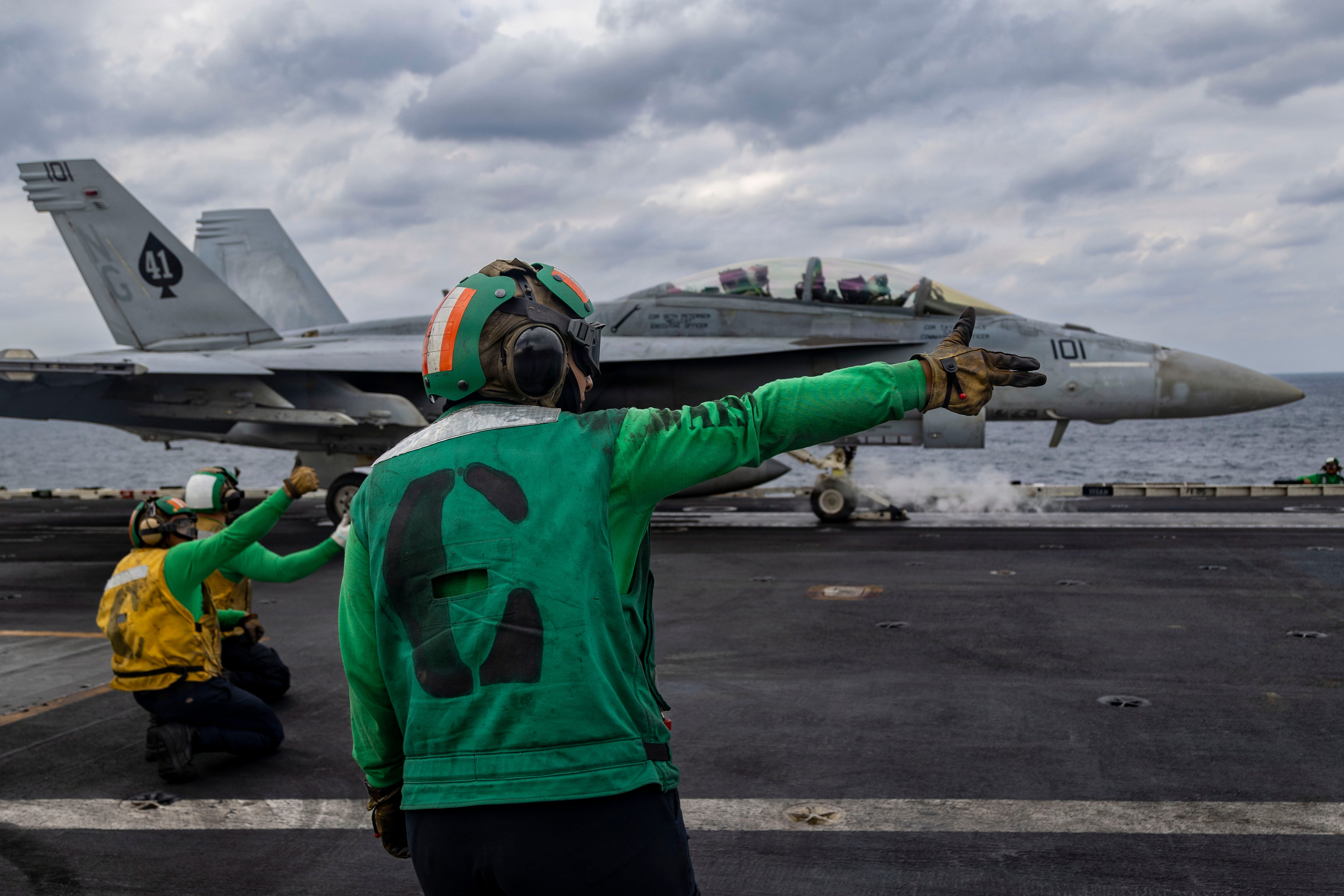
The carrier story is the headline because it’s the most visible symbol of American intent. One carrier strike group, built around USS Abraham Lincoln, was reported operating in the Arabian Sea after being redirected from the South China Sea, with multiple guided-missile destroyers attached.
A second strike force, built around USS Gerald R. Ford, was ordered into theater with additional destroyers and thousands more sailors, pushing the Navy’s regional presence to a number that AP reporting pegged at roughly 14 ships.
Those hulls represent two moving airbases, a floating magazine, a missile-defense umbrella, and a command node that can run sustained strike operations.
Carriers don’t win wars by themselves, and they don’t end wars quickly, yet they give a president options that feel clean on Truth Social. Aircraft take off, targets explode, pilots come home, everyone pretends escalation is a choice you can reverse with a social post.
Now add the air bridge. I’ve been watching a surge of cargo flights and tankers heading into the region. The Military Air Tracking Alliance described tracking dozens of fighters transiting, plus a very large wave of tankers and cargo aircraft moving into Middle East bases.
Even if you haircut the exact numbers, the trendline is the tell. You don’t move that much gas and lift capacity unless you expect sustained flight operations, or you expect to absorb sustained retaliation, or both.
The report stream also mentioned SIX E-3 early warning aircraft heading to Saudi Arabia.
Umm, that’s a lot of AWACS.
Those are exactly the kind of aircraft you send when you want to run a crowded sky without friendly aircraft bumping into each other, or when you want to manage air defense and strike packages at scale, across continental distances.
Okay, so what does this force package actually do?
Start with the carriers.
A modern US carrier air wing gives you a mix of fighters, electronic attack, airborne early warning, and helicopters for anti-submarine and surface work.
The practical output is sortie generation. If you want to hit fixed targets, interdict maritime traffic, suppress air defenses, or provide defensive counter-air for bases and shipping lanes, a carrier gives you a self-contained cycle of “find, fix, track, target, engage, assess,” with the ship acting as both airfield and sustainment hub.
Carriers also matter because they complicate Iran’s targeting problem.
Iran can threaten US bases with missiles and drones, and it can harass shipping with fast boats and mines. A carrier, by contrast, can shift position, expand the threat ring, and stay under layered defenses that include its escorts.

It still isn’t invulnerable, and anyone who says it is hasn’t read enough about anti-ship missile math. But it raises the bar for a clean Iranian “one-and-done” answer.
I’m actually working on an article about what would happen if Iran were to sink a US aircraft carrier. It isn’t pretty.
The destroyers riding along for funsies are basically floating vertical-launch cells. They carry air-defense missiles for fleet protection, land-attack cruise missiles for strike, and anti-submarine systems.
They also plug into the wider American and allied sensor network. In a regional crisis, destroyers help do three things at once: protect high-value units, threaten land targets, and contribute to missile defense.
You don’t need to advertise which mission you’re prioritizing. The ambiguity is part of the deterrent.
Then we get to the zoomies over in the Air Force: F-35s, F-22s, F-15s, F-16s, and support aircraft all now in theater.
F-35s are the Swiss Army knife. They’re strong at penetrating air defenses, collecting data, and passing that data to other shooters.
In a crisis with Iran, the F-35 have already proven (in Operation Midnight Hammer) they can penetrate Iranian air defenses. It’s also a weapon that a president likes because it offers the promise of “surgical,” the favorite word of politicians who haven’t watched war up close.
F-22s are air dominance and a message. Their main value is clearing the airspace so everything else can operate with less risk.
There’s a great F-22 story about Iran flying F-4 Phantoms and trying to shoot down a US MQ-1 Predator in international waters in 2013. An F-22, undetected by the Iranian jets, flew beneath one of them to inspect its weapons before pulling up alongside and advising the pilots to “go home,” which they immediately did. The F-22 was completely invisible to the F-4s’ radar.
Then there are the Eagles… F-15Es are a different beast. They’re a payload and range platform. They can carry a lot, fly far, and hit hard. If you want to surge conventional strike power quickly, without relying only on stealth, F-15Es are the old reliable weapons truck. I would expect these to be tasked with follow-on ground strike missions after air defenses are suppressed.
F-16s fill out mass. The US has somewhere in the neighborhood of 838 to 936 active F-16s; it’s unknown how many are present in the Middle East. But we know they are there.
The support aircraft are notable also. There are currently 85 fuel tankers present. These extend everything. Without tankers, fighters become short-legged, predictable, and easier to plan around.
Early warning aircraft like the E-3 expand the nervous system.
There are 170 cargo planes present; likely C-17, C-5, and C-130s. These carry missiles, spare parts, engines, runway gear, and the boring stuff like generators and communications kits.
A “deployment” without airlift is Kabuki theater. A deployment with a heavy cargo trail is preparation.
All of this is notable if, for no other reason, than to marvel at the US’s ability to move mass around the globe. There really is no other nation with this capability.
As for the high-speed, low-drag special forces guys, the US keeps more than 4,000 operators, including Navy SEALs, Army Green Berets, Rangers, and Marine Raiders on a more or less constant rotation to the region. How many teams are there now, in preparation for Iranian ops, is classified.
What about our friends over at Diego Garcia? Satellite images show a significant US military presence there, including KC-135 Stratotankers, C-130 Hercules transport planes, and P-8A Poseidon maritime patrol aircraft. There are also B-2 Spirits and B-52 Stratofortresses, along with an MC-130J Commando II for clandestine, low-level infiltration, exfiltration, and resupply of special operations forces.

Okay, so what about Iran?
Well, Iran isn’t helpless. It can target US bases with missiles and drones. It can activate proxies. It can attack shipping. It can conduct cyber operations. It can create political pain without trying to sink a carrier. It can also choose to calibrate.
In the past, Tehran has sometimes signaled responses in ways designed to avoid mass casualties, keeping the “honor satisfied” while limiting escalation. Reporting tied to this new crisis argues Iran may feel it needs to “draw blood” more openly if it believes the cycle won’t stop otherwise.
That’s the central problem for an administration that prefers air strikes and special operations over big troop deployments.
Sure, minimal ground forces reduce the political risk, but they don’t erase vulnerability. Bases still exist. Advisers still exist. Aircrews still exist. Tankers still take off and land.
If Iran chooses to retaliate, it doesn’t need to fight the United States symmetrically. It just needs to impose costs that force Washington to choose between escalation and humiliation.
We all know how competitive Trump is with his image in the news. Hell, Obama made an offhanded comment last week about UAPs and this week Trump orders the Pentagon to release everything it knows about UAPs. It must have seriously irked him that Obama was trending for the short time he was.
Now imagine that disposition applied to war. If Iran kills US troops, escalation will be almost instinctual for Trump.
This is why the “public accounting” of assets matters, even when the list is incomplete.
You can see the broad shape of the plan:
Two carriers means sustained air operations and a maritime strike option.
A surge of fighters means the US expects contested airspace conditions, at least at the margins, and it wants redundancy.
Tankers and cargo mean this isn’t a weekend flex.
Six early warning aircraft mean command and control at scale. I think that’s overkill.
If the shooting starts, the most plausible opening moves are systematic. You’d expect an effort to protect US forces and partners first, then degrade Iran’s ability to retaliate effectively, then strike the chosen target set.
Trump has likely been given a binder with four to five strike options ranging from a slap on the wrist to decapitation; however, all options will attempt to avoid Iranian civilians.
If Iran responds, the first wave probably isn’t manned jets. It’s drones, cruise missiles, and ballistic missiles, used in combinations designed to stress defenses, create leakers, and generate footage.
The United States can shoot down a lot, and even a “successful” defense can become a political failure if one missile gets through and kills Americans.
I expect Israel to get pulled in rather quickly.
All of this brings us back to the administration’s preference set. Airpower and special operations feel controllable.
They feel like tools you can pick up and put down.
But Iran is the kind of opponent that punishes that assumption. It can respond indirectly and keep responding, especially if its leadership believes restraint only invites the next strike.
The US has been spoiled with military success in recent years; first against Iran in 2025 and again in Venezuela, taking effectively zero casualties.
I’m afraid the powers that be may begin to think that all military operations will be this bloodless. They won’t.
Stay tuned my friends. Never a dull moment in 2026.
Слава Україні!
Update: This chart does an excellent job of showing the scale of the current US buildup around Iran. This is only what we know from OSINT. There are likely assets on the move that we aren’t aware of yet. We haven’t seen a strike force this size in the Middle East for some time… likely Operation Iraqi Freedom.


so much fora president of peace who demands a nobel peace prize
… so the US has everything, in fact. Except surprise and, more than that, they know how you’re going to do it. Going to be expensive for someone, somewhere. Just because the US is shooting in the Gulf doesn’t mean Iran will. Personal view: this has the makings of a huge and completely pointless mistake: No military gain + terrible loss of life on both sides + an unsettling loss of military credibility. Oh yeah: and the unfortunate “Israel’s poodle” thing (but you know that already).