


Hey friends.
I want to take you back to March 27, near Riyadh.
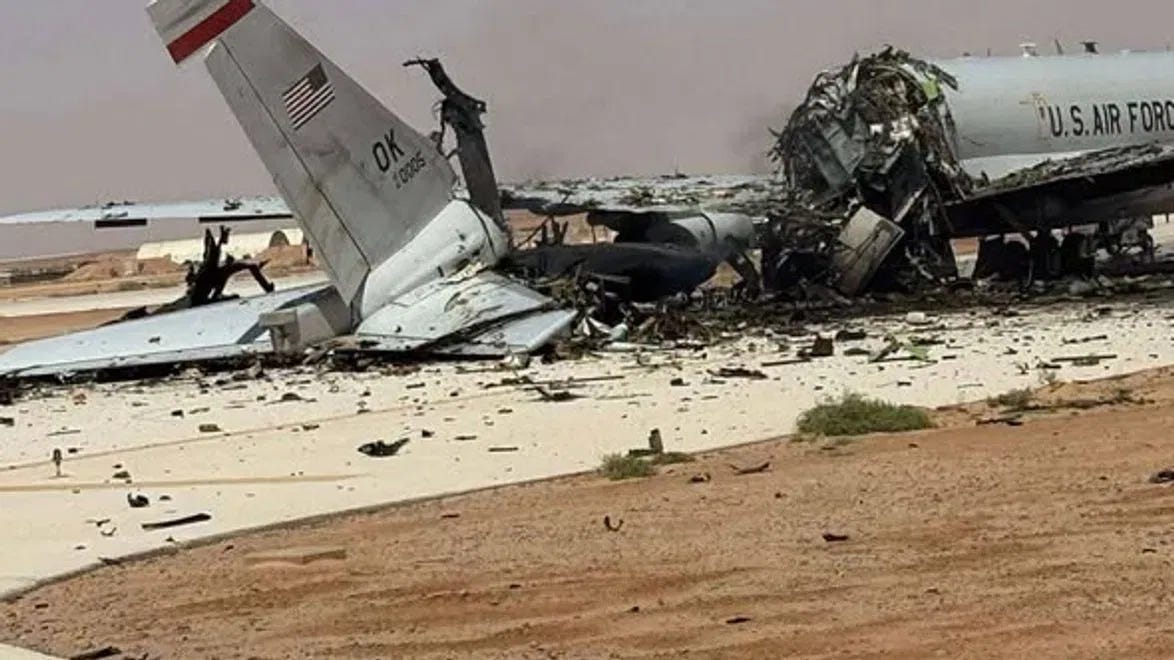
An American E-3 Sentry AWACS, one of the most expensive and irreplaceable aircraft in the entire US inventory, a jet I personally served on for four years, sits parked at Prince Sultan Air Base alongside a handful of other assets.
Iran fires a barrage of missiles and drones.
When the smoke clears, twelve American service members are wounded, that AWACS is completely destroyed, and eight days later a US soldier who’d been hurt in the attack dies of his injuries.
I was pissed, as were many in my AWACS community.
For six months, the question hanging over OSINT world was how did Iran, a regional power without anything close to America’s own reconnaissance architecture, find and hit that specific aircraft with that much precision?
Many of my readers correctly summarized at the time that they must have had help from the Russians. President Zelensky was also warning the US publicly. And yet, we didn’t listen.
This week, CNN gave us confirmation of exactly how much help. Two US officials and additional intelligence sources told the network they have evidence Russian satellites fed targeting intelligence to Iran, and that the scale of the damage would have been nearly impossible to achieve without that Russian geospatial support.
CNN independently reconstructed the collection sequence using orbital data and outside space-tracking firms, Project Aurora and Kayhan Space, and found that fourteen Russian reconnaissance satellites, led by the advanced Cosmos 2573, passed over Prince Sultan in a coordinated sequence in the days before the strike.
A single satellite photograph is super useful. But fourteen satellites, running different sensor types in a coordinated pass over one target, is something else entirely: It’s building the first half of a kill chain, (find, fix, track).
A missile only knows where you tell it to go
People obsess over the missile itself. Things like range, warhead size, speed, accuracy. All beside the point if you don’t have precise, current targeting information to feed the weapon in the first place.
Knowing that an American base sits at a certain latitude and longitude is enough to hit the base in general terms.
It isn’t enough to hit the specific AWACS parked on a specific ramp (exactly in the rotodome no less), or to find the Patriot radar tucked behind a berm, or to know which shelter a THAAD battery moved into overnight, or to identify which radar is actively transmitting and from exactly where.
That level of precision requires intelligence, surveillance, and reconnaissance, and it requires it fresh, because military assets move, hide, and power down constantly.
The modern targeting cycle military planners use runs through six steps, sometimes shortened to F2T2EA. Find the target. Fix its precise location. Track how it changes over time. Develop an actual aimpoint (target). Engage it. Then assess whether the strike actually worked.
Based on CNN’s reporting, Russia appears to have helped Iran with several of those steps at once.
Let me start with the optical layer. Cosmos 2573 is one of Russia’s premier reconnaissance satellites, capable of collecting detailed, military-grade imagery.
That kind of imagery tells you where aircraft are parked, where vehicles have concentrated, where new structures have gone up, where defenses might be positioned, and maybe most important, what’s changed since the previous pass over the same spot.
Optical imagery has real limits, though. Clouds block it. Darkness blocks it. Which is why Russia didn’t rely on Cosmos 2573 alone, instead running a full collection architecture around it.
Russia used eight more satellites, listening instead of looking.
The array included satellites built specifically to intercept radio and radar emissions, alongside spacecraft carrying infrared sensors and synthetic-aperture radar.
A Patriot radar has to emit electromagnetic energy to do its job, and so does THAAD, and so do most military communications networks. Any system that emits announces itself to anyone listening, and it can be detected from a serious distance without ever needing a photograph of it.
With enough patient collection, analysts can start piecing together a radar’s operating frequency, its rough location, its activation schedule, its coverage envelope, and shifts in a defender’s overall posture.
That’s the picture you’d want before planning a strike on defended American assets, and it’s the picture Russia has spent years practicing against Ukraine’s own Patriot, NASAMS, IRIS-T, and Buk networks.
Two more satellites in that same sequence carried infrared sensors, and infrared answers a different question than a normal photograph does.
Heat shows activity: A running engine, a generator, a missile launcher warming up, machinery that’s recently been used all show up as heat; all proof of life.
Then there’s synthetic-aperture radar, or SAR, which I’ve written about before. SAR uses radar rather than visible light, which means it works straight through darkness and cloud cover without any degradation.
Its real strength, though, shows up over repeated passes rather than a single snapshot, because it can flag exactly what’s physically changed on the ground between one orbit and the next like a battery that relocated, a new concentration of vehicles that wasn’t there yesterday, a freshly built revetment, or an aircraft that’s suddenly parked where nothing was before.
Three of the fourteen satellites in Russia’s Prince Sultan pass carried this capability.
Put all four sensor types together, optical for identification, signals intelligence for listening, infrared for activity, SAR for change detection, and you’re assembling an actual target package.
Then Russia came back after the strike.
Ukraine’s own intelligence assessment described continued Russian satellite activity around targets after Iranian attacks had already occurred, documenting at least two dozen reconnaissance surveys covering dozens of sites across multiple Middle Eastern countries within a single ten-day stretch in late March.
That’s the final, closing piece of the kill chain: battle damage assessment.
Did the missile actually hit?
Did the radar survive intact?
Did surviving aircraft or equipment relocate afterward?
Does the target need a second strike?
If a satellite revisits the same site after a strike, it can answer every one of those questions, and answering them turns a single attack into a repeatable, improvable cycle.
Reconnaissance feeds target development, target development feeds a strike, the strike gets followed by another satellite revisit, that revisit produces a damage assessment, and the damage assessment feeds straight back into retargeting for whatever comes next.
So how did Ukraine know first?
Ukraine flagged this pattern months before CNN independently proved much of it.
Zelensky told NBC, in an interview following the Prince Sultan strike, that he’d received daily presidential intelligence briefings showing Russian satellites photographing the Saudi base on March 20, March 23, and March 25, a sequence that all but announced an attack was being planned.
“I think that it’s in Russia’s interest to help Iranians,” Zelensky said. “And I don’t believe, I know, that they share information.”
Five months later, CNN independently tracked the same satellites using entirely different methods and arrived at essentially the same conclusion.
We don’t know exactly how Ukraine’s intelligence services built that early picture, but a few plausible avenues stand out.
Spy satellites aren’t invisible, and their orbits can often be tracked by anyone with the right equipment, the same way CNN later reconstructed Cosmos 2573’s flight path using civilian space-tracking firms.
Ukraine’s own intelligence services, with four plus years of practice watching Russian military behavior in exhaustive detail, could have simply asked the obvious question: Why are Russian reconnaissance satellites suddenly clustering over an American base in Saudi Arabia, and why does an Iranian strike follow shortly after?
Add in four years of intercepting Russian communications and military networks and Ukraine’s extensive intelligence-sharing relationships with Western partners, and it seems obvious in hindsight.
Why didn’t Washington listen?
This pisses me off more than the actual strike.
Ukraine didn’t wait for CNN’s September investigation to raise the alarm. Zelensky went public with almost this exact warning on March 28, one day after the Prince Sultan strike, posting on X that Russian satellites had photographed multiple strategic sites “in the interests of Iran,” and telling NBC News he was “100 percent” certain Russia was sharing that intelligence with Tehran.
He didn’t stop there.
He explained Russia’s own pattern to American reporters in plain, specific language. “We know that if they make images once, they are preparing,” he said. “If they make images a second time, it’s like a simulation. The third time it means that in one or two days, they will attack.”
That’s a targeting cadence, described by the one country on Earth with four years of firsthand experience reading it, handed to American journalists in real time.
By July, months after Prince Sultan, Zelensky was posting again, this time far more specifically. “Since the beginning of July, we have recorded active Russian satellite surveillance of the Gulf states and US military facilities located there,” he wrote. “These images subsequently appear in Iran... there is a clear correlation between Russia’s satellite imagery of these sites and Iranian strikes, both before the attacks, in preparation for them, and afterward, to assess the damage inflicted.”
He said explicitly that he intended to share evidence directly with the United States. That’s the exact same battle-damage-assessment loop CNN would later independently confirm, described by Ukraine two months before it happened again, to a different base, with three more Americans dead.
So, we’re not speculating about whether Ukraine tried to warn Washington. We know it did, repeatedly, publicly, with enough technical specificity to be useful.
So why the hell didn’t we listen?
Trump had already, on the record, told multiple outlets that the United States did not need Ukraine’s assistance in its war with Iran.
That’s a direct position taken by the president himself, offered while Zelensky was actively trying to hand over the kind of warning that might have saved an AWACS or a radar or soldiers’ lives.
A year earlier, in March 2025, the Trump administration had briefly cut off intelligence-sharing with Ukraine entirely. When a reporter asked Trump directly whether Putin was exploiting that pause to intensify strikes on Ukraine, his answer was almost breezy. “I think he’s doing what anybody else would.”
Whatever you take from that exchange, it establishes a documented pattern. This administration has, at multiple points, treated the intelligence relationship with Ukraine as leverage or as an afterthought, rather than as a serious channel worth protecting and using.
A president publicly stating he doesn’t need a country’s help isn’t the ideal precondition for that country’s intelligence getting taken seriously inside the interagency process, regardless of how good the underlying tradecraft is.
Intelligence doesn’t arrive stamped with a neutral, unimpeachable label. It arrives from a source, and if the political relationship with that source has soured, the information gets filtered through that souring whether anyone admits it or not.
That’s the “beautiful reports” dynamic I wrote about with Putin and his own generals, except run in reverse.
Instead of subordinates shading the truth to please a leader, you get a leader who’s already decided a source isn’t worth fully trusting, so accurate information from that source struggles to travel upward with the urgency it deserves.
Compartmentalization is worth mentioning too.
American intelligence runs on classification stovepipes, and a warning about Russian satellite tasking against a Saudi-hosted base sits at an awkward intersection of at least three different agencies’ equities like foreign intelligence liaison, Gulf regional security, and tracking Russia’s own space assets.
Getting a fast-moving, foreign-sourced warning through that structure in time to matter operationally is a hard problem even when everyone involved is acting in good faith, and it becomes a much harder problem when Trump dislikes Zelensky simply because Ukraine reminds him that he was once impeached over his dealings with the country.
China may now be filling the same role
Finally, some extra-shitty news just for funsies…
On September 11, the Wall Street Journal reported that US officials have linked high-resolution satellite imagery supplied to Iran by Chinese entities to the July 17 strike on Muwaffaq Salti Air Base in Jordan, an attack that killed three American soldiers, Army First Lieutenant Tyler James Feehan, Private Isabella Gonzales, and Sergeant Angel S., and wounded four more.
Iran reportedly obtained high-resolution images of the base both before and after that strike, the same before-and-after pattern the satellite kill chain runs on.
US officials haven’t publicly identified the Chinese entities involved, and they haven’t accused Beijing’s government of directing or ordering that support.
Not surprisingly, Beijing has denied the allegations, with China’s Foreign Ministry accusing unnamed parties of trying to drag the country into the conflict, and a Chinese Embassy spokesperson calling the claims a malicious smear.
And this isn’t the first American loss tied to intelligence at that particular base. BBC Verify separately confirmed, through its own satellite analysis, that an American AN/TPY-2 radar, a core THAAD component, was destroyed at the same Jordanian installation back in March.
Asked about the Chinese imagery report aboard Air Force One, Trump waved it off again. “They basically do what we do,” he told reporters. “When they say China spies on us, I say you’re right and we spy on them too.”
We don’t know what Russia transferred to Iran, whether it was raw satellite imagery, fully processed intelligence products, specific coordinates, complete target folders, or direct human analytical support walking Iranian planners through the process.
We don’t know who inside Russia’s government or military actually authorized each individual sharing decision.
We don’t know exactly how much Russian assistance improved Iranian strike accuracy compared to what Iran’s own indigenous reconnaissance could already manage on its own.
But I do know that Iran’s targeting was never good enough alone to hit an AWACS in the rotodome, a nine-meter circle, from 500 km away… Unless a hell of a lot of luck was involved.
Iran already knew how to build missiles long before any of this. It already knew how to build Shahed-derived drones. The hard problem was knowing where the valuable target would be sitting the moment that weapon finally arrived.
Russia helped solve that problem for Iran.
The strategic lesson here should sound familiar to anyone who’s read the smut I write for a while now: Modern combat is decided by who can close the kill chain first, from detection to strike to confirmed damage.
Apparently, our adversaries still believe in the power of “allies” as combat enhancers, at a time when the US is trying to ditch ours as quickly as possible.
Слава Україні!
Absolutely infuriating, Wes! National Command Authority complete failure! There is absolutely no rational explanation or excuse except the one that's obvious! Trump is in Putin's pocket!
Wes, we should all be furious. This administration has willfully cut out allies and ignored intelligence that would help preserve US assets as well as the lives of US personnel. Adm Kimmel and Gen Short in the wake of Pearl Harbor were court martialed for what happened despite having far less intelligence to work with. Trump and Hegseth should be immediately impeached and hauled before Congress for what amounts to a combination of dereliction of duty and or out right treason for how the whole Iran operation has been conducted. To willfully allow the kill chain to be completed while ignoring or encouraging it is beyond the pale.