


If you’ve watched the last three plus years of the Ukraine war through the lens of aerial surveillance, one pattern jumps out: Ukraine is dismantling the Russian Air Force where it’s most vulnerable: AWACS.
The A-50 AWACS fleet, the crown jewels of Russia’s airborne command-and-control capability, is dangerously thin. During the Soviet era, roughly forty A-50 airframes rolled out of Beriev’s plants, but decades of neglect, cannibalization, and now wartime losses have whittled that number down to a shadow force.
By most credible assessments, Russia is operating somewhere between four and eight flyable A-50 or A-50U aircraft today.
Analysts believed there were only about nine operational airframes left before the full-scale invasion; since then, Ukraine has either destroyed or damaged several more, including high-profile shootdowns over the Sea of Azov and deep inside Russian airspace.
What had once been a fleet capable of maintaining round-the-clock radar coverage is now a handful of aging, overworked jets that Moscow rotates like priceless Fabergé eggs on a merry-go-round, each loss tightening the strategic chokehold on Russian command and control.
The latest humiliation came courtesy of Operation Spiderweb, when Ukraine used long-range S-200s to swat down an A-50 over hundreds of kilometers, the kind of shot that would give cold sweats to any Russian veteran who grew up believing “behind the lines” meant “safe.”
And now, with the A-100 modernization program officially dead and buried, Russia is reaching for ideas on the far side of desperation.
Now… Ahem, the United States has its own AWACS drama that I’m neck deep in; as a veteran of the platform, I’m in all the closed AWACS communities on social media where us old-timers complain about the future of air warfare.
But I’ve already written at length about the bad decisions coming out of the Pentagon with respect to the Sentry’s replacement, the E-7 Wedgetail. You can read that here, and be warned, it’s a whole shitload of stupidity.

But back to Russia, they just submitted a patent for something the creators seem convinced is elegant.
It isn’t.
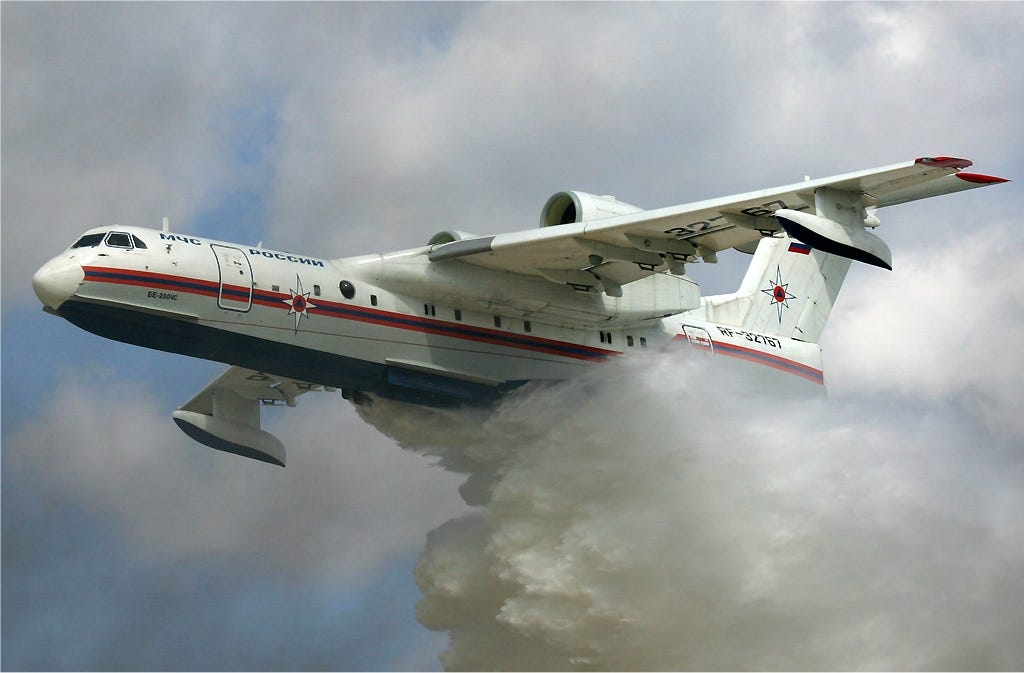
It’s a fever dream: an amphibious jet stuffed with more roles than Marvel’s Avengers Doomsday, pitched as the answer to Ukraine’s newfound ability to blind Russia at long distances.
It’s AWACS, it’s recon, it’s maritime patrol, and it’s anti-sub warfare, all crammed into a single airframe built on the Be-200… the aircraft Russia has been trying, and failing, to build in meaningful numbers since Slick Willy himself, Bill Clinton, was sliding into his White House interns’ DMs.
And here’s the part that made me laugh out loud: they want this thing to replace the A-50.
I flew on the E-3 Sentry. I know what an AWACS actually needs to work. And whatever Russia thinks it’s building here, it isn’t that.
The A-50 Problem Russia Can’t Solve
The hard truth for Moscow is that the A-50 was never built for a modern air war. It came out of an era when airborne radar meant tracking lumbering American bombers over the arctic and keeping tabs on NATO patrols at long distances.
The airframe is old. The avionics are brittle. The ergonomics look like someone designed the interior after losing a bar bet. Even in perfect working order, the A-50 was behind the curve the day it rolled off the line.
But at least Russia had them. That was the entire selling point.
