There’s always been something about Bond villains and their overelaborate super-weapons that struck me as borderline comical.
In fact, the Austin Powers movies leaned into this trope with Dr. Evil and his “sharks with freaking lasers.”
In a textbook case of life imitating art, shirtless equine aficionado Vladimir Vladimirovich Putin has tasked his engineers with exactly this ask: Make me some ridiculously over-complicated super weapons that will strike fear into the West.
One of those is a nuclear-tipped torpedo called “Status-6” or just Poseidon…
Russia made news when it unveiled the Poseidon back in 2015. Now, it’s threatening the UK with it. So, I thought it would be fun to look at the actual engineering and analyze whether this weapon would work as described on Russian state TV.
Russian television host Vladimir Solovyov just suggested giving Britain three days to “learn to breathe underwater” before Russia attacks with Poseidon.
Sure, buddy.
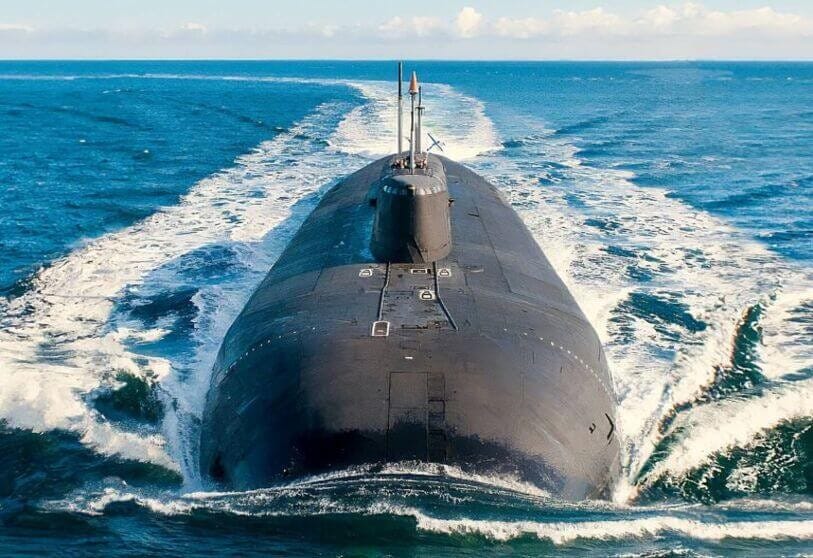
Although the timing is interesting. Russia’s new Project 09851 Khabarovsk submarine has just begun its first reported sea trials in the White Sea. Open-source reporting indicates it departed Severodvinsk around August 17.
Khabarovsk is the first submarine designed from the outset around Poseidon and is generally assessed to carry as many as six of the enormous weapons.
But there’s one big problem with Russia’s plan to turn Britain into Atlantis: Nuclear weapons are surprisingly bad at making tsunamis.
So, how did we get here?
Poseidon began publicly as Status-6 after the famous 2015 Russian television “leak.” The document described an autonomous underwater weapon intended to attack coastal economic infrastructure and create broad radioactive contamination.
That language is accurate. Russia has always presented this primarily as a countervalue strategic weapon rather than an oversized torpedo intended to hunt destroyers.
The Pentagon subsequently acknowledged Russia’s development of an intercontinental, nuclear-powered, nuclear-armed autonomous underwater weapon. I should note that Poseidon’s precise specifications remain classified or based on Russian claims and open-source estimates, though the broad architecture is no longer particularly controversial.
But most credible assessments put it somewhere around 20 meters long and roughly two meters in diameter.
Operating depth approaches 1,000 meters.
Range is commonly estimated around 10,000 kilometers.
Speed claims vary wildly, from roughly 55–70 knots to the sensationalist 2015 100-knot figure. More realistic assessments of the nuclear warhead generally cluster around two megatons or at least the low multi-megaton range rather than the original 100-megaton stories also from 2015.
The Federation of American Scientists assessed Poseidon as not yet operational as of March 2026, despite Putin announcing a successful test in October 2025 in which Russia says it launched the vehicle and activated its nuclear propulsion system.
FAS still places expected Navy delivery around 2027.
I think Russia has demonstrated enough that dismissing Poseidon as fake would be foolish.
But they have not publicly demonstrated a full operational mission across thousands of kilometers, through defended waters, culminating in a nuclear strike.
Could you actually build a nuclear torpedo that crosses an ocean?
Yep. In fact, this is probably the least exotic part of Poseidon.
Once you replace batteries or conventional fuel with a nuclear reactor, endurance stops being the dominant limitation. Nuclear submarines already stay submerged for months because their propulsion systems don’t require atmospheric oxygen and their reactors contain vastly more energy than conventional propulsion systems.
Poseidon essentially takes that principle and removes the inconvenient requirement to keep 130 human beings alive inside the pressure hull.
Russia also has decades of experience building unusually compact and high-performance naval reactors. So, the basic proposition, a small nuclear reactor powering a very large unmanned underwater vehicle for thousands of kilometers, doesn’t violate any fundamental engineering principle.
The October 2025 test matters here.
Putin claimed Russia successfully started Poseidon’s nuclear power unit while the vehicle was underway. I can’t independently verify the details of that test, though Western analysts no longer treat the nuclear propulsion concept itself as implausible.
The harder engineering questions concern reliability.
A submarine has engineers aboard who can fix shit when stuff breaks.
Poseidon doesn’t.
If a pump fails halfway across the Atlantic, nobody crawls into the machinery space with a wrench.
Everything associated with propulsion like cooling, control, navigation, and electrical generation has to function autonomously for potentially days or weeks.
That’s a higher bar than simply making a reactor work and the Russians have largely squandered their Soviet engineering legacy.
Poseidon’s speed claim creates a second problem: water
Water is unsurprisingly useful for hiding submarines.
It’s also extremely unforgiving when you try to move something through it quickly.
Hydrodynamic drag increases roughly with the square of velocity, while the power needed to overcome that drag rises even faster. Increasing underwater speed gets expensive very quickly in power, noise and mechanical stress.
This makes the claim that Poseidon quietly cruises around the ocean at 100 knots extremely difficult to reconcile with, ahem, basic physics.
H.I. Sutton has also demolished one persistent misconception: Poseidon doesn’t appear to be a supercavitating weapon like Russia’s VA-111 Shkval. Imagery indicates a pump-jet propulsor, which doesn’t fit a weapon designed to travel inside a supercavitation bubble.
And that’s important here because at very high speed Poseidon becomes noisy.
Very noisy.
A nuclear reactor, turbines, pumps and propulsion machinery are already sources of acoustic energy. Push a bus-sized vehicle through seawater at extreme speed and you create additional flow noise.
So, I think the more plausible operational concept is slower travel during much of the voyage followed by higher speed once the weapon reaches the target region.
In other words, Poseidon may be capable of being stealthy, or it may be capable of being extremely fast. Asking it to do both simultaneously is a wee bit tougher.
Then there’s navigation
Just an interesting note here: Radio signals at GPS frequencies penetrate almost no useful distance through seawater. Poseidon can’t spend an intercontinental voyage happily following GLONASS.
It would need some combination of inertial navigation, underwater terrain or bathymetric references, acoustic navigation, and potentially occasional external fixes.
That’s technically achievable. Submarines have navigated underwater for generations.
Accuracy drifts over time, however, particularly with inertial systems.
Fortunately for Poseidon, a multi-megaton nuclear warhead doesn’t necessarily require Massive Ordinance Penetrator-level precision if the mission is attacking a large coastal region or naval facility.
A miss measured in hundreds of meters is disastrous for a conventional warhead. But it’s less consequential when you brought two million tons of TNT-equivalent with you.
The Russians also claim it can’t be intercepted…
True, Poseidon presents a horrible anti-submarine warfare problem because it combines very deep operation, long endurance and potentially high terminal speed. Existing torpedoes and many traditional ASW systems weren’t designed specifically to chase an autonomous weapon operating around 1,000 meters.
But that doesn’t make it invisible.
In fact, the speed problem works against Poseidon here. High speed creates acoustic signatures that sonar systems can potentially detect at significant distances. An autonomous vehicle also can’t respond creatively to being hunted the way Captain Marko Ramius would.
A NATO force could potentially detect it through fixed hydrophone networks, submarines, maritime patrol aircraft, surface ships or future seabed sensors. Actually putting an interceptor onto something moving deep and fast is the harder part.
But there’s also a weakness upstream because Poseidon has to come from somewhere.
Khabarovsk is itself a large nuclear submarine. H.I. Sutton’s latest analysis suggests the entire boat has effectively been designed around carrying Poseidon, with its ordinary attack-submarine capabilities compromised by the enormous weapon compartments.
Finding and following the carrier sub before it launches would be part less of a challenge.
The tough part for the West is that Russia doesn’t need to sail Khabarovsk to Brighton Beach. Poseidon’s claimed range allows the carrier to remain in protected Russian waters and send the weapon on the long trip itself. Presumably, that’s part of the attraction.
So “unstoppable” is propaganda.
“Extremely difficult to stop reliably” is much more defensible, methinks.
Now we get to the fun part: can you actually nuke a tsunami into existence?
The intuitive argument sounds reasonable…
A two-megaton nuclear weapon releases about 8.4 × 10^15 joules of energy.
For comparison, NOAA-backed research estimates that the 2004 Indian Ocean tsunami propagated roughly 1.66 × 10^16 joules of wave energy.
Those numbers are in the same general neighborhood.
So nuclear tsunami confirmed?
Hold your horses, buckaroo. Because the amount of energy is only half the story.
The critical question is how you put that energy into the water.
A major earthquake can suddenly lift or drop a section of seafloor hundreds of kilometers long and tens or hundreds of kilometers wide. The 2011 Tōhoku tsunami involved an initial displaced-water volume measured in hundreds of cubic kilometers and a source region roughly 300–400 kilometers long.
That creates an extraordinarily long-wavelength disturbance.
A bomb is the exact opposite.
It dumps enormous energy into a very small area almost instantaneously.
Much of that energy becomes a violent shock wave, heat, vaporized water, an expanding gas bubble, a towering plume and short-period surface waves.
It looks spectacular.
It just doesn’t efficiently produce the sort of long-period ocean displacement that makes a devastating transoceanic tsunami.
In 1946, the Uncle Sam detonated the Baker device during Operation Crossroads (PDF warning in case you don’t want something auto-downloading).
Baker exploded about 90 feet underwater at Bikini Atoll with a yield around 21–23 kilotons. It threw an enormous column of radioactive water thousands of feet into the air and contaminated much of the target fleet.
The wave was initially enormous close to ground zero. Contemporary analyses put the first wave at roughly 94 feet high, about 1,000 feet from the detonation.
By seven kilometers away, waves were around six feet.
That’s the important part here: A huge local water displacement rapidly became a considerably less impressive traveling wave.
The US Navy kept studying the problem. In 1968, the Office of Naval Research commissioned the Handbook of Explosion-Generated Water Waves (another PDF warning), summarizing decades of research into whether large explosions could be used to damage coastlines.
Its conclusion is devastating to the Poseidon mythology: large explosions have a “relatively inefficient wave making potential,” and much of the wave energy can dissipate (yet another PDF) or break before reaching shore.
So Russian television’s giant blue wall washing over Britain is mixing up two very different phenomena.
A nuclear underwater explosion makes very violent waves; unfortunately for Putin, that doesn’t mean it makes a geologically useful tsunami.
Would two megatons change that?
Actually, it makes everything much worse.
A two-megaton Poseidon would contain roughly 100 times the yield of Baker.
But you can’t simply multiply Baker’s wave height by 100.
Explosive effects don’t scale linearly like that, and the interaction depends on depth, bathymetry, shoreline geometry, and the relationship between the explosion bubble and the surface.
The Office of Naval Research was specifically studying this issue as thermonuclear weapons became vastly more powerful. Bigger explosions still proved surprisingly inefficient at generating the long waves required for distant coastal inundation.
This is also why I wouldn’t spend much time entertaining the alleged 100-megaton Poseidon.
The 100-megaton figure comes from early speculation and Russian media. Serious modern assessments tend to put the weapon around two megatons or generically in the multi-megaton category.
Regardless, there still isn’t credible evidence supporting Solovyov’s Britain-erasing 500-meter tsunami.
But Poseidon doesn’t need the tsunami
Suppose Russia’s radioactive mega-tsunami is Bond villain propaganda.
You’re still left with a multi-megaton nuclear weapon exploding immediately offshore.
That’s quite unpleasant.
An underwater nuclear explosion near a coastline could create enormous local shock effects, destroy nearby naval and port infrastructure, produce violent local flooding, throw radioactive water and debris into the atmosphere and generate an intensely radioactive surge.
Operation Crossroads demonstrated this contamination problem. Baker sprayed radioactive water across the target fleet so thoroughly that subsequent decontamination became dangerous and the planned third Crossroads test was canceled outright.
A multi-megaton version would be a bit more destructive locally.
That doesn’t equal “Britain disappears underwater” but it does mean a coastal city or major naval facility near the detonation could experience catastrophic nuclear effects. There’s very little evidence, however, that a Poseidon would somehow manufacture a coherent radioactive wall hundreds of meters high that then rolls across an entire country.
Russian propagandists have actually done Poseidon a disservice.
The ridiculous tsunami claims encourage Western audiences to choose between two equally bad interpretations:
Either Poseidon is an unstoppable weapon that can erase Britain beneath a radioactive ocean.
Or Poseidon is Russian nonsense.
Neither is accurate.
The weapon appears technically plausible. Russia has built its dedicated carrier submarine, has conducted increasingly sophisticated tests, and says it has operated the weapon under nuclear propulsion.
Still, there remain major unanswered questions about reliability, navigation, acoustic vulnerability, operational speed and whether Russia can field it in meaningful numbers.
The tsunami crap is the least convincing part.
Vladimir Solovyov can probably cancel the swimming lessons. Britain isn’t going to disappear beneath a 500-meter radioactive wall of water… but the truth is not as reassuring: Russia appears to be building an autonomous machine capable of carrying a multi-megaton nuclear weapon across an ocean, approaching from beneath the defenses built to stop ballistic missiles, and detonating near a coastal target.
It doesn’t need to summon the wrath of Poseidon or an elaborate scheme from Goldfinger.
Nuclear physics makes it scary enough as it is.
Слава Україні!


Fantastic commentary on a pretty amazing machine… even if it is mostly fabricated by the Kremlin. Some pretty outlandish claims though. Quietly chugging along at 100 kts… impressive 😂
Great reporting / briefing. Thank you.