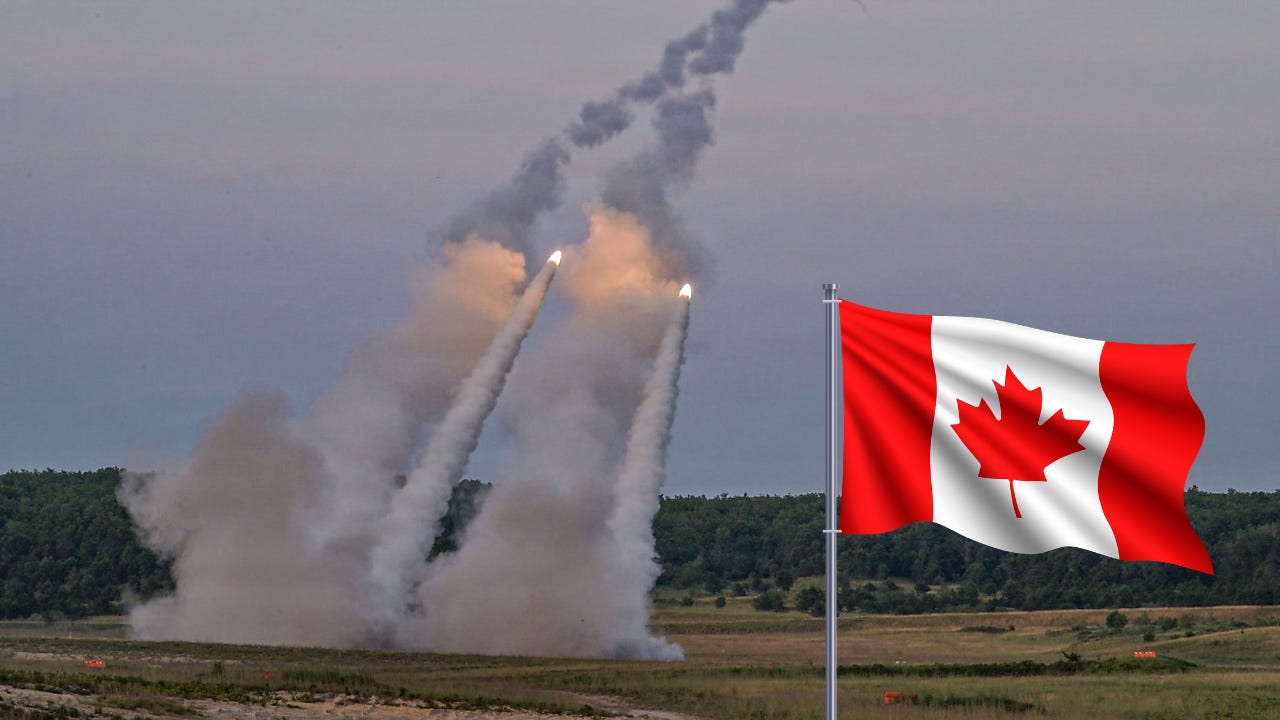
Thanks to Ukraine, Canada Wants the Weapon That Comes After HIMARS
Ukraine proved that long-range firepower needs more than precision. It needs mass production, cheap strike drones, and the ability to adapt faster than the enemy

Back in 2020, Iranian IRGC aerospace commander Ali Hajizadeh was giving an interview on a Tehran news program, and the journalist asked him about his fledgling deep strike program; what would later be known as the now infamous Shahed-136.
He said, “We have drones where if the enemy wants to counter them, on average, if they fire one missile at one of them, they have to spend $5 million to shoot down our $25,000 drone. And that’s only if they succeed. And it’s our drone that hit their missile, not their air defense missile hitting our drone. And these are being produced in very, very high volumes inside the country. They exist and they have completely upended the equations and the balance of power.”
I was struck by his logic, particularly this: “It’s our drone that hit their missile, not their air defense missile hitting our drone.”
Wait, so Iran itself told us about this capability in 2020. Then we watched it in action in Ukraine from 2023 onward… And we still got our shit handed to us in the Gulf, depleted 65% of our Patriots, lost an AWACS on the ground, and acted surprised that Iran has this weapon in the first place? Cool, cool. Just checking.
For years, much of the American defense establishment had little reason to take that argument seriously.
The traditional system rewarded prime defense contractors for producing extraordinarily capable, massively expensive weapons backed by huge government contracts.
That creates a fairly obvious incentive problem.
If the Pentagon is willing to spend millions of dollars on an interceptor, the company building it has little financial reason to suddenly offer a weapon that accomplishes part of the same mission for a fraction of the price.
Sounds to me like “enshitification” has finally reached the defense industry.
Still, as vile as the Iranian regime is, it should be credited with identifying and inventing a solution to a Western weakness: The West has no mass and their weapons are insanely expensive. Ergo, let’s create an overwhelming number of inexpensive deep strike drones and force them to empty their magazine.
As the world saw, Iran’s model of low and slow deep strike attack drones scales quite well to other theaters, because the economics don’t change between the Gulf and Ukraine.
Before 2022, everyone in the West, and even Russia, was chasing “faster” and “more maneuverable” deep strike. Back in the day, I wrote countless articles on hypersonic weapons programs. These days, hypersonics are rarely mentioned at all.
Now, the Western world needs cheap deep strike capabilities.
So where does that leave Canada?
Well, in January, Ottawa finalized a C$2.6 billion acquisition centered on 26 American HIMARS launchers, publicly confirmed in June, with an initial stockpile of precision munitions that includes ATACMS; the same missile Ukraine has used to make life moderately unpleasant for Russian command posts, ammunition depots, and air-defense sites.
The first Canadian HIMARS systems presumably arrive in 2029.
Now Canada wants something else entirely.
On Friday, August 7, 2026, the Canadian Joint Forces Command held a closed-vetting industry Q&A session at Area X.O in Ottawa, Ontario, regarding the new Canadian Deep Precision Strike Capability (CDPSC).
We don’t actually know who was invited. It was secret.
But I can tell you sarcastic journalists certainly weren’t, even though my tuxedo and I are always ready to jump the Michigan border and head to Ottawa if needed.
(Fun fact: I live in Ottawa County, Michigan. So, I’m practically Canadian)
So, the Canadian Armed Forces are shopping for a weapon that can travel more than 500 kilometers, carry more than 100 kilograms of payload, navigate without relying on traditional GPS, survive electronic warfare, potentially operate in coordinated swarms, and complete missions without needing constant command and control.
And Ottawa wants to manufacture the thing in Canada, at scale.
It appears Ukraine has taught Canada the same lesson Washington is slowly learning too. Buying a long-range missile and possessing a genuine wartime deep-strike capability are two very different things.
Missiles give you reach. Factories give you staying power.
This is a developing acquisition program, so there are things we don’t know. Canada hasn’t publicly selected a weapon, the Phase I competition is only now taking shape, and as I mentioned, the government hasn’t released a list of companies invited to its August 7 industry session.
Still, Ottawa has told us enough to understand what it’s trying to build, and it looks remarkably Ukrainian.
Canada already bought the expensive stuff
Canada’s current conventional ground-launched deep-strike cupboard is pretty bare.
The Canadian Army doesn’t currently operate a weapon capable of reaching several hundred kilometers into an adversary’s rear, and HIMARS is about to change that.
The planned force includes 26 launchers and an initial ammunition package reportedly containing ATACMS missiles, along with M31A2 unitary GMLRS, M30A2 alternative-warhead rockets, and extended-range GMLRS. That’s a respectable precision-fires package.
ATACMS is a serious weapon built for serious targets.
A commander might reasonably use one against an air-defense battery, a major headquarters, a hardened command facility, a missile complex, or something else valuable enough to justify spending an expensive ballistic missile on it.
But you don’t want to fire one every time intelligence finds a warehouse full of spare truck tires 220 kilometers behind the front line.
Canada is also buying the Joint Strike Missile for its future F-35 fleet, giving the Royal Canadian Air Force another long-range precision option against ships and land targets.
Again, excellent capability.
Again, premium ammunition.
But there’s an awkward problem baked into learning lessons from Ukraine in real time: by the time a Western procurement system finishes learning one lesson, Ukraine has already moved on to the next three.
HIMARS is the perfect case study for exactly this problem.
When Ukraine received its first launchers in 2022, HIMARS mauled Russian ammunition dumps, headquarters, and logistics nodes sitting comfortably beyond conventional artillery range.
Mykola Bielieskov of the Come Back Alive Foundation now describes summer and autumn 2022 as the system’s peak moment in Ukraine.
Russia adapted from there: Logistics moved. Depots dispersed. Electronic warfare went after GPS guidance. By 2023 and 2024, analysts say some GMLRS missions required considerably more ammunition to achieve effects that Ukraine once accomplished with a single rocket.
Ukraine adapted again in response, and today domestically produced mid-range attack drones are increasingly performing missions once disproportionately assigned to HIMARS, while farther back, FP-1s and other long-range drones attack targets hundreds or thousands of kilometers inside Russia by the thousands.
Canada formally identified its long-range precision fires requirement in 2024.
It requested HIMARS from Washington that December.
The acquisition got announced in 2026.
Canada’s first launchers arrive in 2029.
See the problem? Canada saw how effective HIMARS was in 2023, made the decision to acquire them, and the systems don’t start arriving for six years.
None of this makes HIMARS a bad purchase. HIMARS remains in combat in Ukraine today, its ammunition family keeps evolving, and future weapons like PrSM will give the launcher considerably more reach than the GMLRS-dominated system Ukraine received back in 2022.
The problem is the clock.
Ukraine’s weapons cycle is measured in months while Western acquisition programs are still measured in years. Canada could spend five years procuring a lesson from Ukraine only to discover Ukraine spent those same five years rewriting it.
But Ukraine invented a third category of deep strike, piggybacking on the original Iranian concept, and Canada noticed.
Give an unmanned aircraft an engine, fuel, navigation gear, a warhead, a flight-control computer, and enough airframe to reach the target once.
You don’t need landing gear because it isn’t coming home. You don’t need a pilot because most pilots would reasonably object to that mission profile. You don’t need the airframe to survive 4,000 flight hours because the design life ends with a loud noise somewhere over Russia.
Aside: Flight hours reminds me of another Ukrainian issue. Their F-16s have to be getting close to their airframe limit at this point. Might make for a good future article to investigate how they’re going to overcome this.
Ukraine’s FP-1 shows what happens when that philosophy hits industrial scale.
Ukrainian reporting has put later FP-1 variants at ranges reaching into the thousands of kilometers depending on payload and fuel configuration, with roughly 50 to 120 kilograms of payload and reported unit costs around €50,000, with production hitting thousands of aircraft per month.
Those are ammunition numbers, and Ukraine doesn’t have to ask whether every target deserves a multimillion-dollar cruise missile anymore. It can launch large numbers of cheaper weapons, overwhelm defenses, force Russia to disperse its interceptors and probe air-defense coverage
Today, Ottawa’s wish list reads suspiciously like a Ukrainian requisition report.
Canada wants more than 500 kilometers of range, well beyond normal tactical artillery, enough to threaten headquarters, ammunition depots, airfields, radar sites, logistics hubs, fuel storage, and missile-support infrastructure sitting comfortably behind the front.
It also wants more than 100 kilograms of payload, which immediately rules out a lot of smaller loitering munitions and pushes into the range where the weapon can start doing serious work against buildings, industrial facilities, aircraft, and warehouses.
Then it gets more interesting.
Canada specifically wants alternative position, navigation, and timing technology, so the weapon doesn’t turn into a lawn dart the moment somebody switches on a Russian jammer. A Canadian weapon could eventually blend inertial navigation, terrain matching, computer vision, alternative satellite navigation, or image-based terminal guidance to get around the problem.
Then comes the requirement that may matter more than range, payload, guidance, or speed combined.
Canada wants sovereign production. The government says the future system has to be practical to produce, stockpile, replenish, maintain, upgrade, and sustain at scale and at home.
Canada wants to buy something that already works
The August 7 industry session revealed another interesting piece of the strategy. Canada apparently doesn’t want to spend the next decade inventing the perfect system from scratch.
Phase I looks much more urgent than that. The reported plan calls for a request for proposals around September and an initial operating capability around June 2027, which is extremely fast by defense procurement standards, borderline suspiciously fast by Canadian standards specifically.
That timeline points toward a mature, high-readiness weapon that already exists somewhere on Earth, rather than a clean-sheet design.
Canada wants to buy something, operate it, learn from it, and apply those lessons to the larger sovereign program down the road.
That makes Ukrainian systems particularly interesting candidates.
Fire Point’s FP-1 comes surprisingly close to the Canadian requirement, with enormous range and a maximum reported payload approaching Canada’s desired figure, though payload and range trade against each other, so I won’t casually declare the system compliant on paper alone.
More importantly, Ukraine is already manufacturing and firing FP-1s at a scale most Western manufacturers can only dream about.
Canada also signed a drone-production and industrial-cooperation arrangement with Ukraine back in May, which creates an intriguing possibility: Instead of paying Ukrainian engineers to fly to Ottawa and explain everything they learned during four years of war, Canada could simply license a weapon they already built during it.
Now, there’s no public evidence Fire Point has been selected, shortlisted, or even formally bid, and the attendee list for Canada’s August 7 meeting hasn’t been released. Other potential systems exist too.
Destinus advertises the RUTA family of long-range weapons, including designs with payload and range figures that fit Canada’s broader ambition, though the extremely aggressive 2027 timeline may make emerging systems less attractive for Phase I.
MBDA is pursuing its own expendable strike concepts, and several European manufacturers are rapidly entering the same market.
America’s LUCAS program is another potential option, although I’m not sure how keen Canada is to buy yet another weapon system from Trump.
CENTCOM, just last week, stood up Task Force Scorpion Strike around the Low-cost Uncrewed Combat Attack System, or LUCAS, and has since expanded the idea into a broader multinational attack-drone organization.
LUCAS costs around $35,000 and offers hundreds of kilometers of range, though its reported payload runs much smaller than what Canada wants, meaning Ottawa probably doesn’t want LUCAS itself.
It wants the Canadian version of the Iranian-created philosophy behind LUCAS.
Cheap enough to fire and lose routinely. Long-ranged enough to hit Cleveland, Ohio from the Canadian border. Simple enough to manufacture in real quantity.
Oh, the Canadian weapon also has to survive Canada…
Copying Ukraine’s approach only gets Ottawa so far, because a sovereign Canadian weapon also needs to function somewhere Ukrainian systems were never designed to live.
Specifically, the Arctic.
Canadian military personnel routinely operate in temperatures around minus 40 degrees Celsius and below, with the High Arctic reaching roughly minus 60.
Extreme cold attacks machinery with impressive creativity. Batteries lose performance. Lubricants thicken. Seals stiffen. Plastics and composites turn brittle. Actuators still have to move after hours of cold soaking, and electronics need real thermal management.
Launchers have to work after sitting outside rather than spending the night lovingly tucked into a climate-controlled hangar.
The public Canadian requirement hasn’t specified an operating-temperature envelope yet, which is a little weird.
It probably should, because an allegedly sovereign Canadian missile that quits working at minus 30 degrees would be an extremely Canadian procurement joke.
Ukraine tests its weapons against Russian electronic warfare. Canada may eventually have to test the same weapon against Russian electronic warfare after somebody leaves it outside in Nunavut for three days at minus 50.
Let’s call it Canadianization, and take it seriously, because it’s a different engineering problem than anything Ukraine has had to solve.
So, Canada can probably manufacture a weapon like this domestically, but it’s not a walk in the park. You need engines, explosives, warhead filling, fuses, guidance electronics, navigation hardware, actuators, flight-control software, secure mission-planning equipment, launch systems, test ranges, and quality control, all working together.
Then you need suppliers capable of producing thousands of identical components without discovering six months into a war that one critical servo comes from a single factory outside Shenzhen.
Canada already possesses considerable aerospace, electronics, robotics, sensor, communications, propulsion, and advanced manufacturing expertise. The real problem is connecting those existing capabilities into a production chain built for wartime volume rather than peacetime trickle.
Canada doesn’t currently manufacture HIMARS or the associated long-range American missiles domestically. Buying 64 ATACMS gives Canada 64 ATACMS.
Owning a production line gives Canada tomorrow’s missile too. And next month’s. And the modified version after that.
Sovereignty doesn’t require every screw to carry a maple leaf stamped on it, either.
Canada can license an existing Ukrainian or European design, establish Canadian final assembly, substitute domestic components where it’s practical, and own enough intellectual property to modify the weapon without waiting on another government’s permission first.
It can establish multiple suppliers for critical components and then improve the design continuously from there. Nobody gets bonus points for spending seven years reinventing a fuel pump just because it makes the procurement brochure sound more patriotic.
Two ways this can go
There’s a very Canadian way to handle this program:
Form twelve committees. Commission interoperability studies. Spend three years debating requirements, modify the requirement, hold another industry day, add more paperwork in triplicate, discover the original engine has gone out of production, and start over.
Then proudly unveil 48 spectacular deep-strike drones sometime around the retirement ceremony of the officers who originally requested them while O Canada and God Save the King play in the background.
Or… Canada can copy Ukraine’s wartime model: Buy something. Test it. Give it to soldiers. Break it. Fix it. Build ten thousand more.
The production question may ultimately matter more than which company wins the contract.
Suppose Ottawa selects a weapon with 1,000 kilometers of range and a 150-kilogram warhead.
Great!
How many can Canada actually build?
Can it replace 100 weapons fired during the first week of combat?
Can the factory double production on short notice?
Where does the engine come from, and who manufactures the explosive?
Which component disappears if a foreign government changes its export policy overnight?
How quickly can battlefield feedback produce a software update or a hardware change on the assembly line?
Can the navigation package survive heavy jamming, and can the same weapon launch after spending 72 hours sitting outdoors in the Canadian Arctic?
Those questions now define real deep-strike capability every bit as much as maximum range does.
So, Canada is quietly building something that looks less like a single weapon program and more like an entirely new strike architecture like this:
Artillery and rockets handle the immediate battlefield.
HIMARS and ATACMS hit high-value targets where speed, precision, and penetration justify the cost of an expensive missile, and a future PrSM could push that ballistic layer even farther.
F-35s carrying Joint Strike Missiles add another precision option from the air.
Then a large inventory of Canadian-built one-way attack systems could go after warehouses, logistics hubs, radar installations, fuel facilities, airfields, and command posts; exactly the targets where using a multimillion-dollar missile would be financially deranged, while more capable cruise missiles stay in reserve for the really difficult targets.
This may be the most important lesson Ottawa has actually taken from Ukraine. What Ottawa needs is deep strike in quantities large enough that a commander doesn’t treat every single launch like he’s spending the family inheritance.
Ukraine internalized that lesson because its Western partners couldn’t provide enough missiles, and for long stretches placed restrictions on where some of those weapons could even be used.
Ukrainian engineers responded by building their own long-range strike aircraft for tens of thousands of dollars apiece.
The United States has since embraced the same idea with LUCAS and its dedicated attack-drone formations.
Now it’s Canada’s turn.
The weapon Ottawa eventually chooses will matter, but the factory behind it will matter more. Because the real revolution in long-range warfare in 2026 is whether you can build another one tomorrow.
Слава Україні!


The unreliability/unpredictability of the current US administration is moving Canada toward ITAR-free defense sovereignty. Ukraine and Iran are teaching basic economics to anybody still in love with exquisite weapons systems.
FirePoint is not an entirely Ukrainian enterprise. It has been largely western funded, and worked extensively with Western engineering, aerospace and defense firms as well as militaries developing its weapons So “Ukraine” is a bot misleading. Like all other contractors, they also want to become totally indigenous. But that takes time. Ukriane has a five year head start.