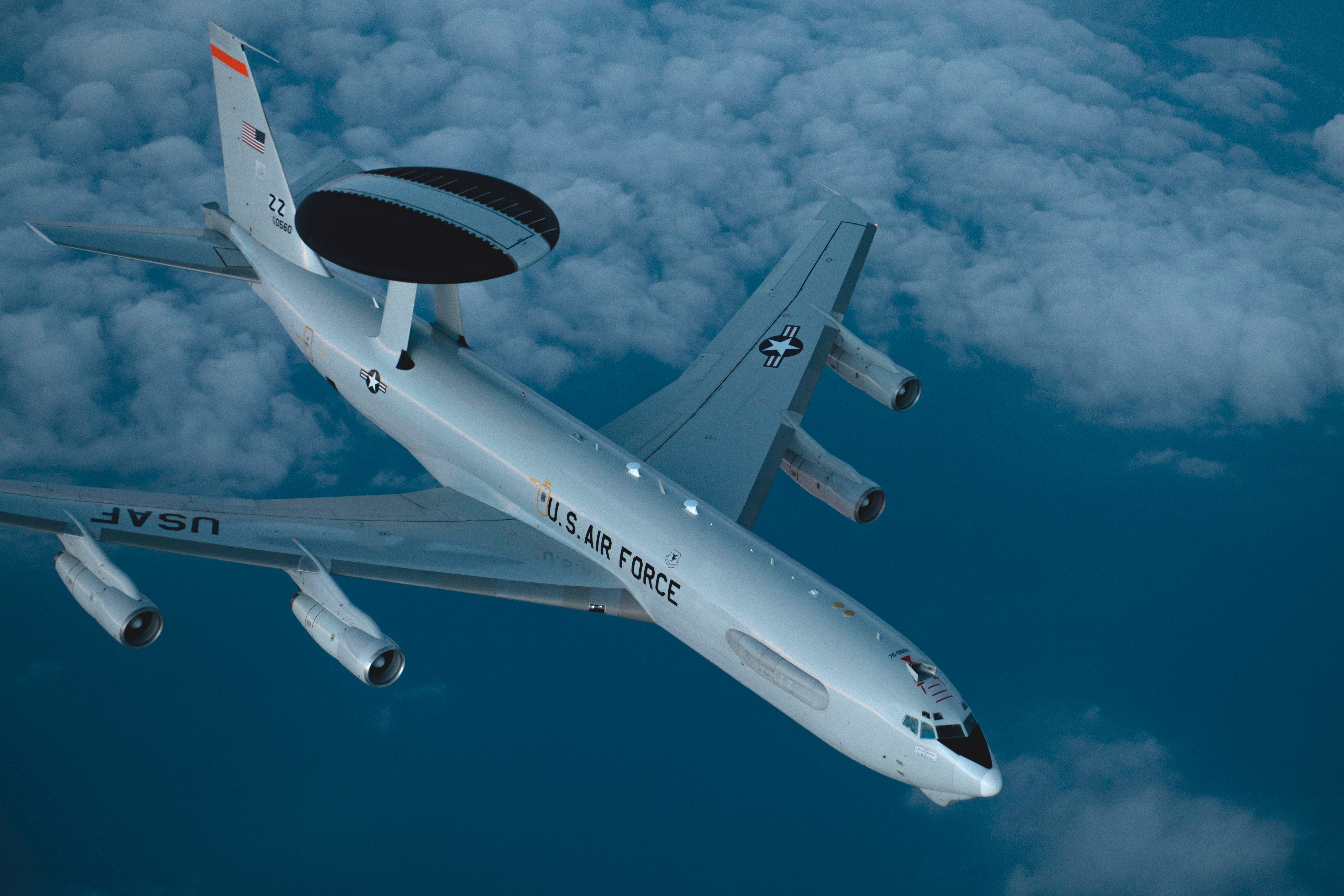
The AWACS War: How the E-3 Sentry Is Running the Air Picture Over Iran
An E-3 Sentry is a flying radar station and command post.

Author’s note: I’m not going to get into the politics of striking Iran at the moment, other than to say that generally, war is bad and should be avoided. As a veteran, it always seems like the politicians who never served in the military are always the most eager to engage in military adventurism. Now that the war has started, however, my interest is in the safety of my fellow servicemembers.
For new subscribers, I served for four years in the US Army infantry with the 101st Airborne Division, two years in a US Army Civil Affairs unit with a primary focus of Eastern Europe, and four years in the US Air Force where I worked on the complex radar system of the E-3 Sentry. Welcome.
I had previously reported that the US Air Force had six E-3 Sentry’s in theater in preparation for attacks against Iran. I have seen more recent reporting of three or four birds. Regardless, that’s a lot of air battle management in one place. So what the hell are these AWACS actually doing right now?
When the shooting started between Iran, Israel, and the United States, the first real fight wasn’t the strike package. It was the air picture.
Right now, US forces are in active air-defense battles across the region as Iran launches retaliatory missile strikes at bases and host nations, with partner air defenses engaging multiple waves.
The list of places getting flashed on warning networks is the usual Gulf geography quiz: Qatar, Bahrain, Kuwait, the UAE, plus Israel dealing with inbound waves of its own.
If you want to understand how this turns into an organized operation instead of a regional bar fight with rockets, you start and end with the E-3 Sentry AWACS. It’s the referee, the traffic cop, and the guy on the radio telling pilots, “No, you can’t shoot that, that’s a friendly Navy squid.”
Here’s what the E-3 is doing at this moment, from the AWACS perspective.
The E-3’s job: make the sky legible
An E-3 Sentry is a flying radar station and command post. It exists to solve the hardest problem in modern air war: you can have a thousand shooters, yet you still lose if nobody shares the same picture.
The E-3 takes radar returns, identification inputs, and reports from other sensors across the theater and turns them into a common air picture that everybody can use. That includes US fighters, tankers, ISR aircraft, Navy ships, Patriot and THAAD batteries, and partner aircraft that plug into the network.
If Iranian missiles are flying toward Al Udeid or Bahrain, the defenders need three things fast: early warning, track quality, and clean identification so they don’t waste interceptors or accidentally swat something friendly.
The reporting we have makes clear that defenses are engaged in multiple places and multiple waves, which is exactly the sort of environment where confusion kills people.
The E-3 is built for that environment.
A grunt buddy from my Army days pinged me on social this morning and asked where the E-3 sits in the order of battle.
“Where the E-3 sits” is the most important decision nobody on social media ever talks about, because it looks boring on a map.
It’s not boring. It’s geometry, fuel, threat rings, and political boundaries all smashed together, then turned into one clean orbit line.
Let’s start with radar physics.
The E-3’s value comes from line-of-sight. The higher it is, the farther it can see, especially against aircraft.
That means the orbit has to be positioned so the E-3 can see as much as possible without drifting into ranges where it becomes a target. If it sits too far back, you lose fidelity on low-altitude tracks and you end up relying more heavily on other sensors. If it sits too far forward, you’ve put a slow, bright aircraft into a neighborhood where the enemy can start targeting it.
Then there’s the threat ring problem. In a theater like this, you’re picking a point outside the best engagement zones of long-range surface-to-air systems, outside the most likely fighter intercept lanes, and away from the places where an adversary can stack effects.
That includes everything from classic SAM coverage to long-range air-to-air missiles, plus the less glamorous threats like one-way drones and cruise missiles that can be aimed at predictable orbits.
While I was in the Air Force, an AWACS old-timer who served during the first Gulf War told me a harrowing story where three Iraqi MiGs were making a break directly at an American AWACS. The AWACS controllers calmly directed a flight of F-15C/D Eagles to intercept the MiGs before they were able to fire on the Sentry.
If you believe the more outlandish version of the story, some of the younger AWACS controllers were “freaking out” and vectoring in every available friendly asset to intercept the MiGs.
Regardless of which version is true, the fear is real when you’re flying in a Boeing 707 with effectively zero defensive countermeasures.
I say “effectively” zero. I know for sure there is one non-kinetic defensive system on the E-3, but it wasn’t my system, so I don’t know a lot about it, and I don’t know if it’s classified, so I’m going to stop talking about it.

An AWACS orbit is predictable by necessity. Predictable is manageable for friendly planning. But predictable is also a gift to anyone trying to hurt you.
So, the orbit needs mobility within boundaries. Crews will shift orbits, change anchor points, or run offset patterns so the enemy can’t treat the E-3 like a fixed radio tower. You still maintain coverage, yet you don’t give the other side a stationary bullseye.
Operators are constantly tuning the picture, and the orbit choice affects what the radar sees, what it struggles with, and how quickly tracks firm up into something usable.
Here’s a typical racetrack orbit pattern in this pic:
The racetrack is generally positioned to allow the 360-degree radar to monitor a specific border or battle sector, often with the long axis parallel to the front line.
Then there’s airspace sovereignty. In a regional fight, you’re rarely operating in a single nation’s cleanly controlled airspace.
The E-3 will usually sit where political permissions are solid, where host-nation coordination is reliable, and where divert fields exist if something breaks.
Now layer in the logistics reality: the orbit is only “alive” if the fuel math works. The E-3 can stay up a long time, but it isn’t infinite, and a sustained crisis means you need persistent coverage.
That becomes an operational rhythm: relief-on-station timing, tanker rendezvous timing, crew duty limits, maintenance cycles, and spare aircraft positioning. If the orbit is too far from tankers, you burn time and fuel just commuting. If it’s too close to tanker tracks, you create congestion and collision risk in already busy airspace.
The orbit has to be positioned so the whole support architecture can breathe.
There’s also a subtle point: the E-3 orbit shapes everybody else’s behavior. When the E-3 is in a stable orbit with high-quality coverage, commanders get confident.
They commit aircraft deeper.
They accept tighter timing.
They run more complex packages.
When the E-3 has to displace, when coverage gets degraded, when a replacement bird is late, everybody becomes conservative fast.
Offense slows, defense becomes jumpier, and the risk of bad calls rises.
The orbit isn’t just a location, it’s the backbone of trust in the air picture.
Put yourself in the mind of an F-35 pilot running SEAD or Suppression of Enemy Air Defense in Iran. You just learned that the on-station AWACS had to bug out for some unknown reason (let’s say both main and redundant transmitters broke) and your air picture is now reduced to only what you and other linked F-35s can see. How does that make you feel?

Defensive operations: the E-3 in the air-defense brawl
Business Insider describes US land, air, and naval forces participating in air defense as Iran fires retaliatory missiles, and it cites multiple Gulf states saying they intercepted incoming waves.
From the E-3 seat, defensive operations break into a few urgent, repetitive tasks.
First, warning. Even if space-based sensors provide ballistic missile warning, the fight still needs a coordinated handoff. Who’s the defended asset. Which sector has priority. Which shooters have shots. Which tracks are real. Which are decoys, debris, or secondary effects.
Second, identification. This is where friendly fire risk spikes. The air becomes crowded with fighters launching, tankers dragging tracks, ISR aircraft, and partner jets. The E-3 helps manage IFF, track correlation, and the “do not shoot” list.
The aim is to keep someone from firing on a friendly track because the timing got weird and the radio got loud.
Third, deconfliction. Missile defense is trigonometry and timing. You don’t want interceptors crossing into somebody else’s basket. You don’t want fighters racing through engagement zones. You don’t want a Patriot battery firing blind because it couldn’t get a clean track.
Then there’s cueing. Cueing is just like it sounds: Putting assets and targets in lines and prioritizing.
If a cruise missile threat exists, if drones are mixed in, if low flyers attempt terrain masking, the E-3 can help cue fighters onto the right sector and clean up leakers.
Insider described “multiple waves,” which usually means mixed salvos or repeated launches. That is an environment where cueing and sorting keep bases alive.
There’s also the political piece, and it’s not small. A base defense shot that misses and lands in a city can turn a military action into a friendly firestorm in minutes. Reuters is already reporting a fatality in Abu Dhabi tied to shrapnel after intercept activity, plus impacts and interceptions around the Gulf.
That’s the nightmare scenario for the defender: you win the intercept and still lose the headline. Remember, the US and its allies, like Canada and the UK, genuinely take steps to avoid civilian casualties. I’ve seen it in action first hand in the shape of highly restrictive rules of engagement and SOPs meant to reduce harm to innocents.
That doesn’t mean, sadly, that they never get hurt or killed. But it’s a far cry from the Russian way of making war.
Offensive operations: the E-3 as the strike conductor
Now flip to offense. The US and Israel have launched strikes inside Iran.
From AWACS, offense is less about “go bomb that” and more about keeping the strike machine coherent.
Strike aircraft need safe lanes through a sky that may contain partner aircraft, civilian diversions, tankers, and defensive air patrols by F-22s. During a fast-moving crisis, airspace closes and reroutes stack up quickly.
Israel may be running its own battle management, the US may run separate packages, and partners may defend their own airspace. The E-3 helps stop these from colliding. It also reduces the risk that defensive shooters mistake friendly aircraft for hostile tracks during a wave.
Then there’s escort and counterair. If US or Israeli aircraft operate near threat rings, they need fighters watching for Iranian aircraft, and they need warning of surface-to-air threats where possible.
Even if Iranian airpower performs poorly, nobody sane ignores it when the stakes include an AWACS, tankers, and crowded orbits.
Finally, there’s recovery. A strike ends when the last aircraft lands and everybody is accounted for. The E-3 helps manage the return flow, the divert plan, and emergency coordination if something gets damaged and needs a quick landing slot.

Why the E-3 matters even more in a drone-and-missile era
A lot of people hear “AWACS” and picture Cold War fighter control. That’s still part of it, yet this war has a different flavor.
Ballistic missiles compress decision time.
Drones and cruise missiles complicate identification.
Mixed salvos create false confidence because you intercept a wave and assume it’s over, then the next wave arrives when your launchers are reloading and your crews are exhausted.
The E-3 can’t shoot anything. What it can do is shorten the time from detection to decision, and it can keep the defenders from stepping on each other.
It also helps reveal patterns. If Iran is firing across multiple countries, you want to know whether salvos align with specific political aims, such as punishing host nations, testing certain defense sectors, or forcing closures around major hubs like Qatar and Bahrain.
Reuters and other reporting suggests multiple targets across the Gulf, with some interceptions and at least one confirmed hit in Bahrain.
That sort of spread attack is designed to create confusion and force everybody to defend everything at once.
An AWACS crew lives to simplify that chaos.
So, what does an AWACS crew fear? They fear losing the orbit. If the E-3 must leave station, the whole force loses a key node. The air picture becomes fragmented and slower to synchronize.
They fear fratricide. Crowded skies, stressed defenders, and split-second calls produce disasters. AWACS exists to reduce that risk, yet the risk rises in exactly these moments.
They fear comms degradation. If the network gets jammed, attacked, or saturated, the E-3’s ability to coordinate drops fast. In a regional fight, adversaries don’t need to win the air war. They need to break the air picture long enough to let leakers through.
They fear political fallout from defensive success. The shrapnel fatality report out of the UAE is a reminder that even good defenses create harm, and the narrative war runs nonstop.
So what happens next, from the E-3 perspective?
If this conflict continues, expect the AWACS mission to expand, not shrink.
More persistent orbits. More tankers committed to support them. More fighter escorts allocated to protect the C2 backbone. More reliance on naval sensors and ground radars to build redundancy, so the force does not hinge on a single aircraft.
You also get a hard prioritization fight.
Do you keep fighters over bases? Do you push fighters toward launch areas? Do you hold assets near Israel? Do you surge protection around Al Udeid since it’s the regional hub?
The reporting highlights Al Udeid’s centrality and the spread of threats across multiple host nations, and that creates constant tradeoffs.
So, the E-3 won’t decide strategy. But it will make strategy executable.
More to come as the conflict expands. I’m sure we’ll have more military tech to talk about in the coming days.
One final note: Don’t let Iran distract from the Ukrainian fight. They still need our support.
Слава Україні!


Awesome article, thank you!👍👊
Our bases are sitting ducks for Shaheds because the Republicans killed our anti-Shahed program
https://bsky.app/profile/brosemitesam.bsky.social/post/3mfwcepowkc2j