


In October 2023, I wrote an article about flamingos. REAL flamingos. The pink ones that stand on one leg.
About a thousand of the birds had gathered at a national nature park on Ukraine’s Black Sea coast. Their presence was unusual for that part of the world, and the birds managed to produce nearly 200 chicks in the middle of Russia’s invasion. Full transparency: I have a personal distaste for most birds, but this was, at the time, a nice bit of stark pink beauty in an otherwise gray, depressing landscape.
Then, in August 2025, I found myself writing about an entirely different species of Ukrainian Flamingo. This one weighed about six tons and had a jet engine.
And now in November 2026, Ukrainian Flamingos, (the heavy ones), have paid a visit to Vladimir Putin’s favorite bridge.
You’ll forgive me if I’m enjoying my coffee a little more than usual this morning.
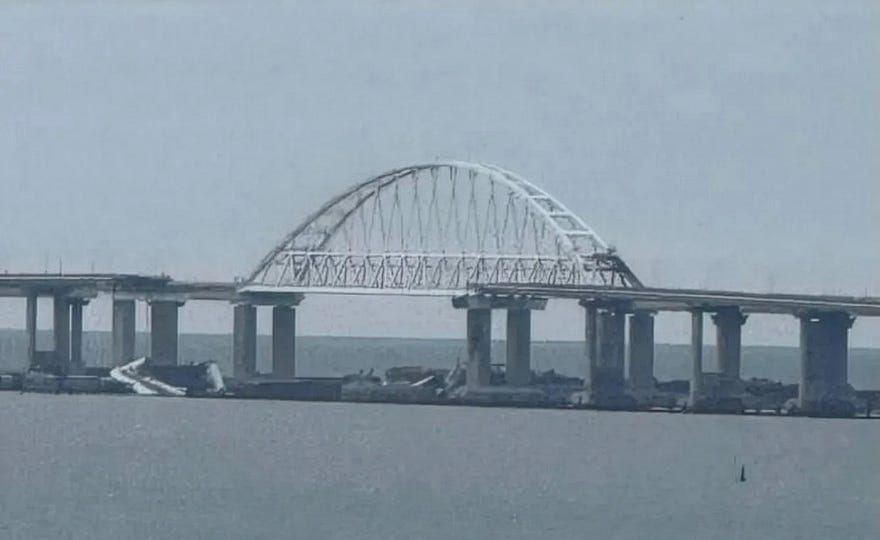
Overnight, Ukraine succeeded in dropping the main road span of the Kerch Strait Bridge into the water below. President Zelenskyy has confirmed that the domestically produced FP-5 Flamingo cruise missile participated in the operation, along with a “who’s who” of other Ukrainian weapons).
I do enjoy waking up to good news.
Almost four years of attacks
On October 8th, 2022, a Ukrainian SBU operation detonated a truck bomb that collapsed sections of the roadway and ignited a passing fuel train. Russia didn’t reopen the bridge to traffic until February of 2023.
Then, in the summer of 2023, Ukraine attacked the bridge with unmanned naval drones. That attack did minor damage and Russia was able to restore traffic somewhat quickly.
But the psychological effect was enough to force Putin to set up what I called “barge blockers” in 2024. These were essentially civilian cargo ships which formed a line blocking water access to key parts of the bridge from the water.
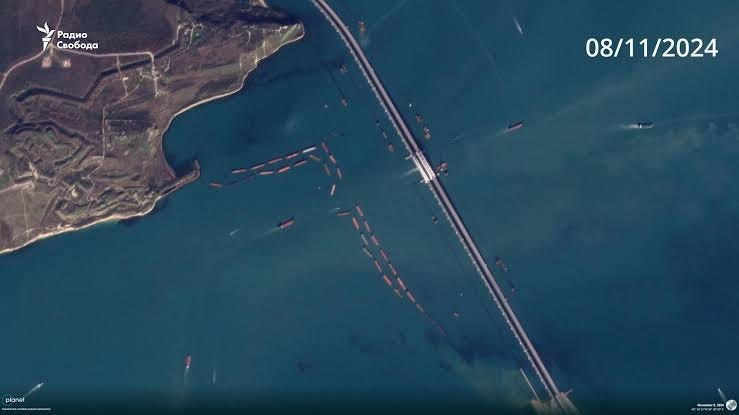
By summer of 2025, Ukraine’s SBU was at work again. In June, Ukraine detonated the equivalent of 1,100 kilograms of TNT underwater. The operation took months of preparation, although traffic resumed pretty quickly.
Which brings us to last night’s attack…
The bridge has inadvertently become a historical record of Ukrainian weapons development. You can follow a through-line from clandestine sabotage to Ukraine’s growing inventory of domestically produced long-range drones and cruise missiles.
These new weapons give Ukraine the ability to engage in complex, multi-stage strike operations.
Why killing bridges is so hard
Blowing up a bridge sounds cinematic. Reality? Eh, not so much.
Most of the time, bridges don’t fail all at once (unless you’re the Francis Scott Key Bridge). They’re designed with structural redundancy, which means that if one part of the support system takes a hit, other components are over-engineered to pick up the slack.
Dropping a single span might sever traffic, but it won’t bring the whole structure down.
Now add the fact that bridges have different failure modes.
You can destroy the deck, shear off a support pier, collapse a truss segment, or deform the superstructure to the point where it’s no longer safe to use. Each of those targets demands a specific kind of munition, delivered with precise timing and placement.
The bigger the bridge, the more specific the equation becomes… And those equations are unforgiving. The energy required to buckle a reinforced concrete pier, crack a tension cable, or shear through a welded steel joint is huge and directional.
Blast energy bleeds out into the environment.
Water absorbs and reflects shockwaves in odd ways.
Air disperses force over distance.
Even the angle of detonation matters: A few degrees off, and the explosive force just punches a neat, ineffective hole.
That’s why successful demolitions in peacetime rely on surgical planning: charges set inside the bridge’s structural cavities, placed by hand, often after weeks of analysis. The exact opposite of what a military strike allows.
Ukraine’s SBU get a drone, a missile, maybe a swimmer delivery system, and one shot. If they’re lucky, they’ll land the explosive close to a known weak point, like the connection between a pier cap and the deck girder, and the rest of the structure might follow.
But usually? They just blow out the sidewalk and call it a good day.
When I first wrote about Fire Point’s FP-5 Flamingo in August 2025, I was preoccupied with the sheer size of the damn thing.
At six tons, with a claimed range of 3,000 kilometers and a 1,150-kilogram warhead, it’s an absolute unit. The International Institute for Strategic Studies (IISS) identified it as one of the largest ground-launched cruise missiles in the world.
But, buried in Zelenskyy’s announcement this morning was a detail that interests me more than the size of the warhead:
“The communications uplink worked flawlessly until the very last seconds.”
Whoa there. Since when have we been talking to the Flamingo?
Traditionally, a land-attack cruise missile leaves its launcher with a large chunk of information already stored in its onboard computer. Depending on the sophistication of the weapon, it can use satellite navigation, inertial navigation, terrain mapping, and even stored images of its destination to figure out where it is relative to where it’s supposed to be.
The original Tomahawks were doing some of this stuff in the 1980s.
But modern cruise missiles maintain a communications link that allows them to receive information after launch. Some newer variants of the American Tomahawk, for example, can receive updated mission instructions while airborne. And now it appears that Ukraine has developed some form of in-flight communications capability for its Flamingo.
How sophisticated is it? I don’t know yet.
There’s footage circulating online purporting to show a Flamingo’s final approach to the Kerch Bridge, and the folks over at The War Zone have suggested that it may demonstrate man-in-the-loop guidance.
If that’s confirmed, Fire Point has been busier than I realized.
Of particular interest to me is the fact that Zelenskyy went out of his way to mention the reliability of the communications link. Presidents don’t generally include technical observations about missile communications in their morning announcements alongside their eggs and bacon.
Then again, if you’ve been following my recent Starshield whodunit articles, you’ll understand why Ukrainian officials might be particularly pleased that their weapons are still talking to them.
For the past month, I’ve been investigating the mysterious speed restrictions on Ukraine’s American-supplied satellite communications. Those restrictions have interfered with everything from deep-strike operations to the interceptor drones defending Ukrainian cities.
And here comes a six-ton Ukrainian cruise missile that, according to Zelenskyy, maintained its communications right up to the final seconds of its flight.
Well, color me curious.
Was the Flamingo using satellite communications at all? Has Fire Point developed an alternative? Had this capability been under development long before the October Starshield debacle?
I’m hoping Fire Point eventually indulges my curiosity, although the Russians would also like the answers to those questions.
Regardless, when the Flamingo made its public debut last year, everybody wanted to talk about how far it could fly and how much explosive material it could carry.
I think we need to start paying more attention to the electronics inside the bird.
Images that emerged after sunrise this morning show that the main road span, which sustained significant structural damage during yesterday’s attack, has collapsed entirely following a second overnight strike.
The adjacent railway span is still standing, although the extent of the damage to that structure remains unclear as I write this.


And there’s a nasty secondary consequence for Moscow. The twisted remains of the steel arch are now obstructing the shipping channel beneath the bridge, which means larger vessels will have difficulty entering or leaving the Sea of Azov. Russia suddenly has a maritime logistics headache on top of its transportation problems in Crimea.
Meanwhile, there’s some fascinating footage circulating online that appears to show the terminal approach of an FP-5 Flamingo cruise missile, possibly under direct human control. (I haven’t been able to independently verify the authenticity of the footage, although the Flamingo certainly packs enough angry Ukrainian chemistry to do some serious structural damage.)


Look, Ma. No Western missiles!
My favorite part of Zelenskyy’s announcement this morning was the shopping list of weapons involved in the operation.
In addition to Fire Point’s FP-5 Flamingo, the Ukrainians employed the Neptune, Palianytsia, Ruta, FP-1, Dovbush, Vendetta, Da Vinci, Sichen, MICH-2000, and An-197.
Eleven different types of weapons… All made in Ukraine.
Take a moment to appreciate how absurd that would’ve sounded in 2022.
Remember how much of 2023 and 2024 we spent discussing whether Washington would provide Ukraine with ATACMS? Then came the debate over which variants Ukraine would receive, followed by another seemingly interminable debate over where the Ukrainians were allowed to use them. Same with the F-16s.
We went through similar diplomatic gymnastics with the British Storm Shadow and its French sibling, the SCALP-EG.
Meanwhile, the Germans spent so long debating the delivery of Taurus cruise missiles that I expect the missiles to reach retirement age before reaching Ukraine.
While Western politicians were agonizing over hypothetical Russian red lines, Ukrainian engineers were busy building an indigenous long-range strike complex.
Individual manufacturers began developing weapons with different flight characteristics, payloads, ranges, and guidance systems. And now, Ukraine’s military has a growing inventory of domestic weapons from which it can draw when planning a major operation.
The Flamingo will understandably get much of the glory for this week’s operation. But there are engineers, machinists, software developers, and military planners across Ukraine who contributed to putting a section of Putin’s bridge at the bottom of the Kerch Strait this morning.
I’d love to buy those folks a Guinness.
There’s also a certain satisfaction in knowing that Ukraine didn’t have to wait for a meeting in Washington or London to authorize the use of these weapons against a Russian military supply route on internationally recognized Ukrainian territory.
So where does this happy news leave us? Stay tuned; I’m currently awaiting more detailed damage assessments so I can report back the extent of the wreckage.
Remember, when Putin inaugurated the Kerch Bridge in 2018, he climbed behind the wheel of an orange KamAZ truck and drove across it for the television cameras because he wanted the bridge to be a monument to the permanence of Russian control over Crimea.
Instead, over the past four years, it has become a fun way to measure the progress of Ukrainian military engineering.
Still, I wonder how those real flamingos are doing down at Tuzlivski Lymany.
I’d like to visit that national park someday, after the war, with my Sony A7SIII camera and absolutely no military equipment to write about. And I’d like to write another article about Ukrainian flamingos in which I don’t have to explain how a cruise missile finds its target.
Here’s hoping.
Слава Україні!
I use AI extensively in my research. Tools like God’s Eye View and SITDECK help me monitor hundreds of news feeds and open-source intelligence sources simultaneously. I also use Claude to help check factual claims and locate supporting sources. I still examine the underlying evidence, verify the reporting personally, and write my articles myself. After writing, I use Grammarly’s AI tool to correct punctuation and spelling.
I’ve disabled Substack’s AI detection feature because I don’t believe a computer can reliably determine who wrote something by examining the finished prose. I’ve had explainer articles I personally wrote in 2017 flagged as partially AI-generated. Apparently, a younger Wes had access to technology from the future. For another example, I wrote a book on writing and public speaking in 2020 called “Own the Crowd” where I have a chapter dedicated to the power of using threes to make a point stick; yet three of anything is now a signature of AI writing? I’m calling BS. I don’t believe in forcing human writers to prove their humanity to an algorithm.
I’m including this blurb at the bottom of every Substack article. I’ve explained my reasoning in greater detail here: Substack’s AI Detector Wants Me to Write Worse. Stay frosty.
Ukraine 🇺🇦 says, if you want something done right you have to do it yourself.
A good way to start the day is with great news!