This Drone Uses Movement to Make Itself Nearly Invisible
Northwestern built a drone that spins itself into a blur
Hey friends.
Somewhere in a training cycle a long time ago, an infantry instructor drilled a simple rule of thumb into my head about spotting a hidden enemy: The eye catches movement first, then resolves shape, and finally recognizes color. (I would later learn this is an oversimplification, but useful for grunts. More on this in a bit.)
It’s the reason a sniper freezes mid-step when a leaf shifts wrong, and the reason the platoon sergeant gets pissed when there’s too much grab-assing (horseplay) going on. Movement is the tripwire in small-unit warfare, especially if you’re trying to stay hidden.
So, you can imagine my reaction when I read about a new drone out of Northwestern University that does the exact opposite of what ten years in uniform taught me to expect.
It hides by moving. Constantly, violently, and on purpose. And the faster the drone spins, the more it disappears.
It’s been a while since I’ve written a pure tech piece, so today’s article is just a cool story about some cool technology… and, of course, whether this could someday be used to kill other humans.
The trick
On July 16, a team from Northwestern’s McCormick School of Engineering presented a project called Phantom Twist at the Robotics: Science and Systems conference in Sydney, and it’s a clever piece of engineering.
Here’s the mechanism.
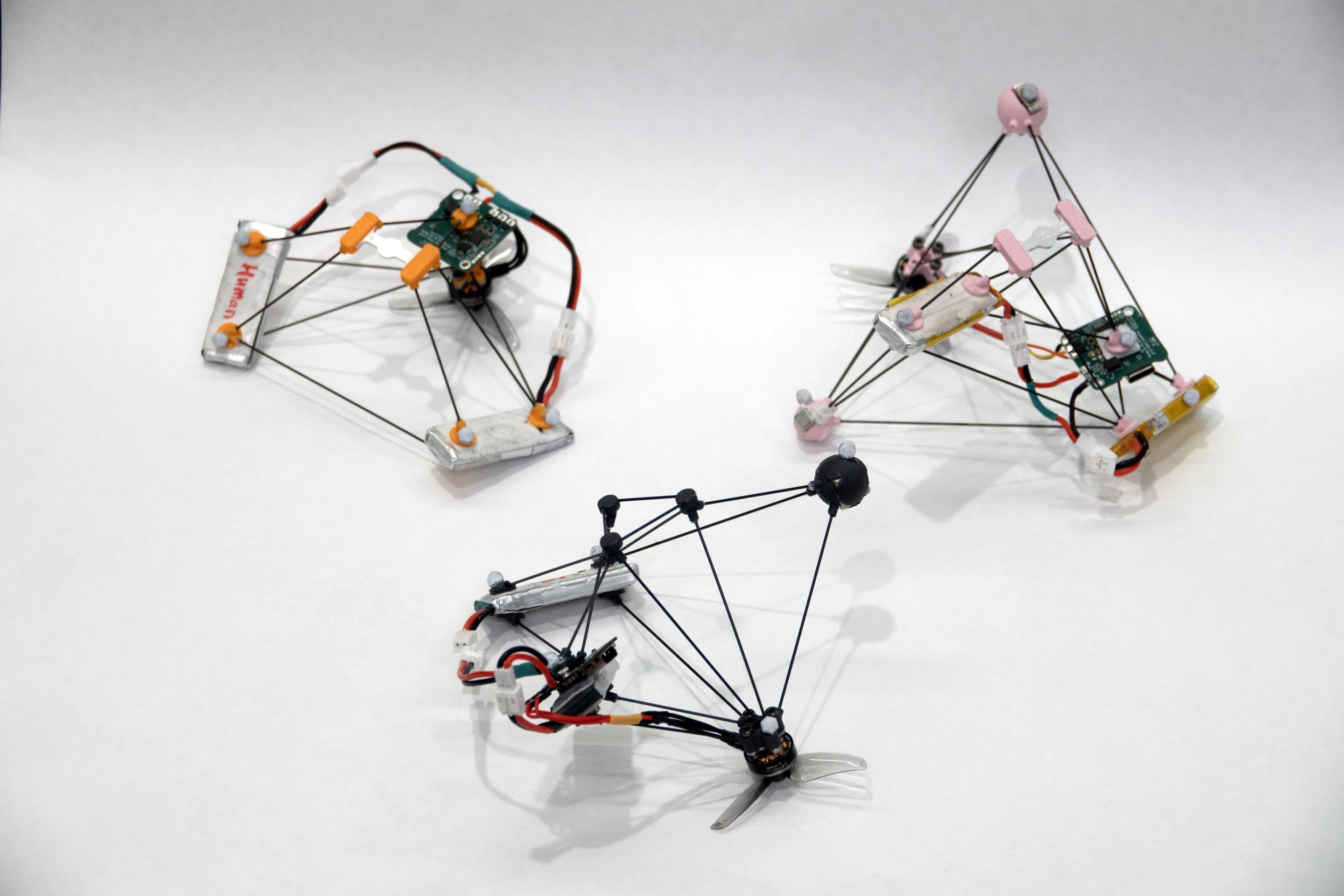
Instead of the usual quadcopter setup with four separate rotors, Phantom Twist runs one single motor and one single propeller. As that propeller spins in one direction, the entire rest of the drone counter-rotates the opposite way, somewhere between 15 and 25 times every second.
That’s fast enough to blow straight past what your eyes can actually resolve.
The human visual system needs roughly a tenth of a second to integrate what it’s looking at before handing the picture off to your brain, and when something moves faster than that window, your eyes simply average the motion together with whatever’s behind it.
The result is a faint, semi-transparent smudge, the same optical trick that makes a ceiling fan blade seem to vanish once it hits full speed.
The team computer-generated roughly 20,000 physically workable drone configurations, narrowed those down to the 500 with the lowest predicted visibility, and then ran an AI-optimization algorithm to figure out exactly where to place the batteries, the motor, the circuit board, and a set of counterweights so that nothing lines up and creates a dark ring when it’s spinning.
The finished prototype weighs about 35 grams, roughly the weight of a AA battery and a half and hovered for around ten minutes during lab testing.
Lead researcher Michael Rubenstein said most efforts to hide a drone try to make it look like its surroundings. His team instead asked whether they could design the drone itself around the way humans actually perceive motion.
The headline that some other engineering blogs are using is, “ten times less visible than a normal drone,” but I need to put an asterisk on that.
The researchers measured this using a computer-vision metric called LPIPS, which compares how similar two images look to each other in a way that roughly mirrors human visual perception.
A standard quadcopter scored more than ten times higher on that visibility metric than the best Phantom Twist design. That’s a legit result but it’s not the same thing as running a room full of human volunteers and clocking how much longer it took them to spot the thing, or how much closer it had to get before someone noticed.
Nobody’s run that test yet.
Also, this is very early in the development phase. The prototype needs an external motion-capture camera system just to know where it is in space, since it has no onboard navigation of its own. At the moment, it also needs an external launcher to spin the whole airframe up to a stable rotational speed before it can fly under its own power.
And the demonstration was controlled hovering inside a laboratory, not FPV-style flight ripping through a tree line at 60 miles an hour while somebody’s shooting at it with a boom stick.
So, this is a proof of concept for a visual effect, not a field-ready weapon system. But it’s still a useful exercise to imagine potential battlefield uses… especially since small-unit warfare has officially moved into the drone era.
One warning channel down, one to go
Here’s where my old Army mnemonic gets a useful correction: Human vision doesn’t actually process movement, shape, and color as three neat sequential steps.
It runs through partly parallel pathways, with one system built to react quickly to motion and rough brightness changes, and a separate system carrying more of the fine detail, shape, and color information.
Motion does tend to grab attention fast, especially out at the edges of your vision. But the brain isn’t dutifully checking off movement, then shape, then color in that exact order like a soldier running through a mental checklist.
The battlefield lesson still holds up fine as a working rule, even if the neuroscience is messier underneath it. Movement is usually the first thing that gives away something trying to stay hidden. What Phantom Twist does is clever precisely because of that fact.
It doesn’t try to eliminate movement the way camouflage or stillness would. It weaponizes one specific kind of movement, pure rotation, to erase the very shape your brain is trying to lock onto in the first place.
But there’s a real crack in the concept.
The visibility model assumes the drone stays relatively stable and centered in an observer’s field of view while it’s spinning in place. Drift, oscillation, or a shifting vantage point could all make it far more visible in the real world than it was in a controlled lab environment.
An FPV-style attack run crossing open sky creates its own kind of blur against a constantly changing background, and that broader motion, the drone’s flight path itself rather than its spin, might trip the exact same motion-detection instinct this whole design was built to defeat.
There’s also the sound. If you watch the video with sound, this thing is loud as fuck.
The researchers didn’t publish decibel readings or a direct acoustic comparison against a normal quadcopter, and Northwestern’s own release is upfront that Phantom Twist remains audible. That’s an understatement…
The full airframe rotates at 900 to 1,500 RPM, and the propeller itself spins considerably faster than that, though the paper doesn’t give an exact figure.
A conventional FPV drone produces the layered whine of four motors and four propellers, with the pitch shifting sharply as the pilot maneuvers, the exact sound soldiers in Ukraine have learned to recognize and dread with only a few seconds of warning.
A single small propeller spinning at high RPM to generate enough thrust could easily produce its own sharp, irritating tone, possibly with a pulsing or warbling quality layered on from the whole body rotating underneath it.
Nobody’s tested that yet either. So, Phantom Twist has suppressed one warning channel and left the other one wide open. A soldier may struggle to see it while the propeller keeps right on announcing that something is close by.
Where the good guys could actually use this
Setting weaponization aside for a moment, since the near-term reality doesn’t support it yet, the most obvious application is close-range reconnaissance.
A micro-ISR drone that can loiter near a treeline, a window, a firing position, or a vehicle staging area while remaining hard to visually confirm buys real time on station, even if a soldier suspects something’s up there.
I did a video on the Black Hornet Nano, another micro-drone for ISR, showing some of the use cases. If Phantom Twist hides by spinning, the Black Hornet Nano hides by being about the size of a Matchbox toy car.
Norway sent 1000+ Black Hornets into Ukraine.
The current Phantom Twist prototype carries no camera, but the researchers have already floated line-scan cameras, time-of-flight sensors, and infrared links that could actually take advantage of the spinning body itself, including the idea of a rotating sensor building a full 360-degree picture over each single revolution instead of needing a mechanical gimbal. Like a panoramic camera.
Urban surveillance and counter-sniper work is another natural fit.
A small stationary quadcopter tends to stand out badly against a wall, a window, or an open patch of sky, which is exactly the kind of terrain where this design should shine, reading more like a faint optical artifact than a recognizable aircraft silhouette.
You could also picture it as a forward sensor or communications relay, hovering somewhere that blocks a normal line-of-sight radio link between separated units, using its own constant rotation to sweep a directional antenna or sensor across the surrounding terrain instead of needing a separate mechanically steered part to do that job.
Covert payload delivery is plausible too, dropping a small listening device, tracking beacon, or sensor package and slipping away before anyone pins down exactly where it came from, though the payload would have to be woven directly into the aircraft’s mass balance and optimization from the start.
Bolt something onto the bottom like a Christmas ornament and you’d create an obvious opaque blob at the center of the blur, which would likely wreck both the flight stability and the entire visual effect the design depends on.
Weaponizing this into an explosive loitering munition is the obvious worry, but the current hardware is nowhere close.
Phantom Twist weighs about 35 grams and runs on a motor rated for roughly 80 grams of maximum thrust, which leaves almost no margin for a warhead, a seeker, a stronger airframe, and the kind of aggressive high-speed maneuvering an actual attack profile would demand.
The demonstrated flight envelope is hovering, not diving, chasing, or punching through wind. In the near term, this technology is a far more plausible fit for quiet surveillance and sensor placement than it is for replacing Ukraine’s five-inch FPV bombers.
Also, Phantom Twist has only been optimized against ordinary human eyesight. The study doesn’t demonstrate any reduction whatsoever in thermal signature, radar return, radio-frequency emissions, acoustic output, shadow, downwash, or detectability by fast-shutter cameras or computer vision specifically trained to hunt for spinning objects.
A soldier’s naked eye might see nothing but a faint smudge in the air, while a thermal scope right next to him lights up on the warm battery and motor at the drone’s core like it’s on fire.
An RF detector can still find its control link. A short-range radar can still pick up the moving mechanical parts. An acoustic array can still triangulate the exact propeller whine we just spent a whole section discussing.
Even a camera running a short enough exposure could freeze a slice of the rotation instead of averaging it into a blur, and the researchers acknowledge that bright light can make the whole thing flicker rather than smoothly vanish.
“Low visibility” is an accurate description of what’s been built here. “Stealth” would be an overreach, but I think this points in an interesting direction; especially the software.
Where this goes next
The software behind Phantom Twist may end up mattering more than this particular airframe ever does. Future designers could hand that same optimizer a camera, a radio, a warhead, or an electronic-warfare payload and let the algorithm build an entirely new airframe around whatever mission that specific hardware needs to fly, balancing mass, control, visual signature, and endurance all at once.

That turns camouflage from something you paint onto a finished machine into something you compute from scratch before you ever cut metal.
In fact, AI-assisted engineering may be the biggest sea change here since it has a knack for coming up with abstract solutions that typically fall outside human’s narrow engineering legacy. But that’s an article for another time.
The paper also proposes transparent structural rods and clear circuit boards, and you could reasonably extend that toward translucent propellers, low-contrast wiring, and casings tuned to match average sky brightness.
Batteries, motors, lenses, and payloads will always remain stubbornly, physically opaque, so the real engineering challenge becomes arranging them so their blurred paths never overlap into a visible dark ring as they spin.
On the propulsion side, the researchers flag both quieter propeller designs and something called electrohydrodynamic thrust, sometimes nicknamed ion wind, which produces thrust without any spinning blades at all, though current versions of that technology don’t generate anywhere near enough force for a practical free-flying aircraft yet.
A more realistic near-term path probably runs through lower-noise propeller shapes, reduced blade-tip speed, and flight profiles that avoid the abrupt throttle changes that make a drone’s whine so recognizable in the first place.
Then there’s the navigation problem, which is arguably the hardest one on this whole list.
An operational version would need real onboard sensing capable of handling an airframe physically spinning up to 25 times a second, some blend of inertial sensors, optical flow, and rotation-aware software, since GPS alone is nowhere near responsive enough for tight flight near buildings or under jamming.
And the mature version of all of this would eventually need to optimize several signatures at once like visual, acoustic, thermal, radar, and RF, simultaneously. That’s a very hard engineering problem, because every fix tends to tax something else.
Cooling the motor down adds weight. Quieting the propeller often means a bigger one. Cutting radio emissions can shrink your effective control range. Transparent materials tend to sacrifice structural strength.
Physics doesn’t offer free lunches, and it never has.
So, here’s what drew me to this story in the first place and made me want to write about it…
A soldier in a trench hears the familiar rising whine overhead and instinctively looks up, and normally the next steps happen almost automatically. Find the dark speck against the sky, judge which way it’s headed, decide in about two seconds whether to shoot, duck, or run.
That whole sequence depends on one simple assumption that’s held true since the first quadcopter buzzed over a battlefield.
If you can hear it, you can eventually see it.
Phantom Twist is a first, fascinating crack in that assumption.
My old infantry instructor taught me to watch for movement because movement always used to mean something was there. Welp, in a lab in Evanston, a team of engineers just built a machine that moves so much, movement stops meaning anything at all.
Слава Україні!


Cool concept. Anyone who has dealt with mosquitoes in the dark is familiar with tracking sound and hitting at something you can’t see well. I imagine the same counter measures will be implemented.
Why are there no movements in the leaves of the plant?