Ukraine Is Shooting Down Shaheds from a Prop Plane with Assault Rifles
It's insane footage. But in a mad world, only the mad are sane
I posted this video to my socials yesterday with a very brief caption, but the more I watch the video, the more I think it needs a full analysis. There are a couple of very cool things happening here.
But first, this video is required viewing if you’re going to get the most out of this. I’ll embed it here:
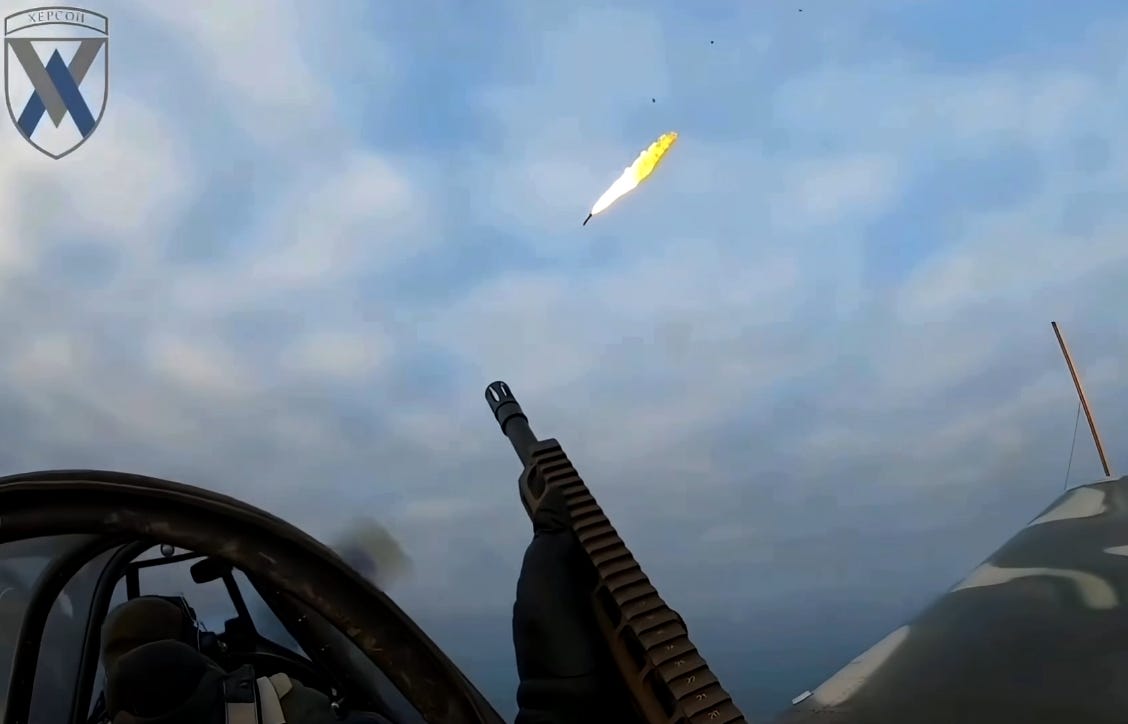
A Ukrainian soldier leans out of the back seat of a Soviet-era Yak-52 trainer aircraft, raises a rifle, and starts shooting at a Russian attack drone.
That sentence sounds like someone fed World War I, cyberpunk, and Charles M. Schulz into a blender and hit puree.
The video looks ridiculous at first. Actually, I thought it was AI on first viewing. (It’s not).
A propeller plane. A human gunner. An AR-style rifle. A Russian drone filled with explosives lumbering through the sky. Then you look closer, pull up the specifications, and realize Ukraine hasn’t lost its mind.
Ukraine has found a cheap answer to a cheap threat, and in doing so, accidentally exposed one of the most expensive structural failures in modern air defense.
By the end of this article, we all should be asking “why.”
Why is Ukraine forced to defend like this?
Why, in the age of supersonic fifth generation fighters, low and slow is so confounding.
And why, or rather what, are some good air defense options that we can present for the low and slow threat?
The aircraft: what the Yak-52 actually is
The aircraft in the footage is the Yakovlev Yak-52, a Soviet-designed two-seat piston trainer built for aerobatic instruction. On social media, commenters are calling this a WWII prop plane. That’s incorrect.
It first flew in 1979, was mass-produced for Warsaw Pact air forces, and has spent most of its life teaching student pilots how not to die. It wasn’t designed for combat. It has no weapons systems, no radar, no self-protection suite, and no provision for turning a passenger into a rear gunner.

Just pure flying.
Ukraine apparently took that last part as a suggestion.
The Yak-52 has a maximum speed around 285 km/h (177 mph), cruise speed approximately 190 km/h (118 mph), stall speed roughly 85 to 105 km/h (53 to 65 mph), depending on configuration, and a service ceiling of around 4,000 meters (about 13,000 feet).
Standard Russian Shaheds cruise somewhere around 170 to 200 km/h (106 to 124 mph). Reuters reported that Russia increased Shahed speeds after Ukrainian interceptor drones began catching them, and some newer jet-powered Shahed variants can reach approximately 400 km/h (249 mph).
The piston-engine Shahed lives squarely in the Yak-52’s performance neighborhood. The jet-powered Shahed does not.
That distinction will become important in a moment.
The Yak-52 offers Ukraine something a truck-mounted machine gun can never provide: geometry. A ground-based crew has to wait for a Shahed to enter their firing arc, hold still long enough to engage, and accept whatever angle the drone decides to present.
A Yak-52 crew can chase the drone, match its altitude, position behind or alongside it, and reduce closure rates enough that a rifleman in the rear seat becomes a realistic threat. The problem shifts from “hit a moving aerial target from the ground at night” to something considerably more tractable.
That’s the entire logic. The airplane is a targeting solution.
The rifle: where the physics get interesting
I can tell you from my infantry service, the weapon is an AR-pattern carbine fitted with a compact red dot optic; the right call for this mission. Magnified optics would slow target acquisition at the ranges this crew is actually working.
A red dot says the gunner already knows he’s solving a close-range problem, not a long-range one.
My farthest qualification target in the Army was 300 meters. That was a stationary target from a stable position.
It was hard. Not impossible, that’s why it was a qualification standard, but there was nothing casual about it. A standard M4-type 5.56mm carbine carries a published maximum effective range of around 500 meters on a point target.
The M16A4 stretches slightly further, around 550 meters for point targets. Those are ground-based figures under controlled conditions.
Now put that same shooter in the rear cockpit of an aircraft moving roughly 100 to 150 miles per hour. The shooter is fighting aircraft motion, turbulence, muzzle blast, awkward body position, sight offset, a limited firing window, and the general physiological experience of hanging partially out of a Soviet trainer at altitude.
The drone he’s shooting at is moving 100 to 125 miles per hour on its own vector. The geometry changes constantly.
And yet the video shows a kill. Several in fact.
The reason is distance.
The Yak-52 crew almost certainly isn’t making a 400-meter rifle shot. They’re closing to a range where the rifle stops being a precision instrument and starts being a close-quarters solution.
That detonation debris cloud is just off the wingtip. The Yak-52’s wingspan is roughly 9.3 meters, and the visible wing section in the video is maybe half that, and the explosion appears to be perhaps 20-40 meters from the aircraft.
Still some decent marksmanship given all of the variables, but it also means that crew is close enough for the detonation to be a genuine threat to the aircraft.
But why does it look so far away in the footage?
Well, the gunner is wearing a Go-Pro-style action cam with its notorious fish-eye view. This makes things around the edges of the frame appear extremely close, and things in the center of the frame appear farther than they are.
This dynamic also explains why shotguns keep surfacing in Ukrainian drone defense.
Benelli’s purpose-built M4 A.I. Drone Guardian, for instance, is advertised for optimal effectiveness from 0 to 50 meters, with an extended range up to 100 meters. The anti-drone small arms conversation has collectively recognized that the weapon isn’t the hard part… closing the distance is.
Once you solve distance, the weapon becomes much less important.
The Yak-52 solves distance. The rifle just finishes the job.
Why not just mount a gun on it
This is the obvious follow-up question, and it has a frustrating answer.
The Aviationist notes that Ukraine appears to be relying on handheld weapons rather than wing-mounted or podded guns because airframe modification is technically difficult and tedious.
A trainer aircraft wasn’t designed around recoil loads, gun harmonization, ammunition feed systems, wiring, sensors, or combat integration. You can bolt something to an airplane quickly. You can make it safe, accurate, reliable, maintainable, and repeatable only after engineers turn it into a multi-month engineering project.
A man with a rifle is available today. A properly integrated gun pod is available after a process that will outlast several Shahed campaigns.
Ukraine picked the option that works now.
There’s a harder problem developing, and it should worry anyone watching this approach with admiration.
Russia is learning.
Business Insider reported in December 2025 that a Ukrainian Sting interceptor drone shot down a Shahed carrying an R-60 air-to-air missile. Wild Hornets assessed that Russia may be actively working to counter the Ukrainian helicopters and aircraft conducting drone intercepts.
That represents a strategic shift: Russia has noticed the hunters, and it’s arming the prey.
A Yak-52 with a rifleman has no answer for a Shahed that shoots back. It has no electronic warfare protection, no missile warning system, no countermeasures, and no margin for error if Russian air defenses or armed drones enter the engagement.
The performance envelope that makes it useful against a slow one-way attack drone, low and slow, also makes it uniquely vulnerable.
This isn’t a reason to dismiss what Ukraine is doing. It’s a reason to understand what needs to come next.
The real argument: fill the gap with something designed for it
This is not a Ukrainian problem. All nations will need to recalibrate their air forces and ground based air defense to adjust to the low and slow problem set.
The Yak-52 has stumbled into a capability gap that NATO should have anticipated and filled years ago.
The Iranian regime may be oppressive assholes, but credit where credit is due. While the rest of the world was dumping millions of greenbacks into hypersonics, they were creating a simple weapon that would destroy the economics of air defense. Then they exported it to Russia where Ukraine has been innovating around it for years.
Modern air defense architecture was built around two assumptions: the threats worth killing are either very fast (jets, cruise missiles) or very small and stealthy (ballistic missiles, maneuvering warheads).
The systems procured to defeat those threats, Patriots, NASAMS, F-16s, F-35s, are extraordinarily capable against those specific targets. Against a 200 km/h propeller drone that costs $35,000 to manufacture, they’re the wrong answer, financially and operationally.
The Yak-52 is Ukraine’s improvised bridge across that gap. What the gap actually demands is a purpose-built aircraft optimized for the low, slow, cheap aerial threat environment.
Three platforms illustrate what that looks like.
The A-29 Super Tucano is a turboprop light attack aircraft designed for counterinsurgency, armed reconnaissance, and operations in low-threat airspace.
Published specifications put it at around 590 km/h maximum speed, roughly 520 to 535 km/h cruise, a stall speed around 148 km/h, approximately 1,800 kg of external payload, and endurance that can stretch for hours depending on stores and fuel load.
That performance band makes it dramatically more capable than the Yak-52 against the full Shahed speed spectrum, including the jet-powered variants, while still slow enough to engage the piston-engine targets without screaming past them at fighter-jet closure rates.
It can carry guns, rockets, and guided munitions. It has a real sensor suite. Its crew doesn’t have to lean out a window.
The A-10 Thunderbolt II makes a compelling case on paper, and the GAU-8 Avenger; a 30mm rotary cannon that fires nearly 4,000 rounds per minute, is exactly the kind of overwhelming kinetic solution you’d want against a drone corridor.
The A-10 is also slower than virtually every other jet in the NATO inventory, armored, survivable, and designed for low-altitude work. There’s one honest complication: its stall speed sits around 220 km/h, which is faster than a piston Shahed’s cruise speed.
Slowing an A-10 down enough to engage the slower Shaheds without departing controlled flight is a real tactical constraint.
Against the jet-powered Shahed variants and as a corridor-clearing platform that can sanitize a known ingress route quickly, the A-10’s argument gets considerably stronger.
The Textron Scorpion might be a good option also. Textron lists it at 450 KTAS maximum speed, a 45,000-foot service ceiling, a 3,000-pound internal payload bay, and six hardpoints.
It was designed for ISR and light strike at a fraction of the cost of high-end combat aircraft. For persistent drone intercept operations, it offers the performance envelope to address fast Shaheds while remaining economically viable as a daily operational platform.
As of now, NATO is content to equip fast-movers with rockets.
That’s where APKWS comes in.
APKWS, the Advanced Precision Kill Weapon System, is basically a guidance kit that turns a standard 70mm Hydra rocket into a laser-guided precision weapon. It was originally designed to give helicopters and aircraft a cheaper way to hit ground targets without firing a Hellfire missile at every truck, bunker, or unlucky technical that wandered into the wrong grid square.
The US Navy describes APKWS II as a conversion of the unguided Hydra 2.75-inch rocket, adding laser guidance to create a relatively inexpensive precision-kill weapon.
Now that same logic is moving into counter-drone work.
The US Air Force has already used APKWS in an air-to-air role against drones. Air & Space Forces Magazine reported that the service first demonstrated APKWS II could be used effectively from an F-16 against aerial targets in a 2019 test.
Since then, US fighters have used APKWS to shoot down drones in the Middle East because it gives pilots a cheaper and more plentiful weapon than AIM-9 Sidewinders or AIM-120 AMRAAMs.
Business Insider reported that during Operation Rough Rider against the Houthis, US fighter aircraft used APKWS rockets for nearly 40 percent of drone kills. These were fired from F-16s and F-15s, giving US pilots a lower-cost alternative to burning through premium air-to-air missiles against cheap drones.
The F-15E Strike Eagle has become especially interesting here. Air Combat Command announced in September 2025 that the F-15E had completed expedited testing with the AGR-20F APKWS variant, including live fires against targets over land and water, as part of a rapid fielding effort.
The War Zone reported that an F-15E configured for this role could carry up to 42 APKWS II rockets along with traditional air-to-air missiles, turning the aircraft into a drone and cruise-missile hunting weapons truck.
That’s the key phrase: weapons truck.
An F-15 carrying a few expensive missiles is lethal, but limited. An F-15 carrying dozens of laser-guided rockets has magazine depth. Against a swarm of cheap drones, magazine depth is oxygen.
You don’t want a fighter returning to base after killing three flying mopeds because it ran out of affordable shots. You want it to stay on station and keep deleting targets until the swarm thins out.
The Eurofighter Typhoon is moving the same direction. In April 2026, BAE Systems announced that it had successfully test-fired an APKWS-equipped weapon from a Eurofighter Typhoon, specifically presenting the trial as a lower-cost answer to uncrewed aircraft systems.
I have a YouTube video coming out next Monday about the APKWS Eurofighter Typhoon.
Breaking Defense reported that the test was internally funded by BAE and that the system uses APKWS guidance kits to convert 2.75-inch rockets such as the Hydra 70 into precision weapons.
That matters for NATO’s eastern flank.
Typhoons, F-16s, F-15Es, and potentially Gripens are all being pushed toward a world where fighters don’t just duel other fighters. They hunt drones.
This is where Ukraine’s Yak-52 starts to look less like an oddity and more like the first ugly draft of a new doctrine.
Ukraine is using what it has: trainers, rifles, mobile gun teams, interceptor drones, electronic warfare, helicopters, and Western air defenses. NATO is trying to build the cleaner version: fighters loaded with cheaper guided rockets, supported by sensors, datalinks, and command networks that can assign the right weapon to the right target.
Bottom line
The specific aircraft matters less than the concept: persistent, armed, sensor-equipped platforms with enough speed to intercept slow threats and enough payload to kill them without expending million-dollar weapons.
A layered defense built around electronic warfare, interceptor drones, mobile gun systems, helicopters, and purpose-built low-and-slow manned aircraft represents a sustainable economic answer to mass drone campaigns.
Individual components of that layered defense are already proven. The gap is the dedicated hunter-killer aircraft sitting between the pickup trucks and the F-16s.
The Yak-52 with a rifleman in the back is proof the gap exists. It’s also proof the gap can be closed for far less money than anyone in a peacetime procurement office was willing to spend.
The larger lesson is for NATO planners who should be watching this footage and asking themselves why the most cost-effective drone intercept platform currently operating in the world’s most active air war is a forty-year-old aerobatic trainer armed with a carbine.
The answer is uncomfortable: because nothing better was procured.
Because the threat wasn’t taken seriously until it showed up over Kyiv.
Because the gap between a Patriot battery and a guy with a machine gun in a pickup truck was considered someone else’s problem.
Because APKWS is just a stopgap.
Ukraine filled that gap with what it had.
The question for everyone else is what they’re building to fill it properly.
Glory to Ukraine, glory to the heroes, Crimea is Ukraine.


Maybe the Nobel Committee should establish an Innovation Prize. If they did, Ukraine should receive it in 2025, 2026 and beyond. In the meantime, they should do the world a solid and give Ukraine the Peace Prize.
The Yak 52 looks like it's equivalent to the old T-6. I can think of several prop aircraft (singles and multi) currently available that can be adapted to hunt drones, like the Tucano you mentioned. I wonder if Ukraine is looking for faster alternatives?
Air to air gunnery isn't easy. Their accuracy is impressive. Slava Ukrani!