


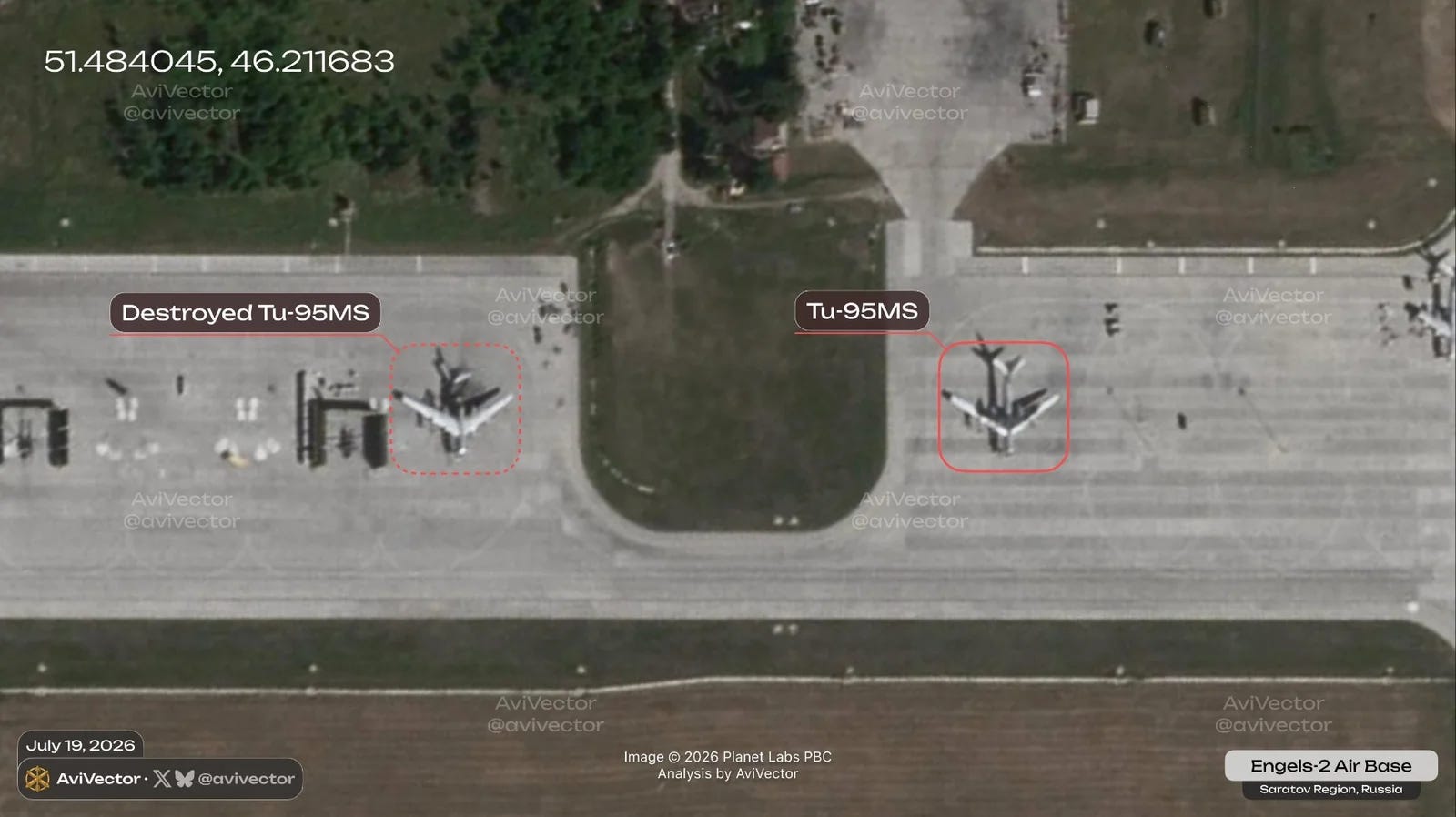
From orbit, the damage looks slightly awkward; like looking at a broken arm that’s definitely not supposed to bend that way.
Two Tu-95MS bombers sit parked beside each other on the apron at Engels-2, and one of them still looks like an airplane. The other one looks like someone threw their toy Styrofoam plane into the sky a little too hard and it broke in half when the thing hit the ground.
Its tail section has come to rest several meters behind where the rest of the fuselage stops, and the most delicious part of this image is knowing that Russia can’t make more of these.
Ukraine’s Security Service said it hit the base overnight on July 15 into 16, using drones that flew roughly 800 kilometers to get there.
Zelensky announced the kill on July 17 and originally, Russia denied Zelensky’s claim with the typical Kremlin talking points; nothing to see here. Move along.
Like Lt. Frank Drebin from The Naked Gun.

Two days after that, Planet Labs satellite imagery, first flagged by the open-source group AviVector and separately obtained by Schemes, (the investigative unit inside Radio Free Europe/Radio Liberty), gave the world a look at the wreckage from above.
The tail was severed clean. Not, I repeat, not reparable. Total loss.
I’ve been following this conflict since 2014 and there’s a huge difference between Ukraine and Russia when it comes to public reporting: If Ukraine is going to announce something publicly, you can usually count on the statement being an accurate accounting. Let’s say 99 percent of the time.
On the flip side, Russia would try to convince you that it still has 100 percent of its armored vehicles ready to commit to the fight when, in reality, Moscow has lost an estimated 25,000 armored combat vehicles and 12,201 tanks as of this writing.
This is part of the fun of reporting on this war… Russia’s claims are so far outside of reality, it’s become a sport to lampoon Kremlin talking points.
I even thought about making a satire series from a parallel universe where things make sense, politicians behave ethically, and justice is always served… not our shitty timeline that we’re stuck in. Let’s call it “Dispatches from the Multiverse.”
Except, my biggest fear about this satire series is that people wouldn’t understand that it’s satire. And then they would get confused when I post real news and not know when I’m joking and when I’m serious. Perhaps I could keep the satire to a specific day every week, like “Multiverse Monday” or something.
BREAKING! Russian Ministry of Defense issues accurate casualty report, causing panic among state television hosts. Nationwide protests ensue.

I mean… I think it’s hilarious, but I’ve always been fond of stuff like The Onion.
Okay, back to the story. So, when Ukraine claims they’ve destroyed an irreplaceable Bear bomber, I don’t actually need to see the satellite evidence from Engels-2. The pictures are just a bonus.
What the aircraft does
The Tu-95 first flew in 1952, which makes it older than the US interstate highway system and roughly contemporary with the first color television broadcasts.
Russia still flies this ancient turboprop because the airframe turned out to be an unusually good missile truck. The Tu-95MS variant hitting Ukraine right now was purpose-built as a standoff launcher, meaning it never has to get close to anything it’s attacking. It lifts off from deep inside Russia, flies to a point well outside Ukrainian air defense range and lets its missiles cover the rest of the distance.
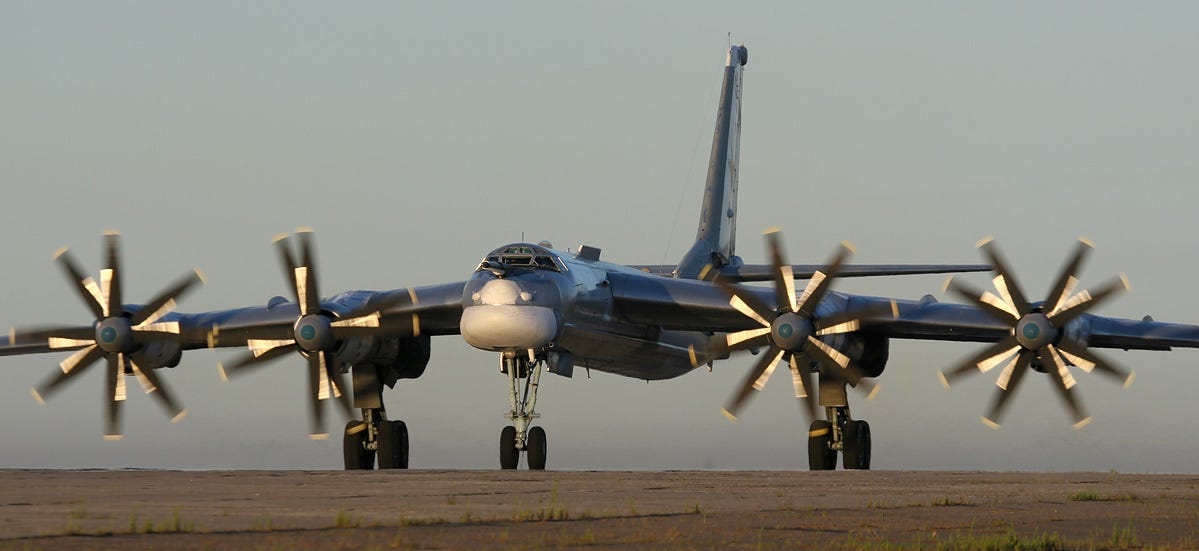
Those missiles are Kh-101s, conventional cruise missiles that have become one of the signature weapons Russia uses against Ukrainian cities and power infrastructure.
The older internal rotary launcher, the six-round carousel built into the bomb bay, was actually designed for the smaller Kh-55 family, an earlier generation of missile. Modernized Tu-95MSM airframes carry the larger Kh-101s, and reportedly the nuclear-capable Kh-102, externally on restored wing hardpoints instead, up to eight of them on a single aircraft.
That nuclear thread is why the Tu-95 also counts as part of the airborne leg of Russia’s strategic deterrent, alongside its submarines and land-based missiles. It’s one leg of a three-legged stool, and Ukraine just kicked out a piece of one of the legs.
Interestingly, this was supposedly one of Putin’s red lines at one point. Don’t dare hit our strategic nuclear deterrent or we’ll be really mad!
Ukraine was like, “yeah, sure buddy. Hold my beer…”
So why can’t these things be replaced? Surely Russia has airplane factories, right?
Well… Tu-95MS production ended in 1992. There is no factory floor anywhere in Russia currently tooled up to build a new one.
Russia can refurbish an existing airframe, cannibalize parts from aircraft already grounded, and modernize whatever survives, and it’s been doing exactly that for years.
What it can’t do is roll a fresh Tu-95MS out of a hangar the way it can crank out another batch of Shahed drones.
The best 2026 estimate puts Russia’s total strategic bomber inventory at around 60 aircraft, split between roughly 45 Tu-95MS variants and about 15 Tu-160s. Operation Spiderweb, the drone raid deep inside Russia last year, is assessed to have destroyed seven Tu-95s outright, with at least one more damaged.
Add Engels-2 and you’re looking at eight visually confirmed kills against a fleet that started this war with no more than 50 or 60 of these things to begin with, out of a total production run that never exceeded a few hundred airframes across the entire Cold War. So, whatever number Moscow assigns this aircraft on a balance sheet somewhere, its real value is the fact that Russia now has one fewer bomber than it had last week, permanently, with no supplier to call and no production line to restart.
The reason the Kremlin initially denied this attack, other than keeping the myth of “Russian invincibility” in hospice for a few more days, is because of the extreme range of Engels-2 from the Ukrainian front.
“It’s too far. Of course Ukraine can’t strike that far… Let’s keep our strategic nuclear bomber parked in the open air on the ramp instead of in a concrete aircraft shelter.”
Engels-2 is one of Russia’s most important strategic aviation bases; the kind of installation that hosts long-term rotations, maintenance cycles, and crew training for both the Tu-95 and Tu-160 fleets.
Exactly two Tu-95MS bombers had reportedly been stationed there for an extended stretch, according to AviVector’s analysis, cycling through routine maintenance and training work rather than sitting in some temporary forward staging area.
Russia knows exactly what it’s up against here, because this isn’t the first time a drone has found a bomber sitting in the open.
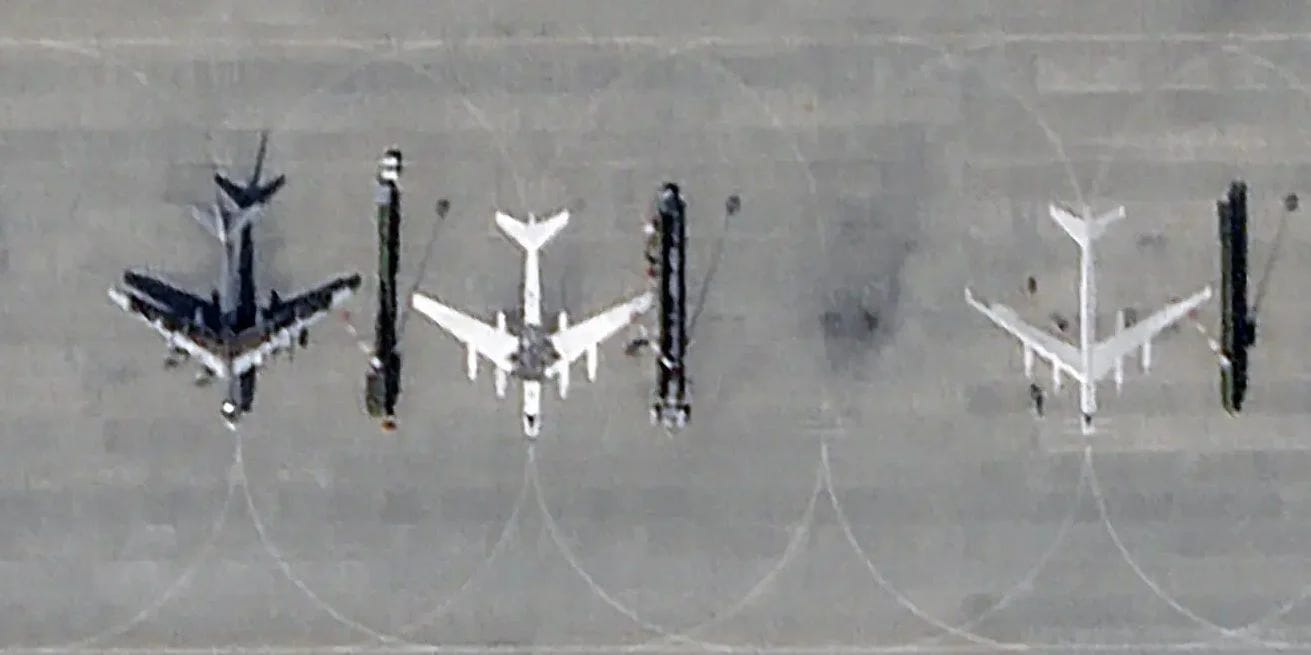
Aircraft have been dispersed to reduce concentration risk.
Old tires have been draped across fuselages and wings, an improvised attempt to defeat the thermal and visual signature drones look for.
Someone painted a full-scale Tu-95 silhouette onto the tarmac at one point, presumably hoping a drone operator would waste a strike on a two-dimensional decoy.
And by June 20, satellite imagery had picked up construction underway on at least 17 large hardened shelters, the kind of reinforced structure that could actually stop a drone strike rather than just make the aircraft slightly harder to photograph.
None of that saved the bomber that just lost its tail. It was still sitting in the open when the drones arrived, because 17 shelters under construction are still 17 shelters that aren’t finished.
Russia does have some options here too. It can push its surviving bombers farther east, out of drone range for now. It can pour more concrete faster. It can thicken air defenses around whatever bases remain viable, and it can lean harder on drones and ballistic missiles to carry weight the bomber fleet used to carry alone.
None of those are free, and all of them cost time, money, or accuracy that Russia would rather spend elsewhere.
Still, the value of this particular kill only really hits once you stop looking at it by itself and start stacking it against everything Ukraine has already taken off the board.
Eight confirmed Tu-95 losses since 2022, against a fleet with no production line, is a fleet that gets smaller every time this happens and never gets bigger.
Compare that to Ukraine’s own long-range strike program, which barely existed in any meaningful form when the full-scale invasion started and now routinely reaches targets thousands of kilometers deep inside Russian territory in a single overnight run, sometimes hitting multiple objectives at once.
The same operation that took out this bomber also reportedly struck three oil depots in Russia’s Stavropol region and a shadow-fleet tanker in the Black Sea, all in the same 24-hour window.
Ukraine’s new deep strike capability is the biggest single advantage right now and may prove decisive if it can bring enough economic pain to the invader to affect regime change.
At least, that’s my hope. Now, on to that satire series I’ve been thinking about…
Stay frosty.
Слава Україні!

Read that Rosatom is having difficulties making ends meet too. Supposedly continuing with their international builds but domestic reactors on hold - as per yesterday's report, "points to poor economic conditions as doubts cast on nuclear projects." David Dalton, NucNet.org.
A great deal has been written about drones being the future of warfare, and that manned aircraft (and other types of human operated weapons delivery vehicles) are a technological dead end and doomed on the battlefield. No doubt what is happening in Ukraine has been a massive eye opener for many, but I wonder about how much drone warfare is driven by a question of available industrial base. You fight with what you can build (or buy).
What is true is that aircraft like the Tu-95 and the Tu-160 have simply become too expensive for Russia to build, both in terms of cost and time. Countries with a more robust economic and industrial base simply have more options. For them, I suspect the future of warfare is somewhere between the manned systems and "all drones, all the time" world predicted by some pundits.